
June 6, 2026
The Hidden Supply Chain War Being Fought Over Aluminium Scrap
Few industrial materials carry as much strategic weight as aluminium, yet for decades its scrap trade has been treated almost exclusively as a commodity flow governed by price signals and market convenience. That assumption is now being formally challenged. Across advanced manufacturing economies, policymakers are beginning to ask a more uncomfortable question: when strategic materials leave the domestic market in bulk, who actually benefits?
The answer, in the case of aluminium scrap, is increasingly pointing toward nations whose industrial ambitions sit in direct tension with American manufacturing competitiveness. This is the core concern animating the Secure Aluminium Supply Chains Act, a piece of proposed U.S. legislation that reframes scrap aluminium not as a trade commodity but as a critical industrial input deserving active supply chain governance.
When big ASX news breaks, our subscribers know first
Why Aluminium Occupies a Unique Position in U.S. Industrial Strategy
Aluminium is one of the few materials that simultaneously underpins four distinct high-priority industrial sectors: defence manufacturing, aerospace engineering, automotive production, and electricity transmission infrastructure. This cross-sector dependency creates a compounding vulnerability that few other materials replicate.
When a single input is deeply embedded across multiple strategic industries at once, any disruption to its supply does not affect one sector in isolation. It propagates across all of them. A constrained aluminium feedstock market does not just slow down car production; it affects the same supply chains that build military aircraft, electrical grid components, and satellite structures.
What makes the current policy debate particularly nuanced is that it is not centred on primary aluminium, the metal produced through energy-intensive smelting of refined alumina derived from bauxite ore. The focal point is secondary aluminium: metal recovered and processed from scrap. Understanding this distinction is essential to understanding why the proposed legislation matters. Furthermore, shifts in U.S. aluminum and steel tariffs have already intensified scrutiny of how domestic industrial materials are managed across the supply chain.
Primary vs. Secondary Aluminium: A Distinction With Strategic Consequences
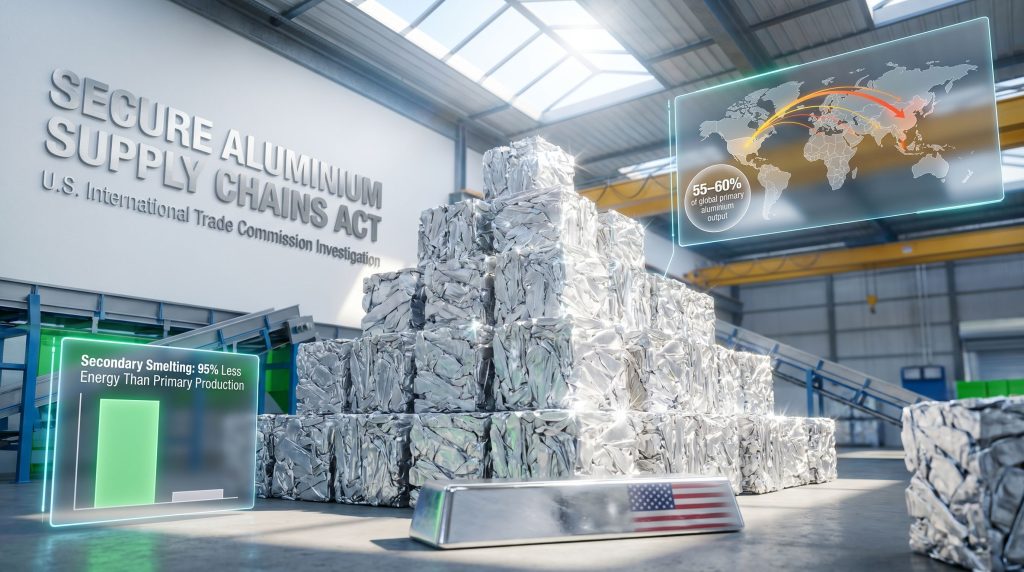
Primary aluminium production requires enormous quantities of electrical energy. The smelting process consumes roughly 13 to 14 kilowatt-hours of electricity per kilogram of metal produced, making it one of the most energy-intensive industrial processes in existence. Secondary aluminium, produced by melting and reprocessing scrap, requires approximately 95% less energy than primary production, according to industry-wide lifecycle assessments.
This energy efficiency gap means that scrap aluminium is not just cheaper to process; it is also strategically superior from a carbon footprint and energy security perspective. For domestic manufacturers, access to reliable scrap feedstock translates directly into lower production costs and reduced exposure to energy price volatility.
Scrap aluminium represents a form of embedded industrial energy. Every tonne of scrap that is processed domestically instead of exported preserves both the material value and the energy value that went into creating it originally.
The United States generates some of the largest volumes of aluminium scrap globally, a direct reflection of high per-capita consumption across packaging, automotive, construction, and aerospace sectors. Yet a significant portion of that scrap has historically been exported rather than processed domestically, raising the fundamental question that the Secure Aluminium Supply Chains Act is designed to investigate.
What the Secure Aluminium Supply Chains Act Actually Proposes
Introduced by Representative Haley Stevens of Michigan, the legislation tasks the U.S. International Trade Commission (USITC) with conducting a structured investigation into where U.S. aluminium scrap exports are flowing, and whether those flows create measurable risks for domestic manufacturers or national security.
Critically, this is not an immediate trade restriction. The bill is designed as an evidence-gathering mechanism, creating a formal analytical foundation before any policy interventions are considered. This positions it as a deliberate precursor to potential future action, not an emergency measure.
The USITC investigation would be required to address the following components:
| Investigation Component | Description |
|---|---|
| Export destination mapping | Identifying the countries receiving U.S. aluminium scrap shipments |
| Strategic competitor classification | Assessing whether receiving nations meet the threshold of strategic competitor designation |
| Economic impact analysis | Evaluating the effect of export volumes on domestic feedstock availability and pricing |
| National security risk assessment | Determining whether exported scrap enhances foreign industrial or military capacity |
| Stakeholder consultation mandate | Engaging domestic producers, recycling operators, and labour unions |
| Congressional reporting | Submitting findings, analysis, and policy recommendations to Congress |
The consultation requirements are particularly meaningful. The bill mandates formal engagement with three distinct groups: domestic aluminium producers representing both primary and secondary smelting interests, recycling industry operators who process and trade scrap material, and labour unions including the United Steelworkers (USW), whose membership is embedded across aluminium-dependent manufacturing sectors.
This tripartite consultation structure ensures the investigation captures perspectives from across the supply chain, from extraction and processing through to the factory floor.
China as the Unstated Reference Point
The bill's reference to countries designated as "strategic competitors" of the United States carries obvious geopolitical weight. Under current U.S. policy frameworks, China consistently sits within that classification.
China is the world's dominant primary aluminium producer, accounting for more than 55% of global output by most industry estimates, a position built over decades of state-directed industrial policy. Chinese aluminium producers have historically relied on imported scrap to supplement domestic supply, reduce energy costs, and meet quality specifications that recycled feedstock can achieve more efficiently than some primary production routes.
The industrial logic is straightforward but the strategic implication is significant. If U.S. aluminium scrap is flowing in volume to Chinese processors, two things happen simultaneously:
- U.S. domestic manufacturers face tighter feedstock availability and potentially higher input costs
- Foreign industrial competitors gain access to cost-effective, energy-efficient material that strengthens their production capacity
This dual effect — domestic constraint plus foreign advantage — is precisely the asymmetry that the bill's proponents argue Congress needs to understand before it becomes structurally embedded. Consequently, the aluminium tariff market impact of recent trade measures has further heightened awareness of how export flows interact with domestic pricing pressures.
The policy framing is deliberate: the bill is not positioned as a trade restriction but as an information-gathering exercise. Any export controls or procurement rules that might follow would require separate legislation based on the USITC's findings.
Where This Bill Fits Within a Broader Legislative Pattern
Representative Stevens has developed a recognisable legislative portfolio centred on domestic industrial capacity and supply chain resilience. The Secure Aluminium Supply Chains Act does not exist in isolation; it is part of a coherent policy approach that includes:
- CHIPS and Science Act (2022): Directed over $52 billion in federal investment toward domestic semiconductor manufacturing, establishing the template for critical materials industrial policy
- Protecting Americans From Chinese Cars Act: Co-introduced with Senator Elissa Slotkin, targeting automotive supply chain exposure to Chinese-manufactured vehicles
- Unearth America's Future Act: Focused on rebuilding domestic critical mineral supply chains from raw extraction through finished processing
The structural parallel to the CHIPS Act is particularly instructive. That legislation followed years of analytical work documenting U.S. semiconductor supply chain vulnerabilities before translating into investment mandates and production incentives. The aluminium scrap investigation follows a similar logic: establish the evidence base, then determine the appropriate policy response.
| Policy Mechanism | Sector | Primary Approach | Current Status |
|---|---|---|---|
| CHIPS and Science Act (2022) | Semiconductors | Federal investment + production incentives | Active, $52B+ deployed |
| Protecting Americans From Chinese Cars Act | Automotive | Import restrictions | Pending |
| Unearth America's Future Act | Critical minerals | Supply chain rebuilding | Proposed |
| Secure Aluminium Supply Chains Act | Aluminium scrap | USITC investigation + reporting | Proposed |
Industry and Labour Voices: Unusual Alignment on a Policy Goal
What distinguishes the Secure Aluminium Supply Chains Act from many trade-adjacent policy proposals is the breadth of its industry and labour support. Convergence between a major international industrial producer and the United Steelworkers on the same legislative goal is not typical.
Roxanne Brown, International President of the United Steelworkers, has confirmed the union's view that aluminium scrap is a foundational component of the broader aluminium supply chain and that understanding the downstream effects of its export flows is a prerequisite for sound manufacturing policy. For the USW, the concern is practical: supply chain disruptions in aluminium affect employment across automotive assembly, aerospace fabrication, and construction manufacturing, all sectors where union membership is concentrated.
Ryan Modlin, Vice President of Norsk Hydro USA, has indicated that mapping aluminium scrap export flows would directly support domestic manufacturing planning and supply chain optimisation. Norsk Hydro's position carries particular analytical weight because the company operates across both primary aluminium production and large-scale recycled aluminium processing, giving it direct visibility into how scrap availability affects production economics at both ends of the value chain.
The Recycled Materials Association (ReMA) has also formally responded to the bill's introduction, signalling active engagement from the recycling industry — a constituency that might be expected to resist restrictions on export freedom but which appears to recognise the value of a structured evidence base. In addition, among the top aluminium producers globally, there is growing acknowledgement that domestic scrap governance is becoming a competitive differentiator.
The next major ASX story will hit our subscribers first
Scenario Analysis: What Happens After the Investigation?
If the USITC investigation confirms material supply chain risks, several distinct policy pathways become available to Congress. Each carries different implications for domestic manufacturers, global scrap traders, and aluminium producers worldwide.
Scenario 1: Export Licensing Requirements
Congress could introduce licensing requirements for aluminium scrap exports destined for strategic competitor nations, similar to controls already applied to certain semiconductor technologies and dual-use equipment. This would create an administrative filter on export flows without necessarily prohibiting them.
Scenario 2: Domestic Content Requirements in Federal Procurement
Federal agencies could be required to source aluminium from suppliers meeting domestic scrap utilisation thresholds. This demand-side approach would create economic incentives for retaining scrap within the U.S. supply chain without directly restricting private sector trade.
Scenario 3: Investment Incentives for Domestic Recycling Infrastructure
Rather than restricting exports, Congress could incentivise the expansion of domestic secondary smelting and scrap processing capacity, making it economically attractive to process scrap domestically rather than export it. This mirrors the supply-side investment logic of the CHIPS Act.
Scenario 4: No Material Action
If the USITC investigation concludes that export volumes do not materially constrain domestic supply or create measurable national security risks, the findings would still create a valuable baseline dataset for future monitoring and policy review.
The Global Scrap Market Implications
Any policy shift that restricts or redirects U.S. aluminium scrap flows would send measurable ripple effects through global secondary aluminium markets. The United States is among the world's largest generators of aluminium scrap, and export volumes represent a material share of globally traded secondary feedstock.
Countries and processors currently reliant on U.S. scrap imports would face two unattractive options: secure alternative scrap sources at potentially higher cost, or increase primary aluminium production, which is significantly more expensive and carbon-intensive. Either adjustment would affect global aluminium pricing dynamics.
From a circular economy perspective, there is an additional dimension worth noting. Secondary aluminium production using recycled scrap generates substantially lower carbon emissions than primary production. Retaining scrap within the U.S. manufacturing system would not only improve feedstock security but would also support domestic producers in meeting increasingly stringent emissions reporting requirements and customer sustainability mandates. The broader implications for aluminum and alumina markets are already being closely watched by analysts tracking downstream pricing trends.
The intersection of supply chain security and decarbonisation objectives means that domestic scrap retention policies could simultaneously serve industrial policy, national security, and environmental goals — an unusual alignment of policy incentives.
Furthermore, major producers are already adjusting their long-term approaches in response to these pressures. For instance, their aluminium operations strategy increasingly reflects the imperative to align energy sourcing and material recovery with evolving regulatory expectations. The ASI Chain of Custody standard offers one framework through which producers can demonstrate responsible material handling across the full supply chain.
Frequently Asked Questions
What is the Secure Aluminium Supply Chains Act?
It is proposed U.S. legislation introduced by Representative Haley Stevens of Michigan that directs the USITC to investigate aluminium scrap export flows, assess whether those exports are reaching strategic competitor nations, and report findings and recommendations to Congress.
Does the bill immediately restrict aluminium scrap exports?
No. The bill mandates an investigation and the development of recommendations only. Any export controls or trade measures that might result would require separate legislation.
Why does aluminium scrap matter for national security?
Aluminium is a critical input for defence systems, aerospace components, and transportation infrastructure. Constrained domestic scrap availability raises production costs for U.S. manufacturers while potentially strengthening foreign industrial competitors using the same material.
Which groups have expressed support for the bill?
The United Steelworkers (USW), Norsk Hydro USA, and the Recycled Materials Association (ReMA) have all publicly engaged with or expressed support for the bill's objectives.
How does this bill relate to the CHIPS Act?
Both share a legislative structure: establish an analytical evidence base documenting supply chain vulnerabilities before designing targeted policy interventions. The CHIPS Act precedent suggests the aluminium investigation could be a first step toward a broader industrial policy agenda for the sector.
Key Takeaways for Manufacturers, Investors, and Policymakers
- The Secure Aluminium Supply Chains Act represents a data-first approach to supply chain security, building an evidence foundation before imposing any trade measures
- Aluminium scrap is being formally repositioned in U.S. policy discourse from a commodity trade flow to a strategic industrial asset
- The energy efficiency advantage of secondary aluminium (approximately 95% less energy than primary production) means scrap retention has simultaneous benefits for cost competitiveness, energy security, and emissions performance
- The bipartisan industry-labour alignment behind the bill suggests it addresses a structural market concern, not merely a political positioning exercise
- The USITC investigation framework mirrors the analytical precursors to previous major interventions in critical materials sectors, indicating this could represent the opening move in a larger aluminium industrial policy agenda
- Global scrap traders and import-dependent aluminium processors should monitor the bill's progress carefully, as any resulting policy measures would have significant effects on international secondary aluminium market dynamics
Readers seeking further context on U.S. aluminium supply chain policy and global market dynamics may find value in the ongoing trade coverage and industry analysis published by AL Circle.
Want to Know Which ASX Mineral Discoveries Could Deliver the Next Major Return?
Discovery Alert's proprietary Discovery IQ model scans ASX announcements in real time, instantly identifying significant mineral discoveries across more than 30 commodities — including those tied to critical materials like aluminium — and translating complex data into clear, actionable investment insights. Explore historic discoveries and their exceptional market returns, then begin your 14-day free trial at Discovery Alert to position yourself ahead of the broader market.