
June 6, 2026
The Geography of Oil Is Shifting: What Mexico's Atlantic Basin Pivot Reveals About Global Crude Trade
When crude oil markets undergo geographic realignment, the signals rarely arrive as dramatic announcements. They appear instead as monthly export tables, revised fiscal projections, and quietly updated government planning documents. Mexico's April 2026 crude export data contains exactly these kinds of signals, and read carefully, they point toward something more significant than a single month of unusual trade flows.
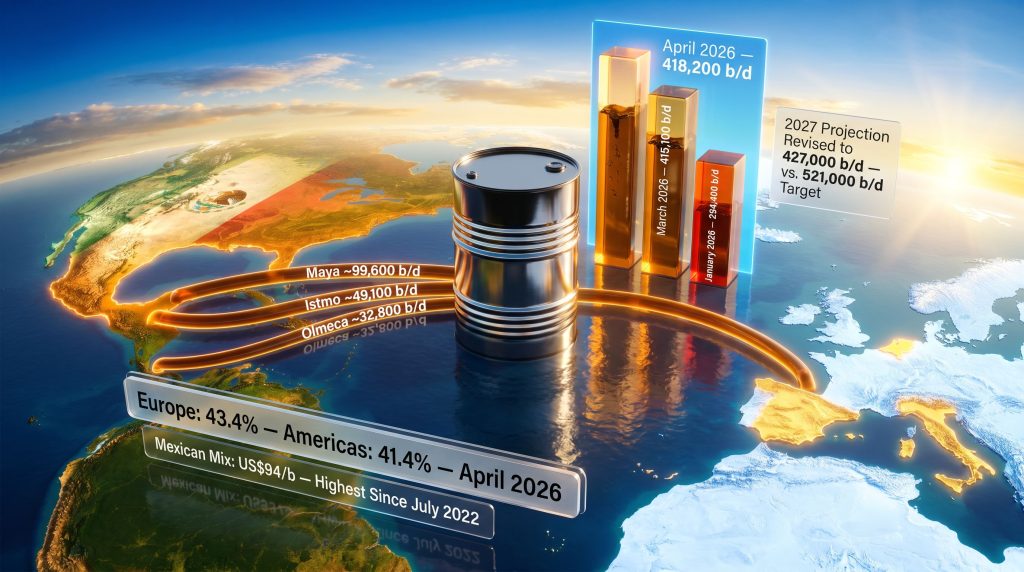
The core development is historically notable: PEMEX exports to Europe overtook the Americas for the first time in at least 36 years, with European buyers absorbing 43.4% of total Mexican crude volumes compared to 41.4% directed toward the Americas. However, understanding why this happened, and whether it persists, requires unpacking three separate forces that converged simultaneously in April 2026.
When big ASX news breaks, our subscribers know first
A 36-Year First: Breaking Down the April 2026 Export Numbers
The headline figures from April 2026 demand careful interpretation before drawing strategic conclusions.
| Metric | April 2026 | Context |
|---|---|---|
| Average export volume | 418,200 b/d | ~20% below SHCP's 521,000 b/d target |
| Europe's share | 181,000 b/d (43.4%) | First time #1 destination in 36+ years |
| Americas' share | 173,300 b/d (41.4%) | First time below Europe in modern PEMEX history |
| Average export price (Mexican Mix) | US$94/b | Highest since July 2022 |
| Total export revenue period | Highest since May 2025 | Price-driven, not volume-driven |
The revenue recovery story and the volume story are fundamentally different narratives. April's strong revenue performance was almost entirely a function of the geopolitical price spike, not an improvement in PEMEX's underlying export capacity. This distinction matters enormously for fiscal planning purposes. For a broader crude market overview, these dynamics reflect wider structural pressures shaping global supply chains.
The Hormuz Premium: How Middle East Tensions Repriced Mexican Crude
The Mexican crude export blend, known as the Mexican Mix, reached US$94 per barrel in April 2026, a level not seen since July 2022. This price elevation traces directly to geopolitical instability surrounding the Strait of Hormuz, where ongoing tensions connected to the Iran conflict have created sustained upward pressure on global benchmark prices. These oil geopolitical factors are increasingly reshaping how producing nations manage their export strategies.
The Strait of Hormuz is the world's most critical oil chokepoint, through which approximately 20% of global petroleum liquids transit daily. Any credible threat to its operational continuity generates an immediate risk premium across Atlantic Basin crude benchmarks, and Mexican heavy sour grades, which compete with Middle Eastern heavy crude in many European refining configurations, benefit directly from supply uncertainty in that corridor.
It is worth noting that March 2026 had already signalled the emerging price trend, with the Mexican Mix averaging US$82.3 per barrel, the highest level since August 2022. April's further escalation to US$94 per barrel compressed the fiscal shortfall that had been accumulating since January, though it did not eliminate it.
Which Crude Grades Are Flowing to Europe and Why
European refinery demand for Mexican crude is not uniform across grade categories. The April 2026 breakdown reveals a clear hierarchy that reflects the processing configurations of European refining infrastructure:
- Maya blend: approximately 99,600 b/d directed to European buyers, making it the dominant grade by a wide margin
- Istmo blend: approximately 49,100 b/d, representing the medium-grade component of European intake
- Olmeca blend: approximately 32,800 b/d, the lightest of the three primary Mexican export grades
The dominance of Maya is particularly significant from a refinery economics perspective. Maya is a heavy, high-sulphur crude with an API gravity typically in the 22-degree range and sulphur content around 3.3% by weight. Processing such crude requires sophisticated refinery configurations with hydrocracking and coking units, known in the industry as complex or conversion refinery configurations.
European refineries in Spain, Italy, and the Netherlands have invested heavily in such configurations precisely to capture the margin advantage of processing discounted heavy sour crude into high-value light products. Furthermore, as Pemex redistributes its oil exports across global markets, the withdrawal of predictable Middle Eastern supply certainty amid Hormuz tensions has made Mexican Atlantic Basin crude a commercially attractive substitute for these facilities, reducing their exposure to Persian Gulf logistics risk.
The convergence of Hormuz-driven Middle Eastern supply uncertainty with existing European refinery configurations optimised for heavy sour processing created a structural commercial pull for Maya crude that reinforced Mexico's deliberate diversification push.
The Policy Architecture Behind the European Pivot
The April export shift did not occur in a policy vacuum. President Claudia Sheinbaum's administration publicly signalled export portfolio diversification as a strategic priority in the context of ongoing USMCA renegotiation pressures. The logic is straightforward: reducing dependence on a single regional trade relationship, particularly during a period of commercial friction with the United States, creates both economic resilience and diplomatic leverage.
The EU-Mexico modernised trade agreement, signed on May 22, 2026, provides institutional scaffolding for this commercial pivot. While crude oil trade operates outside the direct tariff schedule mechanisms of such agreements, closer bilateral commercial relationships facilitate the banking arrangements, port logistics frameworks, and long-term supply contracts through which crude diversification becomes operationally embedded rather than merely tactical. Consequently, these oil trade geopolitics are increasingly influencing how Mexico positions itself within Atlantic Basin supply chains.
The critical analytical point is that April's export data suggests this diversification was already materialising in actual barrel flows before the trade agreement's formal signing, indicating that commercial relationships were being built in anticipation of the broader diplomatic framework.
The Asian Demand Collapse: A Structural Trigger
Equally important to understanding the European pivot is what happened in the opposite direction. Asian demand for Mexican heavy crude contracted sharply during the first quarter of 2026, with PEMEX sending virtually no barrels to the Far East during two months of the quarter. This is a significant departure from historical patterns, as Asian buyers, particularly Chinese refiners, had been consistent consumers of Maya heavy crude.
Several factors likely contributed to this contraction. Chinese domestic refinery throughput adjustments, competing supply from Russian oil trade shifts flowing at discounted prices into Asian markets, and the overall softening of Chinese oil demand growth relative to earlier forecasts all created a demand vacuum that pushed available export barrels toward alternative destinations.
The result was a reinforcing dynamic: deliberate policy diversification toward Europe was accelerated by the structural disappearance of Asian demand, concentrating barrel flows into the Atlantic Basin at precisely the moment when European buyers were seeking alternative supply sources.
The Domestic Refining Priority: Understanding the Volume Ceiling
The most analytically important context for interpreting PEMEX export volumes is the deliberate policy architecture that constrains them. PEMEX directs approximately 69% of its total crude production to the National Refining System, which encompasses seven refineries operating across Mexico.
The results of this prioritisation in the first quarter of 2026 were substantial:
- The National Refining System operated at 58% of nameplate capacity in Q1 2026, its highest quarterly processing volume in 11 years
- Gasoline production increased 29.6% year-on-year
- Diesel production surged 69.9% year-on-year
These are not incidental outcomes. They represent the deliberate execution of an energy sovereignty policy framework that prioritises domestic fuel production over export revenue maximisation. The trade-off is explicit: every barrel directed to the National Refining System is a barrel that does not enter the export stream, creating a structural ceiling on export volumes regardless of international price conditions.
PEMEX produced 1.651 million barrels per day in April 2026, a modest 1.5% year-on-year increase. With 69% of that production absorbed domestically, the mathematical ceiling on exports is approximately 510,000 b/d under optimal conditions, and the actual figure of 418,200 b/d suggests further losses to operational constraints, pipeline logistics, and refinery flexibility.
The IEPS Subsidy Equation
The domestic refining priority also connects to Mexico's fuel subsidy architecture. The IEPS fuel subsidy costs approximately MX$2.5 billion per week in foregone government revenue. Higher international oil prices partially offset this fiscal cost, but the offset is incomplete because elevated prices benefit export revenue only to the extent that export volumes are sufficient to capture them. With volumes running 20% below target, the price uplift is diluted.
Mexico's Finance Ministry (SHCP) acknowledged an additional complication: the peso's appreciation against the US dollar has reduced the peso-denominated value of dollar-based export revenues. Since PEMEX's export receipts are in US dollars but the fiscal impact is measured in pesos, a stronger peso structurally erodes the fiscal benefit of elevated oil prices. According to the SHCP's Carlos Lerma Cotera, the appreciation dynamic means that higher dollar-denominated export revenues translate into fewer pesos than originally projected in the 2026 Revenue Law.
The 521,000 b/d Target: A Gap That Cannot Be Closed in 2026
The SHCP's original 2026 export projection of 521,000 barrels per day has become one of the most consequential planning assumptions in Mexico's fiscal framework, and the gap between that target and reality has been both persistent and wide.
| Month | Export Volume | Gap vs. 521,000 b/d Target |
|---|---|---|
| January 2026 | 294,400 b/d | -43.5% below target |
| March 2026 | 415,100 b/d | -20.3% below target |
| April 2026 | 418,200 b/d | -19.7% below target |
January 2026's 294,400 b/d represented the lowest PEMEX export volume recorded since the early 1990s, a figure that reflects both the depth of the domestic refining priority and production stagnation at the field level. The SHCP's own Pre-Criteria 2027 document has formally revised the 2027 export projection downward to 427,000 b/d, an implicit acknowledgment that the 521,000 b/d target embedded in the 2026 Revenue Law will not be achieved this year.
The fiscal consequences of this acknowledgment are material:
- Oil revenues for 2026 are projected to fall MX$293.4 billion below original budget projections
- PEMEX's own revenues are expected to decline by MX$59.3 billion relative to the assumptions in the 2026 Revenue Law, driven primarily by peso appreciation
- Q1 2026 total export value reached US$2.483 billion, comparable to Q2 2020 when COVID-19 lockdowns had collapsed global oil demand
The 2020 comparison is instructive but requires careful framing. In 2020, oil prices briefly turned negative, and the revenue collapse was driven by the most severe demand shock in modern energy market history. In 2026, prices are near multi-year highs, yet Q1 export revenues are at similarly depressed levels because of a volume contraction. A price-driven revenue collapse can be expected to reverse when geopolitical conditions normalise. A volume-driven revenue shortfall at elevated prices is however harder to resolve without fundamental policy changes.
The next major ASX story will hit our subscribers first
Three Scenarios for PEMEX's Export Geography Through 2027
Scenario 1: Sustained European Diversification
The base case assumes continued Hormuz-related geopolitical instability maintains Atlantic Basin crude price premiums, EU-Mexico commercial relationships deepen following the trade agreement's implementation, and export volumes recover modestly toward 430,000 to 450,000 b/d as domestic refining throughput reaches an operational plateau. This scenario requires no reversal of current policy settings and represents the most likely near-term trajectory.
Scenario 2: Americas Re-Dominance
A reversal scenario requires USMCA renegotiation tensions to stabilise, reducing the political incentive for export diversification. It also requires US Gulf Coast refinery demand for Maya heavy crude to increase as domestic US production mix shifts, and Asian demand to recover sufficiently to pull Far Eastern volumes back into positive territory. In addition, trade war oil prices would need to resolve in a manner that reopens competitive Asian market access for Mexican grades. This scenario is plausible over a 12 to 18-month horizon but depends on multiple external variables resolving favourably.
Scenario 3: Fiscal Pressure Forces Export Volume Prioritisation
The stress case envisions persistent fiscal shortfalls forcing a policy recalibration in which PEMEX redirects crude from the National Refining System to export markets. Export volumes approaching 480,000 to 500,000 b/d would partially close the revenue gap, but at the cost of domestic fuel availability and upward pressure on retail fuel prices. Given the energy sovereignty commitments of the Sheinbaum administration, this scenario carries the lowest near-term probability.
What April 2026 Reveals About Mexico's Long-Term Energy Calculus
The convergence of forces behind the PEMEX exports to Europe overtaking the Americas milestone illuminates a deeper tension at the heart of Mexico's energy strategy. The country possesses crude oil resources with genuine Atlantic Basin commercial value at current price levels, and its geographic position makes European logistical routing commercially viable. Yet the policy framework that directs the majority of production toward domestic refineries, combined with production growth that remains modest at best, structurally limits Mexico's ability to capitalise on favourable international market conditions.
The April data also highlights an underappreciated feature of heavy crude trade dynamics. Maya blend's high sulphur content and heavy gravity, characteristics that make it relatively less desirable in simple refinery configurations, become commercial advantages in markets with conversion refinery infrastructure. European refiners' existing investments in coking and hydrocracking capacity turn Maya's processing complexity from a liability into a margin opportunity, particularly when Middle Eastern heavy sour alternatives carry supply chain risk premiums. According to offshore technology reporting on Pemex's Asian and European strategy, this repositioning reflects a deliberate and durable commercial realignment rather than a short-term tactical adjustment.
Whether April 2026 becomes a turning point or an anomaly in PEMEX's export geography will depend not primarily on geopolitics or trade agreements, but on whether Mexico's domestic policy framework evolves to allow higher export volumes to accompany the deliberate diversification of export destinations.
This article contains forward-looking analysis and scenario projections based on publicly available data. Readers should note that commodity price forecasts, fiscal projections, and geopolitical scenarios involve significant uncertainty and should not be interpreted as financial advice. All volume and revenue figures are sourced from publicly available PEMEX and SHCP reporting.
Want To Spot the Next Major Commodity Discovery Before the Market Does?
While Mexico's crude export geography reshapes Atlantic Basin trade flows, Discovery Alert's proprietary Discovery IQ model is scanning ASX announcements in real time — instantly identifying significant mineral discoveries across 30+ commodities and translating complex data into actionable investment insights. Explore historic discoveries and their extraordinary returns, then begin your 14-day free trial to position yourself ahead of the broader market.