June 6, 2026
The Structural Fault Line Beneath Canada's Critical Minerals Ambitions
The global energy transition is not simply a story about new technologies replacing old ones. It is fundamentally a story about whether the physical supply chains that underpin those technologies can scale fast enough to meet demand. At the centre of that question sits a workforce challenge that many policy circles have been slow to treat with the urgency it deserves: the mining sector cannot deliver the critical minerals energy security the world needs without the people to extract them.
Canada targets mining labour shortages as a national economic priority in 2026, and the policy architecture now being built around that goal reflects a growing recognition that skilled labour gaps are not a temporary fluctuation in the jobs market. They are a structural constraint on the country's ability to participate in one of the most consequential industrial transitions of the modern era.
When big ASX news breaks, our subscribers know first
Why the Labour Gap Is More Than a Hiring Problem
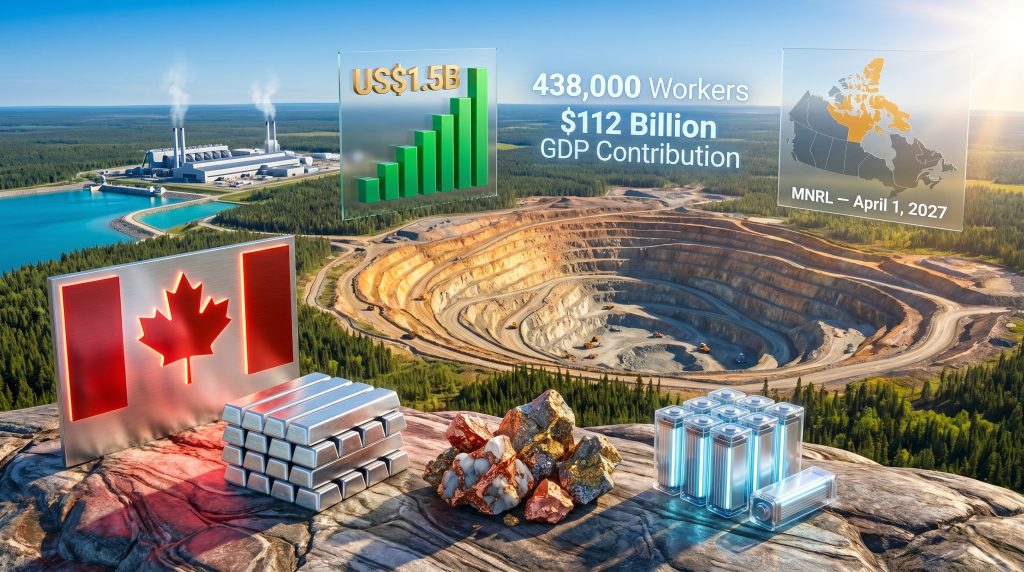
Canada's mining industry is not a peripheral contributor to the national economy. In 2024, the sector directly employed 438,000 workers and generated $112 billion in GDP, figures that place workforce stability squarely within the domain of macroeconomic risk management rather than human resources planning.
The challenge is multidimensional. Furthermore, several compounding forces are converging simultaneously:
- An aging workforce is producing a wave of retirements across skilled trades categories, with no equivalent pipeline of trained replacements ready to absorb the transition
- Geographic remoteness of many Canadian mining operations restricts access to local labour pools, making recruitment both costly and logistically complex
- Rapid technological change in mining operations, from autonomous drilling equipment to real-time geospatial monitoring, is outpacing the curricula of existing training institutions
- The critical minerals demand cycle is generating a hiring spike that was never anticipated in Canada's vocational training system design
According to the Mining Industry Human Resources Council (MiHR), even as some headline employment data softened following the 2023 peak, underlying labour tightness across skilled trades categories has persisted. This distinction matters enormously for investors and policymakers: it separates a cyclical hiring dip from a structural supply deficit that compounds over time.
Industry Note: The roles facing the most acute shortages are not at the executive or engineering end of the spectrum. Mechanics, electricians, and technical supervisors represent the persistent gap, positions that require years of applied experience to develop and cannot be filled through accelerated university enrolment alone.
The Mining and Minerals Workforce Alliance Explained
Announced at the Mining Society of Nova Scotia Conference, the Mining and Minerals Workforce Alliance represents the most coordinated federal-industry response to the skills crisis seen in years. Led by MiHR and backed by the Mining Association of Canada, the Alliance operates as a multi-stakeholder coalition rather than a top-down government programme.
Its membership structure is deliberately broad:
- Industry operators and employers providing direct signals on which skills are most urgently needed
- Organised labour and union representatives ensuring that workforce transitions protect existing workers
- Post-secondary and vocational training institutions designing curricula aligned with employer requirements
- Indigenous community partners creating pathways that reflect the demographic realities of mining regions across Canada
Critically, this Alliance is not a standalone initiative. It is the first of six planned sector workforce alliances being rolled out at the federal level, designed to redirect workers affected by tariff pressures and economic transitions into industries with durable demand. Mining was identified as the first priority sector, a signal of how central critical minerals development has become to Canada's broader economic strategy, particularly given Canada's energy transition challenges.
| Alliance Feature | Detail |
|---|---|
| Lead Organisation | Mining Industry Human Resources Council (MiHR) |
| Supporting Body | Mining Association of Canada |
| Stakeholder Groups | Industry, unions, post-secondary institutions, Indigenous partners |
| Position in Federal Strategy | First of six planned sector alliances |
| Core Focus | Skills alignment, talent pipeline development, workforce transitions |
Is the Alliance Enough to Close the Gap?
Labour gaps risk slowing the mining sector's rise considerably, according to industry observers. However, the Alliance's multi-stakeholder approach positions it well to address structural shortfalls rather than simply patching immediate vacancies. Its success will ultimately depend on how quickly training institutions can align their curricula with employer needs on the ground.
Vocational Training Takes Root in Ontario's Mining Heartland
National alliances set strategic direction, but it is programme-level investment that actually fills the talent pipeline. Collège Boréal in Timmins, Ontario has moved decisively on this front, launching a two-year Construction Engineering Technician, Civil and Mining programme that combines structured classroom instruction with applied, hands-on technical training.
The programme's location is strategically deliberate. Timmins sits within one of Ontario's most productive and historically significant mining regions, meaning graduates will enter a job market where demand for their skills is immediate and geographically concentrated. The first student cohort is scheduled to begin in September 2026.
What makes this programme particularly significant is where it sits in the skills hierarchy. Technician and supervisory roles represent a persistent middle-tier gap in Canadian mining, one that sits below the radar of university-focused recruitment campaigns but above the entry-level positions that attract the most training investment. Filling this band of roles is essential to operational efficiency at active mine sites.
Quebec as a Capital Magnet: Low-Carbon Infrastructure Meets Mining Scale
While workforce strategy takes shape at the national level, Quebec is rapidly consolidating its position as Canada's premier destination for large-scale, capital-intensive mining and metals processing investment. The province's combination of abundant low-carbon hydroelectric power, established industrial infrastructure, and proximity to North American supply chains is attracting commitments that would have seemed ambitious even five years ago. In addition, renewable energy for mining operations is becoming an increasingly decisive factor for investors evaluating long-term project viability.
Rio Tinto's US$1.5 Billion Aluminum Expansion
Rio Tinto (ASX: RIO) has begun commissioning a US$1.5 billion expansion of its AP60 aluminum smelter at the Arvida complex in Quebec. The upgrade adds 96 new AP60 smelting pots, lifting annual primary aluminum production capacity from 60,000 tonnes to approximately 220,000 tonnes, a near-fourfold increase expected to reach full capacity by the end of 2026.
The AP60 technology platform is engineered to produce meaningfully lower carbon emissions than conventional Hall-Heroult smelting processes. This matters not just for regulatory compliance but for commercial positioning: industrial buyers in automotive, aerospace, and construction are under increasing pressure to document the carbon intensity of their materials inputs, and low-carbon aluminum commands a growing premium in global markets.
Troilus Mining Secures Hydro-Québec Grid Access
Troilus Mining has received a 70-megawatt power allocation from Hydro-Québec, endorsed by Quebec's Ministry of Economy, Innovation and Energy. For a project still advancing through permitting, engineering, and financing workstreams, this is a materially significant de-risking milestone.
Access to Quebec's hydroelectric grid resolves one of the most fundamental uncertainties facing any large-scale mining development: reliable, cost-predictable, and low-carbon energy supply. The Troilus copper-gold project is underpinned by a 2024 feasibility study and is targeting a 22-year mine life, a duration that makes energy cost certainty critical to long-term financial modelling.
Investor Perspective: In the current environment, where institutional lenders and ESG-focused capital allocators scrutinise energy sourcing alongside financial returns, grid access from a low-carbon utility provider is not merely operational confirmation. It is a financing prerequisite that meaningfully narrows the risk premium applied to project debt.
Indigenous Partnerships: The Uukiimau Agreement Sets a New Standard
The execution of the Uukiimau Agreement between the Cree First Nation of Waswanipi, the Cree Nation Government, the Grand Council of the Crees (Eeyou Istchee), and Gold Fields represents a landmark development in how community consent and benefit-sharing are structured in Canadian resource development. Considering natural capital in mining more broadly, agreements of this nature are increasingly recognised as essential to responsible and sustainable project development.
The Impact Benefit Agreement (IBA) for the Windfall gold project in Quebec establishes binding commitments across five distinct domains:
- Financial benefit-sharing arrangements ensuring Cree communities receive ongoing economic returns from the project
- Environmental management obligations defining operational standards and monitoring responsibilities
- Operational protocols governing how the mine will be developed and managed in relation to Cree territories
- Social and community development commitments addressing broader quality-of-life outcomes
- Employment, training, and business development pathways creating direct economic participation for Cree communities
Gold Fields has committed $495 million in project expenditure at Windfall in 2026 alone, making the Uukiimau Agreement one of the most financially substantial IBAs executed in Canada's recent mining history.
What distinguishes this agreement structurally is the involvement of multiple Cree governance bodies simultaneously. Multi-party IBAs of this complexity signal an evolution in community engagement from consultation to co-governance, a shift that is increasingly expected by regulators, lenders, and sophisticated investors evaluating social licence risk.
IBAs are also emerging as a complementary mechanism to national workforce initiatives like the Mining and Minerals Workforce Alliance. The employment and training provisions embedded in community agreements create localised talent pipelines that address exactly the geographic labour constraints that national strategies struggle to resolve from the top down.
The next major ASX story will hit our subscribers first
Nunavut's Devolution: Reshaping Governance Across Canada's North
One of the most consequential long-term structural shifts in Canadian mining governance will occur on April 1, 2027, when Nunavut formally launches the Department of Mines, Natural Resources and Land (MNRL). The new department coincides with the territory's devolution agreement with the federal government, a historic transfer of land and resource management authority from Ottawa to Nunavut.
The MNRL is designed as a single-access governance portal for all land and resource development matters in the territory. Its mandate encompasses:
- Public lands and freshwater management
- Oversight of mineral, oil, and gas development activities
- Promotion of geoscience research and mineral exploration through a dedicated Nunavut Geological Survey
For the exploration and development community, the practical implication of devolution is significant. Centralised, territorially controlled decision-making has the potential to reduce regulatory fragmentation and improve investment certainty for operators working in one of Canada's most prospective but chronically underexplored regions. However, whether that potential is realised will depend on how quickly the MNRL builds institutional capacity after its 2027 launch.
Battery Recycling's Limitations and Why Primary Mining Remains Essential
The narrative around battery recycling as a solution to critical minerals supply constraints has persistently overstated what is technically achievable at industrial scale. The reality, as increasingly acknowledged by materials scientists and supply chain analysts, is more complicated. Understanding the battery recycling process more closely reveals why primary mining investment remains indispensable in the near term.
Lithium-ion batteries are precision-engineered products assembled through multi-stage chemical and physical processes. Reversing that production chain to recover battery-grade materials — materials that meet the strict purity thresholds required for new cell manufacturing — is technically demanding in ways that are not fully captured in optimistic recycling forecasts.
The core barriers include:
| Challenge | Supply Chain Impact |
|---|---|
| Mixed battery chemistries in waste streams | Degrades output purity and commercial value |
| Contaminants in black mass | Limits recovery of battery-grade material |
| Reversal of complex multi-step production | Increases processing cost and energy intensity |
| Strict purity thresholds for reuse | Restricts which recovered materials qualify |
Black mass, the intermediate product generated when battery cells are shredded and processed, presents a particular challenge. Its mixed chemical composition makes it difficult to extract individual materials at the purity levels required by battery manufacturers without additional refining steps that significantly erode the economics of the recycling operation.
Proposed pathways forward centre on focusing recovery efforts on intermediate materials rather than attempting direct battery-grade output, investing in improved pre-processing and sorting to reduce contamination at source, and integrating recycling operations more deeply with established chemical refining infrastructure.
The practical implication for investors and policymakers is straightforward: battery recycling will eventually contribute meaningfully to critical minerals supply, but it cannot substitute for primary mining investment in the near to medium term. Projects like Troilus represent exactly the kind of new primary supply that the energy transition requires, regardless of what recycling technology eventually delivers.
Key Takeaways for Investors and Industry Observers
- The Mining and Minerals Workforce Alliance represents a shift from reactive recruitment to systematic talent pipeline development, with Canada targets mining labour shortages being identified as the first priority within a six-alliance federal strategy
- Canada's mining sector contributes $112 billion to GDP and employs 438,000 people, making workforce gaps a macroeconomic risk with direct implications for critical minerals supply security
- Quebec is consolidating its position as Canada's leading jurisdiction for large-scale, low-carbon mining investment, anchored by Rio Tinto's US$1.5 billion smelter expansion and Troilus Mining's Hydro-Québec grid allocation
- The Uukiimau Agreement establishes a new benchmark for multi-party Indigenous engagement in Canadian resource development, with binding commitments across financial, environmental, operational, and social dimensions
- Nunavut's MNRL launch in 2027 could materially improve investment certainty for operators in Canada's north, though institutional capacity will take time to develop
- Battery recycling's technical limitations reinforce the ongoing necessity of primary mining investment to meet critical minerals demand across the energy transition
Disclaimer: This article contains forward-looking statements and financial projections drawn from publicly available sources. These statements involve inherent uncertainty and should not be construed as investment advice. Readers should conduct independent due diligence before making any investment decisions.
Want to Stay Ahead of the Next Major Critical Minerals Discovery?
Discovery Alert's proprietary Discovery IQ model instantly scans ASX announcements across more than 30 commodities — including the critical minerals driving Canada's energy transition — delivering real-time alerts on significant discoveries directly to subscribers. Explore historic examples of major mineral discoveries and their market returns, then begin your 14-day free trial at Discovery Alert to position yourself ahead of the broader market.