June 6, 2026
When Buyers Become Monopolists: The Structural Threat Reshaping Australia's Iron Ore Trade
Commodity markets are typically governed by the interplay of competing buyers and sellers, where pricing emerges organically from supply and demand signals. But what happens when one side of that equation consolidates into a single, state-directed entity with the resources and mandate to dictate terms? That is precisely the question now confronting Australia's iron ore sector as Australia iron ore miners seek Canberra help in price fight with China, and the answer carries consequences that extend far beyond any individual mining contract.
The intersection of resource dependency, geopolitical calculation, and corporate strategy has placed Australia's most valuable export commodity at the centre of a structural pricing dispute with profound implications for federal revenues, diplomatic relationships, and long-term resource sovereignty.
When big ASX news breaks, our subscribers know first
Australia's Iron Ore Economy: The Numbers Behind the Dependency
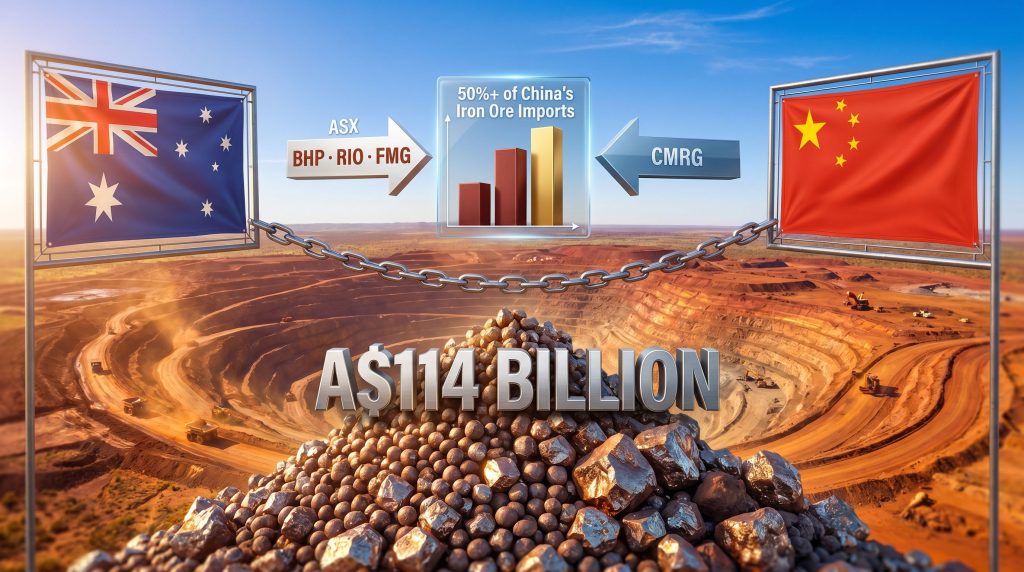
Iron ore is not merely an important Australian export. It is the financial foundation upon which a significant portion of the nation's fiscal architecture rests. Government estimates project that iron ore will generate approximately A$114 billion (roughly USD $81 billion) in export revenue during the current financial year, making it the single largest contributor to Australia's merchandise export earnings by a substantial margin.
This revenue flows through multiple channels. At the corporate level, it drives the earnings of BHP (ASX: BHP), Rio Tinto (ASX: RIO), Fortescue (ASX: FMG), and private operator Hancock Prospecting. At the state level, Western Australia derives a disproportionate share of its royalty income from iron ore extraction, meaning any sustained softening in benchmark prices compresses state budgets with limited capacity to offset the shortfall. At the federal level, corporate tax receipts tied to iron ore profitability create direct sensitivity between commodity price movements and the government's fiscal position.
Treasury modelling has long acknowledged that every USD $10 per tonne movement in the iron ore benchmark translates into material swings in both royalty and tax receipts. When prices are strong, governments benefit from a revenue dividend that funds public services without requiring additional fiscal effort. When prices weaken, that buffer disappears rapidly.
Australia accounts for more than 50% of China's total iron ore import volume, a figure that captures the asymmetric dependency at the core of this relationship. Furthermore, understanding iron ore demand prospects is critical, as China is simultaneously Australia's largest trading partner and the buyer of its most valuable export, creating a dual dependency that constrains the policy options available to Canberra in any confrontation with Beijing.
China Mineral Resources Group: Understanding the Centralised Buyer Mechanism
To understand why Australia's iron ore miners are seeking government assistance, it is necessary to understand exactly what China Mineral Resources Group (CMRG) is and what it was designed to accomplish.
CMRG was established by the Chinese government as a state-backed procurement consolidation vehicle. Its core mandate is to aggregate the purchasing power of China's fragmented steel mill sector into a single negotiating entity, allowing Beijing to engage iron ore suppliers from a position of collective strength rather than as individual, often competing, buyers. The China steel and iron ore market dynamic means the seaborne iron ore market, valued at approximately $132 billion annually, sees China's share of that demand as large enough that centralised procurement through CMRG effectively creates monopsony conditions.
In economics, a monopsony is a market structure where a single buyer faces multiple competing sellers. The buyer in this configuration gains the ability to suppress prices below what a competitive market would produce, because sellers have no alternative buyer of comparable scale to whom they can redirect their product. CMRG's design appears to deliberately engineer this dynamic for iron ore.
How Has CMRG Demonstrated Its Market Power?
The practical effects of this structure are already visible. During protracted contract negotiations with BHP, CMRG blacklisted certain BHP iron ore grades for a period of seven months, effectively excluding that product from the Chinese market and demonstrating a willingness to absorb short-term supply disruptions to extract better pricing terms.
CMRG has also communicated to Chinese steelmakers that engaging in discussions with Fortescue regarding a new iron ore product is discouraged, limiting that company's ability to develop market traction for innovative product offerings. These are not the tactics of a conventional commercial buyer optimising procurement costs. They reflect a state-directed market strategy designed to reshape the structural terms of the iron ore trade over the medium to long term. For context on the broader consequences, the global iron ore tariff impact further compounds the complexity facing Australian exporters.
The Yuan Settlement Dimension: More Than a Currency Preference
One of the more technically significant developments in recent negotiations has been the push by CMRG toward yuan-denominated contract settlement. BHP reached an agreement with CMRG in April that included acceptance of yuan-denominated sales, establishing a precedent that other miners may be pressured to follow.
The implications of this shift extend well beyond currency preference. Iron ore has historically been priced and settled in US dollars, which provides Australian miners with access to deep and liquid USD-denominated hedging markets, clear pricing benchmarks tied to internationally recognised indices, and financial reporting consistency across global operations.
Transitioning to yuan settlement introduces several complications:
- Currency risk exposure in a currency whose exchange rate is managed by the People's Bank of China rather than freely floated
- Hedging complexity as yuan-denominated instruments are less liquid and more constrained than equivalent USD markets
- Pricing opacity where the effective USD-equivalent price received by Australian exporters becomes less transparent
- Internationalisation dynamics where yuan settlement in commodity markets advances China's broader goal of reducing dollar dependency in global trade
From Beijing's perspective, yuan settlement in iron ore contracts serves two strategic purposes simultaneously: it reduces transaction costs for Chinese buyers and incrementally advances the renminbi's role as a global settlement currency, reducing China's own exposure to dollar-based financial systems.
What Australian Miners Are Asking Canberra to Do
The formal confirmation from Australia's Department of Foreign Affairs and Trade (DFAT) that BHP, Rio Tinto, Fortescue, Hancock Prospecting, and the Minerals Council have engaged with government officials on this matter represents a significant escalation from purely commercial negotiation to sovereign-level intervention requests.
DFAT Assistant Secretary Steven Yates confirmed that discussions had occurred and that suggestions had been raised regarding how the government might carry the issue forward, though specific details were withheld on commercial confidentiality grounds. The department indicated it works regularly with Australian miners to support their ability to export iron ore at competitive prices.
Could a Single Selling Desk Restore Negotiating Balance?
The most structurally significant option raised in industry discussions is the concept of a single selling desk for Australian iron ore exports, a mechanism that would coordinate pricing and sales terms across competing producers. The logic is straightforward: if China has constructed a single state buyer with consolidated bargaining power, Australia could theoretically construct a coordinated seller to restore negotiating symmetry.
DFAT Deputy Secretary George Mina acknowledged that previous attempts to coordinate supply in Australia's agricultural sector were poorly received by trading partners. However, the iron ore situation differs fundamentally because a single buyer already exists on the Chinese side, a distinction Mina explicitly noted when describing this as a genuine long-term strategic question. According to reporting from top miners seeking Canberra's assistance, the pressure on government to act is intensifying.
The policy options under consideration span a wide range of interventions:
| Policy Option | Core Mechanism | Primary Risk | Historical Parallel |
|---|---|---|---|
| Single Selling Desk | Coordinated export pricing | WTO scrutiny, competition law | Canpotex (Canada potash) |
| Diplomatic Advocacy | Government-to-government trade pressure | Diplomatic sensitivity | Rare earths disputes |
| Currency Resistance | Maintaining USD settlement terms | CMRG exclusion risk | BHP's April concession |
| Market Diversification | Developing Indian, SE Asian buyers | Long lead times | Infrastructure investment required |
The Canpotex Comparison: A More Useful Precedent Than It First Appears
For investors and policy analysts seeking a structural parallel to the single selling desk concept, Canada's Canpotex model in potash exports offers instructive lessons. Canpotex is a bulk commodity export coordination entity through which Canada's major potash producers market their product internationally, without competing against each other on price in offshore markets.
This model has survived WTO scrutiny for decades because it operates within a framework that separates export coordination from domestic market competition. The key legal distinction is that producers continue to compete domestically while coordinating export terms. A comparable architecture for Australian iron ore would require careful design to avoid classification as an export cartel under WTO rules, which prohibit certain forms of coordinated market restriction.
The De Beers single-channel diamond marketing model offers a different lesson: even the most dominant commodity coordination structures eventually face regulatory dismantlement when market conditions shift. Any Australian coordination mechanism would need to be designed with regulatory durability in mind, not just short-term negotiating effectiveness.
The next major ASX story will hit our subscribers first
Geopolitical Constraints: Why Canberra May Hesitate
The investor community is already pricing in the possibility that Canberra will not move aggressively on this issue. An executive at one of Australia's major iron ore producers has indicated to investors that the government has been informed of the situation, but acknowledged that the ongoing effort to stabilise Australia's diplomatic relationship with Beijing creates real hesitation about escalating a commercial pricing dispute into a formal trade confrontation.
This creates what might be described as a policy paralysis dynamic: the economic rationale for intervention is strong, the legal architecture for a response is theoretically constructable, but the diplomatic cost-benefit calculation tilts against aggressive action while Australia's foreign policy establishment continues to prioritise relationship repair with China.
Comparative analysis of how other resource-exporting nations manage state involvement in commodity pricing negotiations reveals a spectrum of approaches. Brazil, as the world's second-largest iron ore exporter behind Australia, has not historically coordinated iron ore pricing with government support, relying instead on Vale's scale as a competitive counterweight. Moreover, analysis of what this means for ASX mining stocks suggests investor sentiment is already shifting in response to these structural pressures.
Scenario Analysis: Three Trajectories for Australian Iron Ore Pricing
The current dispute is unlikely to resolve cleanly in the near term. Three distinct trajectories appear plausible:
-
Gradual Concession Erosion — CMRG continues applying sustained pressure through selective blacklisting, product exclusions, and yuan settlement demands. Individual miners, facing the choice between conceding and losing market access, incrementally accept worse terms. Australia's export revenue base contracts slowly without any single visible inflection point that would trigger a decisive policy response.
-
Coordinated Industry Response — Miners achieve sufficient political will from Canberra, potentially including some form of coordination mechanism or at minimum a stronger diplomatic advocacy position. This restores partial negotiating symmetry but generates friction with Beijing during a period when Australia is actively working to normalise bilateral relations. The diplomatic cost is real but bounded.
-
Structural Demand Contraction — The pricing dispute becomes secondary to a more fundamental challenge as China's steel intensity peaks alongside its urbanisation and infrastructure investment cycle. If Chinese steel production begins a sustained structural decline, the volume assumptions underpinning current export revenue projections require significant revision regardless of how the CMRG negotiations resolve.
The Critical Minerals Precedent: Why This Dispute Matters Beyond Iron Ore
Perhaps the most underappreciated dimension of the current iron ore pricing dispute is what it signals for Australia's broader commodity export portfolio. If CMRG successfully extracts structural pricing concessions from the world's most financially powerful iron ore producers, including BHP and Rio Tinto with their combined global scale and financial resources, it establishes a template for applying equivalent procurement consolidation strategies to lithium, cobalt, nickel, and rare earth elements.
Australia is a significant producer of multiple critical minerals that China's technology and energy transition industries require. The lesson that state-directed monopsony procurement can extract better terms from even the largest private mining companies would not go unnoticed in Beijing's strategic planning for those commodity categories.
"Treating commodity pricing integrity as a dimension of national economic security, rather than a purely commercial matter, may be the most important strategic reframing that the current iron ore dispute demands of Australian policymakers."
Australia's critical minerals strategy explicitly acknowledges the need to prevent strategic dependencies from developing across the resource export sector. The iron ore pricing dispute provides a live case study in how those dependencies can be operationalised by a sophisticated state buyer, with lessons that should directly inform how Australia structures its regulatory and diplomatic approach to critical mineral export governance going forward.
The Long-Term Structural Picture: Iron Ore Demand Beyond China
Regardless of how the CMRG negotiations resolve, Australian iron ore producers face a medium-term structural challenge that operates independently of pricing politics. China's steel production is approaching the peak of its intensity curve, driven by the maturation of its infrastructure and real estate investment cycles. This is not a near-term collapse scenario, but it represents a directional shift in the demand trajectory that underpins Australia's A$114 billion export revenue expectation.
The emerging growth markets for iron ore demand are centred on India and Southeast Asia, where rapid urbanisation and infrastructure investment are still in relatively early stages. However, redirecting meaningful iron ore export volumes toward these destinations requires infrastructure investment, shipping route development, and the establishment of commercial relationships that take years to mature.
How Does Green Steel Change the Equation?
The green steel transition adds a further layer of complexity. Hydrogen iron ore reduction technology, which is expected to gain industrial scale over the coming decade, favours high-grade iron ore with iron content above 65% over the standard Pilbara blend grades that dominate Australian production. Consequently, this creates a potential quality mismatch between Australia's existing production profile and the specifications demanded by next-generation steelmaking technology — a geological and commercial challenge that sits beneath the current pricing dispute but will become increasingly material over time. This structural reality makes the case for Australia iron ore miners seek Canberra help in price fight with China all the more urgent.
Disclaimer: This article is intended for informational purposes only and does not constitute financial or investment advice. Projections, scenario analyses, and forward-looking statements involve inherent uncertainty and should not be relied upon as the basis for investment decisions. Readers should conduct their own due diligence and consult qualified financial advisers before making any investment or policy-related decisions.
Want to Stay Ahead of Major ASX Mineral Discoveries as Australia's Resource Landscape Shifts?
As structural pressures reshape Australia's iron ore trade and critical minerals gain strategic importance, Discovery Alert's proprietary Discovery IQ model delivers real-time alerts on significant ASX mineral discoveries, turning complex market signals into actionable investment insights for traders and long-term investors alike. Explore historic discoveries and their market-defining returns, then begin your 14-day free trial to ensure you're positioned ahead of the market when the next major discovery is announced.