
June 6, 2026
The Efficiency Paradox: Why More Rigs No Longer Means More Oil
The conventional wisdom of the oil patch once held firm: more rigs in the ground meant more crude flowing through pipelines. That relationship, once so reliable it shaped commodity markets for decades, has fundamentally broken down in the modern shale era. Today, the Baker Hughes US oil rig count remains one of the most closely watched upstream indicators in global energy markets, yet interpreting it correctly demands a far more nuanced lens than it did a generation ago.
Understanding what the weekly rig count actually measures, what it misses, and how it connects to broader production dynamics is essential for anyone tracking US crude supply trajectories in 2026. Furthermore, crude oil price trends and geopolitical forces add additional layers of complexity to any supply analysis.
When big ASX news breaks, our subscribers know first
What the Baker Hughes Rig Count Actually Measures
Baker Hughes, a leading oilfield services company, publishes its North America rig count data weekly, released at noon Central Time on the final business day of each week. The report has been compiled since 1944 and is widely regarded as the most authoritative real-time proxy for upstream drilling activity across the United States and Canada.
The methodology centres on rotary rigs actively drilling new wellbores. A rig qualifies as active only if it is physically turning to the right, meaning it is in the process of drilling. Rigs that are moving between locations, undergoing maintenance, or on standby do not qualify. This point-in-time snapshot captures drilling momentum but says nothing about the completion side of the production cycle.
Breaking Down the Three Rig Categories
The total US oil rig count comprises three distinct categories:
- Oil rigs: Targeting crude oil formations, predominantly in basins like the Permian, Eagle Ford, and Bakken
- Gas rigs: Focused on natural gas plays, including the Haynesville, Marcellus, and Utica shales
- Miscellaneous rigs: A catch-all category covering rigs drilling for geothermal energy or in exploratory roles not clearly classified as oil or gas
This distinction matters because conflating the total rig count with oil-specific drilling activity can badly distort supply analysis. A rising gas rig count has almost no bearing on near-term crude production volumes.
Week of May 29, 2026: What the Latest Data Reveals
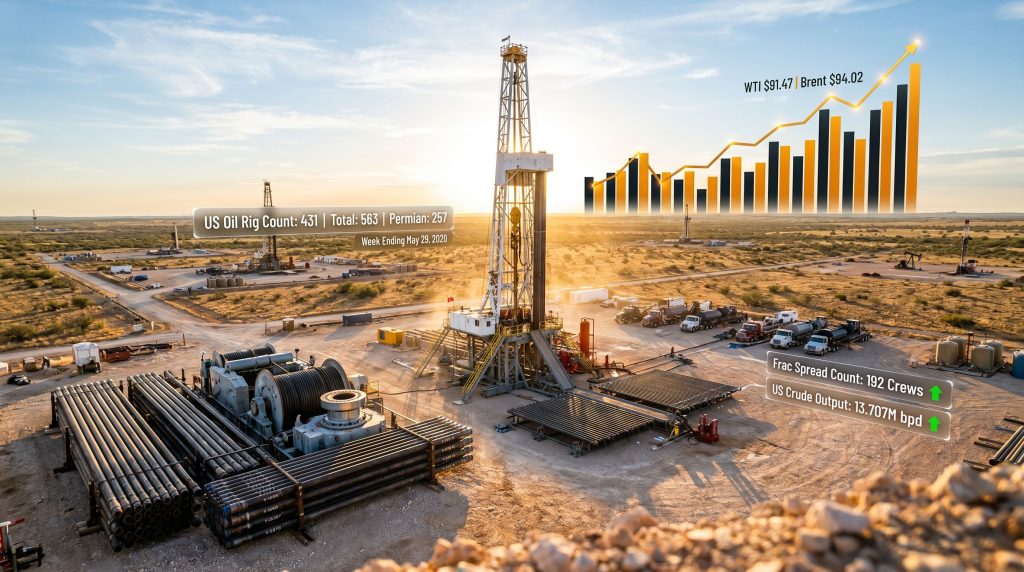
The most recent Baker Hughes release for the week ending May 29, 2026 shows a modest but meaningful shift in US upstream activity. The headline figures are summarised below:
| Rig Category | Current Count | Week-Over-Week Change | Year-Over-Year Change |
|---|---|---|---|
| Oil Rigs | 431 | +2 | -11 |
| Gas Rigs | 124 | -1 | +10 |
| Miscellaneous Rigs | 8 | 0 | Flat |
| Total US Rig Count | 563 | +1 (net) | +4 |
While the total combined count nudged higher by a net of one rig and sits four rigs above year-ago levels, the oil-specific figure tells a more cautious story. At 431 active oil rigs, the count remains 11 rigs below where it stood at the same point in 2025.
That year-over-year deficit carries meaningful implications for medium-term crude supply modelling, and it reinforces the broader theme of restraint that has characterised US shale operator behaviour since the post-2020 capital discipline era began. The trends observed in US drilling activity over the preceding year provide important context for this continued restraint.
"The divergence between a recovering total rig count and a still-depressed oil-specific count is precisely the kind of nuance that gets lost in headline reporting but matters enormously for production forecasting."
Basin-Level Intelligence: Where Rigs Are Moving and Why It Matters
The national rig count aggregates activity across dozens of plays and basins, but the basin-level breakdown reveals where capital is actually being deployed and where it is being pulled.
Permian Basin: Dominant but Running Below Prior Capacity
The Permian Basin added two rigs during the reporting period, bringing its active count to 257 rigs. This single basin accounts for roughly 46% of all active US oil rigs, making it the overwhelming driver of national drilling trends. However, the Permian is currently operating 18 rigs below year-ago levels, a deficit that signals operators in the most productive oil basin on Earth are choosing efficiency over expansion.
This is not simply a cost story. The Permian's leading operators have increasingly shifted towards longer horizontal laterals, in some cases exceeding three miles, which dramatically increases the productive surface area of a single wellbore. Consequently, when a single well can drain a reservoir that previously required multiple shorter wells, the raw rig count required to maintain or grow output falls structurally.
Eagle Ford and Cana Woodford: Diverging Signals
The Eagle Ford Shale in South Texas held steady at 44 active rigs, a level that is four rigs above the same period last year. Flat week-over-week activity in a mature basin like the Eagle Ford typically signals stable operator intentions rather than a growth phase, though the year-over-year improvement suggests a gradual rehabilitation of activity in a play that experienced significant consolidation after the 2020 downturn.
The Cana Woodford in Oklahoma lost two rigs during the week, a softening that warrants monitoring over subsequent reporting periods. The Woodford is primarily a gas-weighted play, and the combination of gas rig losses nationally alongside Woodford weakness suggests some operators are reassessing their natural gas drilling economics in the current price environment.
US Crude Production: The Decoupling That Defines Modern Shale
Perhaps the most instructive data point from the latest reporting period is the relationship between the rising rig count and actual crude output. According to EIA data, US crude oil production for the week ending May 29, 2026 averaged 13.707 million barrels per day, down marginally from 13.715 million bpd the prior week, even as the oil rig count edged higher.
Year-over-year, however, production is up 299,000 bpd from the same period in 2025. This combination of slightly fewer rigs than a year ago but more production is the defining structural feature of the current US shale cycle. In addition, the ongoing US oil production decline narrative from 2025 helps explain why operators remain cautious despite favourable prices.
"The week-over-week production dip despite a rising rig count illustrates a reality that is now deeply embedded in US upstream dynamics: the lag between drilling activity and production additions, combined with natural decline rates from existing wells, means short-term output can move independently of rig count signals."
What drives this structural efficiency gain? Several interrelated factors are at work:
- Extended lateral lengths: Modern horizontal wells in the Permian routinely reach two to three miles, compared to one-mile laterals that were standard a decade ago
- Optimised well spacing: Operators have developed sophisticated spacing models that minimise interference between adjacent wells while maximising reservoir drainage
- Advanced completion designs: Higher proppant loading, tighter stage spacing, and more complex perforation cluster designs extract significantly more hydrocarbons per foot of lateral
- AI-assisted reservoir targeting: Machine learning tools increasingly guide operators towards the highest-quality rock within a formation, reducing dry-hole risk and improving per-well economics
The Frac Spread Count: The Indicator the Rig Count Cannot See
The Baker Hughes rig count measures drilling activity, but a separate and equally important metric tracks what happens after drilling ends. Primary Vision's Frac Spread Count estimates the number of hydraulic fracturing crews actively completing drilled-but-uncompleted (DUC) wells, and for the week ending May 29, 2026, that figure rose by three to 192 active completion crews.
| Indicator | Latest Reading | Direction | Production Relevance |
|---|---|---|---|
| Baker Hughes Oil Rig Count | 431 | +2 | Medium-term (6-18 months) |
| Total US Rig Count | 563 | +1 net | Medium-term |
| Frac Spread Count | 192 crews | +3 | Near-term (30-90 days) |
| US Crude Production | 13.707M bpd | -8,000 bpd WoW | Current output |
The frac spread count is a leading indicator with a shorter production lag than the rig count. Wells that are being completed today will typically begin producing within 30 to 90 days, making the completion crew count a more immediate barometer of near-term supply additions. The three-crew increase in completion activity, running alongside the two-rig increase in oil drilling, paints a picture of gradual but measured upstream acceleration.
The next major ASX story will hit our subscribers first
Price Context and Operator Psychology in 2026
At the time of the Baker Hughes report, WTI crude was trading at $91.47 per barrel, down 1.69% on the day, while Brent sat at $94.02, off 1.06%. These price levels place US shale operators firmly in profitable territory across most plays, with the majority of Permian operators carrying breakeven prices well below $60 per barrel at the wellhead on a full-cycle basis in their core acreage.
Yet the measured pace of rig additions, rather than an aggressive supply ramp, reflects the persistent influence of investor pressure on operator behaviour. Since 2020, institutional capital has demanded that public oil producers prioritise free cash flow generation, debt reduction, and shareholder returns over production growth for its own sake. This represents a fundamental shift from the growth-at-all-costs mentality that characterised the shale sector's earlier boom cycles.
The practical consequence is that even with WTI near $91, operators are not deploying capital at the pace that prior-cycle price levels would have triggered. Furthermore, oil price volatility stemming from trade tensions has added another layer of uncertainty to capital planning. The rig count-to-price correlation that once gave commodity analysts a reliable forward production signal has been structurally disrupted.
EIA Monthly Data vs. Baker Hughes Weekly Snapshots: Knowing Which to Use
A common source of confusion in upstream analysis is the discrepancy between the EIA's monthly drilling activity data and the Baker Hughes weekly snapshot. The EIA's reporting smooths weekly volatility by presenting monthly averages, which produces a figure that can differ meaningfully from the Baker Hughes point-in-time reading.
For tracking near-term drilling momentum, the Baker Hughes weekly figure is the preferred tool. For identifying broader trend shifts over quarterly or annual timeframes, the EIA's monthly-average format provides a less noisy signal. Analysts who conflate the two without accounting for their different methodologies risk drawing incorrect conclusions about the pace and direction of upstream activity.
Key Factors Driving Rig Count Decisions in 2026
Several macro and micro forces shape how operators manage their rig fleets from week to week:
- Crude price thresholds: Most operators have established internal price decks that trigger or suspend rig additions, typically updated at the start of each capital budget cycle
- Capital discipline frameworks: Post-2020 investor expectations have embedded return-focused metrics into operator decision-making that override pure production growth logic
- OPEC+ production policy: When OPEC+ signals supply additions, as it has done in several phases since 2022, the competitive pressure on US shale economics rises, potentially dampening incremental drilling incentives
- Geopolitical risk premiums: Elevated geopolitical tension in the Middle East in 2026 has supported a price floor that makes US drilling economics broadly viable, but the uncertainty itself can delay capital commitment
- Technological efficiency: As noted above, productivity gains per rig continue to reduce the number of rigs needed to sustain or grow output, structurally capping rig count recovery relative to prior cycles
Frequently Asked Questions: US Oil Rig Count and Baker Hughes Data
What is the current US oil rig count?
As of the week ending May 29, 2026, Baker Hughes reported 431 active oil rigs across the United States, a week-over-week gain of two rigs. Including gas and miscellaneous rigs, the total US rig count stood at 563.
How does the Baker Hughes rig count affect oil prices?
A sustained rise in active rigs typically signals growing future supply within a six to eighteen month horizon, which can weigh on prices if demand does not grow proportionally. Conversely, a sustained decline points towards future supply tightening. In the current efficiency era, however, this relationship is less linear than it once was.
What share of US oil rigs does the Permian Basin represent?
At 257 active rigs, the Permian Basin hosts approximately 46% of all active US oil rigs, underscoring its dominance as the primary engine of domestic upstream activity.
Is a higher rig count always bullish for US oil production?
Not necessarily. Structural efficiency improvements, including longer laterals, advanced completions, and AI-assisted reservoir targeting, mean that a smaller rig fleet can now deliver equivalent or greater production compared to earlier cycles. Raw rig count trends must always be contextualised against productivity metrics.
How often does Baker Hughes release the rig count?
Baker Hughes publishes its North America rig count every week, at noon Central Time on the final business day of the work week, with data reflecting the prior week's drilling activity.
The Bigger Picture: What Measured Growth Signals About 2026 US Shale Strategy
The current rig count cycle, characterised by gradual additions rather than an aggressive ramp, tells a story of structural maturation in the US shale sector. Operators are balancing the economics of WTI near $90 against investor mandates for capital discipline, while simultaneously extracting more value per rig than at any prior point in the industry's history.
| Basin | Current Rig Count | Year-Over-Year Change | Trend Signal |
|---|---|---|---|
| Permian Basin | 257 | -18 | Efficiency-led consolidation |
| Eagle Ford | 44 | +4 | Stable, modest recovery |
| Cana Woodford | Not specified | -2 (week) | Softening activity |
The combination of a still-depressed oil rig count relative to year-ago levels, a marginal week-over-week production decline, and a rising frac spread count collectively suggest that US crude output growth in the second half of 2026 will be driven more by completion activity and well-level productivity improvements than by a meaningful expansion in the number of active drilling rigs.
That is a fundamentally different production growth mechanism than the one that characterised earlier shale booms, and understanding the distinction is essential for anyone attempting to model US supply trajectories in the current market environment.
Disclaimer: This article is intended for informational purposes only and does not constitute financial, investment, or commodity trading advice. Rig count data, production figures, and price references reflect publicly available information as of the reporting period noted. Readers should conduct independent research before making any investment decisions.
Want To Stay Ahead Of The Next Major Mineral Discovery On The ASX?
While the US shale sector navigates shifting rig dynamics and capital discipline, Discovery Alert's proprietary Discovery IQ model is scanning ASX announcements in real time, delivering instant alerts on significant mineral discoveries to subscribers — explore the historic returns major discoveries have generated and begin your 14-day free trial at Discovery Alert to position yourself ahead of the broader market.