June 6, 2026
The Hidden Architecture of Oil's War Premium: How Conflict Probability Gets Priced Into Crude
Every time a diplomatic statement crosses a news wire from Washington or Tehran, crude oil futures twitch. Not because a single barrel has moved, gone missing, or changed hands differently, but because the market is continuously repricing the probability of supply disruption across one of the most consequential maritime corridors on the planet. Understanding how that mechanism works, and why oil prices fall on hopes for de-escalation in US-Iran war scenarios, requires looking beneath the headline price moves to the structural architecture underneath.
The concept of a geopolitical risk premium is simple in theory but deeply complex in practice. Futures traders embed a probabilistic estimate of supply disruption directly into the price of crude. When conflict risk rises, that premium expands. When diplomatic signals soften, it contracts. The challenge is that this premium is not observable in isolation. It exists as the difference between what fundamental supply-demand dynamics would otherwise price crude at, and what the market is actually paying given the current threat environment.
When big ASX news breaks, our subscribers know first
The Strait of Hormuz: Why One Waterway Moves Global Commodity Markets
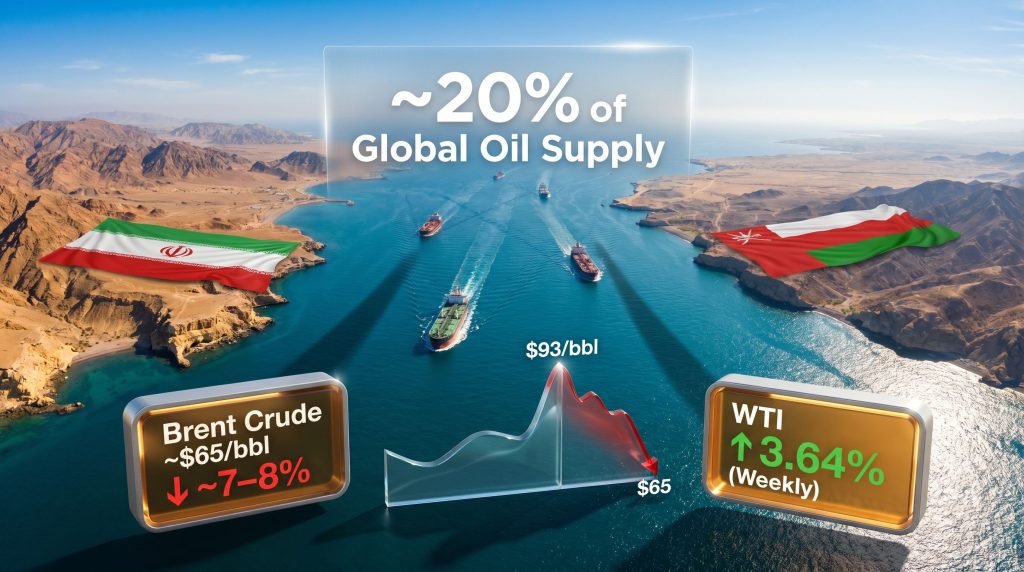
Approximately one-fifth of the world's entire daily oil supply transits the Strait of Hormuz, making it the single most operationally critical maritime chokepoint in global energy infrastructure. At its narrowest point, the navigable shipping channel is only about two miles wide in each direction, a geographic constraint that creates extraordinary concentration risk.
What makes this chokepoint particularly significant from a market psychology standpoint is the asymmetry between perceived disruption risk and actual physical supply impact. Markets routinely overshoot in both directions when Hormuz headlines emerge. A naval incident, a threatening statement, or even a reduction in tanker traffic can move Brent crude by several dollars per barrel within hours, well before any barrel physically fails to reach its destination.
Critical insight: The market does not wait for physical supply disruption to materialise before pricing it in. Traders price the probability distribution of disruption, which means diplomatic tone shifts carry immediate and measurable price consequences, even when operational flows remain unchanged.
This psychological front-running is one reason why the current period, in which oil prices fall on hopes for de-escalation in US-Iran war scenarios, produces such sharp intraday moves. Furthermore, the premium that was built in during peak tension unwinds rapidly the moment the probability distribution shifts toward resolution.
Historical Precedents: When Iran Flashpoints Created and Unwound Premiums
The current market dynamic is not without precedent. Two prior episodes are particularly instructive for understanding how quickly geopolitical premiums can reverse:
- 2019 Strait of Hormuz tanker attacks: Iranian forces seized and attacked oil tankers in the Gulf of Oman, sending Brent crude sharply higher within 24 hours. Once it became clear that physical supply flows were not materially impaired, a significant portion of that premium unwound within weeks.
- January 2020, Soleimani assassination: The killing of Iranian General Qasem Soleimani triggered an immediate spike in crude futures as markets priced in retaliatory escalation. When Iran's response proved more limited than feared, Brent surrendered most of its gains within days.
Both episodes illustrate a recurring pattern: the premium expands faster than it contracts, creating asymmetric volatility that rewards traders who correctly anticipate the de-escalation before consensus pricing catches up.
What the Current Price Data Actually Shows
The most recent session captured the mechanics of this de-escalation repricing in real time. Brent crude settled at $93.09 per barrel, declining $1.94 or approximately 2.04% in a single session, following a 2.84% loss in the prior session. WTI crude finished at $90.54 per barrel, down $2.50 or 2.69%, after a 3.1% loss on the preceding day.
| Benchmark | Settlement Price | Single-Session Decline | Prior Session Loss | Weekly Direction |
|---|---|---|---|---|
| Brent Crude | $93.09/bbl | -2.04% ($1.94) | -2.84% | First weekly gain in 3 weeks (+1.18%) |
| WTI Crude | $90.54/bbl | -2.69% ($2.50) | -3.10% | First weekly gain in 3 weeks (+3.64%) |
Critically, despite the sharp intraday declines, both contracts were positioned to record their first weekly gains in three weeks, reflecting the fact that conflict-driven buying earlier in the week had already lifted prices meaningfully before the de-escalation repricing occurred. For broader context on the trade and geopolitical drivers shaping crude markets, these headline moves rarely tell the whole story.
The catalyst for the reversal was a series of public statements from US President Donald Trump indicating that Iran was engaged in serious dialogue and that an acceptable deal framework was within reach. Markets interpreted this not as confirmation of a deal, but as a meaningful downward revision to near-term conflict probability. That distinction matters enormously. The market did not need a signed agreement to reduce the war premium. It needed only a credible signal that the probability distribution had shifted.
Phil Flynn, Senior Analyst at Price Futures Group, confirmed that market sentiment had pivoted decisively toward interpreting recent developments as de-escalatory, even in the absence of a formal agreement. However, IG market analyst Tony Sycamore cautioned that optimism in this environment is structurally fragile, with the price action remaining highly susceptible to sequential headline reversals.
Three Structural Forces That Were Already Capping Prices Before Diplomacy Shifted
A sophisticated reading of the current oil market requires separating the geopolitical overlay from the fundamental backdrop. Even before diplomatic signals emerged, several structural headwinds were already applying downward pressure on crude prices:
1. Inventory Overhang
Global oil inventories have persisted at levels above consensus forecast expectations, reducing the urgency premium embedded in futures curves. When physical storage remains well-supplied, the market's willingness to sustain elevated forward prices diminishes.
2. Demand Weakness in China
China, the world's largest crude importer, has exhibited subdued economic activity that is flowing through into softer spot demand signals. This China demand weakness has specifically depressed prices for Iranian crude, which has historically found its most reliable buyer base among Chinese independent refiners, known in the trade as teapot refineries. These smaller-scale, privately operated refineries typically purchase discounted sanctioned crude when the arbitrage economics favour it. When Chinese demand softens, this entire channel compresses, simultaneously reducing Iranian export volumes and weakening the spot price at which those barrels can clear.
3. Rerouted Export Flows
Sanctions-driven oil flows have introduced structural inefficiencies into global supply chains. Iranian barrels that once moved through conventional trade routes now travel through shadow fleet networks, introducing freight cost premiums, insurance complexity, and delivery uncertainty that partially offset the apparent supply disruption risk.
Commerzbank analysts noted on Friday that Brent's weekly gains remained structurally capped by this combination of durable inventory levels, rerouted export flows, and softening demand, even as the geopolitical headline premium pushed prices higher mid-week.
OPEC's Demand Signal: What the 1.2 Million BPD Forecast Actually Means
Against this backdrop, OPEC Secretary General Haitham Al Ghais reaffirmed the organisation's oil demand growth forecast of 1.2 million barrels per day (bpd) for the current year. This guidance was maintained explicitly despite the ongoing Middle East conflict and the restricted traffic conditions in the Strait of Hormuz. In addition, the broader OPEC market influence on pricing strategy continues to serve as a key stabilising force in volatile trading conditions.
The maintenance of this forecast carries an implicit message to the market: OPEC does not believe the current conflict will structurally impair full-year consumption patterns. This acts as a stabilising anchor on the demand side of the fundamental equation, even as supply-side uncertainty remains elevated.
For investors interpreting this signal, it is worth understanding what a 1.2 million bpd demand growth figure represents in context. Global oil consumption is approximately 100 to 102 million bpd. A 1.2 million bpd increment represents growth of roughly 1.2%, which, while modest, is sufficient to tighten markets meaningfully if supply-side disruptions materialise even partially.
The next major ASX story will hit our subscribers first
The Lebanon Complication: Why the Diplomatic Path Is Non-Linear
One of the most underappreciated dynamics in the current US-Iran negotiation framework is the multi-party dependency structure that makes bilateral resolution structurally difficult. Iran has formally conditioned any peace arrangement with Washington on a ceasefire between Israel and Lebanon. This creates a sequential negotiating dependency that extends the timeline for any resolution.
Hezbollah Secretary General Naim Qassem publicly rejected a US-brokered ceasefire framework between Israel and the Lebanese government on Thursday, effectively blocking one condition of the Iran deal pathway. President Trump expressed confidence that progress was being made and that Lebanon was deserving of peace, but no binding agreement materialised.
For oil market participants, this multi-node diplomatic architecture means that US-Iran risk cannot be assessed in isolation. Each failed checkpoint in the Lebanon-Israel track has the direct effect of reintroducing the conflict premium into crude prices. Commerzbank analysts observed that each new round of dashed agreement hopes corresponded to a modest upward move in Brent crude and European natural gas, confirming the direct and measurable feedback loop between diplomatic progress and commodity pricing.
Iranian Export Volumes: The Supply Data Behind the Headlines
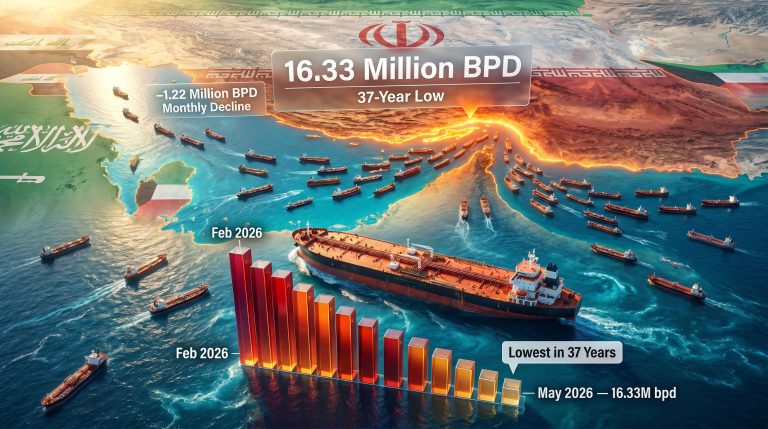
Iranian crude exports have declined to their lowest level in approximately six years, according to shipping and trade flow data. The primary driver is the US naval blockade, which has significantly constrained Iran's ability to move barrels to market through conventional channels. Secondary pressure has come from the weakening Chinese demand environment described above.
This matters for the global supply picture in two distinct ways. In the short term, reduced Iranian export volumes contribute to the perception of supply tightness that has supported prices above purely fundamental levels. In the longer term, however, the prospect of sanctions relief under a negotiated deal represents a bearish overhang that markets are already beginning to partially price in.
If a US-Iran framework were to ease sanctions meaningfully, Iran has the production and export infrastructure capacity to increase crude loadings materially within a matter of months. The market would not wait for first cargo deliveries to adjust. Futures pricing would move to reflect the anticipated supply re-entry well in advance of physical volumes, accelerating the downward price adjustment. Consequently, the US-China oil price impact adds yet another layer of complexity to this already intricate supply and demand calculus.
The Mina al Fahal Incident: A Case Study in Gulf Infrastructure Sensitivity
An explosion near the mooring berths at Oman's Mina al Fahal crude export terminal generated initial reports suggesting oil loading operations had been suspended. Petroleum Development Oman subsequently confirmed that operations remained entirely unaffected.
| Terminal | Daily Export Capacity | Status During Incident |
|---|---|---|
| Mina al Fahal, Oman | 800,000 to 900,000 bpd | Fully operational, unaffected |
The incident, despite its ultimately inconsequential operational outcome, illustrates a critical dynamic in Gulf energy infrastructure: the threshold for market-moving reaction is extremely low. Initial unverified reports of suspension were sufficient to generate immediate price sensitivity, even before any operational confirmation was available. This reflexive market response to infrastructure proximity events reflects the elevated state of alert that pervades Gulf energy trading during periods of active geopolitical tension.
Scenario Analysis: Three Diplomatic Pathways and Their Oil Market Implications
For market participants navigating this environment, a structured scenario framework is more useful than a single-point price forecast.
| Scenario | Current Probability Signal | Oil Market Impact |
|---|---|---|
| Comprehensive US-Iran deal, sanctions eased | Low-to-medium | Significant and sustained Brent decline as Iranian supply re-enters market |
| Partial ceasefire, core sanctions maintained | Medium | Modest price relief, underlying risk premium partially retained |
| Breakdown, renewed active escalation | Remains possible | Sharp Brent spike, Hormuz risk premium re-enters aggressively |
The scenario that markets appear to be partially pricing toward is the partial ceasefire pathway, where diplomatic language softens without producing a binding framework that removes the structural supply threat. This produces exactly the kind of oscillating headline sensitivity that has characterised recent trading sessions.
Key Indicators for Oil Traders to Monitor
Given the signal-to-noise challenge of this environment, disciplined market participants should focus on a defined set of leading indicators rather than reacting to individual headlines:
- Strait of Hormuz tanker traffic data: Any normalisation of shipping volumes would signal reduced physical risk premium
- Iranian crude loading data: Satellite-tracked tanker activity provides a leading indicator of whether sanctions pressure is intensifying or relaxing
- Chinese refinery run rates: Operating levels at Chinese refineries, including teapot facilities, provide a real-time read on demand-side appetite for discounted crude
- OPEC+ production policy signals: Any production adjustment from the group in response to price volatility could amplify or dampen market moves
- Lebanon ceasefire negotiation status: Progress or breakdown in Israel-Lebanon talks functions as a binary input into the Iran deal probability
Investor note: This article contains forward-looking analysis and scenario projections based on publicly available market data and analyst commentary. Oil markets are subject to rapid and unpredictable change driven by geopolitical developments. Nothing in this article constitutes financial advice. Readers should conduct independent research and consult qualified financial professionals before making investment decisions.
Frequently Asked Questions: Oil Prices and US-Iran Tensions
Why do oil prices fall specifically when US-Iran tensions ease?
The Strait of Hormuz, which Iran controls access to militarily, carries approximately 20% of global daily oil supply. When conflict probability between the US and Iran declines, traders reduce the war premium embedded in crude futures, producing measurable price declines even without any change in physical supply. This is precisely why oil prices fall on hopes for de-escalation in US-Iran war contexts, as the repricing is driven entirely by probability shifts rather than physical flow changes.
What are teapot refineries and why do they matter for Iranian oil exports?
Teapot refineries are small to mid-sized independent refiners in China that operate outside the major state-owned refining networks. They have historically been significant buyers of discounted sanctioned crude, including Iranian and Russian barrels, when the arbitrage economics are favourable. When Chinese demand softens, this buyer base contracts, directly pressuring Iranian export volumes and prices.
How quickly could Iranian oil return to global markets if sanctions were eased?
Iran retains substantial production and export infrastructure that has been maintained through the sanctions period. Most analysts estimate that meaningful export volume increases could materialise within three to six months of sanctions relief, with full recovery to pre-sanctions levels potentially achievable within twelve to eighteen months depending on upstream investment decisions.
What is OPEC's current demand growth forecast and what does it signal?
OPEC has maintained its global oil demand growth forecast of 1.2 million bpd for the current year, signalling institutional confidence that the geopolitical disruption will not produce a structural impairment to full-year consumption trends.
Why did oil prices post weekly gains despite falling sharply on Friday?
Earlier in the week, conflict-driven buying pushed crude prices significantly higher as Middle East tensions intensified and Strait of Hormuz traffic remained restricted. The Friday de-escalation repricing, while sharp, was not large enough to fully erase the preceding gains, leaving both Brent and WTI with positive weekly performance for the first time in three weeks.
Want to Stay Ahead of the Next Major Commodity Market Move?
Discovery Alert's proprietary Discovery IQ model delivers real-time alerts on significant ASX mineral discoveries, transforming complex market data into actionable investment insights — explore historic discoveries and their extraordinary returns to understand the opportunity, then begin your 14-day free trial at Discovery Alert to position yourself ahead of the market.