
June 6, 2026
The Split Personality of a Metal: Understanding North America Aluminium Demand in 2025
Few industrial commodities reveal the contradictions of a modern economy quite like aluminium. It sits at the intersection of construction and electrification, packaging and aerospace, legacy infrastructure and next-generation technology. When macroeconomic conditions fracture, aluminium demand does not simply fall or rise uniformly — it splinters along sectoral lines, exposing which parts of the economy are retreating and which are quietly accelerating. That is precisely what happened with North America aluminium demand in 2025, making it one of the more analytically rich years the aluminium market has produced in recent memory.
When big ASX news breaks, our subscribers know first
Why 2025 Became a Defining Year for North American Aluminium Markets
The Macro Conditions That Set the Stage
Entering 2025, North American manufacturers were navigating a genuinely difficult operating environment. Trade policy uncertainty had intensified following a series of tariff adjustments and cross-border regulatory shifts affecting both U.S. and Canadian supply chains. Inflationary pressures, while easing from their 2022 peak, continued to weigh on capital expenditure decisions across industrial end-users. Meanwhile, interest rate conditions remained restrictive enough to suppress residential construction activity, one of aluminium's most significant downstream demand channels.
The U.S.-Canada trade relationship added another layer of complexity. Because the two nations operate deeply integrated aluminium supply chains — with semi-fabricated products regularly crossing the border in both directions — any disruption to cross-border trade flows had amplified consequences for regional demand aggregates. Furthermore, US aluminium tariffs created hesitation among buyers and sellers alike, with policy uncertainty in Washington reverberating almost immediately in Canadian extrusion and rolling mills, and vice versa.
H1 vs. H2 2025: A Tale of Two Halves
The numbers tell a story of two distinct market environments compressed into a single calendar year. Total North American aluminium demand through the first half of 2025 reached approximately 13.1 billion pounds, representing a 4.4% year-over-year contraction from the 13.7 billion pounds recorded across the same period in 2024. According to data from the Aluminum Association, this was particularly striking given that H1 2024 had itself been a period of robust growth, with North American domestic demand expanding 5.2% year-over-year — meaning the swing between the two periods approached nearly ten percentage points in relative terms.
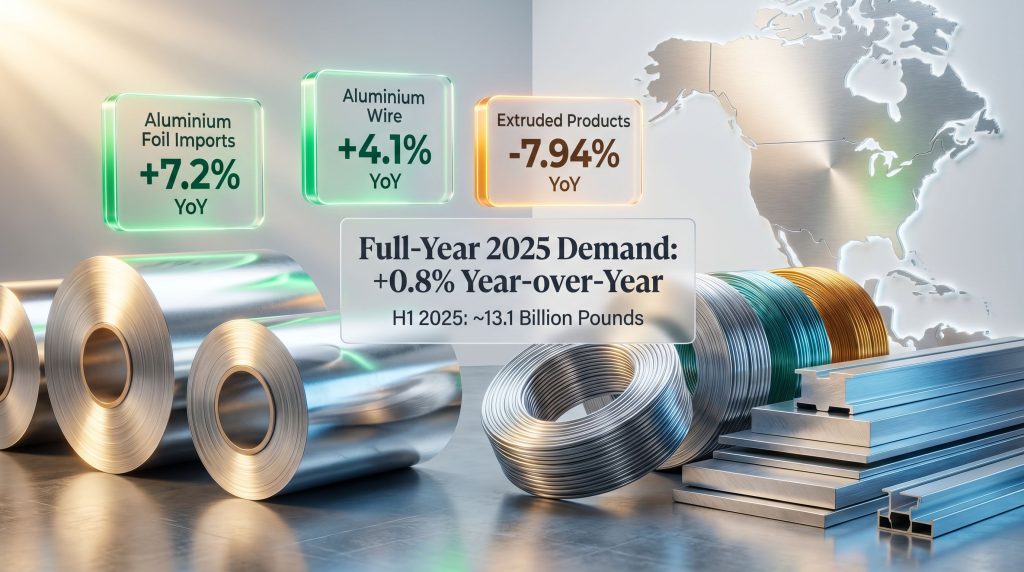
Yet the full-year 2025 picture looked considerably less alarming. Total annual demand ultimately registered a modest +0.8% increase, confirming that the second half delivered a meaningful recovery. This H2 rebound was driven by stronger manufacturing output, restocked inventories across downstream segments, and the continued momentum of electrification-linked demand that proved largely immune to the construction sector's weakness.
"The 2025 aluminium demand story is not one of uniform weakness. It is a structural recovery narrative where a sharp H1 contraction gave way to a manufacturing-led resurgence in the back half of the year, ultimately validating the underlying durability of North American demand fundamentals."
What Drove the H1 2025 Demand Contraction?
Segment-by-Segment Breakdown of the Decline
Understanding the H1 contraction requires looking beneath the headline figure. The weakness was not evenly distributed — it was concentrated in specific segments with heavy exposure to construction and export-sensitive manufacturing.
| Aluminium Segment | H1 2025 Trend | Primary Driver |
|---|---|---|
| Extruded Products | Declined 3.1% YoY | Weak construction and industrial activity |
| Producer Shipments (U.S. + Canada) | Down 4.5% YoY | Reduced domestic manufacturing output |
| Total Regional Demand | Down 4.4% YoY | Lower exports combined with broad segment softness |
| Aluminium Foil | Positive momentum | Consumer packaging resilience |
The Export Drag: Why Lower Shipments Weighed on Headline Numbers
Declining export volumes were identified as one of the primary contributors to the overall demand contraction through mid-2025. When outbound aluminium flows slow — whether due to weaker foreign demand, tariff-related friction, or currency dynamics — the effect ripples back through the domestic production and shipment chain. Producers reduce output schedules, downstream processors cut orders, and inventory buffers shrink rather than rebuild.
This compounding dynamic amplified what might otherwise have been a modest seasonal softening into a more pronounced statistical decline. The broader aluminum and steel tariff impact played a documented role in suppressing these outbound flows, with shifting cross-border regulatory frameworks creating hesitation among market participants during the first half of the year.
Extruded Products: Understanding the 3.1% Sector Decline
The extrusions segment bore the heaviest burden of the H1 contraction. Combined U.S. and Canadian import volumes for extruded products, including plates, sheets, and strips, totalled approximately 1.72 million tonnes in 2025 — a decline of 7.94% year-over-year from the roughly 1.87 million tonnes sourced in 2024.
Breaking this down geographically:
- U.S. extruded product imports: approximately 1.19 million tonnes
- Canada extruded product imports: approximately 532,000 tonnes
The structural factors behind this contraction included softening in residential construction activity, delayed timelines on infrastructure project deployments, and a broadly cautious approach to capital expenditure from industrial end-users facing elevated financing costs. For aluminium extruders, which depend heavily on construction and industrial fabrication activity, this combination was particularly difficult to absorb.
Which Aluminium Segments Outperformed in 2025?
Flat Rolled Products: The Resilience Anchor
While extrusions struggled, flat rolled products (FRP) emerged as a stabilising force across the North American aluminium demand mix. The FRP segment's relative resilience reflected its diversified end-use exposure — spanning automotive lightweighting, beverage can manufacturing, aerospace sheet, and a range of industrial applications — which insulated it from the construction-linked weakness that weighed so heavily on extrusions.
The longer-term structural case for FRP remains compelling. Electrification trends in the automotive sector are driving sustained demand for aluminium sheet used in battery enclosures, body-in-white applications, and thermal management systems. In addition, packaging sustainability mandates are pulling additional volume toward aluminium can sheet and industrial foil, reinforcing energy transition demand as a key pillar of FRP's forward trajectory through 2032.
"Flat rolled products represent the most structurally durable segment of North American aluminium demand, underpinned by long-cycle growth themes in electric vehicles, sustainable packaging, and commercial aerospace that are unlikely to reverse over the medium term."
Aluminium Foil: The Standout Growth Category
Among all major aluminium product categories tracked across North America in 2025, foil delivered the strongest performance by a clear margin. Combined U.S. and Canadian foil import volumes reached approximately 368,745 tonnes, representing a 7.2% year-over-year increase from the roughly 344,000 tonnes imported in 2024.
The geographic split tells its own story:
- U.S. foil imports: approximately 300,338 tonnes
- Canada foil imports: approximately 68,407 tonnes
Several demand catalysts drove this outperformance. Rising consumer preference for food-safe, recyclable packaging materials supported growth in food-grade foil applications. Pharmaceutical foil demand expanded as blister-pack and sterile-barrier packaging requirements increased across North American healthcare supply chains. E-commerce fulfilment packaging added an additional volume channel that did not exist at meaningful scale in previous demand cycles.
Foil was notably the only major aluminium segment to record consistent positive demand momentum across both halves of 2025 — a distinction that reflects its insulation from both construction-sector weakness and trade policy uncertainty.
Aluminium Wire: Steady Volume Growth Amid Electrification Trends
Aluminium wire imports also posted positive annual growth, with total combined U.S. and Canadian volumes reaching approximately 310,897 tonnes in 2025 — a 4.1% year-over-year increase from the roughly 298,674 tonnes recorded in 2024.
- U.S. wire imports: approximately 305,315 tonnes
- Canada wire imports: approximately 5,581 tonnes
The demand driver here was unmistakably electrification. Grid modernisation programs, EV charging network buildouts, and residential electrification initiatives across both countries are creating sustained incremental demand for aluminium wire as a cost-effective and weight-efficient alternative to copper conductors. With aluminium wire carrying roughly one-third the weight of equivalent-capacity copper wire, it is increasingly the material of choice for utility-scale transmission and distribution infrastructure.
How Did Aluminium Scrap Factor Into North America's 2025 Supply Picture?
The Growing Strategic Role of Secondary Aluminium
One of the less-discussed but increasingly consequential dynamics in the 2025 North American aluminium market was the growing strategic importance of scrap and secondary aluminium. As primary metal availability faced constraints and energy costs remained elevated, recycled aluminium stepped into a more prominent supply-side role across both the U.S. and Canadian markets.
The economics are difficult to argue against. Recycled aluminium production requires approximately 95% less energy than primary smelting from bauxite ore — a figure that becomes increasingly significant when electricity prices are elevated and carbon accounting is gaining regulatory and corporate ESG importance.
Scrap Supply Dynamics: Key Structural Considerations
Several structural factors shaped how scrap influenced the 2025 North American supply balance:
- Post-consumer scrap availability remained relatively stable, supported by mature collection infrastructure across both countries, though regional variations in collection rates and sorting quality continued to influence the economics of secondary processing.
- Automotive end-of-life recycling provided a significant and growing feed stream for secondary aluminium producers, as vehicles scrapped from the 2010s production cycle began entering the recycling stream in larger volumes.
- Trade flows of aluminium scrap between North America and global markets were shaped by tariff changes and export regulations, with domestic secondary smelters generally benefitting from policy environments that encouraged scrap retention within the regional supply chain.
- Scrap pricing dynamics reflected the interplay between domestic secondary demand, primary aluminium pricing on the London Metal Exchange, and the availability of specific alloy families.
What Do the Trade Flow Numbers Reveal About North America's Aluminium Position?
Import Dependency and Regional Supply Chain Vulnerabilities
Aggregating the 2025 trade flow data across major aluminium product categories reveals a North American market that retains significant reliance on imported downstream products, particularly for value-added applications where domestic processing capacity falls short of demand. This import dependency creates exposure to currency movements, geopolitical disruptions, and tariff policy shifts that purely domestic supply chains would not face.
The data also highlights an increasingly apparent divergence in consumption patterns. Import volumes fell sharply for construction-linked extrusions while rising steadily for electrification and packaging-oriented products. However, this divergence is not a temporary distortion — it reflects a genuine structural reorientation of North American aluminium consumption toward growth sectors. Consequently, leading aluminum and alumina markets analysts are adjusting their longer-term forecasts to account for this sectoral shift.
Comparative Import Performance: 2024 vs. 2025
| Product Category | 2024 Combined Imports | 2025 Combined Imports | YoY Change |
|---|---|---|---|
| Extruded Products (plates, sheets, strips) | ~1,866,096 tonnes | ~1,717,836 tonnes | -7.94% |
| Aluminium Wire | ~298,674 tonnes | ~310,897 tonnes | +4.1% |
| Aluminium Foil | ~343,975 tonnes | ~368,745 tonnes | +7.2% |
"The divergence between declining extrusion imports and rising foil and wire volumes reflects a fundamental reorientation of North American aluminium consumption, shifting away from construction-linked structural products and toward electrification and packaging-driven applications that are supported by long-cycle structural growth themes."
The next major ASX story will hit our subscribers first
What Are the Key End-Use Sectors Shaping North American Aluminium Demand?
Automotive and Electric Vehicles
The automotive sector's aluminium intensity has been rising consistently for over a decade, and 2025 represented a continuation rather than an inflection in this trend. North American OEMs are incorporating aluminium sheet at increasing rates across body-in-white structures, hood panels, door inners, and boot lids as part of fuel efficiency and EV range optimisation programs. Battery enclosures for electric vehicles represent a particularly high-growth application, requiring both aluminium sheet and cast alloy components.
Packaging and Consumer Goods
Beverage can sheet and foil demand remained structurally robust through 2025, largely insulated from the industrial slowdown that weighed on extrusions. The sustainability imperative driving plastic-to-aluminium substitution across food, pharmaceutical, and personal care packaging continued to gain momentum. Aluminium's infinite recyclability positions it well within sustainability-driven procurement frameworks, and global aluminium producers are increasingly prioritising North American packaging capacity expansion as a result.
Construction and Infrastructure
Construction was unambiguously the most challenged end-use segment of the year. Elevated interest rates suppressed residential construction activity, while the rollout of federally funded infrastructure investment programs moved more slowly than originally projected. The result was a sustained drag on extruded aluminium demand that persisted through most of 2025. A medium-term recovery is anticipated as monetary policy eases and infrastructure spending accelerates.
Aerospace and Defence
Aerospace demand provided a stable, if not spectacular, demand floor for speciality aluminium products throughout 2025. Commercial aircraft production ramp-ups by major manufacturers supported consumption of aluminium alloy sheet and plate, while defence procurement programs provided additional volume support. The aerospace segment's long production cycle times and multi-year order backlogs give it a degree of insulation from short-term economic volatility that most other aluminium end-use sectors do not enjoy.
How Does 2025 Fit Into the Longer-Term North American Aluminium Demand Trajectory?
Cyclical Weakness or Structural Inflection Point?
Placing the 2025 H1 contraction within a multi-year context is essential for avoiding misinterpretation. The -4.4% H1 decline followed a +5.2% H1 2024 expansion, meaning a degree of normalisation was mathematically likely even without the specific macro headwinds that materialised. The full-year +0.8% demand increase confirms that the underlying structural demand architecture remained intact.
The Aluminum Association's assessment of 2025 demand characterised the year's performance as demonstrating resilience under challenging conditions. Finishing the year essentially flat against a backdrop of significant economic and trade uncertainty was a result that exceeded more pessimistic projections that had circulated during the mid-year low. This framing positions modest growth in a difficult environment as evidence of structural durability rather than as a disappointment relative to previous years' stronger performance.
Forward-Looking Demand Drivers Through 2026 and Beyond
Several demand drivers are expected to support North America aluminium demand growth over the medium term:
- Energy transition infrastructure: Grid modernisation programs, utility-scale renewable energy installations, and EV charging network expansion all require substantial aluminium wire and conductor volumes, providing multi-year demand visibility.
- Packaging sustainability mandates: Legislative requirements and corporate ESG commitments are accelerating the substitution of plastic and composite packaging with aluminium alternatives across food, pharmaceutical, and consumer goods sectors.
- Automotive electrification: Accelerating EV production schedules from North American OEMs will sustain and likely grow demand for aluminium flat rolled products and cast alloys used in battery systems and structural components.
- Reshoring and nearshoring trends: Manufacturing repatriation to North America, driven by supply chain resilience strategies and trade policy incentives, has the potential to create new domestic demand centres for both extruded and rolled aluminium products. Furthermore, leading aluminium producers are expanding North American capacity in anticipation of this structural shift.
- Secondary aluminium investment: Growing investment in recycling infrastructure and secondary smelting capacity is expanding the supply side while simultaneously making aluminium more competitive on a cost and carbon basis. Indeed, industry analysts tracking primary production have noted the increasing role of secondary capacity as a structural complement to primary output across the region.
Frequently Asked Questions: North America Aluminium Demand in 2025
What was the overall direction of North American aluminium demand in 2025?
Full-year 2025 demand recorded a modest +0.8% increase, though this masked a significant H1 contraction of -4.4% that gave way to a stronger H2 recovery driven by manufacturing activity and resilient downstream segments including foil and wire.
Which aluminium product category grew the most in North America in 2025?
Aluminium foil recorded the strongest import growth, with combined U.S. and Canadian volumes rising 7.2% year-over-year to approximately 368,745 tonnes — the only major category to sustain consistent positive momentum across both halves of the year.
Why did extruded aluminium product imports decline so sharply in 2025?
Combined U.S.-Canada extruded product imports fell approximately 7.94% year-over-year to around 1.72 million tonnes, driven by a pronounced slowdown in construction activity, reduced industrial capital expenditure, and trade policy uncertainty that suppressed both domestic production and import volumes.
What role did aluminium scrap play in the 2025 North American market?
Secondary aluminium and scrap emerged as critical supply buffers, with recyclers and secondary smelters filling gaps in primary metal availability. The energy efficiency advantage of recycled aluminium — requiring roughly 95% less energy than primary production — made it an increasingly attractive option for cost-conscious and sustainability-focused manufacturers.
How does 2025 compare to 2024 for North American aluminium demand?
The comparison is stark. H1 2024 saw North American domestic demand grow +5.2% year-over-year, while H1 2025 recorded a -4.4% contraction — a swing of nearly ten percentage points reflecting the impact of trade uncertainty and softer manufacturing conditions. Full-year 2025 ultimately recovered to post a +0.8% annual gain.
Key Takeaways: North America Aluminium Demand in 2025 at a Glance
- Full-year 2025 demand: +0.8% year-over-year, resilient despite significant H1 headwinds
- H1 2025 total demand: approximately 13.1 billion pounds, down 4.4% from roughly 13.7 billion pounds in H1 2024
- Foil imports surged +7.2% YoY to approximately 368,745 tonnes, the standout growth segment
- Wire imports grew +4.1% YoY to approximately 310,897 tonnes, supported by electrification demand
- Extruded product imports fell -7.94% YoY to approximately 1.72 million tonnes, reflecting construction sector drag
- Producer shipments declined -4.5% YoY through H1 2025 before recovering in H2
- H2 2025 recovery confirmed the structural resilience of North American aluminium demand fundamentals
- Aluminium scrap and flat rolled products identified as primary momentum drivers into year-end
Disclaimer: This article contains forward-looking statements, market projections, and demand forecasts that are subject to significant uncertainty. Actual outcomes may differ materially from those described. Readers should not rely on this content as financial or investment advice. All trade volume figures referenced are sourced from industry data reported through 2025 and should be independently verified before use in commercial decision-making.
Want to Stay Ahead of the Next Major ASX Mineral Discovery?
While North American aluminium demand reshapes itself around electrification and packaging megatrends, Discovery Alert's proprietary Discovery IQ model scans ASX announcements in real time — instantly identifying significant mineral discoveries across aluminium-linked and critical mineral sectors before the broader market reacts. Explore historic discoveries and their exceptional market returns, then begin your 14-day free trial at Discovery Alert to position yourself ahead of the next major find.