May 18, 2026
Why the Iran-Washington Diplomatic Track Matters More Than Ever in 2026
Global energy markets have long been conditioned to treat geopolitical risk as a peripheral variable, a tail risk to be acknowledged and then discounted. That calculus has broken down entirely in 2026. The combination of an active conflict in the Middle East, a partially closed Strait of Hormuz, and Iran diplomacy negotiations with Washington has created a negotiating environment without a meaningful modern precedent.
This is not the slow-moving nuclear diplomacy of the JCPOA era, where talks stretched across years in controlled multilateral settings. What is unfolding now is a compressed, coercive, and structurally complex bargaining process occurring against the backdrop of real military and economic consequences.
The stakes extend well beyond bilateral relations. Energy supply chains feeding Asia, freight markets, regional production capacity, and the strategic architecture of the Persian Gulf are all in flux simultaneously. Furthermore, understanding how these negotiations actually function, what each side genuinely wants, and where the realistic pathways to resolution lie, requires moving beyond the public rhetoric that dominates the headlines.
When big ASX news breaks, our subscribers know first
The Convergence of Military Pressure and Diplomatic Engagement
What distinguishes the current negotiating environment from previous Iran-US diplomatic episodes is the simultaneity of armed conflict and active talks. A ceasefire has nominally been in place since 8 April 2026, but it has been characterised by senior US officials as fragile, with Washington describing it as effectively on life support.
Shipping disruption through the Strait of Hormuz has persisted throughout, and the US has imposed a separate maritime blockade on vessels travelling to and from Iranian ports, adding a second layer of economic pressure on top of the existing sanctions architecture.
The core analytical tension running through these negotiations is whether they represent a genuine pathway to resolution or a coercive bargaining exercise in which both sides are managing domestic audiences while keeping back-channel communications technically alive. The evidence from May 2026 suggests the latter interpretation carries more weight, but that does not mean a negotiated outcome is impossible.
What Is Actually Being Negotiated? The Expanded Scope of the Talks
The agenda for the current Iran diplomacy negotiations with Washington has expanded substantially beyond the nuclear file that defined earlier diplomatic frameworks. The scope now encompasses a range of interconnected issues that make the negotiation exponentially more complex than the JCPOA-era discussions.
| Negotiation Dimension | Previous Nuclear Framework (JCPOA Era) | Current 2026 Talks |
|---|---|---|
| Nuclear enrichment | Central issue | Still core, but heavily contested |
| Missile programme | Excluded | Now included in US demands |
| Regional proxies | Not addressed | Part of US conditions |
| Sanctions relief | Phased relief offered | Iran demands upfront removal |
| Maritime security | Not relevant | Critical, Hormuz disruption active |
| Ceasefire conditions | Not applicable | Active war context |
| Intermediaries used | EU3 plus US direct | Pakistan and Oman as back-channels |
This expansion of scope reflects a fundamentally different negotiating environment. Each additional issue creates new potential for deadlock while also, in theory, creating new potential for trade-offs across issue areas. Consequently, the oil geopolitics analysis surrounding this conflict has grown increasingly complex for market participants to assess.
What Are Iran's Non-Negotiable Conditions in the Current Talks?
Iran's approach to the current negotiations is structured around a set of preconditions that Tehran frames not as opening bargaining positions but as threshold requirements before substantive progress can occur. This framing is itself a strategic instrument. By positioning these demands as prerequisites rather than concessions to be traded, Iran attempts to shift the burden of flexibility onto Washington while preserving its own domestic political standing.
Iran's Five Core Demands Before Meaningful Progress Can Occur
Based on Iran's publicly stated positions as of mid-May 2026, the following conditions form the foundation of Tehran's negotiating framework:
- A complete halt to all active hostilities, with the existing ceasefire formalised rather than left in its current precarious state
- Removal of the US-imposed maritime blockade on Iranian ports, which Tehran views as an act of economic warfare incompatible with genuine diplomatic engagement
- Comprehensive and upfront sanctions relief, explicitly rejecting the phased approach offered in previous frameworks
- Financial compensation for economic damage caused by the war and associated disruptions
- Binding security guarantees from Washington against future military action, a demand that creates significant difficulties given the US constitutional framework around treaty commitments
The logic behind presenting these as preconditions rather than negotiating positions is straightforward: it forces Washington to make the first visible concession, which carries significant domestic political value for the Iranian government.
Iran's Nuclear Red Line: The NPT Sovereignty Argument
The most consequential of Iran's stated positions concerns uranium enrichment. Iran's foreign ministry spokesman Esmail Baghaei confirmed in mid-May 2026 that Tehran's enrichment activities are protected under the Non-Proliferation Treaty and are therefore not available as a negotiating concession, regardless of what other terms might be offered.
Iran presented a 14-point plan to Washington as the foundation of its negotiating proposal. Despite the Trump administration publicly declaring that proposal unacceptable, Iranian officials confirmed that a set of US amendments was subsequently transmitted through Pakistani intermediaries. This sequence is analytically revealing: the gap between Washington's public rejection and its private engagement suggests that both governments are simultaneously managing domestic audiences and keeping the negotiating channel functional.
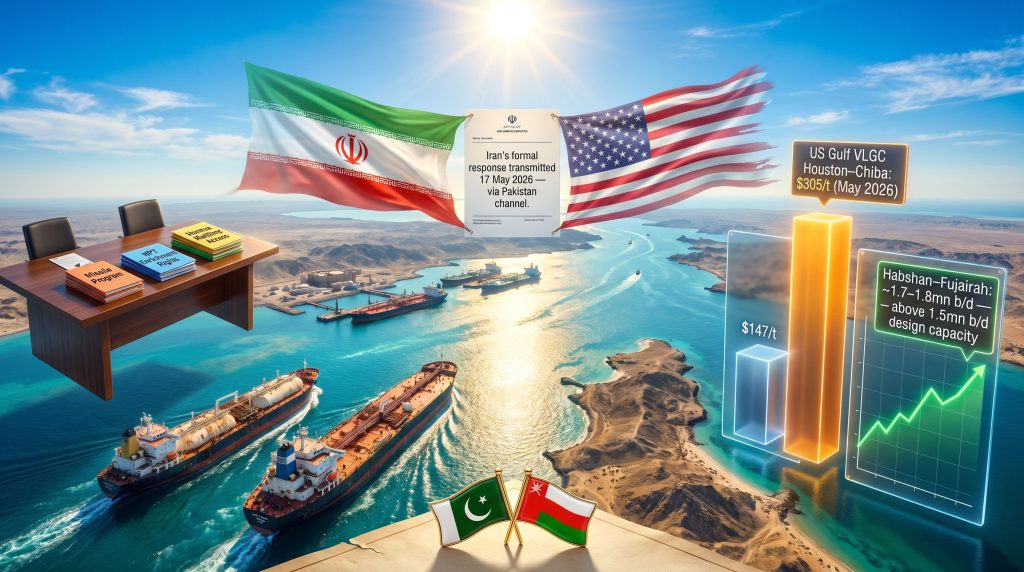
According to ongoing reporting on the Iran–United States negotiations, Iran's formal response to the latest round of US amendments was transmitted on 17 May 2026 through the Pakistan channel, confirming that the process, however strained, remains technically active.
The disconnect between Washington's public declarations that Iran's proposals are unacceptable and its simultaneous transmission of counter-amendments through intermediaries is one of the most analytically significant features of the current negotiating dynamic. It indicates that both parties are managing domestic audiences while keeping the diplomatic channel open.
How Is Washington Applying Pressure? The US Coercive Diplomacy Strategy
Washington's approach to the current negotiations combines maximalist public demands with back-channel engagement, a classic coercive diplomacy framework. The public statements serve multiple functions simultaneously: they signal resolve to domestic audiences, apply psychological pressure on Tehran, and create the impression of momentum toward a deadline that may or may not be real.
Escalatory Rhetoric as a Negotiating Instrument
President Trump's characterisation of Iran's 14-point proposal as entirely unacceptable, combined with warnings that Tehran must act urgently or face severe consequences, follows a recognisable pattern from earlier episodes of US coercive diplomacy. These statements are better understood as pressure instruments than as policy endpoints.
The risk, however, is significant: extreme public rhetoric can strengthen hardline factions within the target government, narrow the political space for compromise, and create conditions where miscalculation becomes more likely. The continued private transmission of amendments via Pakistani intermediaries, even after Trump's public rejection, is precisely the kind of signal that experienced diplomats on the Iranian side would read as evidence that Washington's rhetoric has not yet foreclosed the negotiating space.
The Five US Conditions for a Deal
Iranian state media reported in mid-May 2026 that Washington had communicated five core conditions Iran would need to meet to secure an agreement:
- Closure of all but one nuclear facility within Iran
- Transfer of Iran's existing stockpile of highly enriched uranium to the United States
- Restrictions on the development and testing of ballistic missiles
- Curtailment of financial and material support for regional armed groups
- Normalisation of commercial shipping access through the Strait of Hormuz
Assessing each of these against Iran's stated red lines reveals that conditions one and two directly contradict Tehran's NPT-based enrichment position, making them the hardest gap to bridge. In addition, conditions four and five touch on issues that Iran regards as sovereign prerogatives, while condition three involves a programme Tehran considers essential to its strategic deterrence.
The Maritime Blockade: A New Pressure Lever
Washington's decision to impose a blockade on vessels travelling to and from Iranian ports represents a significant escalation of economic pressure beyond the existing sanctions regime. The strategic logic is clear: the blockade amplifies Tehran's economic pain while simultaneously creating a concrete concession that Washington can offer to lift as part of any eventual agreement. It is, in effect, a bargaining chip created through coercive action.
The Strait of Hormuz: The Energy Market Flashpoint at the Centre of Negotiations
Few geographic features carry the economic weight of the Strait of Hormuz. The waterway, which links the Persian Gulf to the Gulf of Oman and the wider Indian Ocean, serves as the passage for a substantial share of the world's seaborne crude oil, LPG, and refined products. When it is disrupted, as has been the case since the conflict began, its absence reshapes global commodity markets in real time.
Why Hormuz Has Become a Negotiating Variable, Not Just a Consequence
What makes the current situation analytically distinct from previous Hormuz risk episodes is that Iran is actively developing a formal legal and administrative framework to govern traffic through the Strait. Iran's parliament national security council, headed by Ebrahim Azizi, confirmed in mid-May 2026 that a mechanism designed to manage Strait traffic had been prepared and was imminent.
Under this framework, only commercial vessels and counterparties cooperating with Iran would be permitted to benefit from the regime, while operators associated with the US-backed Project Freedom would be excluded. This is a qualitative shift: Iran is moving from disrupting Hormuz as a byproduct of conflict to institutionalising its control over the waterway as a durable lever of negotiating power.
The Commercial Consequences of Hormuz Disruption: Key Market Data
The financial impact of the Strait's effective closure has been rapid and severe across multiple commodity and freight markets.
| Commodity / Route | Pre-War Benchmark | Current Impact (May 2026) |
|---|---|---|
| US Gulf VLGC freight (Houston-Chiba) | approximately $147/t | Record $305/t (13 May 2026) |
| Global seaborne LPG exports | Baseline | approximately 600,000 b/d below pre-war levels |
| UAE crude output (April 2026) | 4.85mn b/d capacity | approximately 2.02mn b/d actual |
| UAE crude output (March 2026) | 4.85mn b/d capacity | approximately 1.9mn b/d actual |
| Neopanamax Panama Canal slot price | Pre-conflict baseline | $1.076mn peak (29 April 2026) |
| UAE Habshan-Fujairah pipeline utilisation | 1.5mn b/d design capacity | approximately 1.7-1.8mn b/d (above design) |
The Houston-Chiba VLGC rate of $305/t, reported by Argus Media on 15 May 2026, represents more than double the pre-war level of $147/t and is the highest rate recorded since Argus began assessments in 2013. Around half of the approximately 120 VLGCs that loaded in the US Gulf during April were routed via the Cape of Good Hope, after Neopanamax slot auction prices reached $1.076mn on 29 April 2026, roughly four times pre-conflict levels.
These disruptions are closely tracked by analysts monitoring crude oil price trends, as the Hormuz situation continues to exert significant upward pressure on benchmark prices. Furthermore, the broader implications for global LNG supply chains are becoming increasingly pronounced as the conflict drags on.
How Regional Producers Are Responding to Hormuz Uncertainty
The UAE's response to the structural risk created by Hormuz disruption illustrates how quickly regional producers are adapting their infrastructure strategies. Abu Dhabi's state energy company is constructing a new West-East Pipeline project designed to double crude export capacity through the Fujairah terminal, targeting a combined pipeline capacity of approximately 3.3mn b/d and total crude export capacity of up to 4mn b/d by 2027.
The existing Habshan-Fujairah pipeline, which has a design capacity of 1.5mn b/d, has been operating at approximately 1.7-1.8mn b/d, above its technical design limit. The UAE's simultaneous exit from OPEC+ effective May 2026, driven by a desire for greater flexibility, reflects a broader strategic repositioning that the conflict environment has accelerated. OPEC's market influence has consequently come under fresh scrutiny as member states pursue increasingly divergent strategies.
The next major ASX story will hit our subscribers first
Who Is Mediating? The Role of Pakistan, Oman, and Regional Intermediaries
The architecture of the current Iran-Washington communication channel is itself a significant feature of the negotiations. Direct dialogue between Tehran and Washington has not been a feature of this process; instead, both sides are operating through a layered system of intermediaries who serve different functional roles in the overall framework.
Pakistan's Back-Channel Function in the Iran-US Talks
Pakistan has emerged as the primary conduit for written communications between the two sides. Iran's foreign ministry confirmed as of 18 May 2026 that the process continues through Pakistan, with Tehran's most recent formal response transmitted on 17 May 2026 via Pakistani intermediaries. Pakistan's suitability as an intermediary reflects several overlapping factors:
- Its longstanding diplomatic relationships with both Washington and Tehran
- Its status as a nuclear-armed state, giving it credibility on nuclear-related technical discussions
- Its geographic position as a regional neighbour of Iran with shared economic interests
- Its ability to maintain diplomatic normalcy with both parties simultaneously
Oman's Parallel Diplomatic Role
Oman's involvement operates on a parallel track focused specifically on maritime and Hormuz-related mechanisms. Iranian and Omani experts met specifically on the matter during the week of 12-17 May 2026, indicating coordinated rather than sequential engagement.
Oman's historical function as a trusted back-channel between Iran and Western powers, including its role in facilitating early contacts that eventually led to JCPOA negotiations, makes it the natural partner for maritime-specific discussions. The division of intermediary responsibilities, with Pakistan handling nuclear and war-termination elements and Oman managing maritime mechanics, reflects the complexity of a negotiation that has outgrown any single facilitation channel.
Is a Deal Possible? Scenario Modelling for the Iran-Washington Negotiations
The following scenarios are analytical projections based on publicly available information as of May 2026. They involve significant uncertainty and should not be construed as predictions. Readers making decisions based on geopolitical assessments should consult multiple independent sources.
Scenario 1: Phased De-escalation Agreement (Most Optimistic)
Conditions required: Iran accepts partial enrichment restrictions in exchange for upfront sanctions relief and removal of the maritime blockade. A jointly accepted Hormuz traffic management framework is established, potentially mediated by Oman.
Market implication: A credible de-escalation signal would likely trigger meaningful crude price relief, a sharp correction in VLGC freight rates from the current record of $305/t, and a resumption of Mideast Gulf LPG exports toward pre-war volumes.
Scenario 2: Prolonged Coercive Stalemate (Base Case)
Conditions: Neither side accepts the other's core preconditions. Negotiations continue through back-channels while public rhetoric remains hostile and the Strait remains partially restricted.
Market implication: Sustained freight rate elevation, continued rerouting of LPG and crude through the Cape of Good Hope, ongoing supply shortages for India and China, and further infrastructure acceleration by regional producers. The relationship between oil prices and trade war dynamics adds further complexity to this scenario.
Scenario 3: Negotiation Collapse and Military Escalation (Tail Risk)
Conditions: A breakdown in back-channel communications, potentially triggered by a maritime incident near the Strait or a domestic political shift within either government.
Market implication: A severe oil price spike, potential closure of the Strait to commercial traffic, a global LPG and crude supply crisis, and broader regional security deterioration.
The most dangerous near-term trigger is not a deliberate decision to escalate, but an accidental confrontation between Iranian maritime enforcement of the new Hormuz framework and US-backed vessels operating under Project Freedom. Both sides' public postures leave limited room to de-escalate such an incident without appearing to capitulate.
What Do the Negotiations Mean for Global Energy Markets?
The Oil Market's Sensitivity to Diplomatic Signals
Energy markets are currently pricing in a prolonged disruption scenario. This creates an asymmetric risk profile that sophisticated market participants need to understand carefully. The downside risk from further escalation is substantial and potentially severe. However, even partial progress, such as a temporary Hormuz access agreement or removal of the US maritime blockade in exchange for limited Iranian concessions, could shift crude price benchmarks meaningfully.
LPG and Natural Gas Supply Chain Disruption
The effective closure of the Strait of Hormuz has fundamentally restructured global LPG trade flows. Global seaborne LPG exports remain approximately 600,000 b/d below pre-war levels, according to Argus Media data from May 2026. India and China, the two largest Asian LPG importers, are facing the most acute supply pressure and have been unable to fully replace lost supply through alternative sources.
Infrastructure Investment as a Hedge Against Diplomatic Failure
Perhaps the most revealing indicator of market expectations about the diplomatic track is the speed at which regional producers are investing in Hormuz bypass infrastructure. The UAE's acceleration of its West-East Pipeline project, targeting up to 4mn b/d of Fujairah export capacity by 2027, reflects a fundamental reassessment of the strategic risk of Hormuz dependency. These are multi-year, multi-billion dollar infrastructure commitments indicating that regional producers are structurally adapting rather than waiting for diplomatic resolution.
Frequently Asked Questions: Iran Diplomacy Negotiations with Washington
Are Iran and the US currently in active negotiations?
As of mid-May 2026, both sides are exchanging proposals through Pakistani and Omani intermediaries. Iran's most recent formal response was transmitted on 17 May 2026 through the Pakistan channel. The process is technically active but remains deeply fragile, characterised by a significant gap between public rhetoric and private engagement.
What is the main sticking point in the Iran-US negotiations?
Iran's nuclear enrichment programme remains the central unresolved issue. Washington has demanded the closure of all but one nuclear facility and the transfer of Iran's highly enriched uranium stockpile to the United States. Tehran maintains that its enrichment rights as an NPT signatory are protected under international law and cannot be surrendered as a negotiating concession.
Why is the Strait of Hormuz central to the Iran-Washington talks?
The Strait is the world's most strategically significant oil and gas shipping chokepoint. Iran's developing legal framework to manage Strait traffic, confirmed as imminent in May 2026, gives Tehran structural leverage in negotiations. Both the US blockade and the Hormuz framework are, in effect, negotiating instruments created through escalation.
What role does Pakistan play in the Iran-US negotiations?
Pakistan is serving as the primary written intermediary between Tehran and Washington. Iran's foreign ministry confirmed as of 18 May 2026 that the negotiating process continues through Pakistan, with formal proposals and counter-amendments transmitted in both directions, even during periods when the US has publicly declared Iranian proposals unacceptable. Further analysis from security policy analysts confirms that both sides are simultaneously preparing for alternative outcomes while maintaining this diplomatic channel.
What would a deal between Iran and the US mean for oil prices?
A credible agreement restoring Hormuz shipping access would likely trigger a meaningful decline in crude prices and a sharp correction in VLGC freight rates, which reached a record $305/t on the Houston-Chiba route in May 2026. Because the market is currently pricing in sustained disruption, any credible positive diplomatic signal carries significant downward price pressure potential.
What happens if the negotiations collapse entirely?
A full breakdown in talks would risk military escalation, the potential formalised closure of the Strait under Iran's new management framework, a severe global energy supply shock, and broader regional instability. The tail-risk scenario includes an oil price spike, an LPG supply crisis for Asian importers particularly India and China, and possible confrontation between Iranian maritime enforcement and US-backed shipping operations.
Key Takeaways: The State of Iran-Washington Diplomacy in 2026
-
Negotiations are technically active but structurally fragile, driven by coercive pressure from both sides rather than mutual confidence or shared diplomatic momentum
-
The agenda has expanded far beyond nuclear issues to encompass ballistic missiles, regional proxies, maritime security, war-related compensation, and ceasefire formalisation, making comprehensive agreement substantially harder to achieve
-
Iran's NPT-based enrichment position and Washington's maximalist nuclear demands, including facility closures and stockpile transfer, represent the hardest gap to bridge in the short term
-
Pakistan and Oman are functioning as essential intermediaries across different issue areas, keeping communication channels open despite intensely hostile public posturing on both sides
-
The Strait of Hormuz has evolved from a consequence of diplomatic failure into an active lever of Iranian negotiating power, with Iran's forthcoming traffic management framework representing a qualitative escalation of its strategic position
-
Energy markets are acutely exposed to both diplomatic progress and further breakdown, with VLGC freight rates at historic highs and regional producers accelerating infrastructure investments that treat Hormuz access as structurally unreliable
This article is intended for informational purposes only and does not constitute financial, investment, or geopolitical advisory advice. Scenarios and projections involve significant uncertainty. Readers should consult independent professional sources before making decisions based on any information contained herein.
Want to Stay Ahead of the Commodity Market Shifts Driving These Geopolitical Disruptions?
As Iran-Washington negotiations reshape global energy supply chains and freight markets in real time, Discovery Alert's proprietary Discovery IQ model instantly identifies significant ASX mineral discoveries, translating complex commodity market movements into actionable investment opportunities — begin your 14-day free trial today and visit the Discovery Alert discoveries page to understand how major resource discoveries have historically delivered exceptional market returns.