June 17, 2026
The Strait of Hormuz and the Physics of an Oil Market Shock
When a single waterway carries roughly 20% of the world's tradeable crude oil, the consequences of closing it ripple far beyond the ships waiting at its entrance. The Strait of Hormuz is not merely a geographic bottleneck — it is a pressure valve for global energy pricing, and when that valve was effectively shut following the outbreak of conflict on February 28, oil markets responded with the kind of premium pricing not seen in years. What is now unfolding in the wake of a US-Iran framework agreement is equally instructive: maritime tracking data has confirmed that Iranian oil tankers pass the US blockade after the US-Iran deal, and the current crude oil prices are already repricing the geopolitical risk built in over months of military enforcement.
Understanding why this matters requires looking beyond the headline tanker counts and into the structural dynamics that made Iranian exports so vulnerable, and so consequential, in the first place.
When big ASX news breaks, our subscribers know first
Iran's Export Collapse: The Numbers Behind the Crisis
Before the blockade took full effect, Iran was exporting an average of 1.67 million barrels per day (bpd) throughout 2025, according to ship-tracking firm Kpler. That volume, while already constrained by existing sanctions architecture, represented a meaningful share of Asian crude supply, particularly for Chinese independent refiners operating on thin margins.
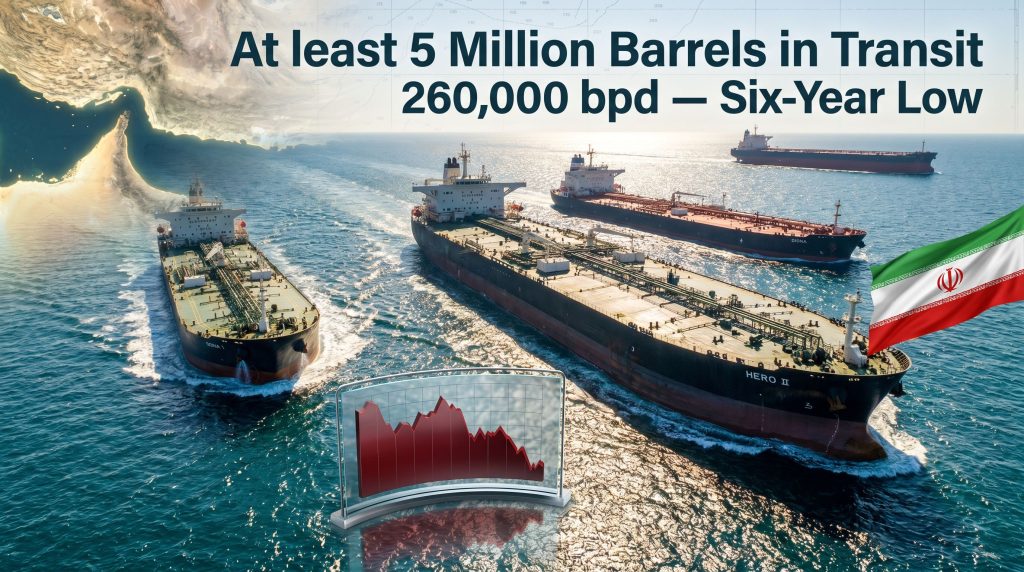
The enforcement of the US naval blockade in the Strait of Hormuz compressed that figure dramatically. By May 2026, Iranian crude exports had fallen to approximately 260,000 bpd — a six-year low and less than one-fifth of the prior year's average. This was not a gradual market adjustment; it was a near-total severance of a significant crude supply line achieved through active maritime interdiction.
To contextualise the scale of that disruption:
| Metric | Value |
|---|---|
| Iran's 2025 average crude exports | 1.67 million bpd |
| Iran's May 2026 export low | ~260,000 bpd |
| Volume reduction | ~1.41 million bpd |
| Reduction as percentage of 2025 average | ~84% |
| Years since comparable export lows | 6 years |
The speed of the collapse was amplified by the nature of the Strait itself. With no viable alternative export corridor capable of handling Iran's full crude volume at comparable throughput, the blockade effectively had no workaround. Iran's Jask terminal, designed to bypass the Strait via the Gulf of Oman directly, has limited pipeline capacity and was not a sufficient substitute for full Hormuz transit volumes.
Tanker-Level Data: What Ship Tracking Is Actually Showing
Maritime analytics platforms Kpler, Vortexa, and LSEG have each independently confirmed movement of Iranian-linked crude carriers through the Gulf of Oman following the framework agreement. As of mid-June 2026, the confirmed vessel activity includes:
- Hero II (VLCC class): Carrying approximately 2 million barrels of crude, loaded in late March. Now heading east through the Gulf of Oman.
- Diona (VLCC class): Carrying approximately 2 million barrels, with cargo loaded between April 8 and April 9. Also heading east.
- Sonia I (Suezmax class): Carrying approximately 1 million barrels, loaded April 8 to 9. Destination confirmed as Singapore, a key Asian refining and re-export hub.
- Stream (VLCC class, empty): Moving toward the blockade zone in what maritime analysts interpret as pre-positioning for a new cargo loading authorisation.
The combined confirmed cargo across the three laden vessels represents approximately 5 million barrels of Iranian crude in active transit. Furthermore, the presence of an empty VLCC moving toward the zone is a forward-looking signal: operators do not position 300,000-deadweight-tonne vessels without reasonable confidence that cargo loading will follow.
Ship operators managing Iranian-linked tonnage are acutely sensitive to boarding risk, and the decision to move an empty VLCC toward the former enforcement zone reflects a calculated read on the post-MOU operating environment, not merely speculative positioning.
According to reporting on Iranian tanker movements, these developments mark a significant shift in the operational reality following the diplomatic framework.
Enforcement Reality: The Blockade Is Neither Fully Active Nor Fully Lifted
One of the more analytically important dimensions of this story is the gap between diplomatic announcements and operational enforcement on the water. The US-Iran memorandum of understanding confirmed that Iran is permitted to immediately resume oil and fuel sales under the interim agreement terms. A senior US official confirmed this position publicly in mid-June 2026.
However, CENTCOM's operational record tells a more layered story. At least five Iranian-flagged vessels were boarded since the blockade commenced, and dozens of commercial vessels were instructed to turn back during peak enforcement. At least one vessel was disabled during an attempted breach. These are not the actions of a blockade that was merely symbolic.
The enforcement picture is therefore best described as deliberately transitional rather than cleanly terminated:
| Enforcement Outcome | Reported Instances | Source |
|---|---|---|
| Tankers boarded and redirected | At least 5 confirmed | US Military (CENTCOM) |
| Tankers disabled attempting breach | At least 1 reported | Defence reporting |
| Tankers successfully transiting post-MOU | At least 3 confirmed | Kpler, Vortexa, LSEG |
| Empty tanker en route to zone | 1 confirmed | Kpler, LSEG |
| Commercial vessels turned back | Dozens | CENTCOM operational reports |
| Tanker reaching final destination | At least 1 (Indonesia, HUGE) | Tanker-tracking data |
This ambiguity is not accidental. Periods of transitional enforcement following diplomatic frameworks serve multiple strategic purposes: they provide the US with ongoing leverage while allowing Iranian exports to resume at a pace that signals good faith. However, the commercial shipping community must navigate this uncertainty in real time, which affects insurance premiums, charter rates, and voyage routing decisions.
For broader context, the 2026 US naval blockade of Iran provides important background on how this enforcement mechanism was established and the legal frameworks underpinning it.
The Shadow Fleet Dimension: How Iranian Oil Moves Under Sanctions
A layer of this story that rarely receives adequate attention is the infrastructure that enabled even the 260,000 bpd floor figure during peak blockade enforcement. Iran's crude export apparatus relies heavily on what the industry terms the shadow fleet — a network of older, often uninsured tankers operating under flags of convenience, with obscured ownership structures and ship-to-ship transfer capabilities designed to mask cargo origin.
The vessels now confirmed in transit, including the Stream VLCC, are consistent with Iranian-linked ownership structures characteristic of this fleet. Several key operational features define shadow fleet logistics:
- Vessel identity obfuscation: Regular AIS transponder manipulation, name changes, and flag-of-convenience registrations make vessel tracking more difficult.
- Ship-to-ship transfers: Crude is frequently transferred between vessels at sea to break the provenance chain before entering buyer port records.
- Third-country intermediary buyers: Cargo is often invoiced through trading entities in jurisdictions that maintain commercial relationships with both Iran and end-user refiners.
- Older vessel classes: Many shadow fleet vessels are beyond the age thresholds preferred by major Western insurers, reducing paper trail exposure to P&I clubs operating under OFAC compliance requirements.
The fact that Hero II loaded its cargo as far back as late March — well before the framework agreement was announced in June — suggests some export activity was already being tested or staged during the diplomatic negotiation period. This is itself an indicator of how closely commercial operators track geopolitical developments ahead of official announcements, particularly given the broader context of crude oil trade geopolitics.
Oil Price Mechanics: How Supply Expectations Move Markets Before Barrels Arrive
Global crude benchmarks do not wait for physical cargo confirmation before repricing. The forward curve in oil markets responds to expected supply changes, which means the diplomatic signal of the framework agreement was sufficient to begin deflating the war premium that had accumulated in Brent pricing since February 28.
Crude prices, which surged sharply after the conflict began, have retreated to three-month lows as of mid-June 2026. This repricing dynamic operates through several interconnected mechanisms:
- Forward contract adjustments: Futures traders revise near-term supply expectations immediately upon credible diplomatic signals, driving price discovery ahead of physical delivery.
- Risk premium deflation: The geopolitical risk premium embedded in spot prices begins to compress as the probability of sustained supply disruption falls.
- Inventory positioning shifts: Refiners and trading houses that built precautionary inventory during the disruption period begin to reduce their forward buying, softening demand in the paper market.
The crude market is often pricing what it fears or expects rather than what it can physically verify. A credible diplomatic framework can move prices by several dollars per barrel before a single additional tanker clears a chokepoint.
In addition, OPEC's market influence remains a critical variable in determining how quickly these price adjustments stabilise across global benchmarks.
The next major ASX story will hit our subscribers first
China's Demand Problem: The Constraint on Iran's Export Recovery
Why Chinese Refining Margins Matter
Even as the supply-side picture improves, a structural demand-side constraint is limiting how quickly Iran can rebuild its export volumes. The China demand outlook remains cautious, as the country's independent refining sector is currently operating at compressed margins.
Poor domestic refining economics in China reduce the incentive for independent refiners, known in the market as teapots, to aggressively seek new crude parcels. These smaller, privately-operated refineries have historically been Iran's most reliable buyers, purchasing discounted crude through shadow fleet channels and processing it for the domestic Chinese fuel market.
When crack spreads — the margin between crude input cost and refined product output value — narrow, teapot utilisation rates drop, and so does their appetite for spot Iranian cargo. This is not a sanctions-driven constraint, but a pure economics problem that operates independently of whatever happens at the Strait of Hormuz.
What a 50% Export Recovery Would Mean for Global Crude Supply
If Iranian exports recover to approximately 50% of their 2025 average, that would represent a flow rate near 835,000 bpd, implying an incremental addition of roughly 575,000 bpd above the May 2026 blockade-period low.
That volume, delivered primarily into Asian markets, would:
- Apply consistent downward pressure on Dubai/Oman benchmark pricing, which governs most Middle Eastern crude sold into Asia
- Widen the Brent-Dubai spread, creating arbitrage opportunities for Atlantic Basin crude to compete in Asia
- Reduce the price advantage that Russian ESPO Blend crude currently enjoys among Chinese buyers who switched suppliers during the Iranian disruption period
- Interact with existing OPEC+ production agreements, potentially complicating the cartel's ability to defend price floors if Iranian volumes return outside the formal quota framework
This scenario analysis is speculative and dependent on the pace of diplomatic implementation, Chinese demand recovery, and continued US enforcement decisions. It should not be interpreted as a price forecast.
Remaining Risk Factors: What Could Reverse the Current Trajectory
The current de-escalation path carries several tail risks that energy market participants are continuing to monitor closely. Furthermore, the broader trade war oil impact adds an additional layer of complexity to an already fragile market environment:
- MOU breakdown: Framework agreements between the US and Iran have historically been fragile. The full terms of the current memorandum remain under active negotiation, and a breakdown in talks could trigger renewed enforcement.
- Third-party spoiler dynamics: Regional actors with interests in maintaining elevated oil prices or containing Iranian influence could take actions that complicate the implementation timeline.
- Sanctions architecture persistence: The MOU permits oil and fuel sales but does not represent comprehensive sanctions relief. Secondary sanctions on financial intermediaries, insurance providers, and vessel operators remain in place, limiting the speed at which Iranian exports can fully normalise.
- Chinese demand recovery pace: If refining margins in China remain compressed through the second half of 2026, demand absorption for returning Iranian barrels will be slower than supply-side recovery would suggest.
Frequently Asked Questions: Iranian Oil Tankers and the US Blockade
How Many Iranian Tankers Have Passed the US Blockade?
At least three tankers carrying a combined cargo of approximately 5 million barrels have been confirmed passing through the Gulf of Oman following the US-Iran framework agreement. A fourth empty vessel is en route, signalling further export activity is imminent. Data from Kpler, Vortexa, and LSEG independently corroborate these movements.
What Was Iran's Oil Export Level During the Blockade?
During the peak enforcement period in May 2026, Iranian crude exports fell to approximately 260,000 barrels per day — the lowest recorded level in six years and less than one-fifth of Iran's 2025 average export rate of 1.67 million barrels per day, according to Kpler data.
Has the US Fully Lifted the Naval Blockade on Iran?
No. Enforcement has become uneven following the framework agreement. While the US Treasury has confirmed that Iranian tankers pass the US blockade under the new terms to support global oil supply, CENTCOM has maintained boarding operations. Consequently, the blockade's operational status remains in a deliberate transitional phase rather than formally concluded.
Why Are Global Oil Prices Falling Despite Ongoing Regional Uncertainty?
Markets are unwinding the geopolitical risk premium built into crude benchmarks after February 28. Forward pricing curves respond to supply expectations before physical barrels reach buyers, meaning diplomatic progress alone is sufficient to drive price adjustments in the near-term futures market.
What Is China's Role in Iranian Oil Export Recovery?
China is Iran's dominant crude buyer. However, poor domestic refining margins at independent Chinese refineries are currently limiting the pace at which new Iranian cargoes are being absorbed, creating a demand-side constraint on export recovery even as supply-side restrictions ease.
What Vessel Types Are Being Used to Resume Iranian Oil Exports?
Confirmed vessels include two Very Large Crude Carriers (VLCCs) capable of carrying approximately 2 million barrels each, and one Suezmax-class tanker carrying approximately 1 million barrels. These vessel classes are consistent with Iran's established crude export infrastructure and broader shadow fleet operations. In addition, a fourth VLCC is currently repositioning empty toward the former enforcement zone.
Want to Stay Ahead of the Next Major Commodity Market Shift?
Discovery Alert's proprietary Discovery IQ model scans ASX announcements in real time, instantly identifying significant mineral discoveries and translating complex data into actionable investment opportunities — the same analytical edge that matters most when commodity markets are moving fast. Explore historic discovery returns on Discovery Alert's dedicated discoveries page and begin a 14-day free trial to position yourself ahead of the broader market.