
August 25, 2026
The Hidden Fragility Inside Asia's Fastest-Growing Energy Economy
Energy security frameworks are rarely tested until a crisis forces the issue. Historically, nations that built robust petroleum reserve systems did so not through forward planning alone, but through the painful memory of supply shocks that devastated their economies. Japan's post-1973 oil embargo response, which ultimately produced one of the world's most formidable strategic stockpile systems, is a textbook example of how vulnerability can be converted into institutional resilience over decades. India is now at a structurally similar crossroads, and India's strategic oil reserves covering only 9-10 days of crude imports reveals a gap that carries significant implications for economic stability and long-term energy strategy.
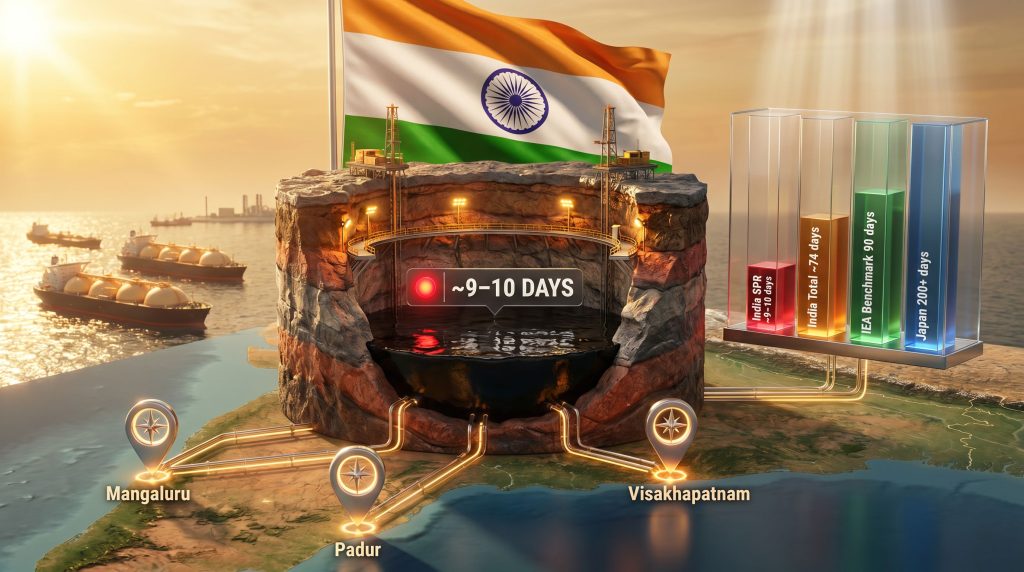
A report released by the Council on Energy, Environment and Water (CEEW), titled How Secure is India's Energy Future? Assessing Accessibility, Reliability, and Affordability, has brought renewed attention to the depth of this exposure. The findings confirm what energy security analysts have long flagged: India's strategic petroleum reserves cover only approximately 9 to 10 days of the country's net crude oil imports, positioning it well behind international benchmarks and most comparable major import-dependent economies.
When big ASX news breaks, our subscribers know first
Understanding the Architecture of India's Strategic Petroleum Reserves
India's dedicated strategic crude storage sits within a network of underground rock caverns operated by Indian Strategic Petroleum Reserves Limited (ISPRL). These facilities are located at three sites: Visakhapatnam in Andhra Pradesh, Mangaluru in Karnataka, and Padur, also in Karnataka. Together, they hold approximately 5.33 million metric tons of crude oil, which is the equivalent of roughly 36.9 million barrels.
This infrastructure was designed specifically for emergency drawdown scenarios, not to serve commercial refining demand. The distinction matters enormously when interpreting reserve coverage figures. The frequently cited 9 to 10 day figure reflects only this dedicated strategic buffer, not the totality of petroleum held across the national system.
Strategic Reserves vs. Total National Stockholding
When commercial inventories and working stocks held by state-run refiners and importers are incorporated into the calculation, India's aggregate petroleum coverage picture changes substantially, though it still falls short of international norms.
| Storage Category | Approximate Volume | Net Import Cover |
|---|---|---|
| Strategic Petroleum Reserves (SPR) | ~5.33 MMT / 36.9 million barrels | ~9-10 days |
| Commercial and refinery inventories | Included in broader national count | ~64 additional days |
| Total National Stockholding | Combined estimate | ~74 days |
| IEA Member Benchmark | Mandatory minimum | 90 days |
Key distinction: The 9-10 day coverage figure for India's strategic oil reserves refers exclusively to the dedicated government-owned SPR network. The broader national tally, incorporating all commercial stock, reaches approximately 74 days, still roughly 16 days short of the International Energy Agency's mandatory 90-day threshold for full member countries.
According to India's Strategic Petroleum Reserve on Wikipedia, the ISPRL cavern network was conceived as part of a broader national energy security architecture, though its coverage has remained limited relative to the country's import volumes. India holds IEA Association status, meaning it operates outside the binding 90-day obligation but is nonetheless measured against it as the globally recognised standard for energy security adequacy.
How India Compares Internationally: A Significant Reserve Gap
The scale of India's strategic reserve position becomes most apparent when placed alongside peer nations that face comparable import dependency.
| Country | Strategic Reserve Coverage | IEA Full Member |
|---|---|---|
| Japan | 200+ days | Yes |
| South Korea | 200+ days | Yes |
| United States | ~90+ days (SPR) | Yes |
| China | ~90+ days (estimated) | No (Associate) |
| India (SPR only) | ~9-10 days | No |
| India (total stocks) | ~74 days | No |
Japan and South Korea are not outliers here: they represent what sustained policy commitment to strategic reserve building produces over several decades of formal IEA membership. India's SPR programme, by contrast, was launched in the mid-2000s and has been constrained by a combination of capital availability, geological site selection timelines, and competing national infrastructure priorities.
One dimension that is less commonly understood is the geological specificity involved in building underground crude storage. Rock cavern facilities of the type used in India require particular subsurface formations, primarily stable igneous or metamorphic rock, to provide the structural integrity needed for long-term pressurised storage. Identifying, assessing, and constructing these facilities is a multi-year process that cannot be compressed simply through policy ambition or increased spending.
The Import Concentration Risk Compounding the Reserve Problem
India's strategic oil reserves covering only 9-10 days of crude imports is compounded by a sourcing structure that amplifies the consequences of any disruption. According to the CEEW report, more than 85% of India's crude oil imports originate from just six countries, including Russia and multiple West Asian producers.
This level of geographic concentration means that a simultaneous disruption across even a subset of those supply corridors, whether through geopolitical conflict, shipping route interference, or production outages, would exhaust India's dedicated strategic buffer within days before the broader commercial stock system absorbs the pressure. Furthermore, the global LNG supply outlook adds another layer of complexity, as tightening LNG markets could amplify pressure on India's broader energy system simultaneously.
Hemant Mallya, Fellow at the CEEW, has noted that disruptions across crude oil, LNG, LPG, coal, or key shipping routes can rapidly cascade into higher cooking costs, transport fuel price spikes, fertiliser subsidy pressures, reduced industrial competitiveness, and broad-based inflationary acceleration. This interconnection between energy supply security and macroeconomic stability is precisely what makes reserve adequacy a fiscal policy concern, not merely an energy sector technicality.
Sector-Level Vulnerability to a Crude Supply Disruption
- Household energy costs – LPG and cooking fuel prices are directly tied to crude input costs and respond within days to supply constraint signals
- Transport and logistics – Petrol and diesel price escalation creates a multiplier effect across domestic supply chains, raising costs for goods movement nationally
- Fertiliser production – Energy feedstock disruptions threaten the availability and affordability of agricultural inputs at precisely the moments when food security demands stability
- Industrial manufacturing – Energy-intensive sectors face margin compression that reduces output competitiveness and can trigger production slowdowns
- Inflation – Cost-push inflation accelerates across the economy as energy price signals transmit into virtually every input category
The Natural Gas Storage Gap: A Less Visible but Equally Serious Risk
Crude oil receives the bulk of strategic reserve attention, but India's natural gas security position carries risks that are arguably less well understood by the broader public.
India imports approximately 50% of its natural gas supply as Liquefied Natural Gas (LNG), yet the country maintains no dedicated strategic gas storage infrastructure of any kind. This is a structural gap that leaves fertiliser manufacturing plants, city gas distribution networks serving urban consumers, and industrial gas users entirely without an emergency buffer.
Unlike crude oil, which can be stored in sealed underground caverns with manageable infrastructure requirements, LNG requires cryogenic storage at temperatures near minus 162 degrees Celsius. Transitioning LNG back into usable gas for distribution adds further infrastructure complexity. Underground gas storage in its gaseous state, which is the approach used in Europe and parts of the United States, requires specific geological formations including depleted gas fields or salt caverns, neither of which are uniformly available across India's geography.
This partly explains why policy prioritisation has historically favoured crude SPR development. The capital expenditure per unit of energy stored is substantially higher for gas, and the geological prerequisites are more demanding. However, as India's gas demand grows and its LNG dependency deepens, the absence of any gas storage buffer represents a systemic vulnerability that is not currently offset by any equivalent mechanism. The relationship between critical minerals and energy security is also increasingly relevant here, as gas infrastructure investments compete with clean energy buildout for the same finite pools of capital and political attention.
Coal Security: A Dual-Track Dependency Problem
India's coal security risk profile operates across two distinct tracks, each with its own exposure mechanism.
Coking coal, used primarily in steelmaking, is sourced predominantly from Australia. Any disruption to Australian export capacity, whether through weather events, port infrastructure failures, trade policy shifts, or logistical bottlenecks, directly threatens domestic steel production. Steel output underpins construction, manufacturing, and infrastructure sectors, meaning that coking coal supply interruptions carry amplified economic consequences.
Non-coking coal, used in thermal power generation, is imported primarily from Indonesia. Indonesian export policies, including volume restrictions or export levy adjustments, have historically introduced price volatility into India's power sector input costs. The CEEW report specifically highlights India's exposure to Indonesian policy decisions as a structural coal security risk factor.
Compounding both tracks is a domestic production dynamic that is frequently underappreciated: declining ore quality and rising extraction costs are gradually narrowing the cost advantage that domestic coal-fired power has traditionally held over firm renewable energy alternatives. This shift has long-term implications for the economic case for continued coal dependency, even before climate considerations are incorporated into the analysis.
The next major ASX story will hit our subscribers first
Clean Energy as an Import Substitution Strategy: The New Strategic Dependency
The CEEW report presents renewable energy scale-up as a meaningful tool for reducing India's exposure to volatile imported fossil fuel markets. Solar, wind, and hydroelectric resources are domestically abundant and structurally immune to geopolitical supply disruptions. Expanding their share in the energy mix reduces the volume of crude, LNG, and coal that must be imported, stored, and insured against disruption.
However, the report introduces a critical counterpoint that is often absent from clean energy advocacy narratives: the transition from fossil fuel imports to clean energy does not eliminate strategic dependency. It transforms it.
Critical insight: A nation that replaces crude oil imports with solar panel and battery imports has changed the composition of its strategic vulnerability, not its magnitude. The critical mineral supply chains underpinning clean energy technologies introduce a new category of concentrated import dependency that demands the same analytical rigour applied to petroleum security.
New Strategic Dependencies Created by the Energy Transition
| Dependency Type | Key Inputs at Risk | Primary Supplier Nations |
|---|---|---|
| Battery storage | Lithium, cobalt, nickel | Australia, DRC, Indonesia |
| Solar PV manufacturing | Polysilicon, wafers | China (dominant) |
| Wind turbine components | Rare earth elements | China (dominant) |
| Grid infrastructure | Copper, aluminium | Chile, China, Australia |
China's rare earth strategy looms particularly large here, as Beijing's dominance across the solar PV supply chain, from polysilicon production through to wafer manufacturing and cell assembly, means that an aggressive renewable energy buildout could, without domestic manufacturing development, simply replace West Asian crude oil dependency with Chinese clean energy technology dependency. The geographic concentration risk does not disappear: it migrates.
In addition, India's lithium supply strategy is becoming increasingly central to how the country manages this transition-era dependency. Advances in direct lithium extraction technology could also alter the economics and speed of securing battery-grade lithium for domestic clean energy manufacturing. Managing this transition-era dependency requires a multi-instrument policy response:
- Domestic manufacturing scale-up through expanded Production Linked Incentive schemes targeting solar modules and battery cells
- Supply chain diversification via bilateral critical mineral agreements with resource-rich nations including Australia, Canada, and African producers
- Recycling infrastructure development to create a domestic secondary supply of lithium, cobalt, and rare earth elements from end-of-life assets
- Strategic multilateral partnerships through frameworks such as the Mineral Security Partnership to formalise cooperative supply chain resilience arrangements
What Would Closing the Reserve Gap Actually Require?
Bringing India's dedicated strategic petroleum reserves to the IEA's 90-day benchmark on a standalone basis would require a roughly ninefold expansion of current SPR capacity. That scale of buildout is not practically achievable within any near-term policy horizon.
Phase II and Phase III SPR expansion proposals have identified Chandikhol in Odisha and an extension of the Padur facility as priority sites. If both phases proceed, they would add approximately 6.5 million metric tons of additional strategic storage capacity. This represents meaningful progress, but still falls substantially short of the 90-day threshold on a standalone SPR basis. Notably, S&P Global reports that India's strategic petroleum reserves are set to receive a further boost through an agreement with ADNOC, which could accelerate the pace of expansion beyond what domestic funding alone would achieve.
A more pragmatic near-term architecture combines modest SPR expansion with mandatory minimum stockholding obligations imposed on private sector refiners and importers. China employs a version of this hybrid model, which allows total national coverage to approach IEA norms without requiring the full fiscal outlay of a government-owned SPR expansion. Analysts estimate that mandatory private sector stock obligations could add 15 to 20 days of additional national coverage at relatively low direct cost to the government.
India's Energy Security Scorecard
| Energy Security Dimension | Current Status | Risk Level |
|---|---|---|
| Strategic crude reserves (SPR only) | ~9-10 days | High |
| Total petroleum stockholding | ~74 days | Moderate |
| Crude import concentration | 85%+ from 6 countries | High |
| Strategic gas storage | None | High |
| Coking coal import dependency | Australia-dominant | Moderate |
| Clean energy transition dependency | Critical minerals emerging | Moderate |
| Domestic renewable capacity growth | Expanding rapidly | Positive |
A Phased Roadmap for Strengthening India's Energy Resilience
Short-Term Priorities (0 to 3 Years)
- Accelerate Phase II SPR cavern construction at Chandikhol to expand dedicated strategic capacity
- Introduce mandatory minimum stockholding obligations for private refiners and importers to broaden national coverage without full government capital expenditure
- Actively diversify crude import sourcing to reduce the 85% concentration across six supplier countries
Medium-Term Structural Reforms (3 to 7 Years)
- Develop pilot underground gas storage facilities in geologically suitable formations to begin addressing the LNG storage gap
- Formalise bilateral critical mineral supply agreements to manage clean energy transition dependencies before they mature into strategic vulnerabilities
- Expand domestic solar and battery manufacturing capacity under PLI frameworks to reduce the clean energy import exposure identified in the CEEW analysis
Long-Term Strategic Architecture (7 to 15 Years)
- Construct a hybrid energy security framework that integrates fossil fuel reserves with critical mineral stockpile mechanisms as the energy mix evolves
- Build a domestic battery and panel recycling industry to generate secondary critical mineral supply from end-of-life clean energy assets
- Pursue deeper engagement with IEA frameworks to align India's reserve obligations and reporting with international norms as its global energy market significance grows
India's position as the world's third-largest crude oil importer means that its reserve adequacy carries implications that extend beyond domestic policy. A supply shock scenario that strains India's strategic oil reserves covering only 9-10 days of crude imports would transmit price and availability pressures across regional energy markets with speed and severity that no single policy instrument could easily contain. Addressing this gap systematically, across crude, gas, and the emerging clean energy supply chain, represents one of the most consequential infrastructure and policy challenges the country faces over the coming decade.
This article contains forward-looking analysis and scenario assessments based on publicly available research, including the CEEW report How Secure is India's Energy Future? Assessing Accessibility, Reliability, and Affordability. Readers should note that reserve coverage figures, supply chain assessments, and policy projections are subject to change as geopolitical, market, and regulatory conditions evolve. Nothing in this article constitutes financial or investment advice.
Want to Identify ASX Opportunities Emerging From the Critical Minerals and Energy Security Boom?
Discovery Alert's proprietary Discovery IQ model delivers real-time alerts on significant ASX mineral discoveries — including the lithium, rare earths, and copper plays central to the global energy transition India and other major economies are accelerating — instantly translating complex geological data into actionable investment insights. Explore how historic mineral discoveries have generated substantial returns and begin your 14-day free trial today to position yourself ahead of the broader market.