
July 11, 2026
The Carbon Arithmetic Rewriting Global Aluminium Scrap Trade
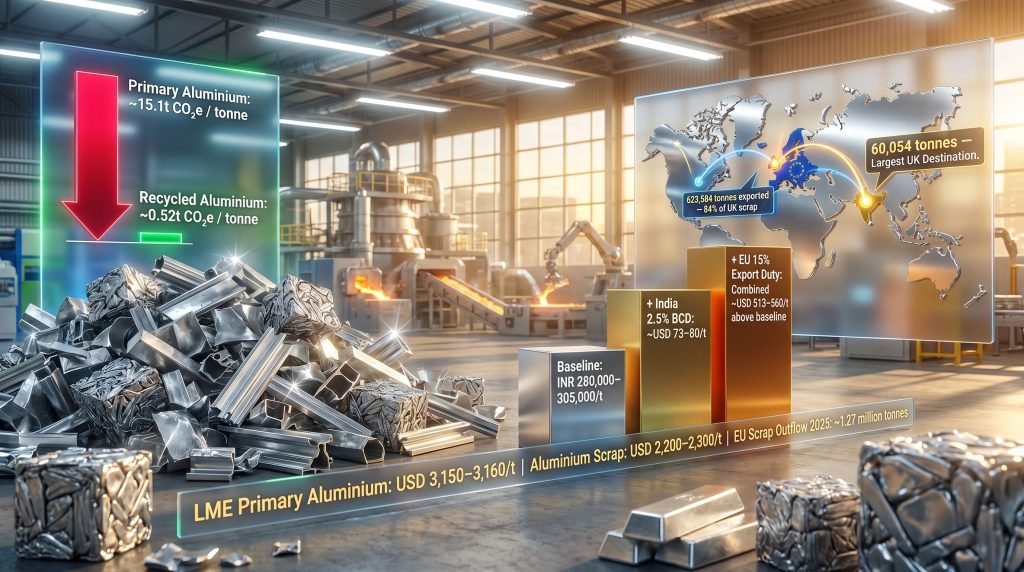
Few industrial transitions carry the mathematical clarity of aluminium recycling's carbon advantage. Primary aluminium smelting generates approximately 15.1 tonnes of CO₂ equivalent per tonne of metal produced. The recycled alternative produces roughly 0.52 tonnes of CO₂e per tonne — a differential of nearly 20 times. That single figure is quietly reordering aluminium scrap trade policies and carbon costs across global supply chains, triggering export restrictions, reshaping import policies, and forcing every participant in the value chain to reconsider their cost assumptions.
The energy economics are equally stark. Recycling aluminium consumes approximately 5% of the energy required to smelt primary metal from bauxite ore. For governments with net-zero commitments and manufacturers under mounting carbon cost pressure, this is not a marginal efficiency gain — it is a structural industrial advantage. As decarbonisation mandates tighten, aluminium scrap is being reclassified from a tradeable commodity into a strategically retained industrial input, and the policies reshaping its movement are accelerating. The broader decarbonisation benefits of this shift extend well beyond individual company balance sheets.
When big ASX news breaks, our subscribers know first
Carbon Border Adjustment Mechanism: The Pricing Engine Changing Trade Economics
The European Union's Carbon Border Adjustment Mechanism is the most consequential pricing instrument now bearing on global aluminium scrap trade policies and carbon costs. CBAM operates by applying a charge based on the carbon intensity of an imported product multiplied by the prevailing EU Emissions Trading System price. For aluminium imports, the formula works as follows:
CBAM Carbon Cost (per tonne) = Scope 1 Intensity (t CO₂e / t metal) × Current EU ETS Price
ETS Shipping Cost = Fuel Consumed × CO₂ Factor × Phase-in Rate × Trade Share × EUA Price
The ETS cost calculation is particularly sensitive to its phase-in factor and trade share variables, meaning outcomes can shift considerably depending on route and timing. CBAM, by contrast, charges directly on the embedded carbon of the imported product, making it more predictable but no less impactful.
Under a conservative EU ETS scenario of €80 per tonne, CBAM surcharges raise extrusion import costs by approximately €0.04 to €0.10 per kilogram. In an aggressive scenario at €150 per tonne, that premium widens to €0.075 to €0.18 per kilogram, with the potential for further escalation if default carbon values are applied to unwrought aluminium imports.
Is There a Loophole in CBAM for Recycled Scrap?
A critically underappreciated dynamic is the current treatment of post-consumer aluminium scrap under CBAM. Recycled scrap currently carries a zero embedded emissions assumption within the framework — a loophole that European Aluminium has been actively lobbying to close. The industry body has urged policymakers to assign a single default carbon intensity to unwrought aluminium imports. If enacted, this change would fundamentally alter the competitive positioning of imported secondary aluminium relative to domestically recycled material.
Furthermore, the imported primary aluminium carbon penalty is often overlooked by traders. Primary aluminium imported into Europe from regions with coal-heavy electricity grids can carry a carbon footprint approximately 60% higher than aluminium produced domestically, where renewable and hydroelectric power sources are more prevalent. This embedded carbon gap is increasingly material to procurement decisions across European downstream manufacturers, particularly as US aluminium tariffs continue reshaping global trade flows.
Europe's Scrap Outflow Problem: Why Export Duties Are on the Table
The scale of Europe's aluminium scrap leakage is difficult to overstate. The EU's aluminium scrap outflows exceeded 1.2 million tonnes in 2024, rising to approximately 1.27 million tonnes in 2025. Despite growing demand for low-carbon secondary aluminium within the bloc, much of this material continues to flow to non-EU markets where domestic recycling infrastructure can absorb it at a lower cost base.
The European Commission has responded with a proposal for a 15% export duty on aluminium scrap — a measure designed to anchor this strategically valuable material within the EU's circular economy. The proposal is still navigating the EU legislative process and is not yet enacted, but its anticipation is already influencing trade positioning and procurement strategies. According to European Aluminium's position on fair trade, maintaining domestic scrap supply is essential to the long-term competitiveness of the bloc's secondary aluminium sector.
Reinforcing the export duty proposal is a suite of existing regulatory instruments:
- The Waste Framework Directive promotes resource efficiency and circular economy principles across member states.
- The Packaging and Packaging Waste Regulation (PPWR) mandates recyclable packaging and Deposit Return Schemes to improve scrap collection rates.
- The Critical Raw Materials Act (CRMA) supports domestic recycling investment and supply chain resilience, further strengthening European raw materials supply chains.
- New end-of-life vehicle circularity rules are targeting improved aluminium recovery rates from the automotive waste stream.
- The EU Waste Shipment Regulation (WSR), taking effect in September 2026, will restrict exports of recyclable waste including aluminium scrap to non-OECD countries — potentially the single most disruptive near-term structural shift in global scrap trade flows.
It is worth noting that some European recyclers have opposed the proposed export duty, arguing it could reduce recycler margins and undermine the commercial viability of the very collection and sorting activity required for decarbonisation. This tension between supply chain security and recycler economics is a genuinely unresolved policy design challenge.
UK and Germany: Diverging Capacity Realities, Shared Export Pressures
United Kingdom: A Structural Recycling Capacity Gap
The United Kingdom's aluminium scrap export trajectory reveals a domestic processing sector struggling to absorb available volumes. Total UK aluminium scrap exports reached 623,584 tonnes in 2025, with approximately 84% of all UK aluminium scrap currently exported rather than processed domestically.
In the first four months of 2026, UK scrap exports climbed 9% year-on-year to 217,611 tonnes, up from 200,374 tonnes in the same period of 2025. Manufacturing trade body Make UK has identified a need for 25% annual growth in recycling capacity to satisfy the targets embedded in the Modern Industrial Strategy — a rate that would require sustained capital investment well beyond current trajectories.
The destination breakdown for UK aluminium scrap exports in January to April 2026 illustrates both the depth of Asian demand and an emerging shift toward North American sourcing:
| Destination | Volume (Jan–Apr 2026) | Notable Trend |
|---|---|---|
| India | 60,054 tonnes | Largest single market |
| Hong Kong | 34,666 tonnes | Major re-export hub |
| China | 20,261 tonnes | Consistent buyer |
| United States | 17,230 tonnes | +174% year-on-year surge |
The 174% year-on-year surge in US imports of UK scrap is particularly noteworthy. It suggests American buyers are actively diversifying supply sources to supplement domestic material, likely in response to tightening scrap availability and the strategic repositioning of recycled aluminium as a manufacturing input.
Germany: Intra-European Flows Gaining Momentum
Germany exported 311,491 tonnes of aluminium scrap in Q1 2026, a modest 0.5% increase year-on-year but an 8.8% rise quarter-on-quarter from Q4 2025's 286,285 tonnes. The distribution of those flows is revealing:
| Destination | Q1 2026 Volume | Year-on-Year Change | Quarter-on-Quarter Change |
|---|---|---|---|
| Italy | 46,941 tonnes | Decline | — |
| Austria | 43,838 tonnes | +13.2% | +23.3% |
| Netherlands | 31,438 tonnes | — | +9.8% |
| Poland | 22,859 tonnes | — | +3.5% |
| France | 20,026 tonnes | +41.2% | +8.4% |
The surge in French demand — up 41.2% year-on-year — alongside strengthening Austrian and Dutch import volumes points to intra-European recycling chains beginning to consolidate around available scrap supply. From a carbon cost perspective, intra-continental scrap flows carry a structural advantage: shorter shipping distances reduce ETS shipping cost exposure, removing a significant landed cost layer that intercontinental buyers must otherwise absorb.
The United States: From Industrial Decline to Strategic Scrap Retention
The trajectory of US primary aluminium production tells a striking story. Output has contracted by approximately 80% since the 1980s, with recycled aluminium now accounting for nearly 85% of domestic aluminium production. The industry has committed more than USD 11 billion to recycling infrastructure investment over the past decade, cementing secondary production as the structural backbone of American aluminium supply. Consequently, low-carbon aluminium operations are gaining strategic prominence globally.
The Aluminum Association has called for a comprehensive strategy to protect this position, centred on several priorities:
- Strengthening scrap retention policies, including targeted export controls on Used Beverage Containers (UBCs) to prevent outflows of high-value, easily processable material.
- Expanding access to affordable electricity to support primary smelting operations where viable.
- Streamlining regulatory approvals for domestic processing and critical mineral projects.
- Maintaining trade measures against unfairly priced aluminium imports that undercut domestic producers.
With global aluminium demand projected to grow by approximately 80% by 2050, the strategic logic of retaining domestic scrap supply is compelling. The USMCA renegotiation process adds another dimension, with industry groups advocating for tighter North American export controls on aluminium scrap to prevent cross-border flows of lower-grade material.
India: The World's Most Contested Aluminium Scrap Import Market
No country better illustrates the internal contradictions of aluminium scrap trade policies and carbon costs than India. The secondary aluminium sector has expanded dramatically, growing from 0.85 million tonnes in FY2015-16 to approximately 2.2 million tonnes in FY2025-26, representing around 35% of domestic aluminium consumption. Yet domestic end-of-life scrap generation satisfies only 15-20% of industry requirements, leaving the remaining 80-85% dependent on imports.
Total aluminium scrap imports reached 2 million tonnes, generating a foreign exchange outflow of approximately INR 402 billion (USD 4.22 billion). Three distinct industry factions hold fundamentally different views on how policy should respond:
| Stakeholder | Position | Rationale |
|---|---|---|
| Aluminium Association of India (AAI) | Retain 2.5% BCD; raise duties on Grade 3–7 scrap to 7.5% post-BIS notification | Protect planned investments exceeding INR 3 trillion; enforce quality standards |
| Material Recycling Association of India (MRAI) | Remove import duty entirely | India imports processed scrap, not unprocessed waste; duty removal reduces costs |
| Aluminium Secondary Manufacturers Association (ASMA) | Support duty removal | Raw materials account for up to 80% of production costs for approximately 3,500 MSMEs |
The Bureau of Indian Standards quality norms for aluminium scrap sit at the centre of the debate. AAI has pushed for immediate implementation alongside grade-wise HSN code classification, arguing that without enforceable standards, India risks absorbing lower-grade scrap unsuited to its manufacturing quality requirements. Once BIS standards are notified, AAI recommends escalating duties on Grade 3 to Grade 7 scrap categories from 2.5% to 7.5%.
NITI Aayog projections indicate that recycled aluminium could account for approximately 45% of India's aluminium demand by 2028, underscoring secondary aluminium's centrality to India's Net Zero 2070 roadmap. Meanwhile, primary capacity expansion plans from Vedanta, Hindalco, and NALCO target nearly 9 million tonnes per annum by FY2033, creating a future scenario where domestic scrap generation could grow substantially but remains structurally insufficient in the near term. The shifting dynamics across aluminium and alumina markets globally will only intensify these pressures.
The next major ASX story will hit our subscribers first
Modelling the Landed Cost Impact: What Policy Stacking Means for Scrap Prices
Current aluminium scrap prices in India across the tense-to-extrusion category range between INR 280,000 (USD 2,935) and INR 305,000 (USD 3,197) per tonne. Layering current and proposed policy costs onto that baseline produces a materially different pricing landscape:
| Policy Measure | Cost Addition (INR/tonne) | Cost Addition (USD/tonne) | Cumulative Price Range |
|---|---|---|---|
| India's 2.5% BCD (current) | ~INR 7,000–7,625 | ~USD 73–80 | INR 287,000–312,625/t |
| EU's proposed 15% export duty | ~INR 42,000–45,750 | ~USD 440–480 | INR 329,000–358,375/t |
| Combined policy stack | ~INR 49,000–53,375 | ~USD 513–560 | INR 336,000–366,000/t (est.) |
Key Insight: If both India's import duty is retained and the EU's proposed export duty is enacted simultaneously, the landed cost of EU-origin aluminium scrap in India could rise by approximately USD 513-560 per tonne above current baseline pricing. At that cost differential, sourcing diversification toward non-EU origins would become a commercially rational response for Indian importers.
Beyond these headline duties, traders must account for a compounding layer of peripheral costs that amplify the headline price impact:
- Freight and international shipping charges, which scale with distance and tonnage.
- Insurance premiums on high-value scrap consignments moving across multiple jurisdictions.
- Port handling, terminal, and demurrage fees that accumulate during customs processing.
- Warehousing and storage costs incurred during clearance delays.
- Working capital and financing costs tied directly to higher landed values and slower inventory turnover.
- Potential GST reduction on metal scrap from 18% to 5%, which could partially offset upstream cost increases for downstream processors.
- The removal of the mandatory Pre-Shipment Inspection Certification (PSIC) system, if enacted, could reduce administrative friction and associated compliance costs.
For context, the LME primary aluminium benchmark currently sits at approximately USD 3,150-3,160 per tonne, while aluminium scrap trades at USD 2,200-2,300 per tonne — a discount of approximately 28%. That spread is the fundamental economic driver behind scrap trade, but it narrows materially when policy cost stacking is applied to intercontinental flows. According to SMM's analysis of aluminium scrap as a strategic resource, nations rolling out domestic supply policies are fundamentally reshaping these competitive dynamics.
A Forward-Looking Policy Risk Register for Scrap Market Participants
Stakeholders navigating this environment should track at least five discrete regulatory risks over the next 12 to 24 months:
- EU Waste Shipment Regulation (September 2026): Restricts aluminium scrap exports to non-OECD countries. The single most immediate structural disruption to global scrap trade volumes.
- CBAM recycled aluminium loophole closure: Assignment of a default embedded emissions value to post-consumer scrap and unwrought aluminium imports would significantly raise effective carbon costs on secondary metal imports.
- India's BIS quality standard notification: Grade-wise HSN code implementation triggering duty escalation on lower-grade scrap categories from 2.5% to 7.5%.
- USMCA renegotiation: Potential inclusion of aluminium scrap under tighter North American export controls, redirecting cross-border material flows.
- HS Code 7602 compliance tightening: Increasing radiation and chemical compliance requirements restricting market access for lower-quality scrap from both organised and unorganised supply chains.
Risk Callout: Organisations sourcing or trading aluminium scrap across multiple jurisdictions should conduct a formal policy sensitivity analysis across at least three scenarios: conservative (current duties maintained), moderate (EU export duty enacted and CBAM loophole partially closed), and aggressive (full policy stack including USMCA restrictions and Indian duty escalation). Failure to stress-test supply chain costs across these scenarios leaves businesses exposed to margin compression that policy changes could trigger rapidly.
Disclaimer: This article contains forward-looking projections, cost modelling, and policy scenario analysis intended for informational purposes only. Figures relating to proposed duties, regulatory timelines, and price forecasts are subject to change based on legislative outcomes and market conditions. Readers should seek independent advice before making commercial or investment decisions based on the scenarios described.
Frequently Asked Questions: Aluminium Scrap Trade Policies and Carbon Costs
What is the carbon cost difference between primary and recycled aluminium?
Primary aluminium production generates approximately 15.1 tonnes of CO₂e per tonne of metal produced. Recycled aluminium generates approximately 0.52 tonnes of CO₂e per tonne — roughly 20 times lower. This differential is the foundational driver behind policy interventions designed to retain scrap for domestic low-carbon manufacturing.
How does the EU's CBAM affect aluminium scrap imports?
CBAM applies a carbon cost charge based on the Scope 1 emissions intensity of the imported product multiplied by the current EU ETS price. Under a €80/tonne ETS scenario, this adds approximately €0.04-€0.10 per kilogram to extrusion imports. At €150/tonne, the surcharge rises to €0.075-€0.18 per kilogram. Post-consumer scrap currently carries a zero embedded emissions assumption under CBAM, though this treatment is under active review.
Why is the EU proposing a 15% export duty on aluminium scrap?
The European Commission's proposed export duty aims to slow the outflow of high-quality aluminium scrap to non-EU markets. The intent is to anchor this material within the EU's circular economy, reduce dependence on carbon-intensive primary aluminium imports, and support the competitiveness of European secondary aluminium producers.
What does India's aluminium scrap import duty mean for buyers?
India's current 2.5% Basic Customs Duty adds approximately INR 7,000-7,625 (USD 73-80) per tonne to the landed cost. If the EU's proposed 15% export duty is also enacted, the combined policy cost stack could add USD 513-560 per tonne above current baseline scrap prices for EU-origin material entering India.
What is the EU Waste Shipment Regulation and when does it take effect?
The EU Waste Shipment Regulation is scheduled to take effect in September 2026. It will restrict the export of recyclable waste, including aluminium scrap, to non-OECD countries — expected to be one of the most significant structural disruptions to global aluminium scrap trade flows in the near term.
Want to Track the ASX Opportunities Emerging From the Aluminium Decarbonisation Shift?
As nations race to secure domestic aluminium scrap supply and carbon costs reshape global trade economics, the ASX companies positioned across low-carbon metals and critical materials stand to benefit significantly — and Discovery Alert's proprietary Discovery IQ model delivers real-time alerts the moment significant mineral discoveries hit the ASX, turning complex market signals into actionable opportunities. Explore historic discoveries and their exceptional market returns on Discovery Alert's dedicated discoveries page, and begin your 14-day free trial today to ensure you never miss a market-moving announcement.