July 11, 2026
When Energy Giants Become Energy Importers: Russia's Refining Paradox
Few disruptions in modern commodity markets reveal the fragility of energy systems quite like watching one of the world's largest crude oil producers scramble to import refined petrol. India petrol exports to Russia represent a striking reversal of conventional energy trade logic, emerging not from deliberate policy but from the systematic destruction of Russian refining infrastructure through sustained military targeting. The resulting supply gap has quietly opened a new and commercially significant trade route, one that runs from India's western coastline into Russian fuel terminals, passing through a web of international trading firms that operate entirely within the letter of existing commercial frameworks.
Understanding how this trade flow emerged, who benefits, who bears risk, and how long it can persist requires moving beyond headlines and into the underlying mechanics of refinery economics, sanctions on Russian oil trading, and India's rapidly evolving role as a global refining intermediary.
When big ASX news breaks, our subscribers know first
Russia's Refining Crisis: More Than Just Bomb Damage
Why Secondary Refining Units Are the Harder Problem
The instinctive assumption when hearing about damaged refineries is that repairs are a straightforward engineering exercise. In reality, modern refinery complexes are built around two distinct layers of processing. The first layer handles crude distillation, separating raw oil into broad fractions. The second layer, known as secondary or conversion processing, transforms those intermediate fractions into finished, specification-grade transport fuels.
This second layer relies on units such as catalytic crackers, hydrotreaters, and reformers — and it is precisely these that Ukrainian drone and missile strikes have most consequentially disrupted. Secondary refining units contain highly specialised components, including proprietary catalyst systems, heat exchangers designed to exact tolerances, and control systems that are not available off-the-shelf. Manufacturing lead times for replacement components can stretch to twelve months or beyond.
"The destruction of secondary refining capacity is strategically more damaging than attacking crude distillation units because it is far harder and slower to replace. Russia can continue to extract and even export crude oil, but without functioning conversion units, that crude cannot become the petrol and diesel that Russian motorists, military logistics chains, and agricultural machinery all depend upon."
The Numbers Behind the Shortage
The scale of Russia's domestic fuel production constraint becomes clearer when examining the operational data that has emerged through mid-2026.
| Metric | Figure |
|---|---|
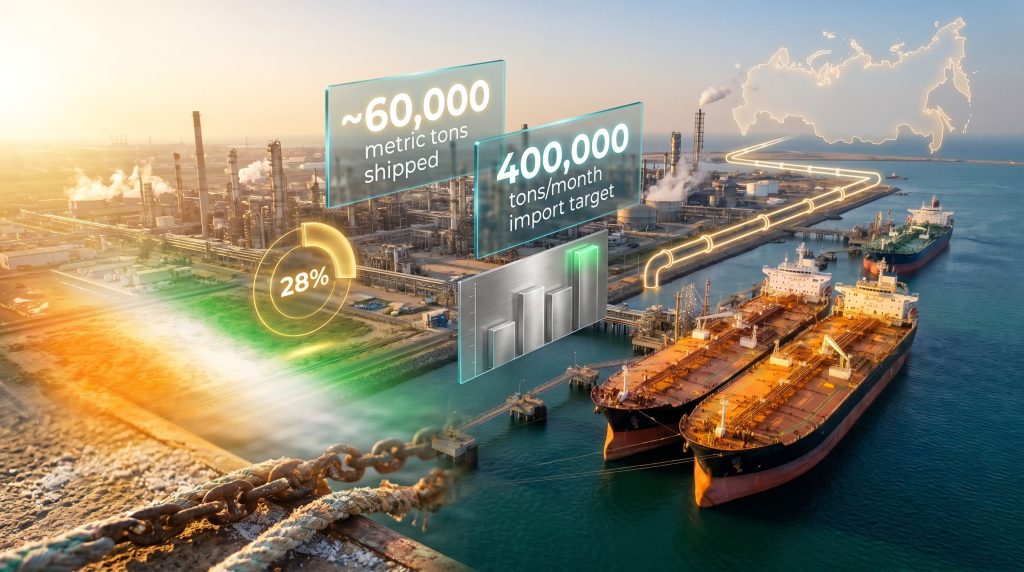
| Indian-origin gasoline shipped to Russia (early July 2026) | ~60,000 metric tons across two tankers |
| Russia's planned monthly gasoline import target | 400,000 metric tons per month |
| India's daily petrol export capacity | 350,000 to 400,000 barrels per day |
| India's share of Russian crude oil imports | ~28% (approximately 1.69 million barrels per day) |
| Rosneft ownership stake in Nayara Energy | 49% |
Refinery utilisation across Russia has dropped to multi-year lows, with the sharpest output declines occurring in petrol and diesel rather than in heavier products such as fuel oil and naphtha. These heavier fractions are produced earlier in the refining sequence and are less dependent on the damaged secondary units. Consequently, Russia has paradoxically continued to export them whilst simultaneously planning emergency petrol imports.
The supply shortfall has been most acute during the summer months, when domestic Russian demand for transport fuel peaks seasonally. Authorities have responded by restricting fuel exports and assembling an import programme targeting volumes from multiple countries including Belarus, though the scale of what has been arranged so far falls well short of the stated 400,000 metric ton monthly target.
How India's Petrol Reaches Russia Without Direct Involvement
The Trader-Mediated Supply Chain Explained
The mechanism through which India petrol exports to Russia occur is structured around commercial intermediation, and understanding this structure is essential for interpreting both the trade's legality and its geopolitical sensitivity. Furthermore, the role of commodity trading giants in facilitating these flows cannot be overstated.
The process operates broadly as follows:
- Indian refiners produce export-grade petrol meeting Euro-5 and other recognised international fuel specifications, then offer those cargoes to market through standard commercial channels.
- International commodity trading firms, operating independently of any government direction, purchase refined fuel cargoes from Indian refiners at prevailing market prices.
- These trading firms assess global demand and route cargoes to the highest-value buyers available within their commercial and compliance frameworks.
- Russian buyers source petrol through these intermediary trading channels, with the trading firm acting as the counterparty rather than any Indian refiner or government entity.
- The Indian government's position is that this entire chain, from the point of sale by an Indian refiner onward, is entirely outside Indian corporate or governmental responsibility for ultimate cargo destination.
India's Union Minister for Petroleum and Natural Gas has publicly clarified that Indian companies are not conducting direct sales to Russian entities. The government has simultaneously acknowledged that Indian-origin fuel may reach Russia through the independent commercial activity of international traders operating on purely market terms. This distinction, between a refiner selling to a trader and a refiner selling to Russia, carries substantial weight under the current international sanctions architecture.
The Sanctions Architecture and Where the Gaps Exist
Western sanctions targeting Russian energy have been primarily designed around three pillars: restrictions on direct transactions with designated Russian entities, limits on financing and insurance for Russian energy exports, and price caps on Russian crude oil. What this framework has been slower to address is the indirect trade in refined products produced outside Russia from Russian crude.
The trader intermediation model creates what analysts sometimes describe as structural distance. The producing refiner transacts with a trading firm. The trading firm transacts with the Russian buyer. Neither transaction is, in isolation, a sanctioned activity under most current regulatory frameworks. Moreover, similar intermediation patterns have been documented in other sanctioned commodity markets across recent decades, as evidenced by broader global trade disruptions in recent years.
Risk Note: The durability of this structural gap should not be taken for granted. Western regulators have demonstrated a willingness to progressively extend sanctions perimeters when indirect trade flows become sufficiently visible or politically significant. Any extension targeting maritime insurers, flagging registries, or financial intermediaries facilitating these transactions could rapidly alter the commercial viability of this route.
Nayara Energy and the Ownership Complexity
A Refinery at the Centre of Two Supply Chains
Market intelligence from mid-2026 identified at least one petrol cargo traced to Nayara Energy's Vadinar refinery in Gujarat as having reached Russia through an indirect trading route. Vadinar is one of India's largest single-site refineries, with a processing capacity that makes it a significant contributor to Indian fuel export volumes.
What elevates Nayara's role beyond straightforward commercial significance is its ownership structure. Russia's state energy company Rosneft holds a 49% stake in Nayara Energy. This means that a Russian state entity has a substantial economic interest in an Indian refinery that produces fuel which may ultimately return to Russia through trader intermediation. The commercial circularity this creates is striking.
Nayara has, since tightened European restrictions emerged on fuels derived from Russian crude, shifted its operational model toward greater reliance on international trading firms for both feedstock procurement and finished product distribution. This structural adaptation has made the Vadinar refinery simultaneously one of India's most internationally connected refining assets and one of the most geopolitically complex.
India's Refining Economics: Why This Trade Flow Makes Sense
The Competitive Advantage Built on Discounted Crude
India's emergence as a meaningful participant in Russia's fuel supply problem is not coincidental. It is the direct consequence of strategic decisions made by Indian refiners over the past two years to aggressively increase their intake of discounted Russian crude. Furthermore, India's energy import framework has created conditions that make this positioning commercially logical at a structural level.
India currently accounts for approximately 28% of Russian crude oil exports, absorbing roughly 1.69 million barrels per day. This volume, which at various points in 2023 and 2024 exceeded China's Russian crude intake, has given Indian refiners a sustained input cost advantage relative to competitors using Brent-linked crude. Lower feedstock costs translate directly into wider refining margins, which in turn fund the capital investment and operational scale that makes India's export position competitive.
The result is a refining sector capable of producing 350,000 to 400,000 barrels of export-quality petrol per day, destined for markets spanning North America, Africa, and increasingly, Russian-adjacent channels through trader intermediaries. As reported by Reuters, India has also been actively expanding into European markets with fuel derived from Russian crude, illustrating the breadth of this commercial reach.
India's Export Reach Across Global Markets
| Export Destination | Primary Products | Market Characterisation |
|---|---|---|
| North America | Petrol, diesel | Established high-volume market |
| Africa | Petrol, diesel, jet fuel | High-growth demand destination |
| Europe (pre-sanctions tightening) | Diesel, jet fuel | Significant but increasingly restricted |
| Russia via traders (2026) | Euro-5 grade petrol | Emerging indirect channel |
| Middle East and Asia | Multiple refined products | Ongoing diversified commercial flows |
The Euro-5 specification is particularly relevant here. Russian domestic fuel consumption standards require Euro-5 grade petrol, and India's advanced refining infrastructure is fully capable of meeting this specification. This technical compatibility is a prerequisite for the trade to function and represents a non-trivial capability that not all global refining hubs can easily match.
Three Scenarios That Could Reshape This Trade Dynamic
Scenario Analysis for Investors and Market Observers
The current India petrol exports to Russia pattern is not a permanent structural feature of global energy markets. It is a contingency trade flow created by a specific set of disruptions, and its continuation depends on several variables remaining stable simultaneously. The oil price geopolitical factors underpinning this arrangement are particularly susceptible to rapid change.
Scenario 1: Sanctions Extension to Shipping and Financial Intermediaries
If Western regulators expand enforcement to cover the maritime insurers, flag state registries, or correspondent banking relationships that facilitate indirect Russian energy trade, the cost and feasibility of the current intermediation model would increase sharply. Trading firms operating within tightening compliance environments would face pressure to demonstrate that cargoes are not reaching sanctioned destinations.
Scenario 2: Secondary Sanctions Pressure on Indian Refiners
A more targeted regulatory approach could focus pressure directly on Indian refining companies rather than on traders. If Indian refiners faced credible secondary sanctions risk for failing to monitor cargo destinations post-sale, they would be incentivised to introduce destination restrictions into their commercial contracts with trading partners. This would not eliminate the trade but would raise its transactional complexity and cost.
Scenario 3: Russian Domestic Refinery Recovery
The most straightforward resolution to the current import dependency is the restoration of Russian domestic refining capacity. Whether this occurs through ceasefire and subsequent infrastructure repair, alternative equipment sourcing through sanctioned supply chains, or political resolution of the underlying conflict, a return to adequate domestic fuel production would eliminate the economic rationale for Russian petrol imports entirely.
Analyst Assessment: Rating agency ICRA has assessed that Russia's petrol import requirement is likely to persist until damaged refinery infrastructure is returned to operational status. The same analysis notes that current import volumes remain too modest to materially shift the economics of India's broader refining industry, suggesting this trade is strategically notable but commercially incremental for Indian refiners at present volumes.
The next major ASX story will hit our subscribers first
The Circular Trade Loop and What It Signals About Sanctions Effectiveness
Russian Crude In, Russian-Bound Petrol Out
The structural arrangement that has emerged by mid-2026 contains a striking internal logic. India purchases Russian crude at discounted prices, uses that crude as feedstock in Indian refineries, produces export-quality petrol, sells that petrol to international trading firms, and a portion of that petrol then returns to Russia through commercial channels.
This circular flow is commercially rational at every individual step. Russian crude sellers benefit from finding willing buyers. Indian refiners benefit from discounted feedstocks that improve margins. Trading firms benefit from arbitraging the price differential between surplus refining capacity and Russian domestic fuel scarcity. Russian buyers benefit from access to specification-grade fuel that domestic production can no longer supply adequately.
What this loop also demonstrates is that sanctions frameworks designed around controlling crude oil flows can be partially circumvented by allowing refined product trade to operate through third-country intermediaries. Russia's situation is, however, one of the most visible and consequential real-time examples of the phenomenon in operation.
Key Indicators to Monitor
For those tracking the evolution of this trade dynamic, the following variables are most likely to signal inflection points:
- Russian refinery operational status: Any credible reports of secondary unit repairs resuming at major Russian refineries would reduce the import dependency that is driving current petrol flows.
- Western sanctions announcements: Regulatory moves targeting shipping insurers, trading firm compliance obligations, or secondary sanctions on third-country entities would directly affect the commercial viability of trader-mediated supply chains.
- Indian petrol export volume data: Sustained increases in total Indian petrol export volumes without corresponding growth in traditional destination markets would suggest increasing flows through non-traditional channels.
- Belarus and alternative supplier volumes: Russia's multi-source import strategy means that Indian-origin fuel is one component of a broader import programme. Tracking Belarus and other potential supplier volumes provides context for understanding how dependent Russia actually is on any single source.
- Nayara Energy cargo disclosures: Given Nayara's Vadinar refinery's identification as a source of at least one confirmed Russian-bound cargo, future reporting on that facility's export routing will be closely watched by energy analysts and sanctions compliance specialists alike.
Frequently Asked Questions: India Petrol Exports to Russia
Is India officially exporting petrol to Russia?
India's government has clearly stated that Indian refiners are not conducting direct sales to Russian entities. However, the government has also acknowledged that Indian-origin refined fuel may reach Russia through the independent commercial decisions of international trading intermediaries who purchase cargoes from Indian refiners and sell them on their own account.
How much Indian petrol has actually reached Russia?
As of early July 2026, approximately 60,000 metric tons of confirmed Indian-origin gasoline had been shipped to Russia, carried across two tanker cargoes each transporting between 30,000 and 40,000 metric tons. This represents a fraction of Russia's stated monthly import target of 400,000 metric tons.
Why does Russia need to import petrol when it produces so much crude oil?
Sustained Ukrainian military strikes targeting Russian refinery infrastructure have significantly reduced the country's capacity to convert crude oil into finished transport fuels. While Russia continues to produce and export crude, its secondary refining capacity — the portion responsible for producing specification-grade petrol and diesel — has been materially impaired. The result is a structural gap between crude production capability and finished fuel production capability.
Could this trade expose Indian refiners to sanctions risk?
Analysts have highlighted that whilst the current intermediation model creates legal and commercial distance between Indian refiners and Russian end-buyers, any future expansion of Western sanctions could increase compliance risk considerably. Moves targeting shipping companies, marine insurers, financial intermediaries, or secondary sanctions aimed at third-country entities could all affect Indian refining companies and their trading partners. The risk is currently assessed as manageable but is not negligible given the political salience of the issue.
Disclaimer: This article contains forward-looking analysis, scenario projections, and market assessments that involve inherent uncertainty. Nothing in this article constitutes investment advice or a recommendation to take any specific commercial or financial position. Readers should conduct their own due diligence and consult qualified advisers before making decisions based on information contained herein. Sanctions frameworks and geopolitical conditions are subject to rapid change.
Want to Stay Ahead of the Resource Sector Shifts Reshaping Global Markets?
Discovery Alert's proprietary Discovery IQ model scans the ASX in real time, transforming complex commodity and resource data into actionable alerts the moment significant mineral discoveries are announced — explore historic discoveries and the returns they generated, then begin your 14-day free trial at Discovery Alert to position yourself ahead of the broader market.