June 23, 2026
When China Relationships Define Commercial Destiny in Iron Ore
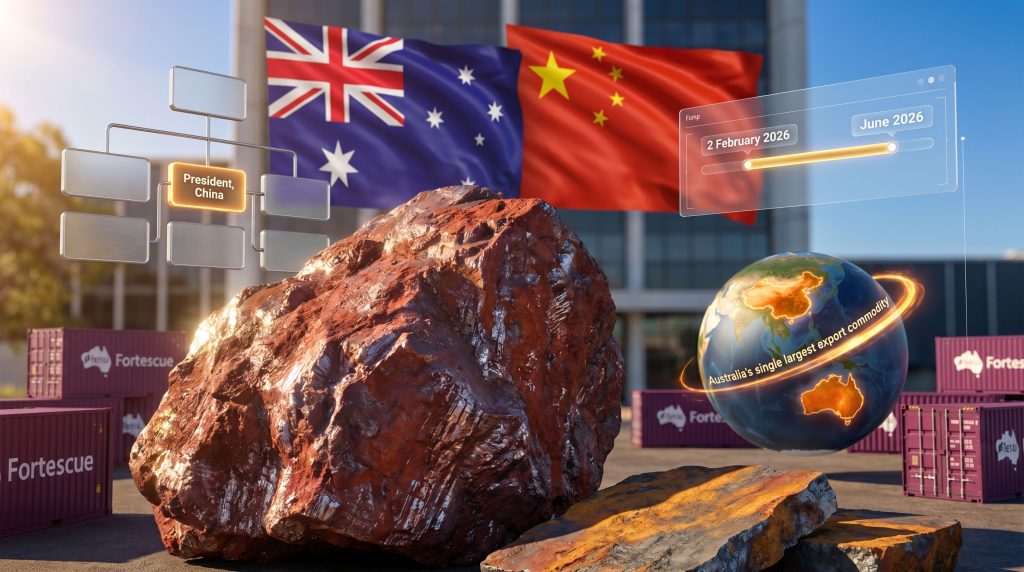
The iron ore trade between Australia and China is one of the most financially consequential bilateral commodity flows on the planet. Australia exports more iron ore by value than any other nation, and China absorbs the overwhelming majority of global seaborne supply to feed its enormous steel sector. Within this dynamic, the individuals responsible for managing the human layer of these transactions carry responsibilities that extend well beyond conventional corporate roles.
They are simultaneously diplomats, commercial negotiators, and institutional relationship managers operating inside one of the world's most complex regulatory and political environments. It is against this backdrop that the departure of Fortescue China president Liu Qing after just four months in the role warrants serious scrutiny. The circumstances surrounding the exit raise questions not only about internal dynamics at Fortescue, but about the broader challenge Western mining companies face when building sustainable leadership capacity inside China.
When big ASX news breaks, our subscribers know first
The Architecture of Fortescue's China Exposure
Why the China Presidency Carries Disproportionate Strategic Weight
Fortescue occupies a distinctive position in the global iron ore hierarchy. As the world's fourth-largest iron ore supplier, the company ships the vast majority of its output to Chinese steel mills, making China not merely its largest customer but effectively its only market of structural significance. This concentration creates an unusual dynamic: the health of Fortescue's entire commercial enterprise is inseparable from the quality of its relationships with Chinese state-owned enterprises, government regulators, and steel industry bodies.
Unlike diversified miners such as BHP or Rio Tinto, which balance iron ore exposure with copper, coal, and other commodity streams across multiple geographies, Fortescue's revenue profile is heavily leveraged to iron ore pricing and Chinese steel demand. Furthermore, understanding the broader China steel and iron ore market helps contextualise why this amplifies the importance of every senior leadership decision made in-country.
The role of President, China, encompasses several interlocking functions:
- Oversight of external affairs across mainland China, including engagement with central and provincial government bodies
- Direct management of relationships with major steel mill customers and procurement entities
- Representation at Chinese steel and resources industry associations
- Serving as the principal conduit between Fortescue's Perth-based executive team and its Chinese commercial partners
Each of these functions depends on something Chinese business culture places extraordinary value on: continuity of personal relationships, known in Mandarin-speaking business circles as guanxi. Disrupting that continuity, particularly at short intervals, carries costs that rarely appear on a balance sheet but are acutely felt in negotiating rooms.
Liu Qing's Appointment and the Cross-Industry Hiring Philosophy
Recruiting Diplomatic Sophistication Over Sector Experience
Liu Qing, also known by his Western name Alvin Liu, was formally appointed as Fortescue's President, China, in early February 2026. His prior position at Boeing China in a senior external affairs capacity provided a particular signal about Fortescue's hiring intent. His LinkedIn profile highlighted a background navigating deeply complex US-China commercial diplomacy, sanctions-adjacent regulatory considerations, and the management of relationships with state aviation authorities.
Recruiting from that environment suggested Fortescue was prioritising political and diplomatic intelligence over traditional mining industry credentials. The appointment was publicised through Fortescue's official WeChat channel, a deliberate choice that reflects the centrality of domestic Chinese communication platforms in stakeholder signalling. For Chinese government contacts, state-owned enterprise partners, and industry associations, a WeChat announcement carries meaning that a Western press release simply cannot replicate.
| Responsibility Area | Strategic Significance |
|---|---|
| Government relations | Critical for navigating China's state-directed resource procurement system |
| Customer coordination | Iron ore pricing and volume negotiations with major steel mills |
| Industry body engagement | Participation in Chinese steel and resources policy forums |
| Strategic partner management | Long-term infrastructure and supply chain alignment |
The Departure: What Is Known and What Remains Opaque
A Four-Month Tenure That Raises More Questions Than It Answers
Liu Qing's exit from Fortescue occurred in early June 2026, roughly four months after his appointment. The departure became public knowledge only after Reuters reporting on 23 June 2026 prompted the company to issue a confirmation. Fortescue had not proactively announced the change, and its response to inquiries was limited to a brief acknowledgment wishing Liu well, with no elaboration on the circumstances of the exit.
Liu could not be reached independently for comment at the time of reporting. Several facts make this departure analytically significant:
- The tenure duration of approximately four months is well below any threshold that could be described as a planned transition or strategic rotation.
- The absence of a public announcement prior to media inquiries suggests the company did not treat this as a routine succession event.
- No successor or interim arrangement was publicly named at the time of confirmation, leaving the status of the China presidency unclear.
- The timing coincides with an active contract negotiation cycle with China's state iron ore procurement body.
The combination of an unexplained short tenure, reactive disclosure, and silence on succession planning creates an information vacuum that markets and commercial partners will attempt to fill with their own interpretations.
The Contract Negotiation Dimension
Why Timing Transforms This From an HR Event Into a Commercial Variable
At the precise moment Liu Qing's departure was confirmed, Fortescue was actively engaged in discussions with China's state-designated iron ore buying entity over a new one-year term supply contract. This context elevates the significance of the development considerably. In addition, China demand prospects for iron ore remain a critical variable shaping how these negotiations ultimately resolve.
Annual iron ore term contracts are not simple transactions. They establish pricing benchmarks, volume commitments, and delivery schedules that anchor Fortescue's revenue forecasting for the following fiscal year. The negotiations involve a sophisticated counterpart operating within China's state procurement architecture, where institutional relationships and the perceived stability of a supplier's in-country team carry genuine negotiating weight.
How Iron Ore Term Contracts Differ From Spot Market Sales
Understanding why leadership continuity matters during these negotiations requires a grasp of how term contracts function differently from spot transactions:
- Spot sales are priced against real-time benchmark indices, primarily the Singapore Exchange iron ore futures curve or the Platts 62% Fe CFR China assessment. They require no long-term relationship architecture.
- Term contracts involve agreed volume floors, pricing formulas often indexed to benchmark averages over specific windows, and sometimes quality specifications tailored to a mill's furnace configuration. These agreements reward relationship depth.
- Renegotiation cycles typically occur annually, meaning the personal credibility of the negotiating team influences both the final pricing outcome and the volume commitment secured.
A leadership vacancy at the top of Fortescue's China external affairs function during this window introduces execution risk that is difficult to quantify but straightforward to understand. Whether Fortescue's Australian executive leadership assumed direct oversight of the negotiation process, or whether a senior China-based team member stepped into an interim capacity, has not been confirmed publicly. Bloomberg has reported that China's CMRG was close to an iron ore deal with Fortescue, underscoring just how active and consequential this negotiation period has been.
Leadership Stability as a Structural Risk Factor in China-Facing Mining Roles
The Complexity Tax on Cross-Jurisdictional Executive Positions
Senior roles that bridge Western mining multinationals and Chinese state institutions carry what might be described as a complexity premium. The executive occupying such a role must simultaneously satisfy:
- The governance and reporting expectations of a publicly listed Western corporation
- The relational and protocol expectations of Chinese government counterparts
- The commercial objectives of a board and executive team operating across time zones
- The cultural expectations of Chinese industry partners for whom face and reciprocity are operational considerations, not social niceties
This multi-directional pressure creates conditions in which even highly capable executives can find the role unsustainable if structural support, mandate clarity, or internal alignment is insufficient.
Comparing Approaches Across Major Iron Ore Exporters
BHP and Rio Tinto both maintain substantial China-based leadership structures with considerable longevity in key positions. Both companies have invested in building internal career pathways that develop China-fluent executives over years, rather than recruiting externally from adjacent industries. This approach sacrifices immediate external affairs sophistication for deep institutional knowledge and relationship capital that accumulates over time.
Fortescue's decision to recruit from Boeing China represents a different philosophical bet: that diplomatic and external affairs skills are transferable across industry contexts. However, whether that hypothesis was tested adequately before Liu's appointment, or whether the mismatch became apparent only after engagement with Fortescue's specific stakeholder environment, remains unknown from available public information.
The next major ASX story will hit our subscribers first
The Green Iron Dimension: An Overlooked Complication
Why Fortescue's Hydrogen and Green Iron Ambitions Depend on Chinese Partners
One dimension of this story that deserves more attention than it typically receives is Fortescue's broader strategic ambition in green iron production. The company has outlined an ambitious pathway toward producing green iron — a product created by reducing iron ore using hydrogen rather than coking coal — which eliminates the carbon emissions associated with conventional steelmaking.
For this strategy to generate commercial returns, Fortescue needs Chinese industrial partners as long-term offtake customers. China's steel sector is the largest on earth, accounting for roughly 54% of global crude steel output in recent years, and its decarbonisation pathway will eventually require low-carbon iron inputs. Fortescue's green iron ambitions are therefore structurally dependent on the same relationship infrastructure that its conventional iron ore business relies upon.
A China president with the external affairs sophistication to engage Chinese government bodies on the policy dimensions of green hydrogen adoption, and the commercial relationships to position Fortescue as a preferred green iron supplier, is a significantly more complex hire than a conventional mining industry executive. Liu's Boeing background may have been partly motivated by this broader strategic requirement, making the brevity of his tenure all the more consequential.
Scenario Analysis: Three Paths Forward for Fortescue's China Leadership
| Scenario | Description | Probability Indicator |
|---|---|---|
| Rapid external replacement | New China president appointed within 60 to 90 days with comparable external affairs profile | Moderate |
| Internal promotion | Senior Fortescue China-based executive elevated to interim or permanent role | Moderate to High |
| Role restructuring | China presidency redefined or consolidated under a broader Asia-Pacific leadership structure | Lower, but plausible given sector restructuring trends |
The speed and profile of any replacement appointment will serve as a proxy indicator for Fortescue's confidence in its China strategy. A rapid external hire signals continuity of approach. An internal promotion suggests the company is drawing on existing relationship capital. Restructuring, however, would indicate a more fundamental reassessment of how the China function is organised. Consequently, the China iron ore outlook will continue to shape how urgently Fortescue addresses this leadership gap.
Key Considerations for Industry Observers and Investors
The Fortescue China president Liu Qing departure after just four months is not an isolated personnel event. It intersects with active commercial negotiations, long-term strategic ambitions, and the persistent structural challenge of building durable leadership capacity inside China's state-influenced business environment.
Several variables warrant ongoing monitoring:
- The identity and background of any successor appointment, which will signal strategic direction
- The outcome of the current one-year term contract negotiations with China's state iron ore buyer
- Whether Fortescue provides any additional disclosure regarding the China leadership structure in forthcoming quarterly or annual reporting
- Any shifts in Fortescue's green iron partnership strategy that may indicate how the China relationship infrastructure is being rebuilt
This article is intended for informational purposes only and does not constitute financial advice. Readers should conduct independent research before making any investment decisions. Forecasts and scenario projections discussed herein are analytical constructs based on publicly available information and should not be treated as predictive statements.
Want to Stay Ahead of Major ASX Mineral Discoveries as They Happen?
Discovery Alert's proprietary Discovery IQ model delivers real-time alerts on significant ASX mineral discoveries, transforming complex data across more than 30 commodities into clear, actionable insights for both short-term traders and long-term investors — explore historic discovery returns on Discovery Alert's discoveries page to see what early positioning can mean, then begin your 14-day free trial at Discovery Alert to secure your market-leading edge.