June 23, 2026
Africa's Deepwater Crossroads: Why the Greater PAJ Project in Angola Changes the Calculus for Offshore Investment
Sub-Saharan Africa's deepwater hydrocarbon sector has long been defined by feast-and-famine cycles. Commodity booms attract capital, discovery campaigns unlock resources, and then prolonged price downturns freeze development pipelines for years at a time. Understanding the Greater PAJ Project in Angola requires stepping into this longer cycle, because the project's journey from initial discovery to Final Investment Decision spans more than two decades and reflects every turbulence this industry has experienced along the way.
What makes this moment structurally distinct from prior cycles is that the FID, formally announced on 22 June 2026, did not arrive on the back of a commodity supercycle. It arrived through deliberate commercial restructuring, sustained regulatory reform in Angola, and a joint venture architecture that removed the bilateral friction that had previously paralysed decision-making. That combination of factors makes Greater PAJ worth examining in considerable depth.
When big ASX news breaks, our subscribers know first
Angola's Production Challenge: The Numbers Behind the Urgency
Angola's position in African energy geopolitics is well established. Alongside Nigeria, the country consistently ranks among sub-Saharan Africa's two largest crude oil producers, with its deepwater basins representing some of the most technically complex and commercially significant acreage on the continent.
The core problem is trajectory. Angola's production peaked at approximately 1.9 million barrels per day in 2008, and output has declined materially since that high point. Sustaining volumes above the psychologically and fiscally important threshold of 1 million barrels per day has required a steady pipeline of new deepwater sanctions, because legacy fields experience natural depletion rates that cannot be offset through workovers alone.
This structural reality creates an important context for evaluating Greater PAJ. At 95,000 barrels of oil per day at peak capacity, the project does not single-handedly reverse Angola's production trajectory, but it delivers a meaningful counterweight to decline rates across the existing portfolio. For Eni, through its Azule Energy joint venture, the uplift is even more pronounced: the company currently produces around 115,000 barrels of oil equivalent per day in Angola, meaning Greater PAJ's plateau volumes would represent a potential production increase exceeding 80% relative to that base.
What Is the Greater PAJ Project in Angola? Architecture and Scope
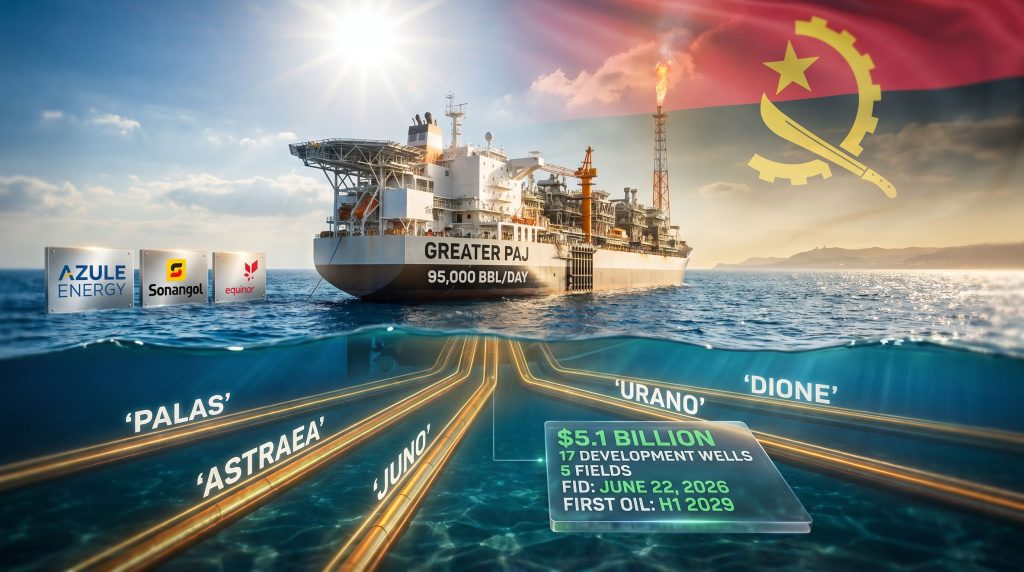
The Greater PAJ Project in Angola is an integrated deepwater multi-field development spanning five discrete offshore fields across two separately licensed concession blocks. This cross-block architecture distinguishes it from every prior Angolan offshore development, all of which were structured on a single-block basis.
The five constituent fields and their respective concessions are:
| Field Name | Concession Block |
|---|---|
| Palas | Block 31 |
| Astraea | Block 31 |
| Juno | Block 31 |
| Urano | Block 31/21 |
| Dione | Block 31/21 |
The name itself reflects this duality. PAJ derives from the three Block 31 fields that form the project's nucleus: Palas, Astraea, and Juno. The Greater designation signals the expanded scope, incorporating Urano and Dione from the adjacent Block 31/21 concession into a single unified development plan.
Development centres on 17 subsea production wells tied back to a purpose-built floating production, storage and offloading vessel. The FPSO was awarded to CIMC Raffles, a Chinese offshore engineering firm, with a nameplate processing capacity of 130,000 barrels per day and a targeted delivery date of 2028. The operational nameplate for the project itself is set at 95,000 barrels of oil per day, with associated gas handled through an export capacity of 70 million standard cubic feet per day.
First oil is targeted for the first half of 2029, with total capital expenditure estimated at approximately $5.1 billion, positioning Greater PAJ among the largest upstream investment commitments in sub-Saharan Africa this decade.
Why Cross-Block Integration Is a Technical Breakthrough
The engineering logic behind combining Blocks 31 and 31/21 into a single development framework deserves more than passing acknowledgment. In conventional deepwater development, separately licensed concession blocks typically require their own infrastructure: distinct FPSO vessels or tiebacks, separate gas handling systems, and independent drilling campaigns. This duplication inflates per-barrel capital costs and often renders individually marginal fields economically unviable in isolation.
By consolidating five fields under a single FPSO, shared gas export pipelines, and a unified 17-well drilling programme, Greater PAJ achieves economies of scale that would be unavailable to any single-block development. The aggregate resource base justifies the major capital commitment, while the shared infrastructure model compresses the per-barrel cost structure across the portfolio. Furthermore, this template has been applied with considerable success in mature deepwater basins including the North Sea and Gulf of Mexico, but its application in Angola's offshore environment at this scale is a genuine first. You can explore detailed project profiles of the PAJ complex for a broader technical perspective.
The Consortium Structure: Who Holds What in Greater PAJ
Azule Energy operates the project and serves as the commercial and technical engine behind its execution. Established in 2022 as an equal joint venture between Eni and bp, Azule Energy was formed specifically to consolidate both companies' Angolan upstream portfolios into a single operating entity, ending years of bilateral complexity that had repeatedly delayed major project decisions, including Greater PAJ itself.
The Block 31 equity consortium reflects the breadth of international and state capital committed to the project:
| Partner | Equity Interest |
|---|---|
| Azule Energy (Eni + bp JV) | 26.67% |
| Sonangol E&P | 45.00% |
| SSI Fifteen (Angola-China JV) | 15.00% |
| Equinor | 13.33% |
Sonangol E&P, Angola's national oil company, holds the dominant 45% stake, ensuring the Angolan state captures the largest share of project economics directly. This structure is not incidental; it reflects Angola's production sharing contract framework, under which the national company retains majority equity across major upstream developments.
Equinor's 13.33% participation reflects the Norwegian major's enduring commitment to deepwater African assets. The company has maintained an active Angola presence for many years, and its involvement here is consistent with a portfolio strategy that continues to value high-quality deepwater barrels even as the broader industry debates long-term oil demand trajectories.
SSI Fifteen, the Angola-China joint venture holding 15%, underscores the depth of Chinese capital involvement in Angola's upstream sector. This relationship has been built over more than two decades, partly through oil-backed financing arrangements that have funded infrastructure investment across the country. Chinese participation in major Angolan deepwater blocks has, consequently, become a structural feature of the sector rather than an occasional occurrence.
Two Decades in the Making: From Discovery to FID
The PAJ complex fields were first discovered in 2005, making the June 2026 FID the culmination of more than 21 years of appraisal work, commercial negotiation, and project restructuring. That timeline is not unusual for large deepwater developments, but it contains several inflection points worth understanding in detail.
The trajectory from discovery to sanction was shaped by several distinct phases:
- Initial discovery and appraisal (2005–2013): Fields confirmed and appraised, early development concepts formulated.
- Oil price collapse derails first attempt (2014): The sharp decline in global oil prices rendered the project's initial cost structure economically unviable. Development plans were shelved.
- FPSO procurement failures (mid-2010s): Multiple attempts to secure a vessel provider were initiated and subsequently abandoned. An earlier agreement with Yinson lapsed before a new competitive tender process was launched.
- Azule Energy formation creates new momentum (2022): The consolidation of Eni and bp's Angolan operations into a single entity streamlined the internal decision-making architecture. Bilateral friction between two major IOCs with differing corporate priorities gave way to a unified operational mandate.
- FID announced (22 June 2026): After four years of renewed commercial momentum under Azule Energy, the project received formal sanction.
The selection of CIMC Raffles for FPSO construction following the earlier Yinson lapse is itself a notable data point. It reflects both the competitive dynamics of the FPSO construction market and the pragmatic approach Azule Energy took in rebuilding a procurement process from the ground up after prior arrangements collapsed. Indeed, the stalled Angola project and its revival with the FPSO award attracted considerable industry attention at the time.
Gas Export Infrastructure and the Angola LNG Connection
Greater PAJ's gas component deserves specific attention because it addresses one of the longstanding criticisms of sub-Saharan African deepwater development: routine associated gas flaring.
The project's 70 million standard cubic feet per day gas export capacity will be transported through a newly constructed pipeline that interfaces with existing Block 31 gas infrastructure. From there, gas flows into the Angola LNG plant, which liquefies the resource for international export rather than allowing it to be flared at the wellhead.
This integration serves multiple purposes simultaneously:
- It monetises a resource stream that would otherwise represent an environmental liability.
- It supports Angola's public commitments to reducing routine gas flaring in line with internationally recognised standards.
- It strengthens the commercial case for project financing by aligning the development with environmental criteria increasingly demanded by institutional lenders and export credit agencies.
Angola LNG, located in Soyo, was originally designed with associated gas monetisation as a central objective. The connection of Greater PAJ volumes into that value chain reinforces the plant's long-term throughput position and the integrated logic of Angola's upstream-to-export infrastructure.
The next major ASX story will hit our subscribers first
The $5.1 Billion Investment Case: Risks and Considerations
At $5.1 billion in total capital expenditure, Greater PAJ carries the financial characteristics of a major deepwater megaproject. However, investors and industry observers should weigh both the opportunity and the execution challenges inherent at this scale. The geopolitical landscape facing metals and mining in 2025 illustrates how external macro forces can reshape capital allocation decisions across resource sectors, and similar dynamics apply here.
Key execution risks include:
- FPSO delivery timing: The CIMC Raffles vessel must be delivered and commissioned in 2028 to support the H1 2029 first oil milestone. Delays in FPSO construction are among the most common sources of schedule slippage in deepwater projects globally.
- Subsea complexity: Drilling and completing 17 wells across two concession blocks, with tie-back architecture spanning different geological units, introduces meaningful technical complexity. Supply chain constraints for deepwater equipment including subsea trees, risers, and umbilicals remain a persistent sector-wide challenge.
- Commodity price sensitivity: A multi-year payback horizon from a 2029 first oil date exposes the project's economics to prolonged commodity price uncertainty. Understanding crude oil price volatility and trends in 2025 provides useful context for assessing this risk. The project's breakeven threshold has not been publicly disclosed, but at this capital intensity, sustained oil prices well above current futures curves would be required for robust returns.
- Regulatory and fiscal stability: Angola has implemented meaningful upstream regulatory reforms since 2017, but production sharing contract terms and local content obligations remain variables that could evolve over the project's production life. Furthermore, the broader trade war impact on oil markets in 2025 adds another layer of macro uncertainty for long-horizon capital commitments.
These considerations do not diminish the strategic significance of the FID but are material factors for any comprehensive assessment of the project's risk-return profile.
Angola's Deepwater Development Pipeline: Where Greater PAJ Sits
Placing Greater PAJ in its competitive context helps clarify both its scale and its strategic timing. In addition, understanding Angola's position within the global energy landscape — including how WTI and Brent benchmarks influence deepwater project economics — is essential for a complete picture.
| Project | Operator | Peak Capacity | FID Year | First Oil |
|---|---|---|---|---|
| Greater PAJ | Azule Energy | 95,000 bbl/day | 2026 | H1 2029 |
| Agogo (Block 15/06) | Eni/Azule Energy | ~200,000 bbl/day | 2019 | 2022 |
| Cameia-Golfinho (Block 20/11) | Eni | TBC | TBD | TBD |
Agogo, which achieved first oil in 2022, demonstrated that Angola's deepwater development pipeline could deliver at scale with Eni/Azule Energy as operator. Greater PAJ builds on that operational track record while introducing the additional structural complexity of cross-block integration. Eni has maintained a continuous presence in Angola since 1980, providing institutional knowledge and relationship capital that few international operators can match in the country.
The National Agency for Petroleum, Gas and Biofuels (ANPG) has worked to reduce the time between discovery and FID for deepwater assets, and Greater PAJ's sanction signals that this regulatory environment has become sufficiently predictable for a consortium of this calibre to commit capital at this magnitude. For broader context, Australia's own resource and energy export challenges in 2025 offer a useful comparative lens on how different jurisdictions manage the tension between regulatory reform and sustained investment attraction. Whether the cross-block integration model is adopted for future multi-concession developments across Angola's offshore acreage will be one of the defining questions for Angola's upstream strategy through the early 2030s.
Frequently Asked Questions: Greater PAJ Project Angola
What does PAJ stand for in the Greater PAJ Project?
PAJ refers to the three Block 31 fields at the project's core: Palas, Astraea, and Juno. The Greater prefix reflects the project's expanded scope, which incorporates Urano and Dione from the adjacent Block 31/21 concession into a single unified development.
When was the FID for the Greater PAJ Project announced?
The Final Investment Decision was formally confirmed on 22 June 2026.
Who is the FPSO contractor for Greater PAJ?
CIMC Raffles was awarded the FPSO construction contract. The vessel carries a design capacity of 130,000 barrels per day and is scheduled for delivery in 2028, ahead of the H1 2029 first oil target.
What is the total estimated cost of the Greater PAJ Project?
Total capital expenditure is estimated at approximately $5.1 billion.
What makes Greater PAJ Angola's first integrated cross-block development?
All previous Angolan offshore projects were developed on a single-concession basis. Greater PAJ unifies five fields spanning two separately licensed blocks under a shared FPSO, common well programme, and integrated gas export infrastructure — a structural first for the country's offshore sector.
How does Greater PAJ's gas production connect to Angola LNG?
Associated gas produced from the five fields will move through a new dedicated export pipeline connecting into the existing Block 31 gas network, with onward delivery to the Angola LNG plant for liquefaction and export, supporting Angola's broader commitment to eliminating routine gas flaring.
Disclaimer: This article is intended for informational and educational purposes only. It does not constitute financial advice or investment recommendations. Statements regarding production timelines, capital expenditure, and project economics involve forecasts and assumptions that are subject to material change. Readers should conduct independent due diligence before making any investment decisions related to companies or projects discussed herein.
Want to Track the Next Major Resource Discovery Before the Market Does?
Discovery Alert's proprietary Discovery IQ model delivers real-time alerts on significant ASX mineral discoveries, transforming complex resource data into actionable investment insights — much like the commercial logic that underpins major capital commitments such as Greater PAJ. Explore historic examples of exceptional discovery returns or visit the Discovery Alert home page to begin your 14-day free trial and position yourself ahead of the broader market.