
June 23, 2026
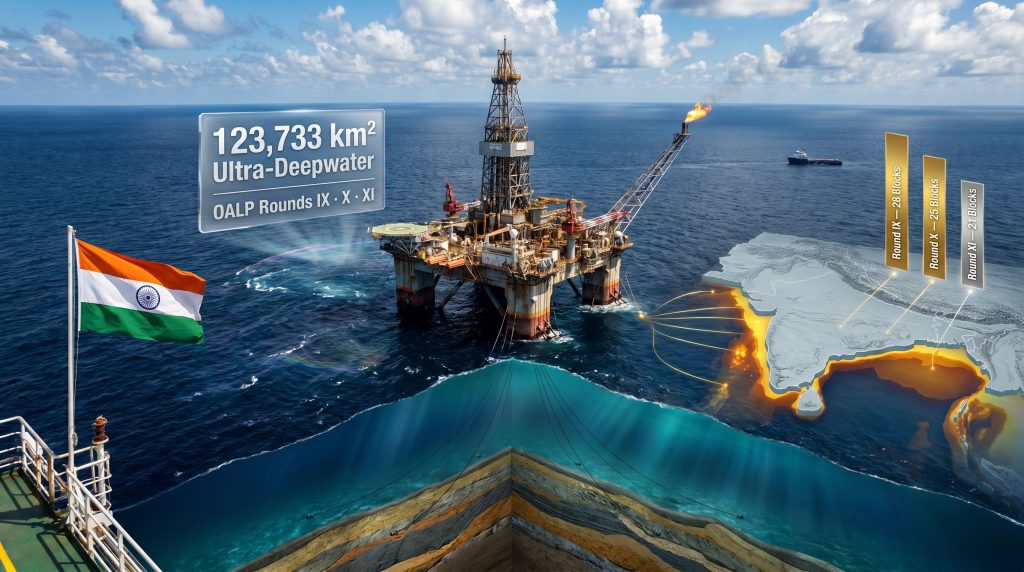
The Hidden Economics Behind Frontier Exploration Failure
When a government extends a bidding deadline once, it signals administrative flexibility. When it extends the same deadline six times across multiple simultaneous licensing rounds, it signals something far more structural: a fundamental misalignment between what a country is offering and what international capital actually requires to commit.
India extends bidding deadline for deepwater oil and gas blocks under its tenth Open Acreage Licensing Programme (OALP-X) round, now set for September 17, 2026, reflecting precisely this kind of systemic friction. The same deadline applies to deepwater assets under OALP-XI, also extended to September 17. These are not isolated scheduling adjustments. They represent the clearest available signal that India's deepwater licensing strategy has not yet crossed the threshold required to attract serious frontier exploration capital.
Understanding why requires looking beyond the headlines and into the underlying mechanics of how international oil majors make capital allocation decisions in a world of competing deepwater opportunities. Furthermore, these decisions intersect directly with oil price movements and broader geopolitical pressures shaping the global energy sector.
When big ASX news breaks, our subscribers know first
What OALP Is and Why Its Architecture Matters
The Open Acreage Licensing Programme was designed to replace India's earlier discretionary licensing model with a more transparent, competitive framework. Under OALP, companies can nominate any acreage across India's sedimentary basins, which then triggers formal bid rounds administered by the Directorate General of Hydrocarbons (DGH), India's upstream regulatory body.
This structural openness was intended to signal a break from the opacity of older systems, giving foreign operators more control over which geological targets they pursue. In theory, it should be a compelling proposition. In practice, the results across the most recent active rounds tell a more complicated story.
| OALP Round | Launch Date | Total Blocks | Deepwater Blocks | Ultra-Deepwater Blocks | Ultra-Deepwater Area (km²) |
|---|---|---|---|---|---|
| Round IX | January 3, 2026 | 28 | 1 | 12 | 123,733 |
| Round X | February 2025 | 25 | 1 | 12 | Not separately disclosed |
| Round XI | March 2025 | 21 | 1 | 4 | Not separately disclosed |
The combined scale of ultra-deepwater acreage on offer across these simultaneous rounds is among the largest parallel deepwater licensing exercises in the Asia-Pacific region. Yet the DGH has been forced to repeatedly extend deadlines specifically for offshore complex-water assets, while allowing bidding to close on schedule for onshore and shallow-water blocks in both OALP-X and OALP-XI.
That selective extension pattern is analytically significant. It means onshore and shallow-water blocks attracted sufficient interest to proceed, while the assets requiring the greatest technical capability and capital commitment did not. The deepwater problem in India is not a general investor hesitancy story. It is a specific frontier capital problem.
A Chronicle of Repeated Extensions
Tracking the extension history across active rounds reveals the depth of the challenge India faces in attracting competitive bids for its most prospective offshore acreage.
OALP Round X Extension History:
- Launched February 2025
- Deadline extended a first, second, third, and fourth time before reaching May 29, 2026
- A fifth extension followed
- The sixth extension moved the deepwater and ultra-deepwater deadline to September 17, 2026
- Non-deepwater blocks in OALP-X closed on schedule without requiring extension
OALP Round XI Extension History:
- Launched March 2025
- Extended five times, with the fifth deadline set at June 19, 2026
- Current deepwater and ultra-deepwater deadline extended to September 17, 2026
- Non-deepwater blocks in OALP-XI also closed on schedule
OALP Round IX Extension History:
- Launched January 3, 2026, with an original deadline of February 29, 2026
- First extension to May 15, 2026
- Second extension to August 31, 2026
- Current deadline: September 21, 2026
- Official reason cited: legislative amendments targeting ease-of-doing-business reforms in the upstream sector
Notably, the DGH did not publicly provide a formal reason for extending deepwater deadlines in OALP-X while simultaneously closing non-deepwater bidding in the same round. That silence is itself instructive.
Why International Capital Is Staying Away
The absence of competitive bidder interest in Indian deepwater acreage cannot be attributed to any single barrier. It reflects a layered set of structural concerns that international oil majors and exploration-focused companies weigh when allocating finite exploration budgets.
Fiscal and Contractual Architecture
India has historically operated production-sharing contracts with cost-recovery provisions that many international operators considered less competitive than comparable deepwater jurisdictions. The government has been drafting revised model contracts and amending key policy provisions since early 2025, but until finalised terms are published and tested, uncertainty itself becomes a deterrent.
Experienced exploration companies have long institutional memory of fiscal renegotiations in emerging market upstream environments, and incomplete reform signals are often treated with more caution than no reform at all. In addition, the importance of oil to the global economy means that any hesitation in committing capital to unproven basins is amplified.
The Discovery Track Record Problem
Perhaps the least-discussed but most commercially significant barrier is geological confidence. India has not recorded a major commercial hydrocarbon discovery in more than two decades. For frontier exploration investors, discovery track record is a primary input into basin prospectivity assessments.
This matters because deepwater exploration decisions are inherently probabilistic. When operators compare Indian ultra-deepwater acreage against pre-salt blocks in Brazil or proven deepwater systems in West Africa, the relative geological confidence intervals diverge sharply. Capital flows toward basins where the probability-weighted expected value of a discovery is supported by recent analogues.
Competing Global Deepwater Opportunities
The international deepwater exploration market has become increasingly competitive in recent years. Brazil's pre-salt regime, anchored by a state operator partnership model, offers proven reserves and established fiscal frameworks. Deepwater acreage across Angola, Mozambique, and Nigeria provides internationally benchmarked production-sharing terms with decades of operational track record.
| Deepwater Jurisdiction | Key Advantage | Primary Investor Concern |
|---|---|---|
| Brazil (Pre-Salt) | Proven reserves, state anchor partnership | Scale of capital required |
| West Africa | Established fiscal terms, IOC track record | Political risk in some markets |
| Southeast Asia | Regulatory speed, proximity to demand centres | Smaller reserve potential |
| India (OALP) | Scale of acreage offered | Unproven recent discovery track record, evolving fiscal terms |
India's deepwater acreage may hold significant geological potential. But potential without geological confirmation and competitive fiscal terms is insufficient to displace other opportunities in international portfolio construction.
Post-2020 Capital Allocation Discipline
Following the 2020 oil price collapse, most international oil majors fundamentally restructured their capital allocation frameworks. The industry-wide shift toward shorter-cycle, lower-risk assets and accelerated returns has systematically disadvantaged frontier deepwater exploration, which typically requires eight to fifteen years from discovery to peak production.
Consequently, India's deepwater rounds are competing not only against other deepwater jurisdictions but against an entirely different risk-return philosophy that has reshaped how major operators think about exploration spending.
The Iran Conflict Variable and Its Upstream Implications
The escalation involving Iran has introduced new urgency into India's upstream strategy calculus. As a major net importer of crude oil with historical dependence on Middle Eastern supply, India is acutely exposed to regional supply disruptions and price volatility driven by geopolitical shocks. The geopolitical landscape for metals and energy mirrors these same pressures across multiple commodity classes.
This exposure has reinforced internal policy discussions around domestic production development in ways that purely commercial arguments had not. Officials have framed international oil major participation in OALP rounds not merely as a commercial licensing exercise but as a component of national energy security architecture.
The long-term production mathematics make this framing rational. Even if a major ultra-deepwater discovery were confirmed in Indian waters during the current bid round, the earliest realistic timeline to peak production extends to the late 2030s. Every deadline extension, in this context, is not merely an administrative delay. It is a compound deferral of India's long-term energy security optionality.
What India's Reform Agenda Looks Like in Practice
Since launching OALP-X in February 2025, India has undertaken a substantial overhaul of its upstream regulatory framework. The reform programme spans multiple dimensions.
| Reform Area | Current Status | Investor Concern Level |
|---|---|---|
| Cost recovery provisions | Under active revision | High |
| Seismic data availability | Partially improved | Medium-High |
| Model contract terms | Amendments ongoing | High |
| Dispute resolution mechanisms | Under review | Medium |
| Royalty and tax framework | Partially reformed | High |
| Environmental clearance timelines | Simplified in select categories | Medium |
The challenge is not the absence of reform intent. Rather, the challenge is that reform processes conducted in parallel with active bid rounds create a moving target problem. Prospective bidders conducting due diligence on Indian deepwater blocks during 2025 and 2026 have been evaluating assets under contractual terms that were simultaneously being rewritten.
A separate special upstream bidding round covering two small oil and gas fields in Mumbai Offshore and one coal-bed methane field in West Bengal also had its deadline extended to September 13, 2026. That even smaller, lower-complexity assets are failing to attract timely bids suggests investor hesitancy extends beyond deepwater technical complexity alone.
The next major ASX story will hit our subscribers first
A Strategic Prescription for Closing the Gap
Achieving meaningful participation in India's deepwater bid rounds requires addressing structural barriers rather than simply providing more time. Furthermore, the lessons learnt here have implications for how nations approach the mining and commodity outlook more broadly, as capital scarcity and risk aversion increasingly shape frontier investment decisions.
A phased reform pathway could include the following priorities:
Immediate priorities before September 2026:
- Publish finalised model contracts with internationally benchmarked fiscal terms before bid deadlines
- Provide unambiguous written clarity on cost-recovery provisions and profit-sharing mechanisms
- Accelerate modern seismic data release through enhanced data room access for qualified bidders
Medium-term structural reforms (1–3 years):
- Establish a dedicated fast-track clearance pathway specific to deepwater exploration activities
- Consider a state anchor partnership model similar to Petrobras's role in Brazil's pre-salt system to reduce perceived risk for international co-investors
- Develop a dispute resolution framework aligned with international arbitration standards
Long-term positioning (3–10 years):
- Invest in systematic geological survey programmes to build the subsurface data quality needed to reduce uncertainty premiums
- Build a transparent track record of successful bid round outcomes to establish India's reliability as a deepwater exploration destination
- Align fiscal terms dynamically with competitive benchmarks as the global deepwater market evolves, particularly given the critical raw materials competition reshaping how governments think about strategic resource development
Frequently Asked Questions: India's OALP Deepwater Bid Extensions
Why has the OALP-X deepwater bidding deadline been extended six times?
The sixth extension reflects persistent difficulty in attracting qualified international bidders. Each extension window has been used to progress policy reforms, but structural barriers including fiscal uncertainty, geological risk, and competing global opportunities continue to limit participation.
What distinguishes deepwater from ultra-deepwater in Indian licensing terms?
Deepwater blocks are generally located in water depths from approximately 300 to 1,500 metres. Ultra-deepwater extends beyond 1,500 metres and requires significantly more advanced drilling technology, specialised equipment, and greater capital commitment, limiting eligible participants to the largest international operators.
What blocks does OALP Round IX cover?
OALP Round IX covers 28 blocks across 13 sedimentary basins, comprising 6 onshore blocks covering 16,871 km², 6 shallow-water blocks covering 41,391 km², 1 deepwater block covering 9,991 km², and 12 ultra-deepwater blocks covering 123,733 km².
Why were non-deepwater blocks allowed to close while deepwater deadlines were extended?
The selective approach indicates that onshore and shallow-water blocks attracted sufficient competitive interest to proceed on schedule. Deepwater and ultra-deepwater assets, requiring greater technical capability and longer capital commitment horizons, did not generate comparable bidder engagement within standard timeframes.
What role does the Directorate General of Hydrocarbons play?
The DGH is India's upstream regulatory authority responsible for administering OALP licensing rounds, managing bid processes, setting submission deadlines, and overseeing upstream exploration policy implementation.
This article is intended for informational purposes only and does not constitute financial or investment advice. Forecasts and projections referenced throughout involve inherent uncertainty and should not be relied upon as predictions of future outcomes. Readers should conduct independent due diligence before making any investment or commercial decisions.
Want To Capitalise on the Next Major Resource Discovery Before the Broader Market Catches On?
Discovery Alert's proprietary Discovery IQ model delivers real-time alerts on significant ASX mineral discoveries, transforming complex geological data into clear, actionable investment insights for traders and long-term investors alike — explore historic examples of exceptional discovery returns to understand the scale of opportunity, then begin your 14-day free trial at Discovery Alert to position yourself ahead of the market.