
June 23, 2026
The Infrastructure Behind the Intelligence: Understanding AI Data Center Energy Demand at Scale
Electricity infrastructure has always expanded in waves tied to transformative technologies. The electrification of manufacturing in the early twentieth century, the rise of air conditioning across the Sun Belt, the proliferation of home computing in the 1990s, and the buildout of internet infrastructure in the 2000s each placed new and unexpected stresses on grids that were never designed to accommodate them. Every one of those waves was eventually absorbed through investment, innovation, and adaptation. The wave now building around AI data center energy demand is different in at least one critical respect: its energy appetite is growing faster than grid infrastructure has ever been asked to respond.
Understanding why requires moving past the headline statistics and into the underlying engineering realities of how AI systems actually consume power, where that power has to come from, and what the physical constraints on delivery look like when demand scales from gigawatts to hundreds of gigawatts within a single decade. The AI investment implications of this trajectory are profound, spanning generation assets, transmission infrastructure, and cooling technology.
When big ASX news breaks, our subscribers know first
What Makes AI Workloads So Much More Energy-Intensive Than Traditional Computing?
The energy profile of a conventional enterprise data center is well understood. Standard server racks draw between 7 and 10 kilowatts each, cooling is handled through raised-floor air circulation, and demand varies predictably across the business day. The total power footprint of a large corporate data center might be measured in tens of megawatts.
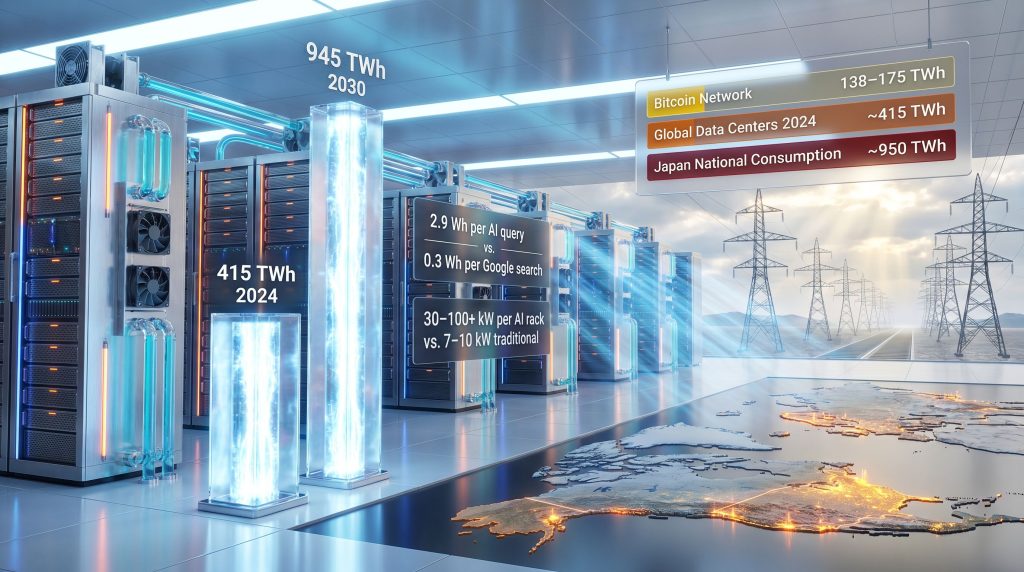
AI infrastructure, however, operates under an entirely different set of physical constraints. GPU-based training and inference clusters routinely draw between 30 and 100+ kilowatts per rack, with dedicated AI facilities averaging above 60 kW across their installed base. That density gap is not simply a matter of more powerful hardware: it represents a qualitative shift in how heat is generated, how it must be removed, and how much electrical infrastructure is required per unit of floor space.
Training vs. Inference: The Two-Stage Energy Architecture
AI systems consume energy across two structurally distinct phases, each with different demand characteristics:
| Workload Stage | Share of AI Energy Footprint | Key Characteristics |
|---|---|---|
| Inference | ~60% | Continuous, scales directly with user adoption |
| Training | ~30% | Episodic but intensifying with each model generation |
| Ancillary Operations | ~10% | Storage, networking, and management overhead |
Training a frontier-class AI model is computationally intensive but episodic. Each new model generation requires a finite burst of compute, after which that specific training run ends. The energy equivalent of training a single large-scale model is roughly what 120 average U.S. households consume across an entire year, a figure that is rising with each successive model generation. By 2027, some forecasts suggest that training a single frontier model could require access to as much as 5 gigawatts of dedicated power, a figure comparable to the total generating capacity of several mid-sized nations.
Inference, however, is the long-term demand driver that changes the grid calculus entirely. Every time a user submits a query to an AI assistant, a recommendation engine processes a browsing session, or an automated system runs a real-time decision, inference workloads are executing continuously at scale. A single ChatGPT-style query consumes approximately 2.9 watt-hours of electricity, compared to roughly 0.3 watt-hours for a conventional web search. That nearly tenfold difference per transaction, multiplied across billions of daily interactions, creates a persistent baseload demand profile that traditional data centers simply do not generate.
The Cooling Constraint: Why Rack Density Changes Everything
The transition from air-cooled to liquid cooling architectures is not a design preference for AI facilities: it is a physical necessity. Air-based cooling systems have a practical upper limit around 20 to 25 kW per rack before thermal management becomes unworkable. At 60 to 100+ kW densities, direct-to-chip liquid cooling or full immersion systems are the only viable options.
This shift has cascading infrastructure implications. Cooling systems already account for 30 to 40% of total data center power consumption even in optimised facilities. A single large-scale AI campus can draw up to 5 million gallons of water daily for thermal management purposes. The geographic implications of that water demand are becoming a binding site-selection constraint in water-stressed markets across the American Southwest and parts of Southern Europe.
How Big Will AI Data Center Power Demand Get by 2030?
The International Energy Agency's 2024 data and forward projections provide the most widely cited quantitative framework for understanding the scale of AI data center energy demand growth.
Global data centers consumed approximately 415 terawatt-hours of electricity in 2024, equivalent to roughly 670,000 barrels of oil equivalent per day when expressed in terms of primary energy. The IEA projects that figure will rise to 945 TWh by 2030, representing more than a doubling of consumption within six years and a daily oil-equivalent demand approaching 1.5 million barrels.
For context, that trajectory places AI data center energy demand in the same order of magnitude as the total electricity consumption of Japan, the world's third-largest economy, within the current decade.
U.S.-Specific Demand: From Percentage Share to Absolute Capacity
The United States currently hosts the largest concentration of data center infrastructure globally. The domestic picture illustrates just how rapidly the demand curve is steepening:
| Timeframe | U.S. Data Center Power Share | Absolute Capacity Estimate |
|---|---|---|
| 2023 (Baseline) | ~4.4% of U.S. electricity | ~17–20 GW |
| 2028 (Mid-Term) | 6.7–12.0% of U.S. electricity | ~50 GW new capacity required |
| 2030 (IEA Projection) | 8–12% of U.S. electricity | Consistent with 945 TWh globally |
| 2035 (Long-Term) | Potentially 15–20%+ | ~123 GW (Deloitte estimate) |
Deloitte's long-range modelling places U.S. AI data center power demand at a potential 30-fold expansion between the present and 2035, reaching an estimated 123 gigawatts of operational capacity. Near-term growth alone is substantial: U.S. data center power consumption is projected to expand by approximately 83 TWh in 2025, an increment equivalent to powering around 7.7 million homes.
How Does AI Energy Demand Compare to Other Major Power Consumers?
Benchmarking AI infrastructure against established energy-intensive industries places the scale of demand growth in sharper relief.
| Energy Consumer | Annual Electricity Consumption (Approx.) |
|---|---|
| Bitcoin Network (2024) | 138–175 TWh |
| Global Data Centers (2024) | ~415 TWh |
| Global Data Centers (2030 Projection) | ~945 TWh |
| Japan (National Consumption) | ~950 TWh |
| Germany (National Consumption) | ~500 TWh |
The Bitcoin network currently draws between 138 and 175 TWh annually, depending on which energy model is applied. AI data center infrastructure is already consuming approximately 2.4 to 3 times more electricity than the entire global cryptocurrency mining industry. By 2030, furthermore, the gap widens considerably.
The carbon arithmetic of AI inference at scale adds another dimension. Processing one million tokens of AI output, roughly equivalent to one dollar of compute cost at current market rates, generates carbon emissions comparable to driving a petrol-powered vehicle somewhere between 5 and 20 miles, depending entirely on the emissions intensity of the underlying grid. That variability makes the geographic location of data center infrastructure, and the carbon composition of the power supply serving it, a critical variable in the environmental accounting of AI at scale. Consequently, the critical minerals demand required to build out low-carbon generation assets is rising in lockstep with AI infrastructure growth.
What Are the Physical Infrastructure Constraints Limiting Expansion?
The gap between AI infrastructure demand and the grid's capacity to serve it is not primarily a financial problem. Capital is available. The binding constraints are physical and institutional.
The Grid Interconnection Bottleneck
Grid connection approval timelines in major U.S. and European markets now extend beyond four years in many jurisdictions. Transformer manufacturing shortages are compounding those delays, as the specialised high-voltage transformers required for large campus interconnections operate on production lead times that have extended significantly as demand has accelerated. Transmission corridor congestion is emerging across established data center clusters in Northern Virginia, Texas, and the Dublin-to-Amsterdam corridor in Europe.
Utilities are increasingly unable to accommodate hyperscale campus requests for hundreds of megawatts of new load within existing grid architecture without undertaking transmission upgrades that themselves require years of permitting, engineering, and construction. The result is that power availability, not capital, land, or permitting, has become the primary limiting factor for AI infrastructure growth. In addition, energy security risks are compounding these bottlenecks, particularly in markets heavily dependent on imported fuels.
Why Northern Europe Has Become a Strategic Priority
The combination of geography, grid composition, and ambient climate has made Northern Europe, particularly Norway and Finland, among the most strategically valuable AI data center locations on the planet.
Northern Europe's convergence of hydroelectric surplus, nuclear baseload capacity, sub-Arctic ambient temperatures, and industrial electricity rates below $0.05 per kilowatt-hour creates conditions that are exceptionally rare globally: low-cost, low-carbon, and naturally cooled compute infrastructure at industrial scale.
Hydroelectric facilities that historically exported surplus power southward now supply digital infrastructure campuses in areas where ambient air temperatures reduce mechanical cooling requirements to near zero for significant portions of the year. The combination eliminates two of the largest cost centres in conventional data center operation simultaneously: energy procurement cost and cooling system power draw.
Operators running facilities at this energy cost level, below 4 to 5 cents per kilowatt-hour all-in, occupy a structurally different competitive position than those operating on U.S. grid power at 7 to 10 cents or more. Those economics are not marginal: at scale, they translate directly into the viability of serving AI workloads profitably over multi-decade infrastructure cycles.
What Energy Sources Are Being Mobilised to Power the AI Build-Out?
Four distinct power strategies are emerging across the industry as operators attempt to secure reliable, scalable supply at the pace AI demand requires:
-
Utility-Scale Renewable Energy Agreements — Long-term power purchase agreements with wind and solar developers, often requiring new dedicated transmission infrastructure to deliver the contracted capacity to data center campuses. The renewable energy solutions being deployed across the sector are evolving rapidly to meet these unprecedented requirements.
-
Nuclear Power Partnerships — Direct agreements with nuclear plant operators for dedicated baseload supply. Several major technology companies have entered into such arrangements as nuclear's always-on, carbon-free profile makes it uniquely suited to the 24/7 non-interruptible demand profile of AI infrastructure.
-
Natural Gas Bridging — Gas-fired generation deployed as transitional baseload while longer-duration renewable and nuclear capacity is developed. This is driving increased investment in gas infrastructure in data center corridors.
-
Vertically Integrated Energy Ownership — Operators acquiring or developing their own generation assets to achieve supply independence from constrained utility grids and bypass interconnection queue delays entirely.
Small modular reactors are attracting growing interest as purpose-built baseload solutions for large AI campuses, though commercial deployment timelines remain uncertain. Behind-the-meter generation through modular gas turbines and fuel cells is being used as an interim solution by operators who cannot wait for grid interconnection approvals.
The Jevons Paradox Problem in AI Computing
One frequently cited counterargument to demand growth projections is that successive generations of AI accelerator chips deliver meaningful improvements in performance per watt, potentially moderating the overall energy trajectory. This argument, however, has a historical precedent problem.
The pattern observed across semiconductor development over decades is that efficiency improvements tend to be absorbed by expanded workload volumes rather than translating into reduced total consumption, a dynamic known in economics as the Jevons Paradox. More efficient chips enable more AI applications at lower per-unit cost, which drives adoption, which increases total query volumes, which increases total energy consumption despite the per-query improvement. Furthermore, the rare earth processing requirements for advanced chip manufacturing add yet another layer of supply-chain complexity to this picture.
The net expectation among energy analysts is that chip efficiency gains will moderate but not reverse the trajectory of AI data center energy demand growth over the projection horizon.
The next major ASX story will hit our subscribers first
The Investment Scale of the AI Power Build-Out
The capital requirements associated with resolving AI's energy equation are themselves historically unprecedented.
JLL estimates global data center capacity will approximately double by 2030, requiring close to 100 gigawatts of new supply and combined infrastructure and GPU spending of up to $3 trillion. McKinsey's projections place total AI infrastructure spending approaching $7 trillion globally by 2030, with more than $5 trillion tied directly to AI workload infrastructure.
The scale of AI-driven electricity demand growth is generating structural investment demand across the entire power value chain, from generation and transmission through cooling technology and grid management software, with capital requirements comparable to constructing an entirely new national electricity system.
Goldman Sachs and other institutional analysts have identified the AI power build-out as one of the largest single drivers of electricity infrastructure investment in the modern era. The investment opportunity is not concentrated in any single technology or geography: it spans generation assets, transmission infrastructure, cooling systems, grid management software, and the underlying real estate and power capacity that AI campuses require to operate.
Three Scenarios for How the Power-AI Collision Resolves
The trajectory of AI data center energy demand over the coming decade is not predetermined. Three plausible scenarios frame the range of outcomes:
Scenario 1: Constrained Growth. Grid interconnection delays and clean energy supply shortfalls create a supply-side bottleneck that moderates AI infrastructure deployment below IEA baseline projections. Demand growth continues but at a slower pace than announced capacity plans suggest.
Scenario 2: Managed Expansion. Coordinated investment in nuclear, hydroelectric, and grid infrastructure enables demand growth broadly consistent with IEA projections. AI operators absorb higher energy costs, which become embedded in the economics of AI service pricing.
Scenario 3: Accelerated Disruption. Breakthrough improvements in AI chip efficiency, combined with architectural changes in model design that reduce inference compute requirements, partially offset demand growth from expanding user bases and new application categories.
The most likely near-term path involves elements of all three: some geographic markets experience constrained growth while others with superior grid and generation positions expand rapidly, efficiency gains moderate but do not eliminate demand growth, and capital deployment into generation infrastructure accelerates but remains behind the pace of announced demand.
FAQ: AI Data Center Energy Demand
How Much Electricity Do AI Data Centers Use Globally Right Now?
Global data centers consumed approximately 415 TWh of electricity in 2024, with AI workloads representing the fastest-growing component of that total, equivalent to roughly 670,000 barrels of oil equivalent per day.
How Much Will AI Data Center Power Demand Grow by 2030?
The IEA projects global data center electricity consumption will exceed 945 TWh by 2030, more than double the 2024 figure, driven primarily by AI adoption across training and inference workloads.
What Percentage of U.S. Electricity Will AI Data Centers Consume?
Current estimates place U.S. data center consumption at 3 to 4% of national electricity demand, projected to rise to 8 to 12% by 2030 and potentially beyond 15% by 2035 under high-growth scenarios modelled by Deloitte.
Why Is AI So Much More Energy-Intensive Than Traditional Computing?
AI systems operate at power densities of 30 to 100+ kW per rack versus 7 to 10 kW for conventional servers, and AI inference operates as a continuous, persistent baseload rather than a variable peak load.
What Is the Biggest Constraint on AI Data Center Expansion?
Grid interconnection capacity is currently the binding constraint, with approval timelines exceeding four years in major markets, compounded by transformer shortages and transmission bottlenecks.
Which Energy Sources Are Best Suited to Power AI Data Centers?
Hydroelectric and nuclear power are considered optimal due to their ability to provide continuous, carbon-free baseload. Natural gas serves as a bridging fuel in many markets, whilst renewable energy PPAs are widely used but require storage or backup solutions to meet 24/7 demand requirements.
Summary: The Energy Equation Powering the AI Era
| Metric | 2024 Figure | 2030 Projection | Change |
|---|---|---|---|
| Global Data Center Electricity Use | 415 TWh | 945 TWh | +128% |
| Oil Equivalent (Barrels/Day) | ~670,000 boe/d | ~1.5M boe/d | +124% |
| U.S. Data Center Power Share | 3–4% of national grid | 8–12% of national grid | 2–3× increase |
| AI Inference Energy per Query | ~2.9 Wh | Improving, but volumes rising | Net demand up |
| Required New Global Capacity | Baseline | ~100 GW | Unprecedented build |
| Combined Infrastructure Spend | Baseline | Up to $3T (JLL) / $7T (McKinsey) | Largest in modern history |
The fundamental dynamic is straightforward even if the engineering details are complex. AI data center energy demand is growing faster than the grid infrastructure designed to serve it, creating a structural gap between announced capacity plans and the power that can actually be delivered to those facilities within any reasonable timeframe. The geographic locations that resolve that tension most effectively, through superior grid access, low-cost clean baseload generation, and favourable ambient conditions for cooling, are emerging as the critical strategic variables in AI infrastructure investment for the decade ahead.
This article contains forward-looking projections sourced from the International Energy Agency, Deloitte, JLL, and McKinsey. Such projections involve assumptions about technology adoption, grid investment, and policy environments that may differ materially from actual outcomes. Nothing in this article constitutes investment advice. Readers should conduct independent research and consult a qualified financial adviser before making investment decisions.
Want to Know Which ASX Companies Are Positioned to Benefit From the AI Energy Build-Out?
Discovery Alert's proprietary Discovery IQ model scans ASX announcements in real time, instantly identifying significant mineral discoveries tied to the critical minerals, energy infrastructure, and commodities underpinning the AI power revolution — from copper and rare earths to uranium. Explore historic discovery returns on Discovery Alert's dedicated discoveries page to understand the scale of opportunity, then begin your 14-day free trial to receive actionable alerts the moment the next major discovery is announced.