
June 23, 2026
When Forum Sentiment Meets Market Reality: Decoding Tuesday's ASX HotCopper Trends
Retail investor communities have long functioned as informal price discovery mechanisms, operating in parallel with institutional research and often reacting faster to news that carries emotional or thematic weight. On any given trading session, the stocks attracting the most discussion on Australia's largest retail investor forum can offer a window into where speculative capital is flowing, what narratives are gaining traction, and which sectors are capturing the collective imagination of the market's most active participants. Tuesday 23 June 2026 produced a particularly revealing snapshot of that dynamic, with Tuesday's HotCopper trends centred on three very different companies united by a single thread: each represented a distinct phase in the lifecycle of a resource or energy project, from early-stage partnership formation through to infrastructure completion and full-scale production commencement.
When big ASX news breaks, our subscribers know first
HotCopper as a Sentiment Barometer: More Than Just Noise
With more than 600,000 average monthly users, HotCopper occupies a unique position in the Australian investment landscape. It functions less like a traditional media outlet and more like a live sentiment index, capturing the immediate reactions of retail participants to news flow, market moves, and thematic developments as they unfold in real time.
Forum activity is not merely a lagging indicator of price action. For smaller-cap stocks where retail participation makes up a meaningful share of daily volume, elevated discussion frequency and intensity can itself become a contributing factor to short-term price movement. This creates a feedback loop that active traders have learned to monitor, using trending forum discussions as an overlay signal alongside technical and fundamental analysis.
What makes Tuesday's session particularly instructive is the divergence in price responses across the three featured names. That divergence tells a richer story than any single stock move in isolation:
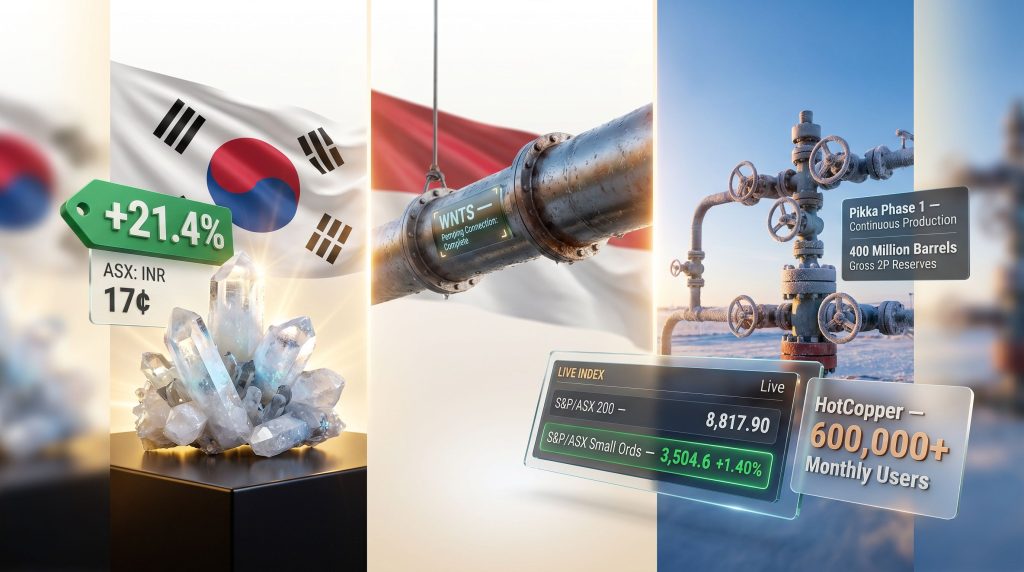
- Ioneer (ASX: INR) surged +21.4% to 17 cents, driven by a critical minerals partnership announcement
- Conrad Asia Energy (ASX: CRD) gained +3.37% to 46 cents, responding to an infrastructure completion milestone
- Santos (ASX: STO) edged up a nominal +0.14% to $7.31, confirming continuous production at a flagship oil project
Each response reflects a different investor psychology at work, and understanding those psychological drivers is as valuable as understanding the underlying corporate news.
Ioneer (ASX: INR): The Psychology Behind a 21% Single-Session Surge
Why Rhyolite Ridge Is Geologically Significant
Not all lithium deposits are created equal. The overwhelming majority of the world's lithium resources exist either as brine deposits in South American salars or as hard-rock spodumene pegmatites in Western Australia and elsewhere. Rhyolite Ridge in Nevada belongs to a rare third category: a sedimentary lithium-boron deposit, where lithium and boron mineralisation co-occur within layered sedimentary sequences rather than being hosted in igneous or metamorphic rock. Investors interested in sedimentary lithium deposits will find Rhyolite Ridge a compelling case study in geological rarity.
This geological distinction matters for several reasons. First, it makes Rhyolite Ridge the only known lithium-boron deposit in North America, a geological rarity that cannot be replicated by simply finding another lithium project on the continent. Second, the co-occurrence of boron creates a genuinely differentiated revenue profile. Boron is not a byproduct to be tolerated; it is an industrial mineral with its own robust demand base across glass manufacturing, agriculture, ceramics, and increasingly, advanced materials.
A project that produces both lithium carbonate for batteries and boric acid for industrial applications carries a dual-commodity revenue structure that reduces the earnings sensitivity to any single commodity price cycle. Furthermore, the processing pathway for such deposits is notably distinct, with techniques such as direct lithium extraction increasingly relevant to how these resources are evaluated and developed.
Rhyolite Ridge's feasibility work has been built around these specific mineralogical parameters, meaning the project's economics are not directly comparable to a conventional spodumene operation.
The KIND and Hyundai Engineering LOIs: What They Actually Signal
Ioneer announced non-binding Letters of Intent with two South Korean entities:
- Korea Overseas Infrastructure & Urban Development Corporation (KIND): a specialised Korean institutional body focused on facilitating and investing in overseas infrastructure and public-private partnership projects
- Hyundai Engineering: a major engineering and construction firm with established project execution capability across large-scale industrial and infrastructure developments
It is important to be precise about what an LOI is and what it is not. A non-binding Letter of Intent is a declaration of mutual interest and intent to negotiate toward a more formal arrangement. It carries no legal obligation on either party to complete a transaction, provide financing, or deliver any specific commercial outcome. Investors who treat an LOI as equivalent to a binding offtake agreement or equity commitment are mispricing the risk.
That said, the identity of the counterparties matters enormously in context. KIND is not a private commercial entity motivated solely by return on capital. It is a government-affiliated institution whose mandate includes securing overseas infrastructure and resource supply chains that serve Korean national economic interests. When an institution of that nature enters into a formal LOI with a junior miner, it signals that the project has passed some threshold of institutional scrutiny.
Non-binding strategic agreements with government-affiliated institutions from major battery manufacturing nations have historically functioned as early-stage de-risking signals for critical minerals developers, even when they do not progress immediately to binding commercial terms. The reputational and due diligence threshold implied by institutional engagement is itself informative.
Unpacking INR's +21.4% Move: Three Psychological Triggers
The scale of the price response reflects the convergence of several retail investor psychological drivers simultaneously:
- Scarcity narrative: The framing of Rhyolite Ridge as the only lithium-boron deposit in North America activates a powerful scarcity heuristic. Investors are drawn to assets described in superlatives, particularly when that uniqueness is geological rather than commercial, because geological scarcity cannot be manufactured or replicated by a competitor.
- Institutional credibility signal: KIND's government-affiliated status lends a layer of legitimacy that a purely commercial partnership announcement would not. Retail investors frequently use institutional involvement as a proxy for due diligence quality, reasoning that a government-backed entity would not enter into even a non-binding agreement with a project that lacked genuine merit.
- Decade-long development arc resolution: Ioneer has been advancing Rhyolite Ridge through permitting, environmental review, and financing processes for approximately a decade. For shareholders who have held through that extended development period, a high-profile international partnership announcement reads as a vindication of long-term conviction, amplifying buying enthusiasm beyond what the news itself might fundamentally justify.
Conrad Asia Energy (ASX: CRD): Infrastructure Completion and the Art of Incremental De-Risking
Understanding the Hot Tap Connection and Its Technical Significance
The term "hot tap" refers to a specific pipeline engineering technique whereby a new branch connection is made to an existing pressurised, operating pipeline without shutting it down or depressurising it. The process involves cutting into the live pipe under controlled conditions, allowing the new spur to be attached while the existing pipeline continues to flow. It is technically demanding and carries inherent operational risk precisely because it is performed on a live system.
The completion of the hot tap connection linking the West Natuna Transportation System (WNTS) to the Pemping gas pipeline is therefore not merely an administrative or commercial milestone. It is a genuine engineering accomplishment that removes a specific category of execution risk from the Mako development timeline. Investors can review the full CRD announcements on HotCopper for the detailed disclosure surrounding this milestone.
Mako's Position in Indonesia's Domestic Gas Market
The Mako gas field sits within the West Natuna basin, a productive offshore area in Indonesian waters that has historically supplied gas into the regional transmission network. Indonesia's domestic gas market is characterised by a structural tension: the country holds substantial natural gas reserves but faces persistent challenges in matching supply geography with consumption geography, particularly for power generation and industrial use in Java and other high-demand centres.
Gas from the Natuna basin, once connected to the WNTS and onward transmission infrastructure, can address part of that structural demand imbalance. The completed hot tap connection is the physical mechanism that makes this possible for Mako's production, and its completion ahead of the targeted Q4 CY2027 first gas date provides a buffer against project schedule slippage.
CRD's Catalyst Timeline: A Forward-Looking Framework
| Milestone | Expected Timing | Investor Significance |
|---|---|---|
| WNTS hot tap connection | Completed June 2026 | Infrastructure execution risk removed |
| Mako development finalisation | H1-H2 CY2026 | Project scope and cost confirmation |
| First gas production | Q4 CY2027 | Revenue generation commences |
| Commercial gas delivery (domestic Indonesia) | Post Q4 CY2027 | Full commercial validation |
The +3.37% price response reflects the incremental rather than transformational character of this milestone. Unlike a binding offtake agreement or a reserve upgrade, an infrastructure connection completion does not change the fundamental economic parameters of the project. It confirms that management is executing against its stated plan, which is valuable but not surprising in the same way that a partnership announcement or a production upgrade might be.
Santos (ASX: STO): Why Continuous Production Is a Different Beast From First Oil
Pikka Phase 1 in Context: Scale and Strategic Positioning
Santos's Pikka Phase 1 project, located on Alaska's North Slope, is developing an estimated 400 million barrels of gross 2P reserves. The North Slope is one of the most extensively studied and developed petroleum provinces on Earth, host to the giant Prudhoe Bay field and supported by the Trans-Alaska Pipeline System (TAPS), which provides established export infrastructure that meaningfully reduces the logistics risk inherent in frontier oil developments.
The commencement of continuous production at Pikka Phase 1 represents a qualitatively different milestone from the initial first oil achievement. First oil confirms that hydrocarbons can be produced from the reservoir and processed through the surface facilities. Continuous production confirms something more operationally demanding: that the wells, processing equipment, and export infrastructure can sustain reliable throughput over an extended period without significant unplanned interruption. It is the difference between demonstrating capability and demonstrating reliability.
Plateau production, which Santos management has indicated is targeted for later in CY2026, will be the true financial inflection point. Plateau rates determine the project's peak revenue contribution and are the basis against which production-sharing, royalty, and operating cost calculations are typically made. Analysts tracking Santos shares have noted the significance of this production ramp-up within the broader energy sector narrative.
Why STO's +0.14% Move Is Not a Disappointment
The near-flat price response to a flagship project production milestone might appear counterintuitive, but it reflects the mechanics of large-cap price discovery rather than any market scepticism about the milestone's importance. Santos is an ASX 100 constituent with substantial institutional ownership and extensive analyst coverage. Major project milestones are anticipated, modelled, and progressively priced in through investor presentations, quarterly activity reports, and analyst earnings forecasts long before the formal announcement arrives.
The inverse relationship between market capitalisation and daily price sensitivity to anticipated news is one of the most consistent behavioural patterns in equity markets. A small-cap stock with thin institutional coverage can surge 20% on a partnership announcement; a large-cap producer may barely move on a production milestone that has been telegraphed for months.
Broader Market Context: What the ASX Was Doing on Tuesday 23 June 2026
Index Performance Snapshot
| Index | Level | Change |
|---|---|---|
| S&P/ASX 200 | 8,817.90 | +1.80 points (near flat) |
| All Ordinaries | 9,018.7 | +12.5 (+0.14%) |
| S&P/ASX 100 | 7,376.5 | +7.90 (+0.11%) |
| S&P/ASX Small Ords | 3,504.6 | +49.7 (+1.40%) |
The broader market context for Tuesday's session was notably subdued. The ASX 200 Index was effectively flat, sitting approximately 4.18% below its 52-week high and having declined roughly 1.12% over the preceding five trading days, suggesting the session occurred during a mild consolidation phase rather than a strong uptrend.
The overnight session on Wall Street provided an additional headwind, with major technology stocks closing in the red and dampening opening momentum for the Australian market. The result was a session that oscillated between modest gains and losses at the index level, masking the considerably more active trading occurring at the individual stock level, particularly in smaller-cap resources and energy names.
The Small Ordinaries Index outperforming the ASX 200 by a wide margin (+1.40% versus near-flat) is a direct reflection of Tuesday's HotCopper trends dynamic: retail-driven activity in smaller stocks produced outsized moves relative to the broader market's directionless session.
The Brent Crude Uncertainty Overlay
Global energy markets on Tuesday were navigating an evolving geopolitical backdrop, with ongoing diplomatic discussions between the United States and Iran taking place in Switzerland following an interim agreement reached the previous week. The potential progression of those talks toward a more comprehensive arrangement carries meaningful implications for global crude supply. Consequently, Brent crude pricing remained an active consideration for energy investors throughout the session.
The removal or reduction of sanctions on Iranian oil exports would increase available supply and exert downward pressure on oil prices. For Santos shareholders specifically, this geopolitical dynamic creates a dual consideration: positive operational news from Pikka Phase 1 is being assessed against a macro backdrop in which the oil price trajectory remains genuinely uncertain. Investors holding energy producers in mid-2026 are therefore managing both asset-specific catalysts and commodity price risk simultaneously.
The next major ASX story will hit our subscribers first
Three Narratives, One Session: What Tuesday's Trends Reveal About Mid-2026 ASX Investor Priorities
Tuesday's HotCopper trends were not randomly distributed across sectors. They clustered around three thematic pillars that reflect the dominant investor preoccupations of mid-2026:
- Western critical minerals supply chain security: Ioneer's Korean partnership speaks directly to the ongoing effort by non-Chinese nations to establish upstream lithium supply chains outside of China's dominant processing infrastructure. The broader critical minerals demand backdrop underpins why South Korea, as a major battery cell manufacturer, has a strategic rationale to secure lithium supply from Nevada that is both geographically proximate to North American assembly facilities and politically aligned with Western supply chain frameworks.
- Southeast Asian gas infrastructure development: Conrad Asia Energy's Mako milestone reflects the longer-term energy transition dynamic across Southeast Asia, where gas is widely regarded as an essential bridging fuel between coal-heavy current energy systems and a future dominated by renewables. Indonesia's demand for domestic gas supply is structural, not cyclical.
- Conventional hydrocarbon production validation: Santos's Pikka Phase 1 commencement underscores that large-scale conventional oil projects continue to attract and retain both institutional and retail capital, even as energy transition narratives evolve. The 400 million barrel 2P reserve base at Pikka represents a multi-decade production asset whose value is not materially disrupted by near-term oil price volatility.
Distinguishing Signal From Noise in Forum-Driven Trading
Retail investors using HotCopper sentiment as a trading input benefit from applying a structured filter to the types of news that generate forum momentum:
- Binding agreements, resource upgrades, and production milestones alter fundamental value and justify re-rating consideration
- Non-binding LOIs and infrastructure completions reduce project risk without guaranteeing commercial outcomes, warranting measured rather than exuberant responses
- Thematic narrative alignment can drive price action that temporarily decouples from near-term fundamentals, creating both opportunity and risk for momentum-oriented traders
Risk Disclosure: Forum-driven price movements, particularly in small-cap critical minerals stocks, can be highly volatile and may not accurately reflect underlying fundamental value. Readers should conduct thorough independent research and consult a licensed financial adviser before making any investment decisions. Past price performance is not indicative of future results.
FAQ: Tuesday's ASX HotCopper Trends Explained
What drove Ioneer's +21.4% surge on Tuesday?
Ioneer announced non-binding Letters of Intent with KIND, a South Korean government-affiliated infrastructure investment institution, and Hyundai Engineering, in relation to the advancement of the Rhyolite Ridge lithium-boron project in Nevada. The project holds the distinction of being the only known lithium-boron deposit in North America.
What is a hot tap connection and why does it matter for Conrad Asia Energy?
A hot tap is an engineering technique for connecting a new pipeline branch to an existing pressurised, operating pipeline without shutting it down. Its completion for the WNTS-to-Pemping gas pipeline link removes a specific infrastructure execution risk from the Mako development, supporting the targeted Q4 CY2027 first gas date.
Why did Santos barely move despite a major production milestone?
Santos is a large-cap ASX 100 company with extensive institutional coverage. The commencement of continuous production at Pikka Phase 1 was a well-telegraphed milestone that had been progressively priced into the stock through prior investor communications. Large-cap anticipated milestones typically produce minimal daily price impact.
What macro factors were affecting the broader ASX on Tuesday 23 June 2026?
The ASX 200 traded near-flat, sitting approximately 4.18% below its 52-week high after declining about 1.12% over the prior five sessions. Overnight weakness in U.S. technology stocks and uncertainty around Brent crude's trajectory amid evolving U.S.-Iran diplomatic talks in Switzerland created a cautious market backdrop.
What does the Small Ordinaries outperforming the ASX 200 on Tuesday indicate?
The Small Ordinaries gaining +1.40% while the ASX 200 was effectively flat reflects the session's underlying dynamic: retail-driven trading activity in smaller-cap resources and energy stocks produced outsized moves that the broader large-cap index did not capture.
This article is intended for informational purposes only and does not constitute financial advice. All figures and data referenced relate to trading conditions as at Tuesday 23 June 2026. Readers are encouraged to conduct independent research and consult a licensed financial adviser before making any investment decisions.
Want To Stay Ahead of the Next Major ASX Mineral Discovery?
Discovery Alert's proprietary Discovery IQ model delivers real-time alerts the moment significant mineral discoveries are announced on the ASX, cutting through the noise of daily forum sentiment to surface genuinely actionable opportunities for both traders and long-term investors. Explore Discovery Alert's dedicated discoveries page to understand the historic returns major mineral discoveries have generated, then begin a 14-day free trial to secure your market-leading edge before the broader market catches on.