June 3, 2026
The global mining sector faces an unprecedented challenge as energy market volatility fundamentally reshapes operational economics. Iron ore extraction, representing the backbone of steel production worldwide, operates within complex cost structures where fuel expenses comprise substantial portions of total production budgets. When geopolitical tensions disrupt traditional energy supply chains, the cascading effects extend far beyond immediate price fluctuations, forcing miners to reconsider decades-old operational strategies and investment priorities. The current iron ore miners fuel costs Iran war situation exemplifies how regional conflicts create global operational challenges.
Energy Vulnerability in Heavy Industry Mining Operations
Iron ore mining distinguishes itself from other mineral extraction sectors through its extraordinary fuel intensity requirements. The operational scale necessary to maintain profitable iron ore production creates unique exposure patterns to diesel price movements that smaller-scale mining operations rarely experience.
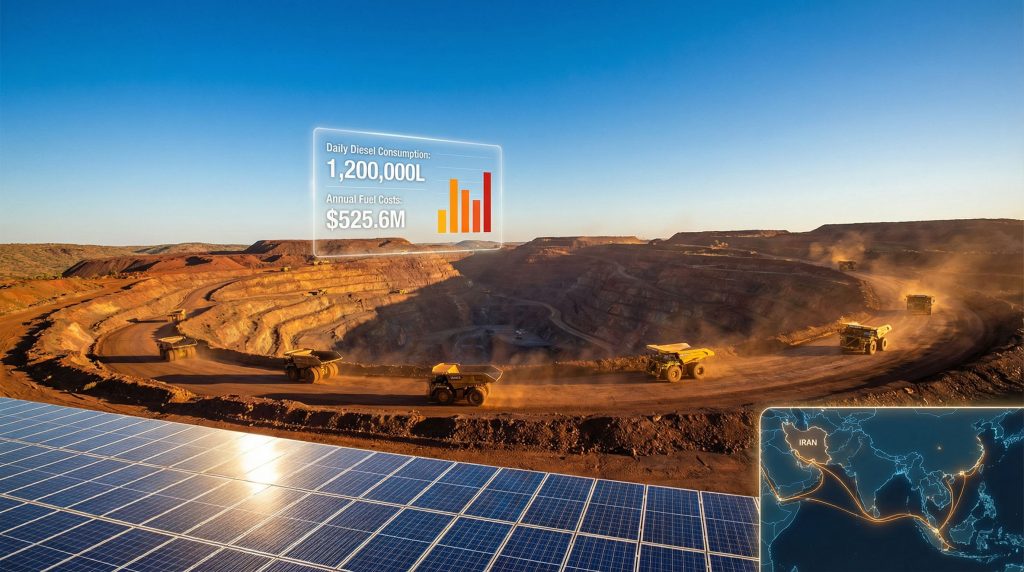
According to Fortescue's Metals and Operations Chief Executive Officer Dino Otranto, the mathematical relationship between fuel costs and operational impact follows predictable patterns. Each ten-cent increase in diesel pricing generates $70 million in additional annual costs for Fortescue's operations alone, as reported by Arab News in March 2026. When extrapolated across the industry's largest players, this sensitivity multiplies dramatically.
Otranto noted that among the top four iron ore producers globally, every ten-cent fuel price movement creates approximately $500 million in collective cost structure impact. This demonstrates how iron ore price trends become intrinsically linked to energy market dynamics.
Regional Supply Chain Dependencies
Geographic fuel sourcing patterns create specific vulnerability profiles for different mining regions. Fortescue sources the majority of its fuel requirements from Southeast Asian suppliers, establishing direct exposure to supply chain disruptions affecting that region. When shipping routes through the Strait of Hormuz face restrictions, Southeast Asian refineries experience reduced crude oil access, creating price pressure that propagates through the entire supply network.
Primary Fuel Supply Vulnerabilities by Region:
- Australian Pilbara Operations: Heavy reliance on Southeast Asian diesel imports creates exposure to Middle Eastern shipping disruptions
- Brazilian Iron Ore Mining: Greater domestic refining capacity provides partial insulation from international fuel market volatility
- African Iron Ore Operations: Mixed dependency on Middle Eastern and regional suppliers creates moderate vulnerability to geopolitical disruptions
- Canadian Mining Operations: Access to North American refining capacity reduces exposure to Middle Eastern supply chain issues
The current Iran conflict demonstrates how regional instability affects global mining operations through interconnected fuel supply networks. The Arab News report indicated that conflict-related shipping disruptions through the Strait of Hormuz had "all but stopped" vessel movements, directly impacting diesel availability for mining operations dependent on that supply corridor.
Equipment-Intensive Operational Requirements
Iron ore mining operations require continuous heavy machinery deployment across multiple operational phases. Unlike precious metals mining, where selective extraction methods can optimise fuel consumption, iron ore production demands large-scale earth movement that cannot be significantly reduced without compromising output volumes.
Key Fuel-Intensive Operations Include:
- Continuous Excavation: Massive earth-moving equipment operating around-the-clock schedules
- Long-Distance Hauling: Transport trucks covering substantial distances between extraction sites and processing facilities
- Processing Plant Operations: Power generation requirements for crushing, screening, and beneficiation processes
- Port Handling Systems: Loading and transportation infrastructure supporting export operations
The scale-dependent nature of iron ore mining means that fuel efficiency improvements often require substantial capital investments in newer equipment or alternative energy systems. Consequently, these create long-term strategic decisions that extend beyond immediate cost management responses.
When big ASX news breaks, our subscribers know first
Geopolitical Risk Transmission Through Mining Cost Structures
Contemporary geopolitical disruptions create multi-layered cost pressures that extend well beyond direct fuel price increases. The Iran war situation illustrates how regional conflicts generate cascading economic effects through interconnected supply chains. Furthermore, these disruptions force mining companies to address both immediate operational challenges and longer-term strategic vulnerabilities.
Direct Cost Impact Mechanisms
Fuel price increases create immediate bottom-line pressure for iron ore miners fuel costs Iran war scenarios, but the transmission mechanisms vary significantly based on operational scale and supply chain architecture. Large-scale producers like Fortescue experience linear cost relationships where each pricing increment translates directly into quantifiable profit impact.
The $70 million annual impact Fortescue faces from each ten-cent diesel price increase demonstrates the mathematical precision with which fuel costs affect mining economics. This linear relationship means that sustained fuel cost increases during prolonged geopolitical conflicts can fundamentally alter project economics and investment priorities across the sector.
Understanding these cost dynamics helps explain broader iron ore miners insights and their implications for market positioning.
Supply Chain Inventory Management Responses
Mining companies facing supply chain uncertainty typically adjust inventory management strategies to buffer against potential disruptions. Otranto indicated that Fortescue maintained comfortable fuel stock levels as of March 2026. However, he noted this comfort level was contingent on avoiding further escalation of the Iran war conflict.
Strategic Inventory Considerations:
- Storage Infrastructure Costs: Maintaining larger fuel inventories requires additional storage capacity and associated infrastructure investments
- Working Capital Impact: Higher inventory levels tie up significant financial resources that could otherwise support operational expansion
- Supply Contract Renegotiation: Long-term fuel supply agreements may require adjustment to accommodate volatile pricing and availability
- Alternative Supplier Development: Diversifying fuel sourcing requires establishing relationships with suppliers in different geographic regions
These inventory management responses represent strategic adaptations rather than temporary operational adjustments. Indeed, they indicate that mining companies view current geopolitical energy market disruptions as potentially persistent challenges requiring structural responses.
Secondary Operational Pressures
Beyond direct fuel cost increases, geopolitical disruptions create secondary operational pressures that compound overall cost impacts. Equipment maintenance schedules may be adjusted to conserve fuel, potentially leading to increased wear patterns and higher long-term maintenance costs. Similarly, operational efficiency may decline as companies implement fuel conservation measures that reduce equipment utilisation rates.
The psychological impact on operational decision-making also influences cost structures. When fuel availability becomes uncertain, operational managers often implement conservative fuel usage policies. These prioritise supply security over maximum production efficiency, creating measurable productivity impacts across mining operations.
Strategic Energy Independence Initiatives in Mining Operations
The current energy market volatility has accelerated previously-announced decarbonisation strategies across the iron ore mining sector. Companies that initiated renewable energy transitions before recent geopolitical disruptions now find their investments providing immediate financial returns through reduced diesel dependency.
Renewable Energy Deployment Financial Returns
Fortescue's renewable energy strategy demonstrates the financial viability of mining industry decarbonisation efforts. Otranto confirmed that the company expects to save at least $100 million over the following twelve months specifically from diesel cost reductions achieved through electrification initiatives powered by renewable energy sources.
The company's ambitious target of reducing diesel consumption by 1 billion litres over the next several years represents a fundamental shift in operational energy sourcing. This reduction target, when achieved, would significantly decrease Fortescue's exposure to fuel price volatility whilst providing substantial environmental benefits.
Shareholder Sentiment Evolution
Otranto's observation about changing shareholder perspectives reveals important insights about investor attitudes toward mining industry decarbonisation. The executive noted that Fortescue's aggressive decarbonisation agenda, announced years before the current energy crisis, initially faced significant criticism from shareholders concerned about the financial viability of such investments.
However, as of March 2026, shareholder sentiment had shifted dramatically. Investors who previously questioned the wisdom of substantial renewable energy investments were urging Fortescue to accelerate these initiatives. They recognised their value as protection against fuel price volatility and supply chain disruptions.
This transformation in investor attitudes reflects broader recognition that energy independence strategies provide financial risk mitigation benefits beyond their environmental advantages.
Electrification Technology Implementation
Mining operations are deploying various electrification technologies to reduce diesel dependency whilst maintaining operational efficiency. These implementations require significant upfront capital investments but provide long-term operational cost reductions and supply chain risk mitigation.
Key Electrification Technologies Include:
- Battery Energy Storage Systems (BESS): Large-scale battery installations supporting renewable energy integration and providing backup power capabilities
- Electric Heavy Equipment: Transition from diesel-powered to electric haul trucks, excavators, and processing equipment
- Hybrid Power Systems: Combined renewable-diesel systems providing operational flexibility whilst reducing overall fuel consumption
- Smart Grid Infrastructure: Advanced electrical distribution systems optimising energy usage across mining operations
The financial returns from these investments become particularly attractive during periods of high fuel price volatility. Consequently, companies with lower diesel dependency experience reduced exposure to geopolitical energy market disruptions.
Alternative Energy Source Development
Beyond traditional renewable energy deployment, mining companies are exploring alternative fuel sources that could provide operational flexibility during supply chain disruptions. These alternatives include liquified natural gas (LNG) for heavy equipment, hydrogen fuel cells for specific applications, and biofuels derived from regional sources.
The development of alternative energy capabilities requires substantial research and development investments. However, it provides strategic options for managing energy supply security during geopolitical crises. Companies with diversified energy sourcing capabilities maintain operational flexibility that single-fuel operations cannot achieve.
Financial Risk Management Strategies for Energy Price Volatility
Mining companies facing substantial fuel cost exposure are implementing sophisticated financial risk management strategies that extend beyond operational efficiency improvements. These strategies recognise that energy price volatility represents a fundamental business risk requiring comprehensive financial hedging approaches, particularly considering oil production decline impact on global markets.
Fuel Price Hedging Mechanisms
Large-scale iron ore miners fuel costs Iran war scenarios typically require multiple hedging instruments to manage fuel price risk exposure. Forward contracts allow companies to secure specific fuel volumes at predetermined prices, providing cost certainty for portion of annual fuel requirements. The challenge lies in balancing downside protection with upside exposure, as excessive hedging can prevent companies from benefiting when fuel prices decline.
Options-based hedging strategies provide more flexible risk management by offering downside protection whilst preserving upside benefits when fuel prices move favourably. However, options carry premium costs that must be weighed against the risk mitigation benefits they provide.
Common Hedging Approaches:
- Forward Fuel Purchase Contracts: Securing 40-60% of anticipated fuel requirements at fixed prices
- Collar Options Strategies: Establishing price floors and ceilings to limit both upside and downside exposure
- Fuel Price Swaps: Exchanging variable fuel costs for fixed payments based on market indices
- Commodity Correlation Hedging: Linking fuel cost exposure to iron ore price movements through structured products
Currency Risk Management
International mining companies face additional complexity when fuel purchases occur in different currencies from their primary revenue streams. Currency fluctuations can amplify or offset fuel price movements, creating additional risk management requirements.
Companies sourcing fuel from Southeast Asian suppliers whilst earning revenue primarily in US dollars or Australian dollars must manage both fuel price risk and foreign exchange risk simultaneously. This dual exposure requires sophisticated hedging strategies that consider correlation patterns between energy prices and currency movements.
Strategic Energy Investment Portfolio
Some mining companies are developing strategic energy investment portfolios that provide natural hedges against fuel price volatility. Direct investment in renewable energy projects, power purchase agreements with energy producers, and strategic partnerships with fuel suppliers can create cost stability whilst generating potential investment returns.
These investment strategies require substantial capital commitments but provide long-term energy cost predictability that traditional hedging instruments cannot achieve. Companies pursuing energy investment strategies essentially become partially integrated energy producers, reducing their exposure to external energy market volatility.
Market Dynamics and Competitive Positioning Effects
Energy cost volatility creates differentiated competitive impacts across the iron ore mining sector based on individual companies' operational efficiency, geographic positioning, and strategic energy management capabilities. These differences can lead to market share shifts and industry consolidation opportunities, particularly when considering broader energy exports challenges facing resource-dependent economies.
Cost Curve Repositioning
Iron ore miners fuel costs Iran war impacts create situations where companies with superior energy efficiency or alternative energy capabilities experience relative cost advantages during periods of high fuel price volatility. Companies that have successfully implemented renewable energy systems or achieved superior operational efficiency find their position on the global cost curve improving relative to less efficient competitors.
Marginal producers operating with thin profit margins face particular pressure during energy price spikes. These operations may be forced to reduce production volumes, temporarily suspend operations, or accelerate mine closure decisions when fuel costs eliminate profitability.
Competitive Impact Categories:
- Low-Cost Producers: Enhanced market position and potential market share gains during high energy price periods
- Mid-Cost Efficient Operations: Maintained profitability through superior energy management strategies
- High-Cost Traditional Operations: Significant margin pressure potentially leading to production curtailments
- Marginal Producers: Risk of temporary or permanent operation suspension during sustained energy price elevation
Strategic Consolidation Opportunities
Energy cost pressures create potential consolidation opportunities as financially strong companies with superior energy management capabilities may acquire distressed assets from competitors struggling with fuel cost pressures. These acquisitions can provide access to mineral resources at attractive valuations whilst allowing acquirers to implement more efficient energy management systems.
The current Iran war-related energy disruptions may accelerate industry consolidation trends as companies with strong balance sheets and advanced energy management capabilities expand their asset portfolios. They achieve this through strategic acquisitions of operations facing fuel cost challenges.
The mining industry faces billions more in fuel costs due to ongoing conflicts, creating strategic opportunities for well-positioned companies.
Supply Chain Integration Strategies
Some mining companies are pursuing vertical integration strategies that provide greater control over energy supply chains. Direct investment in fuel storage facilities, transportation infrastructure, and even fuel supply partnerships can provide operational advantages during supply chain disruptions.
These integration strategies require substantial capital investments but provide supply security and cost control benefits that extend beyond immediate fuel price management. Companies with integrated energy supply chains maintain operational continuity during geopolitical disruptions that affect external fuel suppliers.
The next major ASX story will hit our subscribers first
Investment Implications and Strategic Outlook
The intersection of geopolitical energy disruptions and mining operational requirements creates complex investment implications for both mining companies and their investors. Understanding these dynamics becomes crucial for evaluating company strategies and investment opportunities within the iron ore sector. Moreover, implementing effective diversification investing strategies becomes essential during such volatile periods.
Capital Allocation Priority Shifts
Mining companies are reallocating capital investment priorities toward energy independence and operational efficiency projects that previously received lower strategic emphasis. Renewable energy infrastructure, energy storage systems, and fuel-efficient equipment purchases are receiving increased budget allocation as companies recognise their strategic value for long-term cost management.
This capital allocation shift means that traditional mining expansion projects may face increased competition for investment resources. Companies must balance growth opportunities against energy security investments. The financial returns from energy independence projects become more attractive during periods of sustained energy price volatility.
Technology Investment Acceleration
The current energy market environment is accelerating adoption of mining technology solutions that improve fuel efficiency or reduce diesel dependency. Autonomous vehicle systems, predictive maintenance technologies, and process optimisation software receive enhanced investment priority as companies seek operational efficiency improvements.
These technology investments often provide multiple benefits including fuel cost reduction, productivity improvements, and enhanced operational safety. The compound benefits make technology investments particularly attractive during periods when energy cost pressures threaten overall profitability.
Geographic Risk Assessment
Investment strategies must now incorporate geographic energy supply risk assessment as a fundamental component of project evaluation. Mining projects in regions with secure, diversified energy supply access may command investment premiums compared to operations dependent on geopolitically vulnerable fuel supply chains.
This geographic risk consideration extends to evaluation of existing operations, where companies may need to invest in energy supply diversification or alternative energy systems. This helps maintain competitive positioning during geopolitical disruptions.
Long-term Sector Transformation Outlook
The current energy market disruptions are accelerating long-term transformation trends within the iron ore mining sector. Companies successfully navigating current challenges through energy independence strategies and operational efficiency improvements will likely emerge with sustainable competitive advantages.
Key Transformation Drivers:
- Energy Independence: Reduced dependency on external fuel suppliers through renewable energy deployment
- Operational Automation: Technology-driven efficiency improvements reducing labour and energy requirements
- Supply Chain Resilience: Diversified sourcing and strategic inventory management capabilities
- Financial Risk Management: Sophisticated hedging strategies managing energy price volatility exposure
The mining companies that successfully implement comprehensive energy management strategies during the current challenging period are positioning themselves for enhanced profitability and reduced risk exposure in future operating environments.
This analysis is based on publicly available information and should not be construed as investment advice. Mining industry investments carry substantial risks including commodity price volatility, operational challenges, and regulatory changes. Investors should conduct thorough due diligence and consult with financial advisors before making investment decisions.
Looking for Opportunities in Energy-Resilient Mining Companies?
Discovery Alert's proprietary Discovery IQ model delivers real-time notifications on significant ASX mineral discoveries, instantly identifying companies with superior operational efficiency and strategic positioning during volatile energy markets. Explore how major mineral discoveries can generate substantial returns by examining Discovery Alert's comprehensive analysis of historic mining successes, then begin your 14-day free trial today to secure your market advantage.