June 14, 2026
Why Iron Ore Pricing Has Always Been More Complex Than It Looks
Commodity markets are often described as the purest expression of supply and demand in action. Yet beneath the apparent simplicity of a daily iron ore price lies an intricate architecture of chemical compositions, brand hierarchies, and adjustment mechanisms that most market participants never see. The Fastmarkets iron ore normalization coefficient daily update proposal brings this hidden complexity into sharp focus, revealing how benchmark construction shapes real commercial outcomes across the global steel supply chain.
Understanding why Fastmarkets is proposing a shift to daily normalization coefficient updates requires first understanding why these coefficients exist at all. The answer lies in the fundamental heterogeneity of iron ore as a traded material, and why that heterogeneity creates persistent pricing challenges that standardised benchmarks alone cannot resolve. Furthermore, the iron ore price trends influencing these decisions are far more dynamic than monthly recalibration schedules can adequately capture.
When big ASX news breaks, our subscribers know first
The Problem That Normalization Coefficients Were Designed to Solve
Unlike crude oil, which can be categorised into a manageable number of widely understood grades, iron ore is traded across an enormous variety of products that differ in iron content, silica levels, alumina concentrations, phosphorus content, moisture levels, and brand-specific value-in-use characteristics. A 61% Fe Brazilian fines product and a 62% Fe Australian fines product are not interchangeable. Processed through the same blast furnace, they produce meaningfully different operating outcomes, energy consumption profiles, and slag volumes.
This is where the normalization coefficient becomes essential. It functions as a mathematically derived conversion factor that bridges the gap between the real-world traded prices of specific iron ore brands and the reference benchmarks that form the backbone of global pricing contracts. Without it, a steel mill comparing cargo bids from different origins would be making that comparison on fundamentally unequal terms.
The variables captured within a normalization coefficient include:
- Iron content (Fe percentage, generally ranging from around 60% to 63.5% for standard seaborne fines)
- Silica and alumina content, which introduce cost penalties through increased flux requirements and slag generation inside the blast furnace
- Brand-specific positioning, reflecting historical trading patterns and buyer preferences built up over years of market activity
- Value-in-use relationships, which quantify the economic benefit a specific ore delivers relative to a reference grade
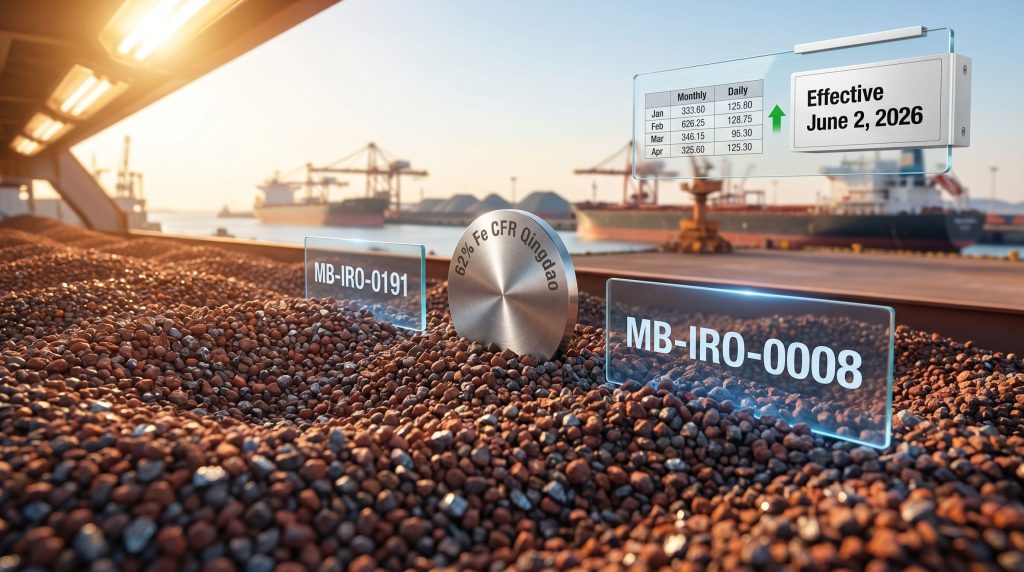
The reference point against which all these variables are normalised is typically the 62% Fe fines index for CFR Qingdao delivery, designated by Fastmarkets as MB-IRO-0008. The 61% Fe equivalent, MB-IRO-0191, operates alongside it as a closely related benchmark for slightly lower-grade material. Together, these two indices sit within the Fastmarkets steelmaking raw materials package and represent the most commercially significant seaborne iron ore pricing points in the global market. The iron ore market types encompassed by these indices reflect the considerable diversity of products traded across seaborne routes.
Value-in-Use: The Concept Underpinning the Entire Framework
Value-in-use, or VIU, is a concept that is often mentioned in iron ore trading circles but rarely explained in full. At its core, VIU answers a specific question: how much hot metal can a steel mill extract from a given tonne of iron ore, and at what operating cost? A higher-grade ore with low impurities generates more iron per tonne of feed, requires less energy and fewer additives, and produces less waste slag. A lower-grade ore with elevated alumina does the opposite.
This means the price premium or discount attached to any specific brand is not arbitrary. It reflects a calculated judgment about the real value that ore delivers inside a steel mill, adjusted for energy costs, reductant prices, and the technical limitations of individual blast furnaces. Understanding this is critical context for appreciating why normalization coefficient accuracy matters so much, and why a coefficient that lags market reality even by a few weeks can distort pricing relationships in commercially significant ways. For further context, Fastmarkets' iron ore pricing explained provides a comprehensive overview of how these mechanisms function in practice.
How the Monthly Update Cycle Created a Structural Lag Problem
Prior to the proposed change, normalization coefficients for Fastmarkets' daily iron ore indices were recalibrated on a monthly basis. For weekly indices, the update cycle operated quarterly. The rationale behind periodic updating has historically centred on methodological stability: recalibrate too frequently and you introduce volatility into the coefficient itself; recalibrate too infrequently and you allow the benchmark to drift away from actual market conditions.
The problem is that the seaborne iron ore market does not operate on a monthly cycle. Brand-level price spreads in the CFR China spot market can compress or widen significantly within a single trading week, responding to:
- Shifts in Chinese steel mill blast furnace utilisation rates and profitability margins
- Supply disruptions or weather events affecting major exporting regions including Australia and Brazil
- Port inventory fluctuations at key receiving terminals such as Qingdao
- Macroeconomic signals influencing steel sector output expectations
- Seasonal construction demand cycles tied to China's infrastructure investment patterns
When brand prices move rapidly within a month but the normalization coefficient remains anchored to the prior month's relationships, the published index price can deviate meaningfully from the true market clearing level. A brand that has narrowed its discount to the benchmark midway through a month continues to be assessed at its larger prior-month discount for the remainder of that period. The inverse applies equally: a brand whose premium has eroded will appear artificially elevated in benchmark terms until the coefficient resets.
This is not a theoretical concern. Fastmarkets observed precisely this dynamic, noting internally that brand prices can shift rapidly within a single month and receiving direct requests from market participants for more timely coefficient updates to better reflect those changes. The proposal to move to daily updating is therefore a response to both internal price surveillance findings and external stakeholder demand.
The February 2026 period is cited in connection with this issue, when pricing judgements were applied to iron ore indices to address coefficient misalignment, with Brazilian Blend fines reportedly indicated in the range of approximately $102.50 to $103.99 per dry metric tonne at that time. This real-world episode illustrates how coefficient lag can require active editorial intervention rather than systematic recalibration. The broader China steel and iron ore market context makes such pricing accuracy particularly consequential, given China's dominant role in seaborne iron ore demand.
The Proposed Change: What Is Actually Changing and What Is Not
Fastmarkets published its formal proposal on May 8, 2026, initiating an industry consultation process running through May 29, 2026. If confirmed, the change takes effect from June 2, 2026.
The proposal is precisely scoped. It does not alter the indices themselves, their publication frequency, or the peer review and senior sign-off requirements that govern all normalization coefficient calculations. What changes is a single parameter: the frequency at which those coefficients are recalculated.
| Parameter | Current Approach | Proposed Approach |
|---|---|---|
| Coefficient update frequency | Monthly | Daily |
| Affected indices | MB-IRO-0191, MB-IRO-0008 | MB-IRO-0191, MB-IRO-0008 |
| Peer review requirement | Retained | Retained |
| Index publication frequency | Daily | Daily (unchanged) |
| Publication timing | Unchanged | Unchanged |
The consultation process reflects Fastmarkets' obligations as a Price Reporting Agency operating under the International Organisation of Securities Commissions (IOSCO) principles for PRAs. Those principles specifically require that methodology changes be subject to transparent stakeholder review before implementation. Written submissions can be directed to pricing@fastmarkets.com and steelrawmaterials@fastmarkets.com, with confidentiality available upon request for any respondent who requires it.
Non-confidential comments will be made available to other market participants upon request, maintaining the open and auditable character that IOSCO compliance demands. It is worth noting that this type of open consultation is standard practice for Fastmarkets across its broader index suite. The Fastmarkets iron ore normalization coefficient daily update sits within this ongoing programme of methodological governance rather than representing an isolated or reactive change. In addition, how tariffs impact iron ore markets further underscores the need for responsive, accurate pricing mechanisms at every level of the benchmark framework.
Who Benefits From Daily Normalization Coefficients, and How
The shift from monthly to daily coefficient recalibration creates practical improvements across several distinct user groups, each of which interacts with the benchmark in different ways.
Steel Mill Procurement Teams
For the raw material buyers at integrated steel mills, the normalization coefficient directly determines how a cargo bid is evaluated against the index on any given day. A daily-updated coefficient means that a procurement decision made on a Tuesday reflects Tuesday's brand price relationships, not those from three weeks earlier. For large mills executing multiple cargo transactions per week, this represents a meaningful reduction in valuation error risk, particularly during periods of rapid price movement.
Iron Ore Traders Managing Multi-Brand Books
Traders who actively manage portfolios of cargoes spanning multiple origins and brands rely on relative value assessments between those brands. A Brazilian Blend cargo, an Australian Pilbara fines product, and a higher-grade South African material may all be competing for the same slot in a mill's blend. The normalization coefficient is what converts each of those cargoes into a comparable benchmark-equivalent price. When that coefficient lags the market, relative value signals become distorted, potentially misdirecting cargo switching decisions and arbitrage positioning.
Derivatives and Risk Management Users
Iron ore futures and swap contracts referencing the Fastmarkets 62% Fe CFR Qingdao benchmark are actively used by producers, trading houses, and steel mills as hedging instruments. When physical cargo valuations and derivatives positions reference the same benchmark but the normalization coefficient connecting specific brands to that benchmark is outdated, a form of basis risk emerges.
A producer holding a short futures position against a long physical position in a specific brand may find that the two sides of that hedge diverge in value — not because the market moved against them, but because the coefficient connecting the physical to the benchmark lagged. Daily recalibration directly compresses this source of basis risk. Furthermore, the China iron ore outlook for 2025 and beyond suggests that demand-side volatility will continue to place pressure on pricing mechanisms, making robust coefficient management all the more important.
Data Platform and System Integration Users
For market participants consuming Fastmarkets data through the dashboard, Excel add-in, API, or mobile application, the practical implication is that normalization coefficient values will now update as frequently as the index prices themselves. Automated pricing systems, ERP integrations, and contract management tools that currently treat the coefficient as a stable monthly input will require workflow updates to handle a daily-varying parameter. The defined implementation date of June 2, 2026 provides a clear preparation window for these operational changes.
A Broader Shift in How Commodity Benchmarks Are Built
The Fastmarkets iron ore normalization coefficient daily update proposal does not exist in isolation. It reflects a wider directional shift in commodity price reporting toward greater frequency, transparency, and data-driven recalibration. Across raw material markets including coking coal, bauxite, and battery materials, the trend has moved steadily away from periodic, judgment-heavy adjustment mechanisms toward systematic daily recalibration anchored in observable transaction data.
This matters for how the credibility of benchmarks is evaluated. A coefficient derived from last month's brand price relationships cannot claim to reflect today's market reality with the same authority as one recalculated using today's observed transactions. As iron ore trading volumes, market participants, and derivative instruments have grown in sophistication, the tolerance for benchmark lag has narrowed considerably.
One under-appreciated implication of daily coefficient updating is what it means for contract drafting. Steel mills and traders with significant volumes of iron ore contracts indexed to MB-IRO-0191 or MB-IRO-0008 may find it worthwhile to review whether their existing pricing mechanisms are structured to capture the improved granularity that daily coefficients provide, or whether legacy contract language assumes a degree of benchmark stability that daily recalibration now renders obsolete.
However, there are also data quality considerations worth acknowledging. Daily coefficient recalibration is only as robust as the volume and quality of brand-level transaction data available on each trading day. In thinner markets or during holiday-shortened trading weeks, the data foundation for daily recalibration may be narrower than on high-volume trading days. Consequently, Fastmarkets' retention of peer review and senior sign-off requirements for each coefficient publication serves as the primary safeguard against coefficient volatility driven by data scarcity rather than genuine market movement. The Fastmarkets iron ore indices methodology documentation provides full technical detail on how these safeguards operate in practice.
The next major ASX story will hit our subscribers first
Key Facts at a Glance
| Topic | Detail |
|---|---|
| What is changing | Normalization coefficient update frequency: monthly to daily |
| Affected indices | MB-IRO-0191 (61% Fe fines) and MB-IRO-0008 (62% Fe fines), CFR Qingdao |
| Proposal published | May 8, 2026 |
| Consultation deadline | May 29, 2026 |
| Effective date | June 2, 2026 |
| Governance framework | IOSCO principles for Price Reporting Agencies |
| Peer review | Retained under proposed approach |
| Primary driver | Rapid intra-month brand price shifts; direct market participant requests |
| Who should engage | Steel mills, traders, derivatives users, automated system operators |
This article is intended for informational purposes only and does not constitute financial, investment, or trading advice. All price data, index codes, and procedural details are sourced from publicly available Fastmarkets pricing notices. Market participants should consult Fastmarkets' official methodology documentation for full specification details before making commercial decisions based on benchmark-related methodology changes.
Want to Catch Significant Iron Ore Discoveries the Moment They Hit the ASX?
Discovery Alert's proprietary Discovery IQ model scans ASX announcements in real time, instantly converting complex mineral data across 30+ commodities into clear, actionable insights — so investors are never left waiting for the market to catch up. Explore historic mineral discoveries and their returns on Discovery Alert's dedicated discoveries page, and start your 14-day free trial to position yourself ahead of the next major find.