June 30, 2026
Why Iron Ore Pelletization Is at the Centre of Steel's Decarbonisation Challenge
The global steel industry faces one of the most technically demanding emissions reduction challenges of any heavy industrial sector. Unlike electricity generation, where renewable substitution is relatively straightforward, steelmaking relies on high-temperature thermal processes that have historically resisted clean energy alternatives. Pelletisation, the process that transforms fine iron ore particles into hardened spheres suitable for blast furnaces and direct reduction reactors, sits squarely at the intersection of this challenge. The furnaces that drive pelletisation consume enormous volumes of fossil fuels, and replacing those fuels without compromising pellet quality demands genuine engineering ingenuity, not merely equipment upgrades.
It is within this context that Samarco's recognition under Brazil's Patente Verde programme takes on its full significance. In March 2026, Brazil's Instituto Nacional da Propriedade Industrial (INPI) granted Samarco the Green Patent seal for its method of producing iron ore pellets using renewable fuel inputs, formally classifying the technology as both technically innovative and environmentally impactful. The distinction matters not just symbolically but commercially, as the Samarco patente verde para substituir combustíveis fósseis positions the company at the leading edge of a transformation that the entire global pellet industry will eventually need to undertake.
When big ASX news breaks, our subscribers know first
What Brazil's Green Patent Programme Actually Demands from Innovators
The INPI Green Patent Framework and Its Dual-Criteria Standard
Brazil launched the Patente Verde programme in 2012, becoming one of the first major emerging economies to create a dedicated fast-track intellectual property mechanism for sustainable technologies. The programme was expanded in 2020 to broaden eligibility criteria, incorporating innovations across renewable energy, resource conservation, and industrial waste management.
The key operational advantage the programme offers is processing speed. Standard patent examination cycles in Brazil, as in most jurisdictions, can extend across multiple years. Under the Patente Verde framework, approved technologies receive accelerated examination with an average approval timeline of approximately 14 months, according to INPI documentation on the programme's structure.
What makes the Green Patent meaningfully harder to obtain than a conventional patent is the additional environmental layer of scrutiny:
- Conventional patents require novelty, inventive step, and industrial applicability
- Green Patents require all three conventional criteria plus objective, measurable environmental benefits
- The environmental benefit must be demonstrable rather than theoretical, meaning the applicant must substantiate real-world outcomes
- The INPI evaluates whether the claimed gains are auditable and verifiable, not merely plausible
This dual-criteria structure is what separates a Green Patent from a standard approval with a sustainability marketing claim attached. For Samarco, the INPI's recognition confirmed that its pelletisation method satisfies both the technical rigour of conventional intellectual property law and the environmental substance demanded by the green classification — a combination that carries meaningful weight with ESG-focused investors and international trading partners.
How the Regulatory Signal Translates to Commercial Value
Beyond faster processing times, the Patente Verde seal functions as a form of third-party validation in an era when greenwashing scrutiny is intensifying across global commodity markets. European steel buyers operating under carbon border adjustment mechanisms, institutional investors applying ESG screening criteria, and voluntary carbon market participants all benefit from independently verified environmental performance claims. A government-granted patent that explicitly certifies measurable emissions reductions provides a level of credibility that internal sustainability reports alone cannot replicate. Furthermore, understanding the broader iron ore market dynamics helps contextualise why this validation carries such commercial weight.
The Engineering Problem: Why Fossil Fuels Are So Difficult to Replace in Pelletisation Furnaces
Thermal Requirements and the Limits of Direct Substitution
Pelletisation furnaces operate at temperatures typically exceeding 1,200 degrees Celsius, with precise thermal profiles required to achieve the physical and chemical transformation of iron ore fines into pellets strong enough to withstand blast furnace or direct reduction conditions. Historically, coke and mineral coal have been the dominant fuel sources because they deliver predictable, high-intensity heat with well-understood combustion characteristics.
The challenge with biomass-based alternatives is not calorific value alone. It encompasses:
- Combustion stability across varying moisture and particle size distributions
- Consistency of thermal profile within the furnace bed
- Absence of contaminating compounds that could alter pellet chemistry or metallurgical performance
- Feed system compatibility with existing industrial infrastructure
- Scalable supply chains that can deliver renewable inputs reliably at industrial volumes
Any renewable fuel candidate that fails on any of these dimensions risks compromising pellet quality, which in a market where product specifications are contractually binding with steel producers, represents a commercially unacceptable outcome. This is why biomass substitution in pelletisation has lagged behind its adoption in other thermal industrial applications.
Why Eucalyptus Charcoal Fines Emerged as the Solution
Samarco's technology centres on moinha de carvão vegetal, the fine residue generated during the processing and transportation of eucalyptus-derived charcoal. Technically, moinha is a co-product of the existing Brazilian charcoal supply chain rather than a primary fuel crop grown exclusively for combustion — a distinction with meaningful implications for land use, cost structure, and circular economy credentials.
Several properties make moinha particularly suited to pelletisation furnace applications:
- Its particle size distribution, while variable, can be managed to suit injection or blending systems
- Eucalyptus charcoal carries relatively low ash content compared to mineral coal, reducing contamination risk
- The material's calorific value is sufficient to contribute meaningfully to furnace thermal requirements at partial substitution rates
- As a widely available co-product in Brazil's established charcoal industry, it offers supply chain resilience at scale
The fact that moinha is a residual material — something that exists regardless of whether Samarco uses it — strengthens the carbon accounting logic of the substitution. Using a co-product that would otherwise go to waste avoids the land-use emissions debates that surround purpose-grown energy crops.
Development Timeline: From Laboratory to Full-Scale Operation
| Phase | Period | Milestone |
|---|---|---|
| Research and laboratory testing | 2022 | Controlled small-scale experiments initiated under Samarco's PD&I programme |
| Industrial pilot application | 2023 | Technology deployed in furnaces at the Ubu Unit in Anchieta, Espírito Santo |
| Continuous operation | 2024 | Transition from pilot to regular operation across pelletisation plants |
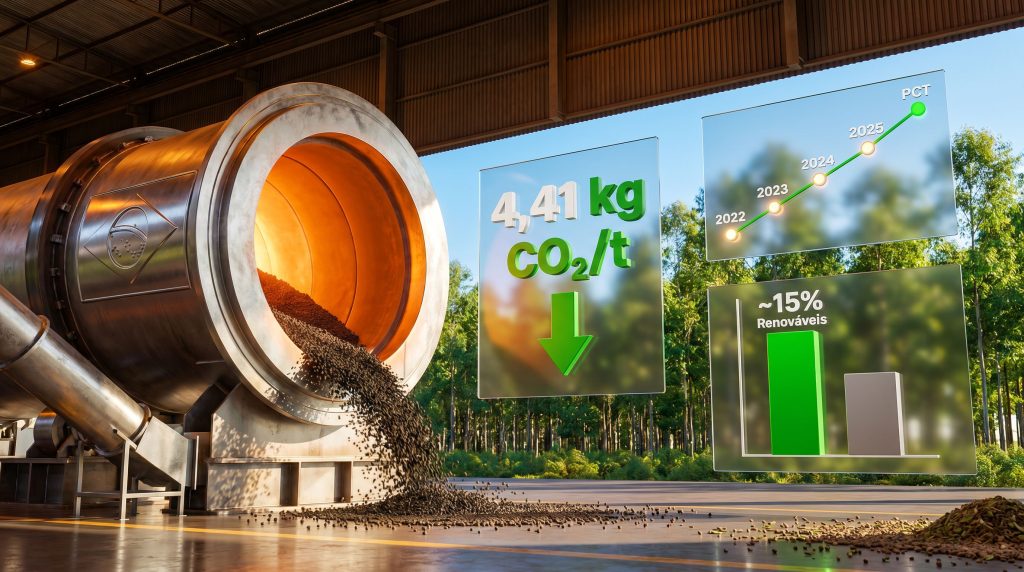
| Full implementation | 2025 | Technology operational across both pelletising plants at approximately 15% fossil fuel substitution |
| International protection | In progress | PCT application filed, national phase entries under evaluation |
The progression from controlled laboratory conditions to full-scale industrial application in approximately three years is notably rapid for a process modification in heavy industry, where operational risk management typically extends timelines considerably.
Measurable Outcomes: What the Carbon Reduction Numbers Actually Mean
The 4.41 kg CO₂ Per Tonne Figure in Context
The headline environmental result of Samarco's technology is a reduction of 4.41 kilograms of CO₂ per tonne of pellet produced, achieved through approximately 15% substitution of fossil fuels with eucalyptus charcoal fines across both pelletising plants. This figure, as confirmed by the INPI's green patent assessment, represents a measurable and auditable outcome rather than a modelled projection.
To appreciate the cumulative significance of this per-unit reduction, it helps to consider it within the context of industrial-scale pellet production. Iron ore pellet plants typically operate at millions of tonnes annually. A consistent reduction of 4.41 kg CO₂ per tonne compounds across production volumes into a material contribution to a company's Scope 1 emissions trajectory.
Equally important is what was not sacrificed to achieve this reduction. The technology was implemented while maintaining pellet quality and operational integrity, confirming that the environmental gain is not the product of a trade-off against product performance.
Comparing Approaches Across Samarco's Decarbonisation Portfolio
| Initiative | Technology Applied | CO₂ Impact | Scale |
|---|---|---|---|
| Eucalyptus charcoal fines substitution | Solid biomass in pelletisation furnaces | 4.41 kg CO₂/t of pellet | Both pelletising plants |
| Renewable bio-oil partnership | 100% renewable bio-oil replacing natural gas | Approximately 2 kg CO₂/t of dry ore (near term) | Plant 3; 220 tonnes used in 2024 |
| Natural gas conversion | Replacement of fuel oil across three plants | Approximately 10% emissions reduction (~160,000 t CO₂/year) | Three plants at Anchieta unit |
The table above illustrates that Samarco is pursuing a portfolio approach to decarbonisation rather than betting on a single technology — a strategy that reduces transition risk while accumulating multiple sources of verified carbon reduction across the operation. In addition, Samarco's partnership with Aperam Bioenergia to use 100% renewable fuel further demonstrates this multi-pronged commitment.
Iron Ore Pellets and the Global Green Steel Equation
Why Pellet Quality Is Non-Negotiable for Low-Carbon Steelmaking Routes
The global steel industry is undergoing a structural shift toward lower-carbon production routes, primarily through direct reduction of iron (DRI) using natural gas or, increasingly, hydrogen — combined with electric arc furnace (EAF) steelmaking. Both DRI and EAF processes require high-quality iron ore pellets with specific metallurgical characteristics, including high iron content, low gangue, and consistent physical properties. Advances in hydrogen iron ore reduction are, furthermore, reshaping the specifications that pellet producers must meet to serve next-generation steelmaking.
This creates a direct commercial link between pellet producer decarbonisation and demand growth. As steelmakers transition to DRI/EAF routes to reduce their own Scope 1 and Scope 2 emissions, they simultaneously generate growing demand for pellets produced with lower embedded carbon intensity. A pellet producer that can demonstrate both metallurgical quality and a credibly lower carbon footprint per tonne is positioned to capture premium pricing or preferential supply agreements in an increasingly carbon-conscious procurement environment.
Market analysis from Wood Mackenzie projects demand for iron ore pellets growing at a compound annual growth rate of approximately 15% through to 2030, driven by net-zero commitments from major global steel producers. With roughly 70% of the world's largest steel companies having announced some form of net-zero or carbon neutrality target, the commercial relevance of low-carbon pellet supply is accelerating.
International Benchmarks: How Competing Mining Regions Are Approaching the Same Problem
Samarco's technology does not exist in a vacuum. Across the global mining industry, comparable efforts are underway, though with different technological pathways and resource bases:
- Australia (Rio Tinto, Fortescue Metals): Both companies have invested in biomass co-firing and hydrogen-based direct reduction pathways, targeting reductions of between 30% and 50% in fossil fuel consumption by 2030, primarily focused upstream in mining operations rather than pelletisation specifically
- European Union: The Horizon Europe programme funds research into low-carbon pelletisation and sintering technologies as part of broader green iron production under the European Green Deal framework
- China and India: Both countries have established green patent fast-track channels within their national intellectual property offices. China's Green Channel programme, operational since the early 2010s, collectively processes approximately 1,000 green patent applications annually according to World Intellectual Property Organization (WIPO) data, reflecting the scale of global institutional interest in protecting clean industrial technologies
What distinguishes the Brazilian approach is the integration of the country's mature eucalyptus forestry and charcoal industry into a pelletisation solution. This is not a technology transfer from another sector; it is an original application of locally available biomass co-products to a specific industrial problem.
Brazil's Structural Advantage in Biomass-Based Industrial Decarbonisation
Brazil's eucalyptus plantation sector is among the most productive in the world, with certified plantation forestry providing a renewable, traceable biomass supply chain that has served the country's charcoal-based steel industry for decades. The moinha co-product that Samarco's technology utilises exists as a consequence of this established chain, meaning the renewable fuel input does not require new plantation development or land conversion to supply at industrial scale.
This structural availability positions Brazil differently from regions where biomass for industrial applications must be purpose-grown, imported, or developed from scratch. For Samarco specifically, the proximity of eucalyptus charcoal processing operations to its pelletisation facilities reduces logistics complexity and input cost variability — two factors that have historically constrained biomass adoption in heavy industry. Consequently, green iron production in Australia and elsewhere faces notably different supply-side challenges when attempting comparable biomass substitution strategies.
International Patent Protection and the Strategic Value of the PCT Filing
How the Patent Cooperation Treaty Extends Samarco's Competitive Moat
The INPI green patent grant covers Brazil, but Samarco's commercial ambitions for the technology extend beyond domestic application. The Patent Cooperation Treaty (PCT), administered by WIPO, provides a mechanism for seeking patent protection across more than 150 signatory countries through a single international filing, preserving rights in multiple jurisdictions while deferring the cost and complexity of national phase entries.
Samarco has confirmed that a PCT application has been filed, opening the international examination process. The subsequent steps involve:
- Completion of the international search and preliminary examination phases under WIPO procedures
- Strategic selection of national jurisdictions for phase entry based on commercial priorities
- Filing in individual national offices within prescribed PCT deadlines
- Navigation of each jurisdiction's domestic patent examination requirements
The most strategically significant jurisdictions for entry are likely to be major green steel consuming markets: the European Union, where carbon border adjustment mechanisms create direct incentives to source lower-carbon intermediate goods; Japan and South Korea, which host globally significant electric arc furnace steel sectors; and the United States, where infrastructure investment and clean manufacturing policies are reshaping steel procurement criteria.
"A PCT filing transforms Samarco's pelletisation technology from a protected operational process into a globally deployable intellectual property asset. If successfully granted in key jurisdictions, the patent creates a foundation for licensing arrangements with other pellet producers worldwide, converting an internal cost-reduction innovation into a potential revenue stream."
The Multidisciplinary Collaboration Behind the Patent's Strength
One of the less-examined dimensions of this achievement is the organisational model that produced it. The technology was developed by Samarco's Process Engineering team from 2022 onward, but converting an industrial process innovation into a legally defensible, internationally protected patent required close collaboration between engineering expertise and intellectual property legal strategy.
Samarco's internal Intellectual Property Group worked alongside the Legal Management division to structure the patent application in a way that satisfied both the technical documentation requirements of the INPI and the environmental substantiation criteria specific to the Patente Verde classification. This integration of engineering and legal disciplines from the earliest stages of the project — rather than treating IP protection as an afterthought — is widely regarded as a factor in the application's robustness and the speed of its approval.
The next major ASX story will hit our subscribers first
The ESG Portfolio Context: Where the Patent Fits in Samarco's Sustainability Architecture
Verified Metrics Across Samarco's 2025 Sustainability Performance
The green patent technology is one component within a broader ESG performance framework that Samarco has been building across its operations. According to the company's 2025 sustainability reporting, key operational sustainability indicators include:
- 100% renewable electricity used across operational activities
- 87.7% water recirculation rate across general operations, with the Ubu Unit achieving 100% water reuse
- Fourth consecutive Gold Seal from the GHG Protocol Brazil programme, recognising the quality and transparency of the company's greenhouse gas emissions inventory
These metrics collectively indicate that the renewable fuel substitution patent is not an isolated initiative but part of a systematic approach to reducing environmental intensity across multiple operational dimensions simultaneously.
Carbon Credit Monetisation: Turning Emissions Reductions into Financial Assets
The measurable per-tonne CO₂ reduction that the moinha technology delivers creates a quantifiable basis for engagement with voluntary carbon markets. Samarco's complementary natural gas conversion programme, which involved an investment of R$ 43 million across three plants, projects potential carbon credit value of approximately R$ 45 million over a ten-year horizon based on expected emission reduction volumes.
The biomass substitution patent adds another verifiable layer to this carbon accounting structure. As voluntary carbon markets develop more rigorous industrial process methodologies and as mandatory carbon pricing mechanisms expand across key trading regions, the ability to demonstrate technology-backed, patent-protected emissions reductions becomes increasingly valuable from a balance sheet perspective.
The combination of multiple verified decarbonisation initiatives also strengthens Samarco's access to green financing instruments, including sustainability-linked bonds and green loans, where pricing advantages depend on demonstrated and measurable environmental performance against independently verified benchmarks. The evolving steel and iron ore market further underscores why securing these financing advantages now is strategically important.
Frequently Asked Questions: Green Patents and Decarbonisation in Iron Ore Pelletisation
What distinguishes a Patente Verde from a standard Brazilian patent?
| Criterion | Conventional Patent | Patente Verde |
|---|---|---|
| Average approval timeline | Multiple years | Approximately 14 months |
| Core requirements | Novelty, inventive step, industrial applicability | All conventional requirements plus objective, measurable environmental benefits |
| Sector focus | Any technology domain | Renewable energy, conservation, waste management, related categories |
| Programme availability in Brazil | Since the 19th century | Since 2012, expanded in 2020 |
What is moinha de carvão vegetal and why is it suitable for pelletisation furnaces?
Moinha is the fine particulate residue that results from the mechanical handling, processing, and transportation of charcoal derived from eucalyptus plantations. Because it is a co-product of an existing industrial chain rather than a primary energy crop, its use in pelletisation does not create new land use pressures or require dedicated cultivation. Its physical and chemical characteristics, particularly its calorific value and relatively low ash content compared to mineral coal, make it compatible with the thermal demands of pelletisation furnace systems at partial substitution rates.
How significant is a 4.41 kg CO₂ per tonne reduction in industrial terms?
On a unit basis, the figure may appear modest, but it compounds significantly at production scale. Iron ore pelletising operations process tens of millions of tonnes annually across major producing companies. Applied consistently across large production volumes, a per-tonne reduction of this magnitude translates into hundreds of thousands of tonnes of avoided CO₂ annually at the operational level. The additional significance lies in the fact that this reduction is verifiably attributed to a protected technology, making it eligible for carbon accounting and potential credit monetisation under recognised methodologies.
What does the PCT filing mean for the technology's international future?
The PCT application preserves Samarco's right to seek patent protection in more than 150 countries through a single international process. After international examination phases are completed, the company can select specific national jurisdictions for entry, prioritising markets where the technology has the greatest commercial relevance. If granted in key markets such as the European Union, Japan, South Korea, or the United States, the patent creates a basis for licensing the technology to other pellet producers globally.
Why does pellet quality matter so much in the context of green steel?
Direct reduction steelmaking — the primary low-carbon alternative to conventional blast furnace routes — requires pellets with high iron content, low impurity levels, and consistent physical strength to perform correctly within shaft furnace or fluidised bed reactor environments. A biomass substitution technology that achieves emissions reductions but compromises pellet metallurgical specifications would be commercially unviable. Samarco's technology maintained product quality throughout the transition, which is a prerequisite for the innovation to have real-world value beyond laboratory conditions.
What This Innovation Reveals About the Future Trajectory of Low-Carbon Mining
The Replicability Question and What It Means for the Global Pellet Industry
Perhaps the most consequential dimension of Samarco's Samarco patente verde para substituir combustíveis fósseis achievement is not the specific technology itself but the proof-of-concept it establishes for the broader industry. The development pathway — from controlled laboratory experiments in 2022 to full-scale commercial operation across two pelletising plants by 2025 — demonstrates that industrial-scale fossil fuel substitution in pelletisation is technically achievable within a realistic timeframe and without compromising product integrity.
The model offers a replicable framework for other pellet producers operating in regions with access to biomass co-products, with the caveat that local feedstock characteristics, furnace configurations, and supply chain structures will require adaptation rather than direct duplication. The patent protection Samarco has secured, if extended internationally via the PCT process, means that any replication would need to occur through licensing arrangements rather than independent reinvention.
Structural Forces Reinforcing the Commercial Case for Low-Carbon Pellets
Several converging market forces amplify the long-term significance of this technology development:
- The European Union's Carbon Border Adjustment Mechanism is progressively expanding to cover steel and iron products, creating direct financial incentives for lower-carbon upstream inputs
- Major steel producers' net-zero pledges are increasingly cascading down supply chains into procurement specifications, with carbon intensity of purchased pellets becoming a contract variable alongside iron grade and moisture content
- Voluntary carbon markets, while still developing robust industrial process methodologies, are moving toward greater standardisation that rewards technology-backed, auditable emissions reductions over project-based approaches
- Green financing markets are growing rapidly, with sustainability-linked debt instruments offering preferential terms to companies that demonstrate progress against independently verified environmental targets
"The projections and market growth estimates referenced in this article, including Wood Mackenzie's 15% CAGR forecast for pellet demand and carbon credit valuation projections, involve forward-looking assumptions that are subject to change. Readers should not interpret these figures as guarantees of future market conditions. This article is intended for informational purposes and does not constitute financial or investment advice."
Want to Stay Ahead of the Next Major ASX Mineral Discovery?
Discovery Alert's proprietary Discovery IQ model delivers real-time alerts on significant ASX mineral discoveries — turning complex data across more than 30 commodities into clear, actionable insights for both short-term traders and long-term investors. Explore why historic mineral discoveries have generated extraordinary returns and begin your 14-day free trial at Discovery Alert to position yourself ahead of the broader market.