
July 27, 2026
Why Iron Ore Pricing Power Is Shifting From Sellers to Buyers
For most of the past two decades, the iron ore trade operated under a simple assumption: whoever controlled supply controlled the price. Australian miners shipped vast quantities of ore eastward, and China absorbed it because it had to. That assumption is now being systematically dismantled.
The Fortescue negotiations with China over iron ore supply terms in 2026 represent more than a bilateral contract disagreement. They mark the visible emergence of a third structural era in iron ore pricing, one where a state-backed Chinese buyer is actively reshaping the terms of engagement across the entire seaborne market. Understanding what is happening — and why it matters far beyond Fortescue's own balance sheet — requires examining how procurement power became a geopolitical instrument.
When big ASX news breaks, our subscribers know first
The Architecture of CMRG's Buying Power
From Coordination Body to Centralised Procurement Authority
China Mineral Resources Group was established in 2022 with a mandate that was always more ambitious than its initial public framing suggested. While officially positioned as a coordination mechanism for China's fragmented steel industry, CMRG was designed from the outset to consolidate the purchasing power of hundreds of domestic steel mills into a single negotiating entity.
China accounts for roughly 70% of global seaborne iron ore imports, a concentration of demand that, in theory, should have always given Beijing extraordinary leverage over pricing. The reason that leverage went largely unexercised for so long was structural fragmentation: individual mills negotiated independently, often competing against each other to secure supply, which paradoxically drove prices upward and benefited miners.
CMRG changed this calculus fundamentally. By absorbing mill-level purchasing decisions into a centralised framework, it transformed asymmetric demand into coordinated negotiating weight. This is not a commercial evolution — it is a restructuring of the buyer-seller dynamic at its foundation. The China steel and iron ore market is consequently entering a period of profound transition, one that demands close attention from investors and producers alike.
The Mechanics of Precision Commercial Pressure
Rather than deploying blunt instruments like blanket import bans, CMRG has developed a more sophisticated playbook of targeted commercial coercion. The tactics deployed against Fortescue in mid-2026 illustrate this precision approach clearly.
| CMRG Tactic | Commercial Impact | Strategic Signal |
|---|---|---|
| Cargo delivery restrictions at port | Inventory buildup, cash flow pressure on miners | Willingness to absorb short-term supply disruption |
| Product-specific exclusions (Super Special Fines) | Reduces demand for lower-grade products | Targets Fortescue's most price-sensitive product lines |
| Mill-level purchasing directives | Fragments miner's customer base | Undermines bilateral relationships built over decades |
| Delayed long-term settlement | Prolongs pricing uncertainty | Maintains leverage through sustained ambiguity |
The distinction between product-level restrictions and broader trade measures is strategically important. By targeting a specific grade of ore rather than all Australian imports, CMRG creates maximum commercial disruption for its target while limiting the diplomatic exposure that a blanket ban would generate. Analysts tracking iron ore trade impacts have noted this precision approach as a hallmark of the new procurement era.
Key Insight: Product-level trade restrictions are emerging as a precision instrument of commercial pressure — one that sits in a grey zone between commercial negotiation and state-directed trade policy. They create real operational damage without triggering the formal diplomatic responses that accompany broader trade measures.
The Products at the Centre of the Dispute
Understanding Super Special Fines and Their Role in Blast Furnace Operations
To understand why the CMRG directive targeting Fortescue's Super Special Fines is commercially significant, it helps to understand how iron ore grades function within Chinese steelmaking operations.
Iron ore is priced against a benchmark of 62% iron (Fe) content. Ore with lower Fe content trades at a structural discount to this benchmark, and the steeper the grade discount, the more sensitive the product becomes to pricing pressure. Fortescue's product suite is heavily weighted toward lower-grade ore, typically in the 57–58% Fe range, compared to the higher-grade products exported by BHP and Rio Tinto.
Super Special Fines is a lower-grade iron ore product that Chinese steel mills have historically incorporated into their blast furnace feed through a blending process. Because blast furnaces are calibrated to specific ore mixes, removing Super Special Fines from the supply equation is not simply a matter of substituting one product for another. According to recent reporting, mills that have optimised their blending ratios around Fortescue's lower-grade material face genuine operational challenges when that supply is disrupted, including increased costs from sourcing higher-grade replacement ore at premium prices.
Fortune Fines, another Fortescue lower-grade product, was also reportedly subject to CMRG scrutiny during the negotiation period, suggesting the restrictions were designed to cover Fortescue's most price-sensitive and volume-significant product lines simultaneously.
Why Grade Discount Exposure Amplifies Fortescue's Vulnerability
The grade discount structure in iron ore markets creates a compounding effect for lower-grade producers during pricing negotiations. When a buyer like CMRG negotiates a percentage reduction in the discount applied to lower-grade ore, the revenue impact per tonne is proportionally larger than the same percentage change applied to benchmark-quality product.
Fortescue's position as the world's fourth-largest iron ore producer, combined with its lower-grade product mix, means that every basis point conceded in discount negotiations translates into a material revenue reduction across its entire production volume. This is why the Fortescue–CMRG standoff is structurally more commercially threatening to Fortescue than a similar dispute would be to BHP or Rio Tinto. Furthermore, iron ore price trends suggest that downward pressure on grade discounts is unlikely to reverse in the near term.
A Chronological Map of the Escalating Dispute
The deterioration of Fortescue's supply negotiations with China followed a recognisable escalation pattern, moving from quiet commercial resistance through to public diplomatic engagement.
| Period | Key Development | Significance |
|---|---|---|
| 2025 (Ongoing) | CMRG increases resistance to standard supply terms across multiple miners | Signals systemic buyer-side strategy, not isolated to Fortescue |
| Early 2026 | Talks described as stalled; pricing and discount terms remain unresolved | Negotiations enter deadlock phase |
| Late April 2026 | Bloomberg reports Fortescue close to a deal; long-term settlement expected within months | Market optimism briefly elevated |
| Early July 2026 | CMRG notifies Chinese steel mills to avoid certain Fortescue products | Tactical escalation; dispute becomes public |
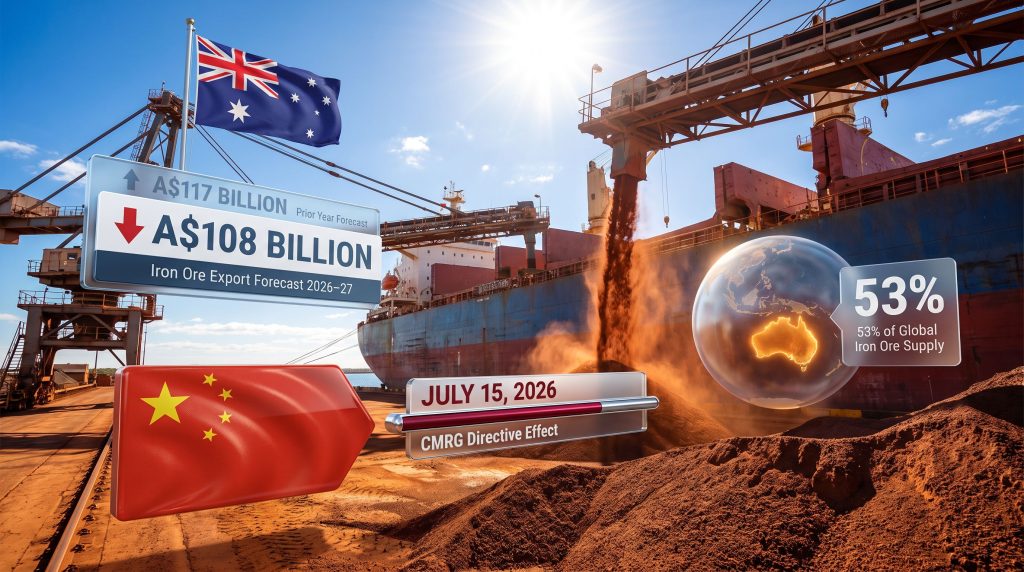
| July 15, 2026 | CMRG directive takes effect: mills must not accept Super Special Fines at Chinese ports | Direct operational disruption to Fortescue's supply chain |
| July 27, 2026 | Fortescue's executive chairman calls for fair bilateral negotiations at the Boao Forum Perth | Public diplomacy deployed as commercial pressure intensifies |
The April 2026 reports of near-settlement are particularly notable in hindsight. The subsequent escalation through product restrictions suggests that whatever provisional agreement was in sight during those discussions broke down over specific pricing terms — most likely the structure of grade discounts that CMRG sought to standardise across its centralised procurement framework.
Australia's Iron Ore Position: Dominance With Diminishing Pricing Power
The Revenue Compression Dynamic
Australia's iron ore dominance in global supply is well established. The country accounts for approximately 53% of global iron ore supply by volume, making it the world's largest producer by a considerable margin. Yet dominance in supply does not automatically translate into dominance in pricing, particularly when the demand side consolidates faster than the supply side can respond.
Iron ore export earnings from Australia are projected to decline to approximately A$108 billion (around US$75.57 billion) in the 2026–2027 financial year, down from A$117 billion the prior year. The primary driver of this iron ore price decline is rising global supply rather than a collapse in Chinese steel demand, but the effect is directionally the same: incremental pricing power is shifting toward buyers.
This revenue trajectory creates a compounding negotiating problem. As earnings decline, the economic cost to Australia of a prolonged supply dispute with CMRG increases, which subtly strengthens the buyer's hand in extended negotiations.
The Gabon Factor: Diversification as Strategic Signal
Fortescue's active development of iron ore operations in Gabon introduces a dimension to this dispute that extends beyond the immediate pricing argument. By developing production capacity outside Australia, Fortescue is signalling to CMRG that its long-term supply strategy is not confined to a single geographic origin.
The practical limitations of this signal should not be understated. African iron ore development faces significant infrastructure constraints — including rail and port capacity, logistics costs, and political risk — that prevent Gabon from becoming a near-term alternative supply source at scale. The shipping distance from West Africa to Chinese ports is also substantially greater than from Western Australia, adding freight cost premiums that would partially offset any pricing flexibility gained through geographic diversification.
However, the strategic value of the Gabon operations may lie less in their immediate output and more in the long-term optionality they represent. If Fortescue can credibly demonstrate that it is developing supply alternatives, the leverage equation shifts incrementally in its favour over a multi-year horizon.
The Mutual Dependency Paradox
Why CMRG's Leverage Is Real but Not Unlimited
The structural dependency between Australia and China in iron ore is genuinely bidirectional, even if the balance has shifted. China imports approximately 70% of its seaborne iron ore from Australia, and its port infrastructure, shipping contracts, and blast furnace blending operations have been calibrated around Australian ore specifications over decades.
The supply substitution alternatives available to China are meaningful in theory but constrained in practice:
- Brazil (Vale): The second-largest global supplier, but distance, shipping costs, and infrastructure bottlenecks at Brazilian ports limit the speed at which volume can be redirected to China
- South Africa: A regional supplier with growing export capacity, but volumes are insufficient to replace Australian supply at scale
- India: Periodically restricts iron ore exports based on domestic steel industry needs, making it an unreliable alternative supply source
- Guinea (Simandou): The large-scale Simandou iron ore project in Guinea represents a longer-term supply alternative, but commercial production at meaningful scale remains years away
The operational reality is that Chinese steel mills have spent years optimising their production processes around the specific chemical and physical characteristics of Australian ore. Switching to alternative sources mid-production cycle involves engineering adjustments, increased costs, and potential impacts on steel quality and yield — none of which serve the interests of mill operators working to thin margins in a challenging domestic steel market.
Market Dynamics Note: China's domestic steel sector is itself under pressure from overcapacity and weak property market demand, which means CMRG is deploying procurement leverage at a time when the steel mills it represents are not operating from a position of financial strength. This creates an internal tension in the buyer's position that limits how far the disruption strategy can be sustained.
The next major ASX story will hit our subscribers first
Structural Comparison: How Australia and China Are Positioned
| Dimension | Australia's Position | China's Position |
|---|---|---|
| Supply concentration | 53% of global iron ore supply | ~70% of seaborne imports from Australia |
| Pricing leverage | Limited by grade discount exposure | Enhanced by centralised CMRG structure |
| Diversification options | Gabon, other African projects (long-term) | Brazil, Africa, constrained by logistics and volume |
| Negotiation urgency | High, export revenue declining year-on-year | Moderate, domestic steel demand under structural pressure |
| Geopolitical risk | Moderate, trade relationship stabilising post-2022 | Moderate, supply security remains a strategic priority |
Decoding the Public Messaging Strategy
The Boao Forum Perth as a Commercial Pressure Tool
Andrew Forrest's appearance at the Boao Forum Perth on July 27, 2026, was not a passive diplomatic engagement. The choice of platform was deliberate. The Boao Forum for Asia and its regional offshoots are designed to facilitate constructive dialogue between Asian and Pacific economies at the intersection of business and policy, making them an appropriate venue for messaging that bridges commercial and diplomatic registers.
By framing the iron ore trade relationship as one built on mutual benefit — referencing the role of bilateral trade in supporting Australian employment and public services while simultaneously providing China with the secure raw material supply that underpinned its industrial expansion — Forrest was constructing a narrative frame that makes commercially aggressive CMRG tactics appear inconsistent with China's own long-term interests.
The inclusion of Gabon in his remarks about growing together was also noteworthy. Positioning Gabon alongside Australia and China as a trilateral partnership signals that Fortescue sees its African operations as part of a China-linked value chain rather than as a supply alternative to it — a framing designed to reduce the adversarial tension in the negotiation.
Analytical Note: Public calls for equitable negotiations from a major resource company executive are rarely impromptu gestures. They are typically deployed when private commercial channels have stalled and reputational framing becomes a necessary tactical supplement to direct negotiation. Reporting from The Australian has similarly highlighted how the public dimension of this standoff has escalated in tandem with stalled private negotiations.
Three Scenarios for Resolution
Scenario 1: Negotiated Settlement With Modified Discount Framework
Both parties face escalating costs from a prolonged standoff. Fortescue absorbs inventory buildup and logistical disruption costs, while Chinese steel mills face substitution challenges and increased blending costs. The most probable resolution involves CMRG securing incremental pricing concessions on lower-grade products in exchange for restored delivery access and a long-term supply framework.
The market implication would be modest short-term revenue dilution for Fortescue, partially offset by restored supply chain stability. However, the precedent set would have longer-term implications for how the entire Australian iron ore sector prices its lower-grade products.
Scenario 2: Protracted Standoff With Selective Supply Diversion
If neither party is willing to concede on core pricing principles, and public statements from both sides harden negotiating positions, Fortescue may progressively redirect cargo volumes to alternative markets in Southeast Asia, India, and the Middle East. This scenario involves higher logistical costs, potential spot price volatility for lower-grade iron ore, and accelerated investment in Fortescue's geographic diversification strategy.
The risk for Fortescue in this scenario is that alternative markets cannot absorb its product volumes at comparable price levels, creating a sustained revenue gap that pressures its capital allocation decisions.
Scenario 3: Government-Level Diplomatic Intervention
If the commercial dispute reaches a point where it creates systemic disruption to Australian iron ore export earnings or Chinese steel production continuity, the dispute becomes a candidate for bilateral diplomatic resolution. Given the scale of economic dependency on both sides, this scenario is more likely than a prolonged supply rupture, though the threshold for government intervention is higher than most market observers typically assume.
What This Dispute Means for the Broader Iron Ore Sector
The implications of the Fortescue negotiations with China over iron ore supply terms extend well beyond a single company's annual contract cycle. If CMRG successfully restructures supply terms with the world's fourth-largest iron ore producer, the resulting framework becomes a template that is directly applicable to BHP, Rio Tinto, and every other exporter dependent on Chinese demand.
Smaller and mid-tier iron ore producers face a disproportionately severe version of this risk. Without the balance sheet resilience of a major producer, a CMRG-imposed pricing regime that permanently compresses grade discounts could threaten the commercial viability of projects that were developed under more favourable pricing assumptions.
The discipline that CMRG is introducing into iron ore procurement represents the most significant structural shift in the market since the transition from annual benchmark contracts to spot-linked pricing mechanisms in 2010. That earlier transition redistributed value from buyers to sellers during a period of surging Chinese demand. The current shift is moving in the opposite direction — at a time when supply is rising, demand growth is moderating, and the buyer has spent three years building the institutional infrastructure needed to exercise its latent pricing power.
For investors assessing exposure to Australian iron ore equities, the central question is no longer whether CMRG will succeed in restructuring supply terms. It is how deeply those restructured terms will compress realised revenue per tonne, and which producers have the product quality, cost structure, and geographic diversification to absorb that compression without material damage to long-term returns.
This article contains analysis and forward-looking scenarios based on publicly available information as of late July 2026. It does not constitute financial advice. Investors should conduct their own due diligence before making any investment decisions related to iron ore producers or the commodities discussed herein.
Want To Stay Ahead of Structural Shifts in ASX Commodity Markets?
Discovery Alert's proprietary Discovery IQ model delivers real-time alerts on significant ASX mineral discoveries, cutting through complex market data to surface actionable opportunities the moment they emerge — explore historic discovery returns to understand the scale of what early positioning can achieve, then begin your 14-day free trial at Discovery Alert to secure your market-leading edge.