June 9, 2026
Global supply chain resilience has emerged as a defining characteristic of modern resource security, with mining corporations increasingly evaluating infrastructure investments through the lens of geopolitical alignment and strategic diversification. The iron ore sector, representing one of the world's most capital-intensive commodity markets, exemplifies how geographic positioning, regulatory frameworks, and corridor economics intersect to shape long-term investment returns and national security considerations. Furthermore, the iron ore project in Liberia demonstrates how strategic positioning can create competitive advantages in increasingly complex global markets.
What Makes Liberia a Strategic Iron Ore Investment Destination?
Geographic Advantages and Resource Quality Assessment
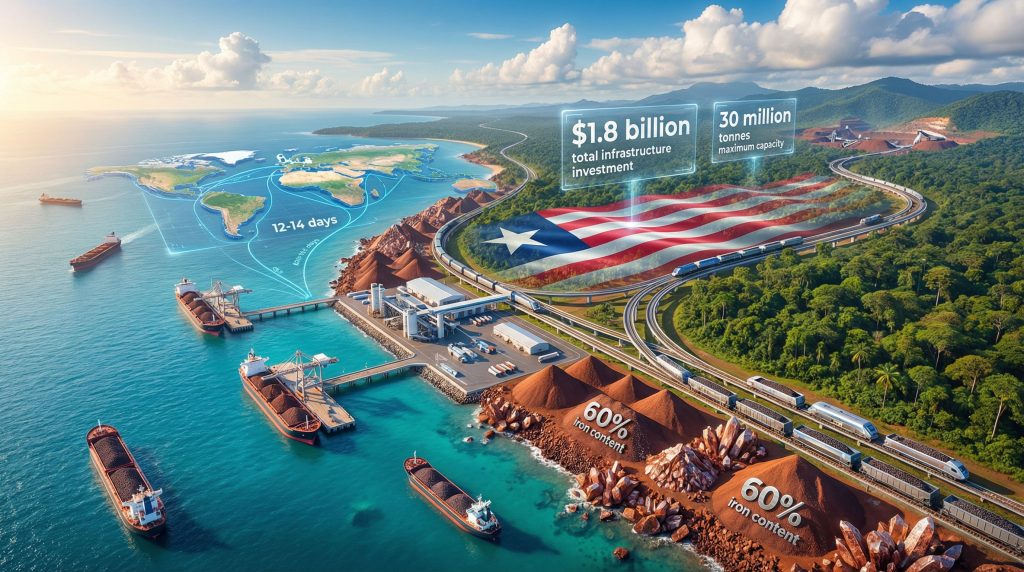
Liberia's position along West Africa's Atlantic coastline creates natural advantages for global iron ore distribution networks. The Kon Kweni iron ore project in Liberia represents a significant development containing over 750 million tonnes of Direct Shipping Ore (DSO) with exceptional iron content exceeding 60% grade. This deposit quality eliminates the need for complex beneficiation processes, reducing both capital expenditure and operational costs compared to lower-grade ore bodies requiring extensive processing.
The strategic positioning near Buchanan Port provides direct access to deep-water shipping facilities capable of accommodating Post-Panamax and Capesize bulk carriers exceeding 175,000 deadweight tonnes. Atlantic shipping routes from this location reduce transit times to European markets to approximately 12-14 days, compared to alternative routing options requiring 18-22 days through more circuitous paths.
Transport cost advantages become particularly significant when examining per-tonne economics. Buchanan Port routing enables transport costs of $15-25 per tonne versus $35-45 per tonne via alternative inland routes, creating substantial competitive margins that improve project economics across varying commodity price cycles. For instance, these iron ore price trends significantly influence project viability assessments.
The cross-border proximity between Guinea's interior deposits and Liberia's coastal infrastructure creates natural corridor synergies. This geographic configuration allows mining operations in Guinea to utilize Liberian export infrastructure, maximising asset utilisation while distributing capital costs across multiple operators.
Regulatory Framework and Investment Climate Analysis
Liberia's regulatory environment has demonstrated capacity for managing complex, multi-jurisdictional mining developments. The Environmental and Social Impact Assessment (ESIA) approval process, completed in March 2026, required coordination between the Liberian Environmental Protection Agency and Guinea's parallel regulatory system, establishing precedent for cross-border project management.
The $1.8 billion Liberty Corridor concession represents one of West Africa's largest infrastructure commitments, with negotiations spanning approximately five years before conclusion in July 2025. Legislative ratification occurred in December 2025, demonstrating parliamentary support for major mining infrastructure investments. Additionally, Ivanhoe Atlantic secured Liberia approval for iron ore transport, highlighting the project's regulatory momentum.
Equity participation frameworks reflect evolving African mining investment models. The current structure allocates 85% operational control to Ivanhoe Atlantic while Guinea maintains 15% government equity participation. This arrangement balances operator autonomy with national ownership requirements increasingly common across African mining jurisdictions.
Concession duration and operational security provide 25-30 year development horizons essential for capital-intensive mining projects. Extended operational agreements enable long-term infrastructure planning and provide revenue certainty for both operators and host governments.
The multi-user infrastructure policy framework represents an innovative approach to regional development. Rather than single-operator dedicated facilities, the regulatory structure enables shared access to rail and port infrastructure, reducing individual project capital requirements while maximising asset utilisation across multiple mining operations.
When big ASX news breaks, our subscribers know first
How Do Infrastructure Corridors Transform Regional Mining Economics?
Liberty Corridor vs. Trans-Guinean Railway: Competitive Analysis
West African iron ore development increasingly reflects global supply chain bifurcation along geopolitical lines. The Liberty Corridor infrastructure model positions itself as a Western-aligned alternative to China-controlled logistics networks, particularly the Trans-Guinean Railway serving the massive Simandou project. However, analysing iron ore demand insights reveals the complexity of global market dynamics.
Liberty Corridor Specifications:
- Total Infrastructure Investment: $1.8 billion across rail upgrades and port facilities
- Initial Capacity: 2-5 million tonnes annually in Phase 1 operations
- Maximum Capacity: Scalable infrastructure supporting up to 30 million tonnes through phased expansion
- Export Routing: Buchanan Port deep-water terminal serving Western markets
- Multi-User Access: Shared infrastructure reducing individual operator capital requirements
Competitive Infrastructure Metrics:
| Metric | Liberty Corridor | Alternative Routes | Advantage |
|---|---|---|---|
| Transport Cost per Tonne | $15-25 | $35-45 | 40-60% reduction |
| Shipping Time to Europe | 12-14 days | 18-22 days | 30% faster |
| Annual Throughput | 30 million tonnes | Variable limitations | Flexible scaling |
| Capital Efficiency | Shared infrastructure | Dedicated facilities | 40-60% lower |
The Simandou comparison reveals contrasting strategic orientations. China's Simandou project represents 150+ million tonnes annual capacity targeting Asian markets through China-controlled Trans-Guinean Railway infrastructure. This massive scale serves Chinese steel industry requirements while creating dependency on Chinese logistics networks.
Liberty Corridor's deliberate Western supply chain alignment addresses European and North American market requirements through infrastructure independent of Chinese control. This positioning reflects broader global supply chain diversification trends following lessons learned from concentrated sourcing vulnerabilities exposed during 2020-2025 disruptions.
Multi-User Infrastructure Economic Impact Modelling
Shared infrastructure economics fundamentally alter regional mining development patterns. Traditional single-operator dedicated facilities typically achieve 40-50% annual berth utilisation rates, while multi-user port facilities reach 70-85% utilisation through coordinated scheduling across multiple operators.
Capital Efficiency Analysis:
- Individual Project Savings: 40-60% reduction in infrastructure capital requirements through shared rail and port access
- Asset Utilisation Optimisation: Multiple operators maximise throughput within existing capacity constraints
- Risk Distribution: Infrastructure costs spread across multiple projects reduce individual project financial exposure
Government Revenue Diversification:
- Infrastructure Access Fees: Projected $200 million annually from multi-operator facility utilisation
- Employment Generation: 15,000+ direct positions plus 45,000+ indirect employment across supply chains
- Regional Development: Infrastructure benefits extend beyond mining to broader economic development
Economic Multiplier Effects:
Direct mining employment typically generates 2-3x indirect employment through supplier industries, construction services, transportation, and retail commerce serving workforce communities. The 15,000 direct positions translate to approximately 45,000 indirect jobs across regional economies, creating sustainable economic development beyond mining operations.
Revenue Collection Mechanisms establish per-tonne charges for rail utilisation and port handling, creating predictable government income streams independent of commodity price volatility affecting mining project profitability. This structure provides fiscal stability for host governments while enabling transparent cost allocation across facility users.
What Are the Geopolitical Implications of Western-Aligned Supply Chains?
Strategic Resource Competition Analysis
Global iron ore market segmentation increasingly reflects geopolitical competition between Chinese-controlled and Western-aligned supply chains. China's dominance in African mining infrastructure, exemplified by the Simandou project's 150+ million tonnes capacity, creates strategic dependencies that Western policymakers seek to counterbalance. Indeed, understanding how this relates to the strategic iron ore asset landscape becomes crucial for investors.
Supply Chain Bifurcation Dynamics:
- Asian Market Orientation: Chinese infrastructure serving Chinese steel industry requirements
- Western Market Diversification: Alternative supply routes targeting European and North American consumers
- Infrastructure Control: Competing logistics networks reflecting broader geopolitical competition
- Market Access: Export destination preferences influencing infrastructure investment decisions
The European steel industry's annual requirement of 180+ million tonnes creates substantial demand for supply chain diversification away from Chinese-controlled sources. High-grade direct shipping ore from West African deposits serves this diversification strategy while providing supply security for critical industrial infrastructure.
Critical Minerals Security Considerations:
Iron ore represents a foundational input for steel production supporting defence industries, infrastructure development, and manufacturing sectors. Supply chain resilience gained prominence following global disruption experiences during 2020-2025, when concentrated sourcing created vulnerability to geopolitical and logistical disruptions. Furthermore, this connects to broader concerns about china ore price decline and market dynamics.
Western governments increasingly evaluate mining infrastructure investments through national security frameworks, considering both immediate supply requirements and long-term strategic autonomy. The US Embassy facilitation of the Liberty Corridor agreement reflects this elevated policy priority.
National Security and Trade Policy Intersections
Regulatory scrutiny processes for foreign investment in critical minerals sectors have intensified across Western jurisdictions. Mining projects face enhanced due diligence regarding ownership structures, technology transfers, and export destination commitments.
The iron ore project in Liberia addressed these concerns through explicit Western supply chain commitments. Company leadership articulated clear export restrictions, stating that iron ore production would serve markets outside China and avoid Chinese-controlled logistics infrastructure.
Strategic Partnership Requirements:
- Export Destination Controls: Contractual commitments to serve Western markets
- Infrastructure Independence: Avoiding Chinese-controlled logistics networks
- Technology Transfer Restrictions: Preventing sensitive mining technology access
- Long-term Supply Agreements: Securing reliable supply for Western steel producers
Trade Policy Implications:
Preferential trade agreements and export financing mechanisms increasingly favour mining projects aligned with Western supply chain objectives. Development finance institutions provide concessional financing for infrastructure projects supporting supply chain diversification, creating competitive advantages for Western-aligned developments over Chinese-backed alternatives.
How Do Production Scale Economics Drive Investment Returns?
Phase Development and Capacity Scaling Models
Iron ore project in Liberia development follows phased expansion models designed to minimise initial capital requirements while creating scalability for market demand growth. This approach reduces financial risk during early production phases while preserving expansion optionality as market conditions evolve. Consequently, understanding the context of largest iron ore mines helps benchmark this project's scale potential.
Phase Development Economics:
| Development Phase | Annual Capacity | Capital Investment | Break-even Timeline | Revenue Potential |
|---|---|---|---|---|
| Phase 1 (Initial) | 2-5 million tonnes | $800 million | 18-24 months | $240-700 million |
| Phase 2 (Expansion) | 15-20 million tonnes | $1.2 billion | 12-18 months | $1.8-2.8 billion |
| Phase 3 (Maximum) | 25-30 million tonnes | $600 million | 8-12 months | $3.5-4.2 billion |
Operating Cost Advantages:
Direct shipping ore deposits provide significant cost advantages through elimination of beneficiation requirements. Operating costs of $35-45 per tonne compare favourably to industry averages of $55-65 per tonne for operations requiring extensive processing. High-grade ore (60%+ iron content) commands premium pricing of $120-140 per tonne in global markets.
Revenue Generation Analysis:
- Premium Pricing: High-grade DSO receives price premiums above standard ore grades
- Cost Advantages: Minimal processing requirements reduce operational expenditure
- Government Revenue: 3-5% royalty structures plus corporate taxation
- Export Efficiency: Direct shipping eliminates inventory carrying costs
Profitability and Investment Return Projections
Break-even analysis demonstrates rapid payback periods reflecting high-grade ore economics and efficient infrastructure utilisation. Phase 1 operations achieve positive cash flow within 18-24 months, while subsequent expansions benefit from existing infrastructure and operational experience.
Investment Return Drivers:
- High-Grade Resource: 60%+ iron content reducing processing requirements
- Infrastructure Efficiency: Shared facilities optimising capital deployment
- Market Access: Premium pricing through Western supply chain positioning
- Operational Scale: Economies of scale reducing per-tonne production costs
Risk-Adjusted Returns:
Mining investment returns require adjustment for geological, political, and commodity price risks. The iron ore project in Liberia benefits from established resource definition (750+ million tonnes proven), stable regulatory environment, and long-term supply agreement potential with Western steel producers.
What Environmental and Social Governance Factors Shape Project Viability?
Environmental Impact Assessment Requirements
Multi-jurisdictional ESIA processes across Guinea and Liberia establish comprehensive environmental compliance frameworks. The Liberian Environmental Protection Agency's March 2026 ESIA approval followed extensive review by consultant Earthtime Group, ensuring international environmental standards compliance.
Environmental Management Requirements:
- Biodiversity Protection: Conservation measures in tropical forest regions
- Water Management: Mining and processing water system controls
- Carbon Footprint: Renewable energy integration targets
- Waste Management: Tailings and overburden disposal protocols
International Compliance Standards:
Environmental assessments follow World Bank Environmental and Social Framework guidelines, ensuring global market acceptance and financing accessibility. ISO 14001 environmental management systems provide operational frameworks for ongoing compliance monitoring and performance improvement.
Cross-Border Coordination:
Guinea's parallel ESIA process requires coordination with Liberian environmental authorities, establishing precedent for integrated environmental management across national boundaries. This coordination ensures consistent environmental standards throughout the logistics corridor.
Community Development and Local Content Strategies
Local content requirements mandate 25-35% procurement of goods and services from local suppliers, creating economic opportunities for Liberian and Guinean businesses. Skills development programmes provide technical and operational training for local workforce participation in mining operations.
Community Benefit Programmes:
- Infrastructure Development: Road and utility improvements benefiting local communities
- Revenue Sharing: Distribution mechanisms with traditional authorities and local governments
- Education Investment: Technical training and educational facility development
- Healthcare Services: Medical facility expansion and healthcare worker training
Stakeholder Engagement Processes:
Community consultation requirements integrate local voices into project planning and operational decision-making. Traditional authority recognition ensures cultural sensitivity and sustainable community relationships throughout project lifecycle.
Social Impact Monitoring:
Ongoing social impact assessment tracks community development outcomes, employment generation, and social service improvements. Independent monitoring ensures accountability and provides feedback mechanisms for community concerns.
How Do Leadership Transitions Affect Major Mining Project Execution?
Corporate Governance and Management Continuity
Executive leadership changes during critical development phases present both risks and opportunities for major mining projects. The iron ore project in Liberia experienced significant leadership transition with CEO Bronwyn Barnes' resignation after four years, followed by interim leadership appointment of retired US Ambassador J. Peter Pham. However, this represents a major win for the US in strategic resource positioning.
Leadership Transition Impacts:
- Stakeholder Relationships: Maintaining government and community relationships across leadership changes
- Strategic Continuity: Preserving long-term project vision and execution plans
- Investor Confidence: Communicating stability and competence during transitions
- Operational Momentum: Avoiding disruption to development timelines and milestones
Board Composition and Expertise:
The appointment of former US Ambassador J. Peter Pham as Executive Chairman and Interim CEO brings diplomatic expertise valuable for navigating complex international relationships. This background proves particularly relevant for projects spanning multiple jurisdictions and requiring government coordination.
Risk Mitigation Strategies:
- Succession Planning: Prepared leadership transitions minimising operational disruption
- Institutional Knowledge: Documentation and transfer of critical project information
- Stakeholder Communication: Proactive engagement maintaining relationship continuity
- Strategic Partnerships: External relationships providing stability during internal transitions
Investor Confidence and Market Perception Factors
Market reaction to leadership changes reflects investor assessment of management capability and strategic direction consistency. The iron ore project in Liberia maintained development momentum through regulatory approval achievement despite concurrent leadership transition.
Confidence Maintenance Strategies:
- Performance Continuity: Achieving development milestones during leadership transitions
- Communication Transparency: Regular investor updates on project progress and leadership decisions
- Strategic Partnership Stability: Maintaining relationships with financing partners and customers
- Operational Excellence: Demonstrating project execution capability independent of specific leadership
Track Record Considerations:
Investor confidence depends on institutional capability rather than individual leadership personalities. The successful ESIA approval and regulatory milestone achievement during leadership transition demonstrates organisational resilience and operational competence.
The next major ASX story will hit our subscribers first
What Market Dynamics Drive Iron Ore Demand Projections?
Global Steel Industry Demand Forecasting
Infrastructure development in emerging markets drives projected 3-5% annual growth in global iron ore consumption. Urbanisation trends across Africa, Asia, and Latin America create sustained demand for steel-intensive construction and manufacturing development.
Green Steel Production Requirements:
Environmental regulations increasingly favour high-grade ore for efficiency improvements in steel production. Direct shipping ore with 60%+ iron content reduces energy consumption and carbon emissions compared to lower-grade ore requiring extensive beneficiation, aligning with global decarbonisation objectives.
Demand Growth Drivers:
- Infrastructure Investment: Global infrastructure spending supporting economic development
- Manufacturing Expansion: Industrial capacity growth in developing economies
- Green Technology: Renewable energy infrastructure requiring steel inputs
- Defence Spending: Military equipment and infrastructure supporting national security
Supply Chain Diversification Trends:
Steel industry procurement strategies increasingly emphasise supply source diversification following concentrated sourcing vulnerabilities exposed during recent global disruptions. Western steel producers actively seek alternative suppliers independent of Chinese-controlled logistics networks.
Regional Market Positioning and Export Strategies
European steel industry requirements exceed 180 million tonnes annually, creating substantial market opportunity for West African iron ore developments. The iron ore project in Liberia's Atlantic coast positioning provides optimal access to these markets through efficient shipping routes.
Market Penetration Strategies:
- Long-term Supply Agreements: Multi-year contracts providing price and volume certainty
- Quality Premium Positioning: High-grade ore commanding premium pricing
- Logistics Optimisation: Efficient transport routes minimising delivered costs
- Supply Chain Integration: Partnership development with major steel producers
Price Volatility Management:
Long-term supply agreements provide revenue stability through commodity price cycles while ensuring market access during high-demand periods. These contractual arrangements benefit both producers through guaranteed sales and consumers through secure supply access.
Regional Export Diversification:
Multiple destination market capability reduces dependence on single regional demand cycles. The iron ore project in Liberia's infrastructure design enables flexible export routing to European, North American, and other Western markets based on optimal pricing and demand conditions.
Frequently Asked Questions About West African Iron Ore Development
What Makes This Project Different from Other African Mining Ventures?
The iron ore project in Liberia distinguishes itself through strategic Western alignment reducing geopolitical supply risks for consuming industries. Unlike mining developments dependent on Chinese financing and logistics networks, this project explicitly targets Western markets through independent infrastructure controlled by Western operators.
Unique Characteristics:
- Multi-User Infrastructure: Shared facilities enabling broader regional development beyond single-project requirements
- High-Grade Resource: Direct shipping ore requiring minimal processing before export
- Established Infrastructure: Existing port and rail networks reducing initial capital requirements
- Supply Chain Independence: Western-controlled logistics avoiding Chinese infrastructure dependencies
How Do Environmental Approvals Impact Development Timelines?
Comprehensive ESIA processes typically require 18-24 months for completion, involving extensive environmental baseline studies, community consultations, and regulatory review. The iron ore project in Liberia's March 2026 ESIA approval demonstrates successful navigation of these requirements.
Timeline Factors:
- Multi-Jurisdictional Coordination: Parallel processes in Guinea and Liberia requiring coordination
- International Standards: World Bank and ISO compliance ensuring global market acceptance
- Community Consultation: Stakeholder engagement integrated throughout approval processes
- Technical Studies: Comprehensive environmental baseline assessment and impact modelling
What Are the Key Risk Factors for Investors?
Political stability considerations across two-country operations require ongoing monitoring of governmental relationships and policy continuity. The iron ore project in Liberia benefits from US diplomatic support and established regulatory frameworks, but investors must evaluate cross-border operational complexities.
Primary Risk Categories:
- Political Risk: Government stability and policy continuity across Guinea and Liberia
- Infrastructure Risk: Construction cost overruns and timeline delays for corridor development
- Market Risk: Global iron ore price volatility affecting project economics
- Regulatory Risk: Environmental and social compliance requirements maintaining operational licences
Risk Mitigation Approaches:
- Diplomatic Support: US government backing providing political risk reduction
- Insurance Coverage: Political and operational risk insurance protecting investor capital
- Contract Structure: Fixed-price construction contracts limiting cost overrun exposure
- Market Hedging: Commodity price risk management through derivative instruments
Disclaimer: This analysis is based on publicly available information and should not be considered investment advice. Mining investments involve significant risks including political instability, regulatory changes, and commodity price volatility. Potential investors should conduct independent due diligence and consult qualified financial advisors before making investment decisions. Forward-looking statements regarding production capacity, timelines, and market demand represent estimates subject to material changes based on operational, regulatory, and market developments.
Could This Iron Ore Project Signal Your Next Investment Opportunity?
With major discoveries in West African iron ore creating new supply chain dynamics and the global steel industry actively seeking Western-aligned sources, Discovery Alert's proprietary Discovery IQ model identifies significant mineral announcements instantly across the ASX. Understand why historic discoveries can lead to substantial market returns by exploring Discovery Alert's dedicated discoveries page, then begin your 14-day free trial to position yourself ahead of the market.