
July 16, 2026
Indigenous Procurement as a Competitive Differentiator: Why ESG Metrics Are Reshaping Uranium Exploration Economics
Across the global resource sector, a fundamental reorientation is underway. Environmental, social, and governance performance is no longer treated as a reporting obligation sitting at the periphery of corporate strategy. For uranium explorers operating in politically sensitive jurisdictions, ESG metrics have become structural inputs to permitting timelines, capital access, and ultimately, project viability. The IsoEnergy sustainability report Indigenous procurement disclosures are a prime example of how the most sophisticated investors now evaluate Indigenous procurement rates and environmental incident records with the same rigour previously reserved for grade, tonnage, and metallurgy.
This shift is particularly acute in Canada's Athabasca Basin, where uranium exploration occurs on or near the traditional territories of multiple First Nations communities. In this context, IsoEnergy's 2025 Sustainability Report carries analytical weight that extends well beyond standard ESG disclosure. The figures embedded within it tell a story about permitting readiness, community trust, and institutional ambition that deserves careful deconstruction.
When big ASX news breaks, our subscribers know first
IsoEnergy's ESG Positioning Within the Uranium Exploration Landscape
IsoEnergy Ltd. (NYSE American: ISOU | TSX: ISO) operates a multi-jurisdictional uranium portfolio spanning Saskatchewan and Quebec in Canada, Utah in the United States, and exploration interests in Australia. This geographic spread gives its ESG performance a cross-jurisdictional dimension that is increasingly scrutinised by institutional capital allocators evaluating uranium supply chain exposure.
The 2025 Sustainability Report represents the company's second consecutive annual disclosure, building on the inaugural 2024 release. The progression from early-stage ESG reporting toward structured, metrics-driven accountability reflects a deliberate maturation arc. The NYSE American listing achieved during the reporting period serves as an external credibility signal, bringing with it elevated disclosure standards and a broader institutional investor audience.
2025 ESG Performance: Key Metrics at a Glance
| ESG Dimension | Metric | Result |
|---|---|---|
| Environmental Incidents | Reportable incidents across portfolio | Zero |
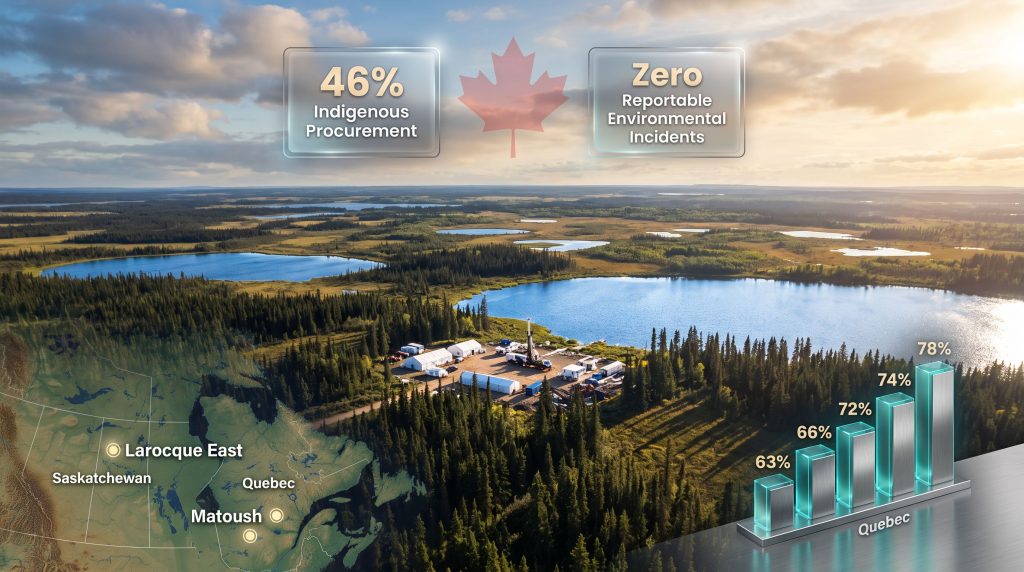
| Indigenous Procurement (Canada Total) | Share of Canadian exploration spend | 46% |
| Indigenous Procurement (Quebec) | Share of Quebec exploration spend | 75% |
| Indigenous Procurement (Saskatchewan) | Share of Saskatchewan exploration spend | 42% |
| Indigenous Workforce (Quebec) | Site workforce participation rate | 78% |
| Indigenous Workforce (Saskatchewan) | Site workforce participation rate | 33% |
| Larocque East Baseline Program | Duration of water quality and hydrology study | Two years |
What a 46% Indigenous Procurement Rate Actually Communicates to the Market
At face value, directing 46% of Canadian exploration spending to Indigenous businesses and contractors is a notable operational achievement. In practical terms, this encompasses drilling services, environmental monitoring, camp operations, logistics, catering, and field-level supply chains. Nearly half of every dollar spent on Canadian exploration activities flowed toward community-affiliated enterprises during 2025.
For institutional ESG investors, this figure functions as a proxy for social licence depth. A high Indigenous procurement rate indicates that community relationships are operationally integrated, not merely documented in policy frameworks. It also reduces a specific category of project risk that is poorly understood by generalist investors: the risk of community-based objections during environmental assessment proceedings.
Furthermore, understanding the broader context of mining claims and First Nations relationships is essential to appreciating why these figures carry such weight with regulators and institutional investors alike.
Investor insight: In Canadian mining, community opposition lodged during the environmental assessment process can extend permitting timelines by years. A demonstrated record of economic partnership with affected communities materially reduces this probability, functioning as a form of risk mitigation that does not appear on the balance sheet.
Regional Variation Explained: Quebec at 75% vs. Saskatchewan at 42%
The pronounced gap between Quebec and Saskatchewan procurement rates warrants analysis. The 75% Quebec figure reflects the operational characteristics of the Matoush project, where proximity to Cree Nation communities, established contractor relationships, and a relatively concentrated community structure have enabled deep supply chain integration. The Starsailor rocket launch project, a joint initiative with Space Concordia and the Cree Nation of Mistissini, illustrates the qualitative depth of engagement at this site.
Saskatchewan's 42% figure reflects different structural realities. The Athabasca Basin covers a vast remote geography, with community infrastructure spread across multiple First Nations. Supply chain integration at this scale requires longer relationship-building timelines and a more complex logistics environment. The figure should be contextualised against the exploration stage of Larocque East rather than treated as evidence of weaker corporate intent.
Procurement vs. Workforce Participation: Why Both Metrics Are Analytically Distinct
These two data streams measure fundamentally different forms of community economic benefit:
- Procurement rates capture the flow of contract revenue to Indigenous-owned and affiliated businesses, including companies that may operate regionally rather than at the project site itself
- Workforce participation rates measure direct employment integration, reflecting skills transfer, local hiring pipelines, and daily economic participation at the exploration site level
- Together, they form a more complete picture of genuine community economic impact than either figure read in isolation
Year-on-Year Trajectory: How 2025 Compares to the 2024 Baseline
| Participation Metric | 2024 Report | 2025 Report |
|---|---|---|
| Indigenous workforce at Matoush (Quebec) | 63% | 78% |
| Indigenous workforce at Larocque East (Saskatchewan) | 36% | 33% |
| Total Canadian Indigenous procurement share | Not disclosed | 46% |
Quebec's workforce participation rate improved meaningfully, rising from 63% to 78% over twelve months. The Saskatchewan figure moved from 36% to 33%, a slight decline that most likely reflects changes in exploration activity scale and workforce composition at the Larocque East site rather than any deterioration in community relationships.
Importantly, the 2024 report did not disclose a national procurement percentage, making 2025 the first year in which total Canadian Indigenous procurement spend has been quantified.
The Larocque East Baseline Program: The Most Consequential Permitting Milestone in the Report
For investors focused on project development timelines, the completion of a two-year baseline water quality and hydrology study at the Larocque East project is the single most materially significant disclosure in the IsoEnergy sustainability report Indigenous procurement narrative. This distinction is easily missed amid the broader ESG narrative, but its implications for permitting readiness are substantial.
Technical context: Under Canadian federal and provincial environmental assessment frameworks, regulators require multi-year baseline environmental datasets to evaluate the potential hydrological impacts of proposed mining activities. A two-year dataset is typically the minimum duration considered credible for seasonal variation capture. Without this data, an environmental assessment submission cannot proceed. Its completion effectively unlocks the next phase of the regulatory pathway for the Hurricane deposit.
The Hurricane deposit is described by IsoEnergy as hosting the world's highest-grade indicated uranium mineral resource. Grade is the defining economic variable in uranium mining, and high-grade deposits carry disproportionate development value because they generate superior uranium output per unit of ore processed. Completing the environmental baseline program at this deposit is therefore a de-risking event of real economic consequence, not simply an administrative milestone.
Environmental Zero-Incident Performance: Operational Discipline Across a Multi-Asset Portfolio
Reporting zero environmental incidents across a geographically dispersed portfolio during an active exploration year reflects genuine operational discipline. Pre-production uranium explorers face a specific reputational challenge: the radioactive nature of their target commodity creates heightened public and regulatory sensitivity to any environmental breach. A clean environmental record across Canadian, American, and Australian operations simultaneously signals strong site-level management and protects the regulatory standing required to advance the Larocque East environmental assessment.
Tony M Mine, Utah: Environmental Infrastructure and Strategic Optionality
At the Tony M Mine in Utah, a permitted past-producing uranium and vanadium operation currently maintained under a toll milling arrangement with Energy Fuels, IsoEnergy invested in upgraded water management infrastructure and installed remote monitoring systems during 2025. This is not a passive maintenance posture. The upgrades preserve operational readiness for a rapid restart when uranium market conditions support that decision, without requiring full restart capital expenditure in the interim. The standby approach reflects disciplined capital allocation aligned to uranium contracting cycle realities.
How IsoEnergy Structures Its Indigenous Partnership Architecture
The company's Indigenous engagement framework operates across multiple dimensions simultaneously:
- The Collaboration Agreement with Ya'thi Néné Lands and Resources, representing Athabasca Denesųłiné First Nations, establishes formal consultation and benefit-sharing mechanisms tied to environmental protection and project permitting at Saskatchewan assets
- Mineral exploration scholarship support through Northlands College builds a longer-term pipeline of Indigenous talent into the resource sector
- High school site tours at the Tony M Mine in Utah embed early community familiarity with responsible resource development
- Regional event sponsorship across Saskatchewan and Quebec maintains ongoing community relationships between formal consultation periods
- The Starsailor rocket launch project with Space Concordia and the Cree Nation of Mistissini represents an innovation-oriented engagement model that transcends conventional community investment approaches
Industry context: Collaboration agreements of the type established with Ya'thi Néné Lands and Resources have shifted from being viewed as corporate differentiators to baseline regulatory expectations in Canadian uranium permitting. Regulators and courts have increasingly interpreted the Crown's duty to consult as requiring meaningful benefit-sharing arrangements, not simply notification processes.
The next major ASX story will hit our subscribers first
Governance Expansion and What It Signals About Institutional Trajectory
The 2025 report disclosed two senior leadership appointments: a Vice President of Strategy and Commercial, and a Director of External Relations. These additions are structurally significant. The VP of Strategy role signals a shift toward commercially oriented portfolio positioning, while the Director of External Relations appointment reflects growing recognition that stakeholder communication requires dedicated institutional capacity rather than ad hoc management.
CEO Philip Williams has indicated that talent quality represents a distinguishing characteristic of the company's current growth phase, with incoming leadership reflecting an expanding institutional profile. Combined with the NYSE American listing, these governance developments position IsoEnergy for an institutional investor audience that evaluates management quality and disclosure standards alongside geological fundamentals.
How IsoEnergy's Sustainability Framework Maps to Project Development Progression
The company's ESG activities are not standalone initiatives. They form a sequenced framework that directly advances the development pathway for its core assets:
- Environmental baseline completion at Larocque East generates the hydrological dataset required for EA submission
- Collaboration agreement formalisation with Ya'thi Néné Lands and Resources establishes the community consent architecture required for regulatory proceedings
- Indigenous procurement integration directs exploration spending toward community enterprises, building economic partnership ahead of formal permitting
- Workforce participation programmes develop local employment pipelines, reducing future labour supply risk at the project level
- Governance infrastructure expansion through senior appointments creates the institutional communication capacity required for EA engagement with regulators and communities
- Environmental monitoring continuity preserves the clean regulatory record required for EA advancement
- Tony M standby maintenance retains a permitted, past-producing US asset in a state of rapid-restart readiness without incurring full capital activation costs
ESG Performance as a Capital Access Mechanism in the Current Uranium Investment Cycle
The uranium sector is currently navigating a contracting cycle in which equity market valuations for explorers remain sensitive to permitting progress and community relations track records. Shifts in uranium market dynamics mean that institutional capital allocators with ESG mandates, which now represent a substantial portion of the investable capital available to junior resource companies, apply negative screens to companies with poor Indigenous relations records.
A 46% national Indigenous procurement rate, combined with zero environmental incidents and a completed environmental baseline programme, places IsoEnergy in a relatively strong position on the criteria most commonly evaluated by ESG-screened institutional funds. This is not a secondary consideration. For a company at the pre-production exploration stage, ESG-gated capital access can be the difference between adequate and constrained exploration budgets in any given year.
However, it is worth noting that uranium supply-demand volatility and the broader shift resulting from the Russian uranium import ban have further intensified the scrutiny applied to global uranium reserves and the explorers developing them. In this environment, strong ESG credentials function as both a risk mitigant and a capital attraction mechanism.
Speculative perspective: As uranium contracting cycles mature and spot prices respond to reactor restart activity and new build commitments globally, the explorers that have already resolved their permitting prerequisites, social licence architecture, and environmental baseline requirements will be positioned to compress development timelines relative to peers who are still at the community engagement stage. IsoEnergy's 2025 ESG disclosures suggest it is building toward exactly this competitive position at Larocque East.
Frequently Asked Questions: IsoEnergy Sustainability Report and Indigenous Procurement
What does a 46% Indigenous procurement rate mean in practical terms?
It means that nearly half of all Canadian exploration expenditure was directed to businesses and contractors affiliated with Indigenous communities. This spans drilling, camp operations, environmental monitoring, logistics, and other field-level services, representing a substantial and measurable economic transfer to local communities during active exploration.
How does the Larocque East baseline programme support future permitting?
The two-year water quality and hydrology study generated the environmental dataset that Canadian regulatory authorities require to evaluate potential mining impacts. Without multi-year baseline data capturing seasonal hydrological variation, an environmental assessment submission cannot proceed. Completing this programme removes a foundational barrier on the development pathway for the Hurricane deposit.
Why is the Tony M Mine on standby rather than in active production?
Maintaining a standby posture reflects disciplined capital allocation relative to uranium spot price and contracting cycle conditions. The toll milling arrangement with Energy Fuels preserves operational flexibility, while environmental infrastructure upgrades ensure the site can be reactivated efficiently when market conditions support that decision without incurring premature full restart expenditure.
What is the Ya'thi Néné Lands and Resources Collaboration Agreement?
It is a formal agreement between IsoEnergy and the representative body for Athabasca Denesųłiné First Nations, establishing structured consultation, benefit-sharing, and joint oversight mechanisms tied to permitting and environmental protection at the company's Saskatchewan projects.
How has Indigenous workforce participation changed since the 2024 report?
Quebec-based workforce participation at the Matoush site increased from 63% to 78%. Saskatchewan participation at Larocque East moved from 36% to 33%, a slight decline that likely reflects changes in exploration activity scale and workforce composition at that site rather than any directional weakening of community integration. The IsoEnergy sustainability report Indigenous procurement figures collectively indicate a maturing and deepening community engagement programme across both jurisdictions.
This article contains forward-looking assessments and speculative perspectives regarding project development timelines, permitting outcomes, and market positioning. These should not be construed as financial advice. Investors should conduct independent due diligence and consider all material risks before making investment decisions. Additional information on IsoEnergy's portfolio and ESG disclosures is available through Crux Investor at cruxinvestor.com.
Want to Stay Ahead of Significant ASX Uranium and Mineral Discoveries?
Discovery Alert's proprietary Discovery IQ model scans ASX announcements in real time, instantly converting complex mineral data into actionable insights for both short-term traders and long-term investors — explore historic discovery returns on the Discovery Alert discoveries page to understand the magnitude of opportunity, then begin your 14-day free trial to position yourself ahead of the broader market.