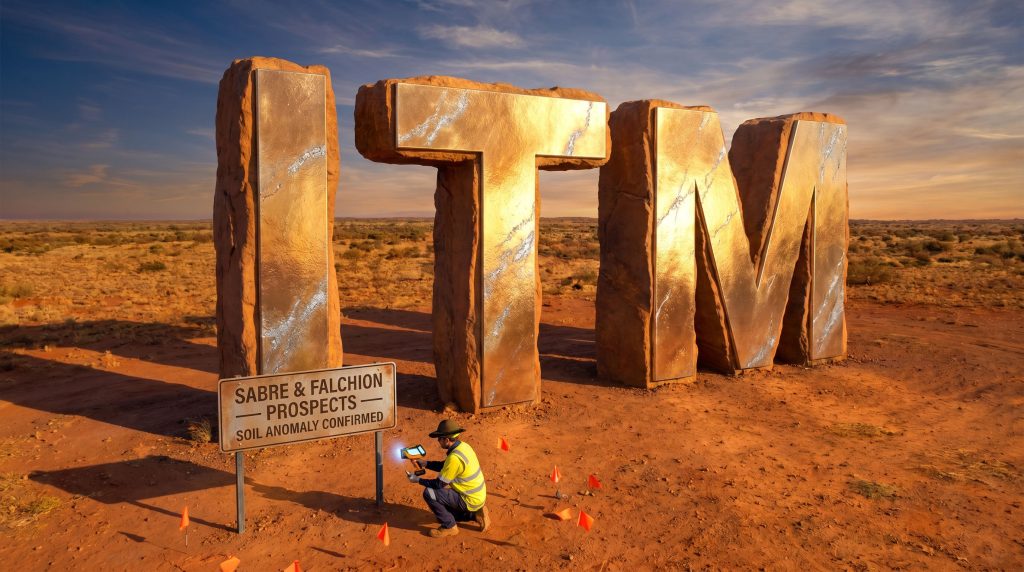
Itech Minerals Ltd
- ASX Code: ITM
- Market Cap: $8,838,759
iTech Minerals Confirms Real-Time Gold-Antimony Vectoring at Reynolds Range
iTech Minerals (ASX: ITM) has reported soil geochemistry results from the Reynolds Range Project in the Northern Territory that do two things at once. The program returned high-grade laboratory assays including 12.1 g/t Au at Sabre and 9.1% Sb at Falchion, while also validating field-portable XRF as a practical first-pass exploration tool for gold-antimony targeting. This dual outcome makes the iTech Minerals Reynolds Range gold antimony soil geochemistry results particularly noteworthy for investors.
For investors, the update matters because it is not only about isolated soil numbers. The announcement indicates that iTech can now use rapid, lower-cost in-field screening to assess a much larger search area, including 13 kilometres of structures identified in recent drone magnetics and the broader more than 42-kilometre Stafford Gold Trend.
When big ASX news breaks, our subscribers know first
The Numbers From Sabre and Falchion
In the report, iTech said 182 soil samples were analysed across the Sabre and Falchion prospects, with all samples first tested in the field by portable XRF and then submitted for laboratory gold and multi-element analysis.
The strongest laboratory results were:
- 12.1 g/t Au from sample SS26002 at Sabre
- 9.1% Sb from sample FS26070 at Falchion
- 48 of 182 samples returned more than 0.1 g/t Au
- 9 samples returned more than 1 g/t Au
- 21 samples returned more than 0.1% Sb
These results sit alongside drilling previously reported by the company at the same project. Recent drilling intersected 31m at 2.5 g/t Au and 0.65% Sb at Sabre and 14m at 6.3 g/t Au and 0.5% Sb at Falchion.
That connection is important. Soil anomalies can be more meaningful when they sit above known drill-confirmed mineralisation, because it suggests the geochemistry is reflecting a real mineral system rather than isolated surface noise.
Why the Portable XRF Result Matters
The more important part of the update may be the validation of the exploration method itself. Portable XRF, or pXRF, is a handheld instrument that measures the presence of certain elements in soil or rock in real time.
In the report, iTech tested whether pXRF readings taken in the field could reliably map the same gold-antimony system later confirmed by laboratory assays. The answer, based on the company's correlation data, appears positive for several key pathfinder elements.
How Did pXRF Compare to Laboratory Results?
| Element | Paired samples (n) | Spearman ρ | Pearson r (log₁₀) | Median lab/pXRF ratio |
|---|---|---|---|---|
| Arsenic (As) | 158 | 0.91 | 0.90 | 1.62x |
| Antimony (Sb) | 75 | 0.87 | 0.83 | 1.78x |
| Lead (Pb) | 159 | 0.81 | 0.84 | 1.18x |
| Copper (Cu) | 149 | 0.45 | 0.43 | 0.70x |
| Bismuth (Bi) | 146 | -0.01 | 0.03 | n/a |
A simple way to read this is that higher numbers close to 1.0 indicate a stronger relationship between the field reading and the laboratory result. On that basis, arsenic, antimony and lead all showed strong correlation, meaning the pXRF device was effective in ranking anomalies in the field.
Furthermore, the report states that pXRF systematically underestimates absolute concentrations, with laboratory results typically coming in around 1.2 to 1.8 times higher. That means pXRF is more useful for identifying and ranking targets than for precise grade estimation.
Copper showed only moderate correlation, and bismuth showed none. As a result, iTech said bismuth will not be used in the exploration toolkit.
"These results are a gamechanger for how we explore at Reynolds Range. The process has demonstrated that pXRF soil geochemistry gives us reliable, real-time vectors to gold-antimony mineralisation in the field, at a fraction of the cost and turnaround time of laboratory-only programs." — Michael Schwarz, Managing Director
Arsenic Stands Out as the Key Gold Pathfinder
The report places particular emphasis on arsenic as the most effective real-time pathfinder for gold at Reynolds Range. A pathfinder element is an element that tends to occur with the target metal and can be easier or faster to detect.
How Well Does Arsenic Correlate With Gold?
| Variable vs lab Au | Paired samples (n) | Spearman ρ | Pearson r (log₁₀) |
|---|---|---|---|
| As (laboratory) | 168 | 0.86 | 0.84 |
| As (pXRF) | 148 | 0.83 | 0.81 |
| Sb (laboratory) | 168 | 0.72 | 0.72 |
| Sb (pXRF) | 75 | 0.44 | 0.33 |
This is operationally significant because pXRF arsenic performed almost as well as laboratory arsenic when compared with lab gold results. In practical terms, that means field crews may be able to recognise areas trending towards gold mineralisation while still on site, then tighten sample spacing and refine targets in the same campaign.
Antimony also showed a meaningful relationship with gold at the laboratory level. In addition, the company said the strong relationship between antimony and arsenic is consistent with a coherent gold-antimony-arsenic epizonal system across both prospects.
For investors, that increases confidence that the company is not chasing isolated geochemical spikes. It suggests a broader and internally consistent mineral system.
New Falchion Zone Extends the Target Area
Beyond validating the method, the soil program also identified what the company describes as a new zone of mineralisation at Falchion, located about 180 metres northeast of recent drilling.
According to the announcement, the new anomaly is defined by:
- More than a dozen contiguous samples
- A strike length of at least 100 metres
- The program's highest antimony assay at 9.1% Sb
- Arsenic values up to 1,011 ppm As
- Gold values up to 314 ppb Au, with multiple samples above 200 ppb Au
The significance lies in the coincidence of gold, antimony and arsenic within the same coherent anomaly. In the report, iTech said the strength of the response is comparable to the soil signature over already drilled mineralisation to the southwest. The company also stated that this newly identified zone has already been drill tested, with results due in the next few weeks.
What Is an Epizonal Gold-Antimony System?
For non-specialist investors, this announcement is partly a lesson in how some gold systems are found. An epizonal system refers to mineralisation formed relatively close to the Earth's surface, generally at shallow crustal depths and under lower temperature conditions than deeper deposit styles.
In a gold-antimony epizonal system:
- Gold is the target commodity
- Antimony can occur alongside gold and may also have independent value
- Arsenic commonly travels with the same mineralising fluids and becomes a useful pathfinder
- Lead can also appear as part of the same geochemical signature in some systems
This matters because gold is not always easy to detect directly in soils at low concentrations. Pathfinder elements such as arsenic can produce stronger and more consistent geochemical signals, allowing explorers to locate the broader footprint of the system before drilling.
Key Technical Terms Explained
| Term | Meaning |
|---|---|
| pXRF | A portable X-ray fluorescence device used to detect elements in soil or rock in real time |
| Pathfinder element | An element that tends to occur with a target metal and helps guide exploration |
| Spearman ρ | A statistical measure showing how closely two datasets move together in rank order |
| Soil anomaly | An area where element concentrations are above background levels |
| Epizonal | Mineralisation formed at shallow crustal levels |
For exploration companies, this kind of method can improve efficiency considerably. If field teams can identify arsenic-rich zones immediately, they can follow up faster and potentially reduce the number of less effective samples and drill holes.
Reynolds Range Scale and Project Setting
The report notes that Reynolds Range comprises four granted Exploration Licences covering 791km² in the Aileron Province of the North Australian Craton. The project lies 90km to 230km north-northwest of Alice Springs and forms part of the more than 42-kilometre Stafford Gold Trend, with 50 kilometres of strike coincident with the Trans-Tanami regional structure.
Ownership is also relevant. The tenements are held by iTech Energy Pty Ltd, a wholly owned subsidiary of iTech Minerals. The project is subject to an agreement under which SQM International Pty Ltd has the option to earn up to 70% of the lithium mineral rights only. However, iTech retains the right to 100% of all other commodities, including gold and antimony. That distinction matters for valuation context, as the gold-antimony upside described in this update remains fully attributable to iTech.
What Comes Next From the Current Programme?
In the report, iTech outlined a clear set of next steps linked to both drilling and geochemistry.
Near-Term Milestones
| Milestone | Timing |
|---|---|
| First phase drilling results from Reynolds Range | Next 2 to 3 weeks |
| Drilling to recommence at Reynolds Range | 20 July 2026 |
| pXRF-supported soil geochemistry across priority Stafford targets | Ongoing |
| Integration with drone magnetics and structural interpretation | Ongoing |
The company said the current drilling programme totals 56 holes for approximately 7,000 metres. Soil geochemistry will be integrated with that drilling programme, while pXRF-supported sampling is expected to be rolled out across priority targets along the wider Stafford Gold Trend.
This indicates a move towards a more systematic screening model. Rather than waiting on laboratory turnaround before deciding where to intensify sampling, the company may be able to define and infill anomalies during a single field campaign.
The next major ASX story will hit our subscribers first
Why Investors May Be Watching Closely
This ASX update provides two separate reasons for market attention. First, it reports strong soil assays over and beyond known mineralisation at Sabre and Falchion. Second, it suggests iTech now has a field-tested process for screening a large and underexplored corridor more efficiently.
There is still an important distinction between anomaly definition and economic discovery. Soil geochemistry and pathfinder correlations help direct drilling, but they do not replace drill assays. That is why the pending results from the newly tested Falchion zone and the broader first phase drilling programme are likely to be the next major proof points.
Even so, the iTech Minerals Reynolds Range gold antimony soil geochemistry results strengthen the exploration framework considerably. According to the company, pXRF arsenic can now be used as a reliable real-time vector for gold-antimony mineralisation, supported by antimony and lead, across a project area that includes 13 kilometres of identified structures and a more than 42-kilometre regional gold trend. For an early-stage explorer, that combination of scale, method validation and near-term drilling news flow is likely to remain central to the investment case over the coming weeks.
Want to Catch the Next Major ASX Gold Discovery the Moment It's Announced?
Discovery Alert's proprietary Discovery IQ model scans ASX announcements in real time, instantly identifying significant mineral discoveries like gold-antimony systems before the broader market reacts — explore historic discoveries that have generated exceptional returns and begin your 14-day free trial at Discovery Alert to position yourself ahead of the market.