June 12, 2026

West Africa's Emerging Gold Powerhouse: Understanding the Ivory Coast Production Surge
The global gold mining industry has long been shaped by a handful of dominant producing nations, but beneath the surface of established hierarchies, quieter transformations are taking shape. West Africa, already home to some of the world's most prolific gold belts, is witnessing one of its most consequential production shifts in decades. The Birimian Greenstone Belt, a geological formation stretching across much of the region, has been the source of multi-million-ounce discoveries for over a century, and Ivory Coast sits squarely within its most prospective corridors. What makes the current moment distinctive is not the geology, which has always been compelling, but the convergence of regulatory maturation, foreign capital mobilisation, and a government-driven imperative to diversify away from agricultural commodity dependence.
When big ASX news breaks, our subscribers know first
A Nation Rewriting Its Economic Identity Through Gold
Ivory Coast has built its global economic reputation on cocoa. As the world's largest cocoa producer, the country has historically been vulnerable to the boom-and-bust cycles that define soft commodity markets. Price collapses, climate variability, and supply chain disruptions have repeatedly exposed the structural fragility of single-commodity dependence. The deliberate pivot toward formalised gold mining represents something more fundamental than sector diversification — it is a recalibration of the country's long-term fiscal architecture.
Gold mining provides a different kind of economic anchor compared to agriculture. It generates royalties, corporate taxes, and infrastructure investment that compound over decades, and it attracts the kind of institutional foreign direct investment that builds lasting industrial capacity. For a government seeking to fund infrastructure programmes and expand formal employment, a growing gold sector offers leverage that cocoa simply cannot match.
The Ivory Coast gold production increase now underway is the result of years of sustained regulatory reform, licensing expansion, and strategic positioning within the West African investment landscape. Understanding it properly requires looking at both the numbers and the structural forces behind them. Furthermore, the importance of mineral exploration in supporting this growth cannot be overstated.
Production Trajectory: Reading the Numbers Correctly
The output projections for Ivory Coast over the coming years are notable not just for their absolute values, but for the rate of acceleration they imply.
| Year | Output (Metric Tons) | Key Driver |
|---|---|---|
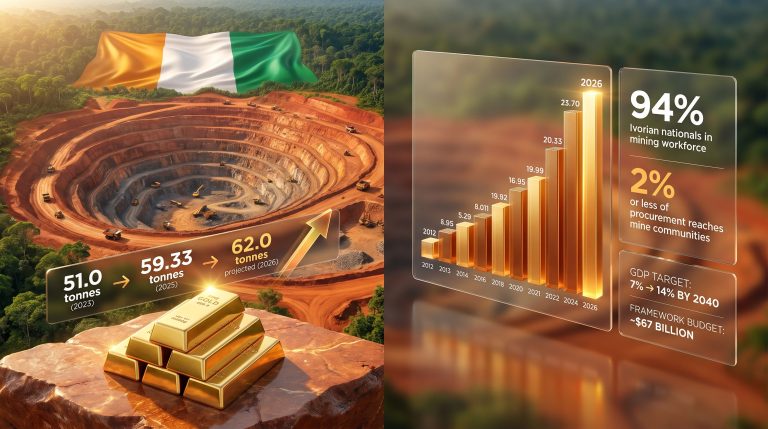
| 2023 | 51.19 | Operational expansion at existing mines |
| 2024 | ~52.00 | Continued ramp-up, elevated gold prices |
| 2025 | 59.33 | Mine expansions, regulatory tightening |
| 2026 | 62.00 (projected) | Scaling of existing operations |
| 2027 | 63.00 (projected) | Kone mine contribution begins |
| 2028 | ~69.00 (projected) | Doropo and Tanda mines operational |
The compound growth from 51.19 metric tons in 2023 to a projected 69 metric tons by 2028 represents an increase of approximately 35% across five years. More telling is the year-on-year acceleration: the jump between 2024 and 2025 alone was approximately 14%, a pace that significantly outstrips the modest linear growth visible in earlier periods.
The most decisive production leap is forecast between 2027 and 2028, when output is projected to rise by roughly 6 metric tons in a single year. This step-change is directly attributable to the commissioning of the Doropo and Tanda gold mines, making their on-schedule delivery the single most critical variable in Ivory Coast's medium-term production outlook.
Any slippage in the commissioning timeline for Doropo or Tanda would directly compress the 2028 production target. These two projects are not incremental contributors — they are the structural pillars of the next growth phase.
The Mine Pipeline: From 14 to 17 Operating Assets
As of 2026, Ivory Coast operates 14 active gold mines, a figure that is set to grow in a carefully sequenced expansion over the next three years. The development pipeline is structured as follows:
- 15 mines following the commissioning of the Kone gold mine, expected within approximately two years
- 16 mines as Doropo moves to production within approximately three years
- 17 mines upon the subsequent commissioning of the Tanda gold mine
This staggered sequencing is significant from an operational planning perspective. Bringing multiple large mines online simultaneously would strain processing infrastructure, power supply networks, and skilled labour availability. The phased approach suggests deliberate capacity management rather than opportunistic expansion.
Each new mine also introduces compounding fiscal benefits beyond raw tonnage. Royalty streams, local procurement requirements, and associated infrastructure investment create secondary economic multipliers that extend well beyond the mine gate. For a country with ambitious infrastructure targets, this pipeline represents a meaningful fiscal resource base.
The Birimian Greenstone Belt: Why the Geology Matters
Most commentary on Ivory Coast's gold sector focuses on production statistics and investment flows. Less discussed, however, is the geological foundation that makes these numbers achievable in the first place.
The Birimian Greenstone Belt, which underlies much of West Africa including Ivory Coast, Ghana, Mali, and Burkina Faso, is one of the most mineralised Precambrian geological formations on Earth. Dating back approximately 2.1 to 2.2 billion years, the belt hosts gold deposits characterised by structurally controlled quartz vein mineralisation, often associated with shear zones and contact boundaries between volcanic and sedimentary sequences.
What distinguishes Birimian-hosted deposits from many other gold-bearing formations is their grade consistency at depth. Many operations across the belt have demonstrated that ore grades remain economically viable as mines extend underground, a characteristic that supports long mine-life projections and justifies the capital intensity of large-scale underground development.
The Doropo project, for instance, sits within a portion of the belt where multiple mineralised trends have been identified across a large land package. This suggests that initial mine construction may be followed by resource extensions that further underpin production longevity — geological optionality that is a key, if underappreciated, component of the investment case.
Research License Trends: The Exploration Barometer
One of the most reliable leading indicators of a mining sector's health is the trajectory of exploration licence activity. In Ivory Coast, this metric tells a consistently positive story, and broader gold exploration trends across the continent reflect similarly encouraging signals.
| Year | Applications Submitted | Licenses Issued | Approval Rate |
|---|---|---|---|
| 2023 | 189 | 151 | ~79.9% |
| 2024 | 203 | 160 | ~78.8% |
| 2025 | 225 | 171 | ~76.0% |
While the approval rate has declined slightly, from approximately 80% in 2023 to 76% in 2025, the absolute volume of licences issued has grown by 13.2% across the same period. This distinction matters. A marginally lower approval rate against a substantially larger application pool still produces net growth in exploration coverage, and the rising application volumes independently confirm compounding investor interest.
The slight decline in approval rates warrants monitoring. If this trend steepens, it could signal emerging capacity constraints within the licensing bureaucracy or a tightening of technical requirements, either of which would eventually slow the exploration pipeline feeding future mine development.
The next major ASX story will hit our subscribers first
Who Is Investing and Why
The international operators currently active in Ivory Coast's gold sector reflect a deliberate diversification of capital sources:
- Endeavour Mining (United Kingdom) — one of the largest pure-play gold producers focused exclusively on West Africa
- Perseus Mining (Australia) — a mid-tier operator with multiple producing assets across the region, and Perseus Mining expansion into new African territories further illustrates the confidence mid-tier operators have in the continent
- Resolute Mining (Australia) — with a long operational history in African gold mining
- Roxgold (Canada) — focused on high-grade underground operations in West Africa
The presence of multiple mid-tier international operators, rather than domination by a single major mining house, creates a structurally healthier investment environment. Diversified ownership reduces sovereign concentration risk, distributes operational knowledge across multiple management approaches, and typically produces more competitive royalty and tax negotiations from the government's perspective.
The spread of mid-tier operators across Ivory Coast's gold sector is a structural advantage that is rarely highlighted. It means no single company failure or exit can materially destabilise the national production base, unlike in countries where one operator controls the majority of output.
Ivory Coast's government is actively competing for the next wave of capital through forums like SIREXE, an international exhibition covering mining, energy, and petroleum scheduled for November 18 to 22 in Abidjan. These platforms serve a dual function: showcasing existing project pipelines while simultaneously opening dialogue with prospective investors evaluating entry points into the sector. In addition, gold M&A activity globally continues to reinforce appetite for West African assets among institutional investors.
The Informal Economy Problem: Formalisation as a Hidden Growth Driver
Any serious analysis of the Ivory Coast gold production increase must engage with a figure that rarely appears in mainstream coverage. According to reporting on Ivory Coast's gold output, the World Bank estimated that approximately 40 metric tons of gold left Ivory Coast through informal or illegal channels in 2022 alone.
To understand the significance of this figure, consider the following comparison:
- 40 metric tons estimated informal outflows in 2022
- 51.19 metric tons formally reported production in 2023
- The informal outflow therefore represented roughly 78% of the following year's entire reported output
This suggests that Ivory Coast's true gold mobilisation has historically been far larger than official statistics indicate. It also means that a meaningful portion of the projected production growth over the coming years may not represent new physical extraction at all, but rather the conversion of previously unrecorded informal output into the formal reporting system.
Investors and analysts should therefore distinguish between two structurally different sources of reported production growth:
- Greenfield and brownfield mine expansion driven by capital investment and new physical extraction capacity
- Formalisation conversion where artisanal and small-scale mining (ASM) output enters official records for the first time
Both contribute to reported production growth, but they carry fundamentally different implications for capital requirements, sustainability, and long-term sector development. Formalisation gains require regulatory investment rather than mining capital expenditure, they produce fiscal returns more quickly, and they carry no depletion risk in the conventional sense. However, they also reflect a one-time conversion effect that cannot be repeated indefinitely once the informal sector is substantially absorbed.
Regional Positioning: Where Ivory Coast Fits in the West African Gold Hierarchy
| Country | Approximate Annual Output | Key Operators |
|---|---|---|
| Ghana | ~187 metric tons | Newmont, AngloGold Ashanti, Gold Fields |
| Mali | ~70-80 metric tons | Barrick Gold, B2Gold |
| Burkina Faso | ~50-60 metric tons | West African Resources, Endeavour Mining |
| Ivory Coast | ~59-62 metric tons (2025-2026) | Endeavour Mining, Perseus Mining, Resolute Mining |
| Senegal | ~30-40 metric tons | Endeavour Mining |
Ivory Coast's projected 69-ton output by 2028 would place it ahead of Burkina Faso on current trajectories and within striking distance of Mali's output range, assuming both countries maintain present production rates. However, both comparisons carry significant caveats. Burkina Faso's output has been materially disrupted by security deterioration, making it an unstable benchmark. Mali's figures may similarly be affected by political transitions and operating environment changes.
Ghana's 187-metric-ton annual output remains a distant target, but the gap-closing narrative is less important than the absolute trajectory. Ivory Coast does not need to match Ghana to become a materially significant producer. At 69 tons, it would rank among the top five gold-producing nations on the African continent — a meaningful achievement with tangible implications for export revenues and fiscal capacity. Furthermore, gold production insights from recent quarters suggest that West African output broadly is trending upwards, reinforcing Ivory Coast's favourable positioning.
Risk Factors That Could Reshape the Outlook
Several variables could materially alter Ivory Coast's production trajectory in either direction.
Operational risks:
- Commissioning delays at Doropo or Tanda would directly compress the 2028 target, given how heavily that projection depends on these two assets
- Infrastructure constraints, including power supply reliability and road access to remote mining areas, remain practical bottlenecks
- Processing capacity may face pressure if multiple mines ramp up simultaneously ahead of infrastructure upgrades
Market and financial risks:
- A sustained gold price correction would reduce the economic viability of marginal pipeline projects and could slow exploration licence conversion into development decisions
- Currency volatility affecting capital repatriation for international operators can compress investment margins and delay project timelines
Governance and formalisation risks:
- The persistence of structural incentives driving informal gold trading — including price differentials and porous border controls — makes complete formalisation a long-term rather than near-term achievement
- Declining licence approval rates, if the trend from 80% to 76% continues, could signal emerging regulatory friction that dampens the exploration pipeline over the medium term
- Social licence management will become increasingly complex as the mine count grows from 14 toward 17, particularly in areas where land use conflicts require active engagement. Recent regulatory changes, including higher royalty requirements introduced in late 2025, also illustrate the evolving governance environment operators must navigate
This article contains forward-looking projections and production estimates that are subject to change based on operational, regulatory, and market conditions. Nothing in this article constitutes investment advice. Readers should conduct their own due diligence before making any investment decisions.
Frequently Asked Questions: Ivory Coast Gold Production
How much gold does Ivory Coast produce per year?
Ivory Coast produced approximately 59.33 metric tons of gold in 2025. Output is projected to rise to 62 metric tons in 2026, 63 metric tons in 2027, and approximately 69 metric tons in 2028, with new mine commissioning serving as the primary growth catalyst.
How many gold mines are currently operating in Ivory Coast?
As of 2026, Ivory Coast operates 14 active gold mines. The Kone mine is expected to bring this total to 15, with Doropo and Tanda subsequently raising the count to 17 within approximately three years.
Which international companies are mining gold in Ivory Coast?
The major international operators active in the sector include Endeavour Mining (UK), Perseus Mining (Australia), Resolute Mining (Australia), and Roxgold (Canada).
Is Ivory Coast the largest gold producer in Africa?
No. Ghana leads African gold production at approximately 187 metric tons annually. Ivory Coast's multi-year expansion plan will progressively reduce the gap, though Ghana's output remains substantially higher for the foreseeable future.
Why does illegal gold mining matter for production statistics?
The World Bank estimated that approximately 40 metric tons of gold left Ivory Coast through informal channels in 2022, nearly equivalent to the country's entire formally reported output for the same period. Formalisation efforts therefore serve both a governance function and a statistical one — converting previously unrecorded flows into officially reported production figures.
For ongoing coverage of Ivory Coast's mining sector and broader African gold production developments, additional reporting is available at Mining Doc, which publishes continued analysis of mining operations across the continent.
Want to Track the Next Major Gold Discovery Before the Broader Market Does?
Discovery Alert's proprietary Discovery IQ model delivers real-time alerts on significant ASX mineral discoveries — cutting through the complexity of West Africa's expanding gold sector and beyond to surface actionable investment opportunities the moment they are announced. Explore how historic discoveries have generated substantial returns on Discovery Alert's dedicated discoveries page, and begin your 14-day free trial today to position yourself ahead of the market.