June 12, 2026
The Illusion of Progress: Why Rising Gold Output in Côte d'Ivoire Isn't Translating Into Domestic Wealth
There is a persistent tension at the centre of resource-rich economies that runs deeper than any single policy debate. When a country extracts and exports a commodity in raw form at ever-increasing volumes, the headline numbers tell one story while the structural reality tells another. Côte d'Ivoire gold production local content challenges are a textbook illustration of this divide. Output has expanded dramatically, fiscal receipts have grown, and employment figures have outperformed regulatory benchmarks. Yet the architecture of who owns the mines, who wins the contracts, and who retains the wealth generated remains overwhelmingly foreign.
Understanding why that gap persists, and what it would genuinely take to close it, requires looking beyond production statistics and into the mechanics of local content policy, supplier ecosystem development, and beneficial ownership transparency.
When big ASX news breaks, our subscribers know first
From 13.2 Tonnes to 62 Tonnes: A Production Surge With Uneven Returns
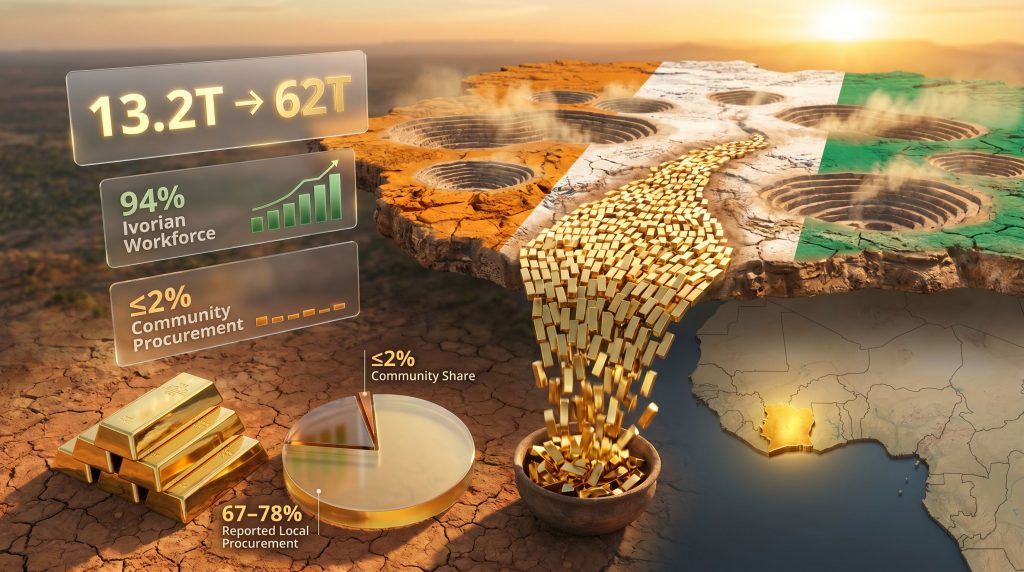
Côte d'Ivoire's trajectory as a gold producer over the past fourteen years is remarkable by any measure. Output stood at approximately 13.2 tonnes in 2012. By 2015, that figure had risen to 23.54 tonnes, driven by a wave of new mine commissioning. The 2023 EITI report for the country recorded production of 51.185 tonnes, and by 2025 the total had climbed further to 59.33 tonnes. Forecasts point toward 62 tonnes in 2026, representing a nearly fivefold increase in output over the period.
This growth has positioned Côte d'Ivoire as one of West Africa's most dynamic gold economies, competing meaningfully alongside Ghana and Mali in regional output rankings. The acceleration has been driven primarily by the commissioning of successive new mine operations, each adding to the country's base production capacity. Furthermore, gold has become the country's dominant mineral export commodity, with the vast majority of production shipped abroad in unprocessed form.
Broader gold exploration trends across West Africa have contributed to this expansion, with Côte d'Ivoire consistently attracting new capital into its mineral basins. The core challenge embedded in this production story, however, is that volume growth and domestic economic capture are not the same thing. The Côte d'Ivoire gold production local content gap illustrates precisely why output statistics alone are an insufficient measure of a mining economy's developmental health.
Who Actually Controls the Gold? Foreign Capital's Structural Dominance
The ownership landscape across Côte d'Ivoire's active and pipeline gold operations is heavily concentrated among companies headquartered outside the country. Canadian, Australian, and Chinese capital dominates the sector, with operators including Perseus Mining, Endeavour Mining, Montage Gold, and Zhaojin among the principal players across producing and development-stage assets.
This foreign capital concentration is not inherently problematic from a developmental standpoint. International mining companies bring exploration expertise, access to project finance, and technical capacity that most emerging mining jurisdictions cannot replicate domestically in the short term. The challenge arises when foreign ownership concentration combines with an underdeveloped local supplier ecosystem, creating a structural condition in which the country hosts the extraction without capturing meaningful portions of the value chain.
The most significant domestic ownership development in the sector to date has been the transition of the Tongon mine to Atlantic Group, controlled by Ivorian businessman Koné Dossongui. This represents an important precedent, but it remains an exception rather than a trend within the broader ownership structure. Consequently, gold M&A activity in comparable markets offers instructive lessons about how ownership transitions can be structured to embed greater local participation over time.
The EITI Framework and What Transparency Reveals
Côte d'Ivoire participates in the Extractive Industries Transparency Initiative, which provides a structured mechanism for disclosing production volumes, fiscal flows, and beneficial ownership data. The 2023 EITI report documents the country's production trajectory and fiscal contributions from mining operations.
What remains underdeveloped within this framework is mandatory beneficial ownership tracking that extends beyond primary operators to encompass the full subcontracting network. This gap matters because the subcontractor layer is precisely where local content policy is most difficult to enforce and most vulnerable to definitional manipulation.
Where Local Content Is Working, and Where It Is Not
Employment: The Bright Spot in an Otherwise Mixed Picture
The clearest local content success story in Côte d'Ivoire's mining sector is workforce localisation. According to the 2022 local content assessment commissioned by the German development agency GIZ, Ivorian nationals already accounted for 94% of employees across the mining sector as of 2019, a figure that exceeded the regulatory benchmark at the time.
| Metric | Target / Benchmark | Reported Performance |
|---|---|---|
| National workforce share | Regulatory minimum | 94% Ivorian nationals (2019, exceeded) |
| Management-level roles | Partial national participation | Some Ivorian nationals in senior positions |
| Community-level employment | Minimal formal tracking | Limited structured data |
The reasons for this employment success are structural rather than exceptional. Local hiring is cost-efficient, regulatory pressure creates incentives, and most operational roles below senior technical grades are accessible to workers without highly specialised international credentials. However, a critical distinction must be drawn between the volume of jobs held by Ivorian nationals and the quality and seniority of those roles.
Positions in senior engineering, project management, and technical specialisations remain disproportionately held by expatriate staff, representing a skills transfer gap that employment statistics do not capture. A parallel challenge sits in the artisanal and small-scale mining sector. Formalization of ASM activity, which spans both employment and traceability dimensions, has gained attention through a World Bank-linked partnership announced in 2025, though the structural complexity of integrating informal miners into regulated supply chains remains significant.
Procurement: The 67-78% Figure That Demands Closer Scrutiny
Mining companies operating in Côte d'Ivoire have reported sourcing between 67% and 78% of their purchases from local suppliers. On the surface, this appears to represent meaningful domestic economic participation. In practice, the figure is far more ambiguous than it appears.
The GIZ-financed 2022 assessment identified three distinct categories that are typically bundled together under the label of local supplier:
- Foreign subsidiaries registered and operating within Côte d'Ivoire but with no meaningful Ivorian beneficial ownership.
- Local intermediaries that facilitate transactions between mining companies and upstream foreign suppliers without themselves holding majority Ivorian ownership.
- Businesses with genuine majority Ivorian ownership, which represent the actual target of local content policy.
Without a harmonised, legally binding definition that distinguishes between these categories based on beneficial ownership thresholds, the 67-78% figure serves as a poor proxy for genuine domestic economic benefit. The assessment explicitly recommended adopting a stricter ownership-based definition as a prerequisite for any meaningful measurement of local content achievement.
The Community Procurement Deficit: The 2% Problem
Beneath the headline procurement figures lies a more troubling reality. The GIZ assessment found that 2% or less of total purchase value flows to communities directly affected by mining operations. This is the sharpest expression of local content failure in the sector, and it reveals the difference between national-level participation and community-level participation.
Several structural barriers explain this gap:
- Absence of formal business registration among community-based enterprises.
- Lack of working capital to take on supply contracts with extended payment cycles.
- Limited technical capacity even in basic service categories.
- No dedicated supplier development programmes connecting community businesses to mine procurement processes.
The sectors where community-level suppliers could realistically compete without major capacity investment include mine camp provisioning, food services, general maintenance, basic logistics, and facility upkeep. These are not technically demanding categories, yet they remain largely inaccessible to the communities sitting closest to the operations that generate the wealth.
The Five Barriers Limiting Ivorian SME Participation
The structural constraints holding Ivorian businesses back from meaningful mining supply chain participation can be mapped across five interconnected dimensions:
- Access to credit: Commercial banks remain reluctant to extend financing to SMEs without established track records in the mining supply chain, creating a circular barrier where companies cannot build track records without contracts, and cannot win contracts without demonstrated financial capacity.
- Collateral and guarantee requirements: International mining operators typically require performance bonds and financial guarantees that most Ivorian SMEs cannot source through domestic financial institutions.
- Payment cycle delays: Extended payment terms, often standard in large mining contracts, create severe cash flow pressure for undercapitalised domestic suppliers.
- Technical capacity gaps: Specialised mining supply segments, including drilling services, metallurgical analysis, and engineering, require expertise and equipment that most Ivorian businesses have not yet developed.
- Scale and price competition from international groups: Even where Ivorian suppliers exist in a given category, they frequently cannot match the pricing, reliability, or delivery scale of established international competitors.
A critical insight from gold mining and development research in Côte d'Ivoire is that operators engage suppliers based on performance metrics, not charitable obligation. Regulatory preference clauses create the opportunity for local companies to participate, but only supplier capability converts that opportunity into a sustainable contract relationship.
Article 131 of the Mining Code establishes a formal preference for Ivorian companies and workers when equivalent conditions of quality, price, and quantity exist. The practical limitation of this provision is significant: in high-value, technically specialised contract categories, equivalence conditions are rarely satisfied. Preference legislation and supplier development investment are not interchangeable. One creates a right; the other creates the capacity to exercise it.
The Policy Architecture: What the 2022 Law and 2025 Consultations Are Building
The 2022 Local Content Law's Four Pillars
Côte d'Ivoire formalised its local content objectives in a 2022 law that established a structured framework for increasing domestic value retention across the mining sector. The law rests on four implementation pillars:
- Training and skills development programmes targeting Ivorian workers across technical disciplines.
- SME capacity building and technical upgrading to close the competitive gap with international suppliers.
- Research and innovation linkages connecting the mining sector to domestic knowledge institutions.
- A digital monitoring platform for compliance tracking, which was launched in 2025.
The 0.5% community development contribution, channelled through the Local Mining Development Fund, represents a revenue redistribution mechanism requiring mining operators to direct a portion of annual turnover toward infrastructure and social investment in mine-affected communities. The effectiveness of this mechanism depends heavily on governance quality and disbursement oversight, areas where stronger frameworks are still needed.
The 2025 Stakeholder Roundtable: Three Priority Themes
A stakeholder consultation convened by Ivorian authorities at the end of 2025 brought together mining companies, business associations, and local SMEs to address the sector's local content challenges. Three priority themes emerged from those discussions:
- Updates to the regulatory framework governing local content compliance obligations.
- Development of financing instruments and support mechanisms specifically designed for Ivorian suppliers.
- Enhanced monitoring of beneficial ownership across subcontractor networks.
The strategic objective underpinning all three themes is enabling Ivorian SMEs to move up the value chain from basic service provision into technically demanding contract categories where margins and long-term economic returns are substantially higher.
The next major ASX story will hit our subscribers first
Regional Benchmarking: How Côte d'Ivoire Compares
| Country | Local Content Law | Workforce Localisation | Community Benefit Mechanism | Ownership Requirements |
|---|---|---|---|---|
| Côte d'Ivoire | 2022 | 94% nationals (exceeded) | 0.5% turnover fund | Preference clause only |
| Ghana | Minerals Commission Act | Tiered by role category | District development levy | Mandatory equity in some categories |
| Tanzania | Mining (Local Content) Regulations 2018 | Phased targets by skill level | Community development agreements | Minimum local equity thresholds |
| Senegal | Hydrocarbons-focused, developing | Sector-specific | Under construction | Under construction |
Côte d'Ivoire's framework is more advanced than many regional peers on employment localisation but lags meaningfully on ownership requirements and subcontractor transparency. Ghana and Tanzania have both moved toward mandatory equity participation thresholds and more granular role-based workforce targets, providing models that Ivorian policymakers could draw upon as the 2022 law matures toward deeper enforcement.
In addition, the broader mining industry consolidation now reshaping global markets may intensify pressure on host governments across Africa to negotiate stronger local participation terms as a condition of new project approvals.
Three Levers That Could Close the Local Content Gap
Redefining What a Local Supplier Actually Means
The definitional loophole at the heart of Côte d'Ivoire's procurement statistics is both the most straightforward problem to address and the most politically complex. Establishing a mandatory beneficial ownership threshold, for example requiring majority Ivorian equity ownership to qualify as a local supplier, would immediately clarify the actual scale of domestic participation and expose the gap between reported and genuine local procurement.
Building a Dedicated Mining SME Financing Facility
A blended finance structure combining development bank capital with commercial lending, structured specifically around the cash flow and collateral realities of mining supply chain SMEs, could unlock supplier participation that regulatory preference clauses alone cannot produce. International development partners including GIZ and the World Bank have already demonstrated willingness to engage in this space through assessment and partnership activities.
Tiered Subcontractor Development Programmes
Mapping Ivorian SMEs against the full mining value chain, from basic services through to technically intensive segments, and building targeted capacity development programmes for each tier would create a pipeline of competitive domestic suppliers over a five to ten year horizon. This approach requires sustained commitment from both mining operators and government, but it represents the only path to genuine Côte d'Ivoire gold production local content improvement that does not depend on definitional manipulation.
The Long-Term Horizon: From Raw Export to Value-Added Processing
Côte d'Ivoire currently exports the overwhelming majority of its gold in raw, unprocessed form. The value chain opportunity embedded in refining and processing, which would allow the country to capture a greater proportion of the commodity's final market value, remains largely unrealised. This is not unique to Côte d'Ivoire; most African gold producers face the same structural constraint.
Furthermore, the gold price outlook for the years ahead adds urgency to this conversation. Sustained high prices amplify both the opportunity cost of exporting raw gold and the potential returns from in-country value addition. The critical minerals demand narrative reshaping global resource investment also reinforces the case for African producers to capture more of the value they generate, rather than exporting wealth in unrefined form.
What is important to recognise is that in-country processing ambitions cannot be credibly pursued without first maturing the local content ecosystem in services and procurement. Processing investment requires a sophisticated domestic supplier base, reliable infrastructure, and a regulatory environment with proven enforcement credibility. Building toward a refining capacity future is a legitimate long-term objective, but it follows from, rather than substitutes for, the harder work of closing the current local content gaps.
Disclaimer: Production forecasts, procurement statistics, and policy assessments cited in this article are drawn from publicly available sources including EITI reporting and the 2022 GIZ-financed local content assessment. Forward-looking projections involve inherent uncertainty and should not be interpreted as guaranteed outcomes. This article does not constitute investment advice.
Readers seeking ongoing coverage of West African mining policy and local content frameworks can explore economic reporting from Ecofin Agency's mining section at ecofinagency.com, which tracks sector developments across francophone Africa.
Want To Identify The Next Major Mineral Discovery Before The Broader Market?
Discovery Alert's proprietary Discovery IQ model delivers real-time alerts on significant ASX mineral discoveries, instantly converting complex mineral data into actionable investment insights for both short-term traders and long-term investors. Explore historic discoveries and their exceptional returns, then begin your 14-day free trial today to position yourself ahead of the market.