
August 5, 2026
The Quiet Reordering of Global Reserves That Most Investors Are Missing
Something fundamental is shifting beneath the surface of global monetary architecture. Over the past decade, reserve managers at central banks worldwide have been quietly, methodically restructuring the composition of their foreign exchange holdings. The catalyst is not a single crisis or policy announcement. It is a slow-moving, structural recalibration driven by sovereign risk awareness, inflation psychology, and a deepening distrust of dollar-denominated asset concentration. Central bank gold buying has emerged as the defining story of this shift, and the pace of accumulation tells a story that quarterly price volatility cannot obscure.
Understanding why this trend matters requires looking beyond headlines and into the mechanics of how monetary authorities think about reserve adequacy, geopolitical exposure, and long-run currency stability.
When big ASX news breaks, our subscribers know first
Why Central Bank Gold Buying Has Become a Defining Feature of the 2020s
The Strategic Logic Behind Reserve Diversification
Central bank reserve management is, at its core, about preserving optionality. Reserves serve three primary functions: supporting monetary policy operations, maintaining exchange rate stability, and providing a buffer against external shocks. For decades, US Treasury securities were the uncontested instrument of choice. They offered deep liquidity, reliable yield, and the implicit backing of the world's largest economy.
That calculus has been disrupted. The weaponisation of dollar-denominated reserves following Russia's 2022 invasion of Ukraine sent a clear signal to reserve managers globally: sovereign assets held within foreign jurisdictions carry geopolitical risk that yield cannot compensate for. Gold, by contrast, is a physical asset held domestically, outside the reach of sanctions or asset freezes.
This realisation has been particularly acute among emerging market central banks. Nations with complex geopolitical relationships with Western powers have been the most aggressive accumulators, driven by a desire to reduce their vulnerability to financial leverage and currency coercion. Furthermore, the broader global monetary shift away from dollar dependency has reinforced this structural pivot at an accelerating pace.
The Structural Forces Accelerating Bullion Demand
Several reinforcing dynamics are driving sustained central bank gold buying:
- Inflation hedging: Prolonged monetary expansion following the COVID-19 pandemic eroded confidence in paper currency stability. Gold's historical role as an inflation hedge has regained relevance.
- Currency debasement risk: Sovereign debt levels in advanced economies have reached historically elevated thresholds, raising long-term questions about fiscal sustainability and the real purchasing power of reserve currencies.
- Geopolitical fragmentation: A multipolar world order creates demand for reserve assets that are neutral, non-sovereign, and universally recognised.
- Renminbi internationalisation: China's deliberate gold accumulation is widely interpreted as a component of a broader strategy to support the renminbi's credibility as an alternative reserve currency, creating a structural buyer with long-duration intent.
How Much Gold Are Central Banks Actually Buying?
Q1 2026 Data Reveals Robust Underlying Demand
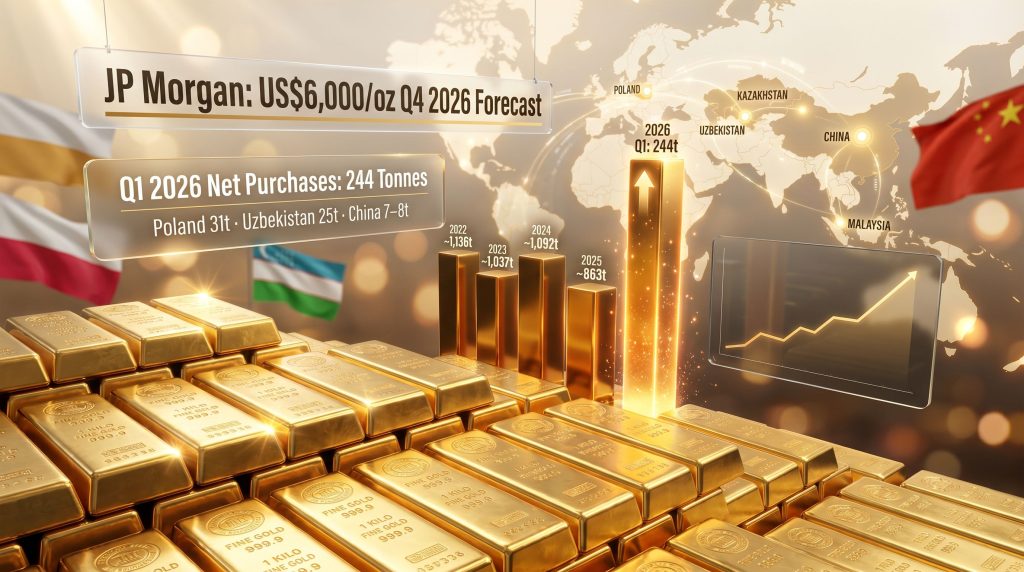
World Gold Council data confirms that central banks purchased a net 244 tonnes of gold during the first quarter of 2026. This figure is particularly notable given that March 2026 recorded net sales of 30 tonnes, meaning January and February purchases were sufficiently large to generate a strongly positive quarterly total despite the March reversal.
That March dip proved short-lived. In April 2026, central banks returned to net buying with purchases of 19 tonnes, reinforcing the interpretation that single-month fluctuations are tactical noise rather than evidence of any structural reversal. According to recent central bank statistics, this consistency of demand underscores how deeply embedded the accumulation trend has become across sovereign institutions.
Short-term fluctuations in central bank gold demand are consistently attributable to liquidity management needs at the individual institution level. The broader structural demand trend has remained intact across multiple years and multiple economic cycles.
Why Official Data May Understate True Demand
A critical nuance in interpreting World Gold Council figures is that not all central bank purchases are reported promptly or transparently. Several monetary authorities either delay disclosure or report holdings on a lagged basis. This creates a situation where official net purchase figures likely represent a floor, not a ceiling, on actual accumulation activity. The true scale of central bank gold demand may be meaningfully higher than published statistics reflect at any given point in time.
Which Countries Are Leading the Accumulation Trend in 2026?
The geographic distribution of buying activity reveals important patterns about which nations are most actively repositioning their reserves.
| Country | Q1 2026 Purchases | Notable Context |
|---|---|---|
| Poland | 31 tonnes | Largest reported buyer; advancing toward declared reserve target |
| Uzbekistan | 25 tonnes | Consistent top-tier accumulator |
| China | ~7-8 tonnes (Q1-April) | 18 consecutive months of net buying as of April 2026 |
| Kazakhstan | Reported buyer | Part of broader Central Asian diversification trend |
| Czech Republic | Reported buyer | Continued European reserve rebalancing |
| Malaysia | Reported buyer | Southeast Asian reserve strategy shift |
| Indonesia | Reported buyer | Emerging market hedging against currency risk |
Poland's Declared Reserve Strategy
Poland stands out not only for the volume of its purchases but for the transparency of its intent. Polish monetary authorities have publicly articulated a target for gold as a proportion of total reserves, making their accumulation program one of the most explicitly strategic in Europe. The 31 tonnes acquired in Q1 2026 reflects ongoing execution against that declared objective, rather than opportunistic positioning.
China's Systematic and Long-Duration Approach
China's accumulation pattern is distinct in both scale and strategic framing. Having recorded 18 consecutive months of net buying through April 2026, with its April purchase of approximately 8 tonnes representing the highest monthly figure since December 2024, China's approach reflects what analysts at JP Morgan Global Research have characterised as a deliberate, long-duration strategy. The objective appears to extend well beyond near-term price optimisation, connecting instead to the broader internationalisation of the renminbi as a credible global reserve currency alternative. In addition, the role of gold in the monetary system more broadly is becoming increasingly central to how nations like China frame their long-term reserve architecture.
The Sellers: Russia, Turkey, and SOFAZ
Not all central banks are buyers. Russia continued net gold sales in April 2026, recording 6 tonnes of net sales for the month, bringing year-to-date sales to 22 tonnes. Turkey and the State Oil Fund of Azerbaijan (SOFAZ) have also appeared on the selling side at various points. These sales typically reflect domestic liquidity requirements or currency management needs rather than any philosophical shift away from gold as a reserve asset. Critically, the aggregate volume of selling activity has remained significantly below aggregate buying, meaning the overall balance of official sector activity continues to favour accumulation.
The Multi-Driver Framework: Why Central Banks Prefer Gold Over Treasuries
The transition from US Treasuries to gold as a preferred reserve instrument is not driven by any single factor. Reserve managers are responding to a convergence of pressures:
- Single-currency dependency risk: Concentrating reserves in dollar-denominated instruments creates systemic exposure to US fiscal and monetary policy decisions.
- Real yield erosion: When inflation-adjusted returns on sovereign bonds turn negative, the opportunity cost of holding non-yielding gold diminishes substantially.
- Sanctions precedent: Post-2022, the freezing of Russian sovereign reserves demonstrated that dollar assets can be politically neutralised, a risk that gold held domestically cannot replicate.
- Debt sustainability concerns: With sovereign debt-to-GDP ratios at multi-decade highs across advanced economies, the long-run credibility of fiat currencies faces structural questions that gold sidesteps entirely.
Paul Wong, Managing Partner and Market Strategist at Sprott Inc, has noted that despite persistent geopolitical and macroeconomic volatility, gold's price behaviour remains consistent with a consolidation phase rather than any fundamental breakdown in demand. Wong has also emphasised that the broader macro environment, including high debt levels that limit policymakers' options and increase the probability of monetary intervention and negative real rates, continues to support gold's structural investment case.
Annual Demand Trends: Is 1,000 Tonnes the New Normal?
Four Years of Historically Elevated Purchases
The sustained scale of central bank gold buying since 2022 represents a genuine structural shift in the demand landscape. Official sector purchases have averaged more than 1,000 tonnes annually across the past four years, a figure that would have appeared extraordinary against the pre-2022 historical baseline. Furthermore, central bank gold reserves globally have expanded at a pace not witnessed since the era before the Bretton Woods dissolution.
| Year | Estimated Central Bank Net Purchases | Context |
|---|---|---|
| 2022 | ~1,136 tonnes | Post-Ukraine conflict reserve reorientation accelerates |
| 2023 | ~1,037 tonnes | Sustained accumulation across emerging markets |
| 2024 | ~1,092 tonnes | Record-level buying; advanced economy holdings largely stable |
| 2025 | ~863 tonnes | Moderation but still historically elevated |
| 2026 (Q1 only) | 244 tonnes | Quarterly pace exceeds 2025 annualised rate |
Interpreting the 2025 Decline in Context
The reduction from 1,092 tonnes in 2024 to 863 tonnes in 2025 may appear concerning at first glance, but context matters considerably. Even at 863 tonnes, 2025 represents one of the strongest years for central bank gold demand in recorded history. The moderation should be understood as normalisation within a new, structurally elevated range rather than evidence of a reversal. With Q1 2026 already recording 244 tonnes, the current annual pace is running ahead of the full-year 2025 total when extrapolated, suggesting demand has re-accelerated.
The next major ASX story will hit our subscribers first
The Price Outlook: What Central Bank Demand Means for Gold
The Structural Price Floor Argument
When a single demand category consistently absorbs hundreds of tonnes of physical gold annually, it creates what market analysts describe as a structural price floor. Central bank purchases function differently from investment demand in that they are largely price-insensitive. Reserve managers are not optimising entry points with the same urgency as discretionary investors. They are executing strategic mandates. This characteristic makes official sector demand a uniquely stabilising force in the gold market. Consequently, gold safe-haven demand from both institutions and investors has reinforced price resilience across multiple periods of elevated uncertainty.
JP Morgan's US$6,000/oz Forecast for Q4 2026
JP Morgan Global Research has projected gold will average US$6,000 per ounce during the fourth quarter of 2026. This represents approximately US$1,800 per ounce above current spot prices, though the bank noted this figure is approximately 5% below its earlier February 2026 forecast. The revision reflects short-term headwinds including the prospect of the US Federal Reserve responding to energy-driven inflation with rate increases, which has dampened near-term investor appetite.
However, JP Morgan's head of base and precious metals research Greg Shearer has highlighted that the way recent geopolitical conflicts have unfolded, particularly tensions involving Iran, Israel, and the United States, has actually reinforced many of the structural themes driving gold demand diversification rather than undermining them. According to analysis from Brookings Institution, the importance of central bank gold holdings to overall reserve stability is increasingly well-documented across sovereign wealth management literature.
Cyclical Headwinds Versus Structural Tailwinds
A critical analytical distinction is between forces that are cyclical in nature and those that are structural. Energy-driven inflation and its impact on policy expectations represent cyclical pressures that will eventually resolve. By contrast, the forces underpinning gold's reserve asset status, including high sovereign debt burdens, geopolitical fragmentation, and the debasement trade, are structural in character. As Paul Wong of Sprott Inc has observed, rising nominal yields are unlikely to remain sustainably positive in real terms given the fiscal constraints confronting major economies. That macro backdrop provides durable support for gold even when short-term sentiment turns cautious.
Three Scenarios for Central Bank Gold Demand Over the Next 24 Months
Scenario 1: Sustained Accumulation (Base Case)
- Geopolitical fragmentation persists; emerging market reserve diversification continues
- Annual demand stabilises above 800 tonnes
- Gold maintains a structural price floor above US$3,000 per ounce
Scenario 2: Demand Moderation (Risk Case)
- Geopolitical de-escalation reduces urgency of reserve diversification
- Liquidity pressures in key emerging economies trigger temporary net sales
- Annual demand retreats toward 600 to 700 tonnes
Scenario 3: Accelerated Accumulation (Bull Case)
- Dollar credibility deteriorates further; reserve reorientation accelerates globally
- China and aligned central banks increase purchase frequency and volume
- Annual demand exceeds 1,100 tonnes; gold tests and potentially surpasses US$6,000 per ounce
Advanced Economy vs. Emerging Market Central Banks: A Structural Divide
One of the most underappreciated dynamics in the current gold accumulation cycle is the sharp divergence between advanced and emerging economy central bank behaviour. Institutions in the United States, Germany, France, and other Western nations have largely held their gold reserves stable or, in some cases, recorded modest net sales. The accumulation story is overwhelmingly an emerging market phenomenon.
This bifurcation carries significant implications for the global monetary architecture. As emerging market central banks increase their gold holdings relative to dollar-denominated assets, the effective demand for US Treasuries as reserve instruments gradually declines at the margin. Over a long enough time horizon, this creates a structural shift in the relative balance of monetary power, with gold occupying a larger role in the international monetary system than at any point since the dissolution of the Bretton Woods framework.
The WGC's forthcoming annual Central Bank Gold Reserves Survey, expected to be released in mid-2026, is anticipated to shed further light on reserve manager sentiment, their intentions for the year ahead, and the degree to which the structural themes described above are reflected in forward-looking allocation plans. Historical survey data has proven a reasonably reliable leading indicator of subsequent official sector demand trends, making this an important data point for gold market participants to monitor closely.
Frequently Asked Questions: Central Bank Gold Buying
What is central bank gold buying?
Central bank gold buying refers to the net acquisition of physical gold bullion by sovereign monetary authorities as part of their official foreign reserve management strategy.
How much gold did central banks buy in Q1 2026?
Central banks purchased a net 244 tonnes of gold in the first quarter of 2026, exceeding both the prior quarter and the five-year average, according to World Gold Council data.
Which country bought the most gold in 2026?
Poland was the largest reported buyer in Q1 2026, adding 31 tonnes toward its declared reserve target, followed by Uzbekistan at 25 tonnes and China with approximately 7 to 8 tonnes.
Why are central banks buying gold instead of US Treasuries?
Reserve managers are increasingly prioritising gold for its independence from any single issuer, its inflation-hedging properties, and its resilience during periods of geopolitical stress, characteristics that US Treasuries cannot replicate.
Will central bank gold buying continue in 2026?
Structural drivers including reserve diversification mandates, elevated sovereign debt levels, and geopolitical fragmentation suggest the broad demand trend remains intact, even if quarterly figures fluctuate.
How does central bank buying affect the gold price?
Sustained official sector demand creates a structural price floor by absorbing significant supply annually. With central banks averaging over 1,000 tonnes per year across the past four years, their collective purchasing power represents a material and persistent market force.
This article contains forward-looking statements and analyst forecasts including price projections that are subject to material uncertainty. Gold price forecasts, demand projections, and scenario analyses discussed herein are not guarantees of future outcomes. Investors should conduct their own due diligence and seek independent financial advice before making any investment decisions. Past demand trends and price performance are not reliable indicators of future results.
Readers seeking additional data on central bank reserve strategy and official sector gold demand can access ongoing updates and survey publications through the World Gold Council at gold.org.
Want to Know When the Next Major Mineral Discovery Hits the ASX?
Discovery Alert's proprietary Discovery IQ model delivers real-time alerts the moment significant ASX mineral discoveries are announced, giving subscribers an immediate edge in identifying actionable opportunities across gold and beyond — explore how historic discoveries have generated extraordinary returns and begin your 14-day free trial today.