August 1, 2026
When Structure Becomes Strategy: Why Not All Gold Markets Are Built the Same
Across global commodity markets, the composition of demand matters as much as its volume. A market anchored by domestic consumers behaves fundamentally differently from one driven by transitory visitors. This distinction, often overlooked in headline demand figures, is precisely what separates the Saudi gold market to outshine regional peers from its competitors, and explains why analysts at the World Gold Council now view the Kingdom as positioned to lead the Middle East in the months ahead.
Understanding this structural divide requires looking beyond quarterly percentage changes and examining the underlying architecture of who buys gold, why they buy it, and how resilient that demand is when external conditions shift. Furthermore, the broader gold market outlook suggests that structurally robust markets will continue to attract sustained institutional interest.
When big ASX news breaks, our subscribers know first
The Structural Divide: Domestic Demand vs. Tourism-Driven Consumption
How Market Architecture Separates Saudi Arabia from Gulf Competitors
Gold markets across the Gulf Cooperation Council share geographic proximity and cultural affinity for the metal, but their demand structures diverge in ways that carry real consequences during periods of price volatility or disrupted visitor flows.
The UAE has developed into one of the world's most prominent gold trading and retail hubs, with Dubai's Gold Souk functioning as a globally recognised destination for international shoppers. This tourism-centric model generates impressive transaction volumes during peak visitor seasons but introduces a structural dependency on external demand that domestic market fundamentals cannot easily replace.
Saudi Arabia's gold market, however, operates from a different foundation. Consumption is anchored by resident buyers, including a growing middle class, domestic investors, and wealth management clients whose purchasing decisions respond to local economic conditions and investment sentiment rather than the rhythms of international tourism.
The UAE's Tourism Dependency Problem: A Structural Vulnerability
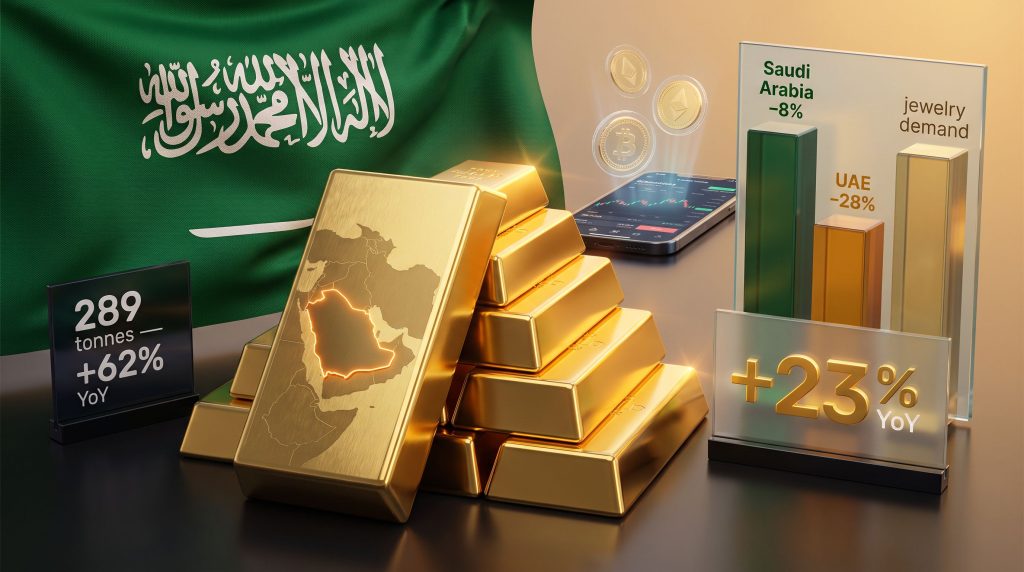
When gold prices rise sharply, tourist buyers — typically purchasing jewellery as discretionary gifts or souvenirs — reduce or defer spending more readily than committed investors. The UAE's Q2 2026 jewellery demand decline of 28% year on year illustrates this vulnerability in concrete terms. Elevated gold prices collided with price-sensitive tourist demand, producing one of the steepest regional contractions recorded in the period.
This is not a permanent weakness in the UAE model, which benefits from world-class infrastructure, sophisticated financial services, and a robust private wealth sector. However, it does highlight how tourism dependency amplifies price sensitivity in ways that structurally domestic markets are better insulated against.
Saudi Arabia's Demand Base: Why Local Consumers and Investors Anchor the Market
Saudi Arabia recorded a jewellery demand decline of just 8% year on year in Q2 2026, the smallest contraction among all Middle Eastern markets tracked by the World Gold Council. This outperformance did not occur because Saudi consumers were indifferent to higher prices. It occurred because a larger share of demand was driven by investment-oriented buyers whose motivation for holding gold extends beyond jewellery aesthetics into portfolio construction and wealth preservation.
For instance, gold as a safe haven has become an increasingly prominent consideration for Saudi investors navigating geopolitical uncertainty and inflationary pressures, reinforcing the Kingdom's structurally resilient demand profile.
Markets anchored by domestic consumers and institutional investors tend to demonstrate greater resilience during periods of high gold prices and softening tourist flows, a dynamic that increasingly favours Saudi Arabia's position over tourism-dependent regional peers.
How Does Saudi Arabia's Gold Demand Compare to the Broader Middle East?
Q2 2026 Regional Gold Demand Snapshot: A Market-by-Market Breakdown
The demand figures published in the World Gold Council's Gold Demand Trends Q2 2026 report reveal a stark regional divergence:
| Market | Jewellery Demand Change (YoY) | Bar and Coin Demand Change (YoY) |
|---|---|---|
| Saudi Arabia | -8% | +23% |
| UAE | -28% | +30% |
| Middle East (Overall) | -19% | -12% |
Two patterns stand out immediately. First, Saudi Arabia's jewellery demand held up far better than the regional average. Second, both Saudi Arabia and the UAE bucked the broader Middle Eastern trend on bar and coin investment demand, recording substantial growth even as the wider region declined by 12%.
According to Arab News reporting on the Saudi gold market, Saudi Arabia is increasingly poised to outperform other Middle Eastern gold markets, a trajectory consistent with the structural demand advantages outlined above.
Q1 2026 Comparison: Saudi Arabia's Relative Resilience Holds
This outperformance was not a one-quarter anomaly. In Q1 2026:
- Saudi Arabia jewellery demand fell 13% year on year
- Regional Middle East jewellery demand fell 23% year on year
- Saudi bar and coin demand rose approximately 15% year on year
The consistency across two consecutive quarters reinforces the structural rather than cyclical nature of Saudi Arabia's relative resilience.
Why Saudi Arabia Recorded the Smallest Jewellery Decline in the Region
Several factors contributed to Saudi Arabia's comparatively muted jewellery demand decline. Cultural purchasing patterns tied to weddings and family gifting traditions provide a degree of baseline demand that is less price-elastic than discretionary tourist purchases. Additionally, the Kingdom's expanding middle class, supported by ongoing economic diversification efforts, has maintained household income stability in ways that support continued participation in the gold jewellery market even at elevated price levels.
What Bar and Coin Demand Growth Signals About Shifting Saudi Consumer Behaviour
The 23% year-on-year surge in Saudi bar and coin demand during Q2 2026 is arguably the more significant data point. It signals a fundamental reorientation of how Saudi consumers and investors relate to gold. Rather than stepping back from the market as prices rose, a growing segment of the Kingdom's buyer base rotated from jewellery into investment-grade physical formats.
This suggests that price elevation is accelerating the transition from consumption to investment behaviour rather than suppressing gold participation altogether. Consequently, understanding the distinction between physical gold vs ETFs has become increasingly relevant for Saudi investors navigating this shift.
Global Gold Demand in 2026: The Macro Context Behind Regional Trends
H1 2026 Global Gold Demand: Key Metrics and What They Mean
Regional trends do not exist in isolation. The broader global context provides essential framing for understanding what is driving demand patterns across the Middle East:
- Total global gold demand in Q2 2026: 1,269 tonnes
- First-half 2026 total demand: 2,522 tonnes, up 2% year on year
- Total first-half 2026 demand value: $380 billion
These figures reflect a market that has absorbed historically high price levels without a significant collapse in aggregate demand — a meaningful signal about gold's embedded role in institutional and retail portfolios globally.
Price Consolidation After Record Highs: How Markets Are Adapting
Despite gold prices retreating from record highs reached earlier in 2026, overall demand remained broadly stable, a signal that gold's role as a portfolio diversifier and store of value continues to attract sustained institutional and retail interest globally. (World Gold Council, Gold Demand Trends Q2 2026)
The ability of global demand to hold near 2,500 tonnes in the first half of the year, even as prices corrected from peaks, suggests that the structural drivers supporting gold ownership — including geopolitical uncertainty, inflation hedging, and reserve diversification — have deepened beyond what short-term price movements can easily dislodge.
What Is Driving Investment Demand for Gold in Saudi Arabia and the GCC?
Geopolitical Risk, Inflation Pressures, and Trade Disruption: The Three Pillars of Safe-Haven Demand
Investment demand for gold across the GCC is being reinforced by three converging forces:
- Geopolitical risk — Regional tensions and broader global instability have elevated safe-haven demand, with gold functioning as a liquid, politically neutral asset that retains value when other holdings come under pressure.
- Inflation pressures — Protectionist trade policies and elevated global trade costs have increased inflationary expectations across import-dependent economies, strengthening the case for gold as a purchasing power hedge.
- Trade disruption — Shifts in global supply chains and the weaponisation of trade policy have introduced a new layer of macroeconomic uncertainty that benefits gold's role as a non-correlated store of value.
Why Gold's Low Correlation to Other Asset Classes Matters for GCC Investors
One of gold's most structurally important properties from a portfolio construction perspective is its historically low correlation with equities, bonds, and real estate. For GCC investors who may carry significant exposure to hydrocarbon-linked assets and regional equity markets, gold provides genuine diversification benefits that become particularly valuable during synchronised drawdowns in other asset classes.
Furthermore, gold and bond dynamics play an important role in shaping how institutional investors across the region allocate capital, particularly during periods of elevated fixed-income uncertainty.
The Opportunity Cost Equation: US Interest Rates, Dollar Strength, and Gold Pricing
The relationship between gold prices and US monetary policy remains one of the most closely watched dynamics in the market:
- Higher US interest rates increase the opportunity cost of holding non-yielding gold, exerting downward pressure on prices
- A stronger US dollar has a historically inverse relationship with gold, since gold is denominated in dollars and becomes more expensive for non-dollar buyers as the currency strengthens
- A lower interest rate environment has historically catalysed accelerated gold investment flows as the relative attractiveness of yield-bearing alternatives diminishes
For GCC investors operating in dollar-pegged currency environments, the dollar-gold relationship has particular relevance, since currency hedging costs are effectively eliminated for regional buyers, making gold price movements more directly accessible.
How Is Digital Technology Reshaping Gold Investment Across the Middle East?
The Tokenisation of Gold: Broadening Access Beyond Traditional Buyers
One of the most consequential structural shifts underway in GCC gold markets is the digitisation of investment gold. Tokenisation — the process of representing ownership of physical gold on a blockchain or digital ledger — is enabling fractional access to institutional-grade bullion bars that would otherwise require substantial capital commitments beyond the reach of most retail investors.
This is not a theoretical development. Regulated digital gold platforms are already operational across several GCC markets, and the World Gold Council has identified the digitisation of gold investing as one of the most significant structural changes anticipated over the next two years.
Fintech, Online Banking, and the Shift Away from Physical Delivery
The broader fintech ecosystem across the GCC is accelerating the adoption of digitally held gold. As confidence in regulated financial institutions deepens, investors — particularly younger high-net-worth individuals — are increasingly comfortable holding gold through digital certificates or tokenised instruments rather than requiring physical delivery.
This shift has important implications for market liquidity, since digitally held gold can be traded in real time through online platforms without the logistical costs associated with physical storage and transportation.
Vaulting and Storage Infrastructure: Why International Financial Centres Are Expanding Capacity
The growth of private wealth across the GCC is generating parallel demand for professional vaulting and storage services. The UAE, given its status as an established international financial centre, is expected to see particularly strong growth in institutional-grade storage demand as wealthy individuals and family offices seek secure, auditable custody solutions for growing bullion holdings.
As regulated financial institutions gain investor confidence across the GCC, digitally held gold is emerging as a preferred format, particularly among younger, high-net-worth individuals who prioritise liquidity and accessibility over physical possession.
The next major ASX story will hit our subscribers first
Central Bank Gold Buying: How Official Sector Demand Shapes Market Sentiment
Net Central Bank Gold Purchases in Q2 2026: The Numbers
Central bank gold demand continues to function as one of the most powerful structural demand floors in the global gold market:
- Net central bank gold purchases in Q2 2026: 289 tonnes, up 62% year on year
- Official sector share of annual global gold demand: approximately 22%
The scale and consistency of central bank accumulation matters beyond its direct demand impact. When sovereign reserve managers allocate to gold at scale, it sends a signal to institutional and retail investors about gold's perceived role as a stable, strategically important reserve asset — influencing broader market sentiment in ways that extend well beyond the tonnes directly purchased.
What the World Gold Council's Central Bank Survey Reveals
The World Gold Council's June 2026 Central Bank Gold Reserves Survey provided additional forward-looking evidence of sustained official sector appetite:
- 45% of central banks surveyed indicated plans to increase gold holdings over the next 12 months
- Reserve managers are expanding bullion allocations as gold assumes a larger strategic role in sovereign portfolio construction
This forward guidance from central banks is significant for market participants, since official sector demand has become sufficiently large — at roughly 22% of total annual global gold demand — that changes in sovereign buying behaviour can materially influence price dynamics.
Formalising Artisanal Mining: The Global Initiative and Why It Has Limited GCC Relevance
Artisanal and small-scale gold mining accounts for approximately 20% of global gold supply but is largely absent from GCC economies, meaning regional central banks are not primary targets for domestic sourcing initiatives, though the broader formalisation agenda may affect global supply dynamics over time.
Efforts to integrate artisanal miners into formal supply chains have significant implications for global gold supply integrity. While formalisation initiatives will have minimal direct impact on GCC markets, any material shift in the formalised supply of artisanal gold could influence global supply volumes and, by extension, pricing dynamics that affect all market participants. Notably, thesauditimes.net reports that Saudi Arabia's gold market has surged as prices approach historic highs in 2026, further underscoring the Kingdom's growing regional prominence.
Saudi Arabia vs. UAE: A Structural Gold Market Comparison
| Dimension | Saudi Arabia | UAE |
|---|---|---|
| Primary Demand Driver | Domestic consumers and investors | Tourism and expatriate buyers |
| Q2 2026 Jewellery Demand Change | -8% YoY | -28% YoY |
| Q2 2026 Bar and Coin Demand Change | +23% YoY | +30% YoY |
| Exposure to Tourist Flow Volatility | Low | High |
| Digital Gold and Wealth Management Growth | Emerging | Advanced (international financial centre) |
| Vaulting and Storage Demand Outlook | Growing | Strong and expanding |
The table above encapsulates the fundamental trade-off between the two markets. The UAE offers a more developed digital gold and wealth management infrastructure but carries greater exposure to demand volatility through its tourism dependency. Saudi Arabia, however, presents a more structurally stable demand base, though it remains earlier in the journey toward sophisticated digital gold investment infrastructure.
What Is the Outlook for Saudi Arabia's Gold Market Over the Next 12 to 24 Months?
Investment Demand as the Dominant Growth Engine
The trajectory of the Saudi gold market to outshine regional peers points clearly toward investment demand as the primary growth driver over the near to medium term. The acceleration in bar and coin purchasing relative to jewellery consumption is not a temporary response to elevated prices but rather reflects a deeper shift in how Saudi investors conceptualise gold within their portfolios.
Key Macroeconomic Variables to Monitor
Several external variables will determine the pace and magnitude of Saudi gold market outperformance:
- US Federal Reserve interest rate trajectory — the single most influential external variable for gold pricing globally
- US dollar index movements — the inverse relationship with gold prices remains a critical pricing signal for all market participants
- Geopolitical risk escalation — continued regional and global tensions reinforce safe-haven demand fundamentals
- Domestic wealth formation in Saudi Arabia — ongoing economic diversification is expanding the investable household wealth base that supports gold investment demand
Hypothetical Scenario: What Happens If US Rates Fall in Late 2026?
Scenario Analysis: If the US Federal Reserve initiates a rate-cutting cycle in the second half of 2026, the opportunity cost of holding gold declines — historically a catalyst for accelerated investment inflows. For Saudi Arabia, where investment demand is already the dominant growth driver, such a scenario could amplify bar and coin purchasing significantly beyond the current Q2 2026 growth rate of +23% year on year. This remains speculative and is dependent on a range of macroeconomic conditions that are subject to change. Readers should not interpret scenario analysis as a forecast or investment recommendation.
Risks to the Outlook: What Could Undermine Saudi Gold Market Outperformance
A sustained period of US dollar strength, combined with an unexpectedly hawkish Federal Reserve stance, would raise the opportunity cost of gold ownership and potentially redirect investment flows toward yield-bearing alternatives. Additionally, a sharp recovery in oil revenues supporting broader Gulf equity market re-ratings could draw discretionary capital away from defensive allocations including gold. These scenarios represent genuine risks to an otherwise constructive near-term outlook.
Frequently Asked Questions: Saudi Arabia's Gold Market
Why is Saudi Arabia's gold market expected to outperform other Middle Eastern markets?
Saudi Arabia's gold market benefits from a structurally different demand base compared to regional peers. Unlike markets that depend heavily on tourist spending, Saudi Arabia's gold consumption is anchored by domestic buyers and a growing investor class, making it less exposed to fluctuations in visitor numbers and more responsive to macroeconomic investment drivers.
What happened to gold jewellery demand in Saudi Arabia in Q2 2026?
Saudi Arabia recorded an 8% year-on-year decline in gold jewellery demand during Q2 2026 — the smallest contraction among Middle Eastern markets tracked in the period. By comparison, the UAE saw a 28% decline and the broader Middle East region fell 19%.
How strong is bar and coin investment demand in Saudi Arabia?
Bar and coin demand in Saudi Arabia rose 23% year on year in Q2 2026, reflecting growing investor appetite for physical gold as a hedge against inflation and geopolitical uncertainty.
What role does tokenisation play in the future of gold investing in the GCC?
Tokenisation allows investors to purchase fractional interests in institutional-grade gold bars, lowering the entry threshold for retail participants. Combined with growing fintech infrastructure and regulated digital platforms, this is expected to significantly expand gold's investor base across the GCC over the next two years.
How much gold are central banks buying globally?
Central banks added a net 289 tonnes of gold to reserves in Q2 2026, representing a 62% increase year on year. The official sector accounts for approximately 22% of total annual global gold demand, and 45% of central banks surveyed plan to increase their gold holdings within the next 12 months.
What macroeconomic factors most influence gold prices?
US interest rates and the strength of the US dollar are the two most closely watched variables. Higher interest rates raise the opportunity cost of holding gold, while a stronger dollar typically suppresses gold prices. Conversely, rate cuts and dollar weakness have historically supported significant gold price appreciation.
Key Takeaways: Saudi Arabia's Gold Market Advantage Summarised
- Saudi Arabia recorded the smallest jewellery demand decline in the Middle East during Q2 2026, at -8% versus a -19% regional average
- Bar and coin investment demand grew +23% year on year in Saudi Arabia in Q2 2026
- The Kingdom's demand structure, anchored by domestic consumers and investors rather than tourism, provides structural insulation against external demand shocks
- Digital gold platforms and tokenisation are expected to be the most significant structural change in GCC gold markets over the next two years
- Central bank buying at 289 tonnes net in Q2 2026, up 62% year on year, continues to provide a powerful demand floor for global gold markets
- US interest rate trajectory remains the primary macroeconomic variable to monitor for gold price direction
Further Exploration: Readers seeking additional data and institutional analysis on global and regional gold demand trends can explore the World Gold Council's Gold Demand Trends Q2 2026 report, available at gold.org. This report provides comprehensive demand, supply, and price analysis across all major gold market segments globally. Nothing in this article constitutes financial advice. All forecasts, scenario analyses, and market projections are illustrative and subject to material uncertainty. Investors should conduct independent research and seek qualified financial advice before making investment decisions.
Want to Capitalise on the Next Major Gold Discovery Before the Broader Market?
Discovery Alert's proprietary Discovery IQ model delivers real-time alerts on significant ASX gold and mineral discoveries, instantly translating complex data into actionable insights for investors at every level — explore historic discovery returns to understand the magnitude of opportunities these moments can generate, then begin your 14-day free trial at Discovery Alert to position yourself ahead of the market.