
August 24, 2026
The Metallurgical Frontier: Why Producing Five-Nines Gold at Scale Is Harder Than It Sounds
Gold refining is one of humanity's oldest industrial arts, yet the chemistry and thermodynamics involved remain deceptively complex. Most people understand that gold purity can be measured, but few appreciate how exponentially more difficult it becomes to remove that final fraction of impurity as you approach theoretical perfection. The difference between 99.9% pure gold and 99.999% pure gold sounds trivial in conversation. In practice, it represents a fundamentally different class of metallurgical challenge, one that eliminates most of the world's refineries from contention before the casting even begins.
This is the technical landscape against which the Perth Mint world's largest gold bar must be understood, and furthermore, it contextualises why this achievement resonates far beyond a simple marketing milestone.
When big ASX news breaks, our subscribers know first
What the 521.2 kg World Record Actually Represents
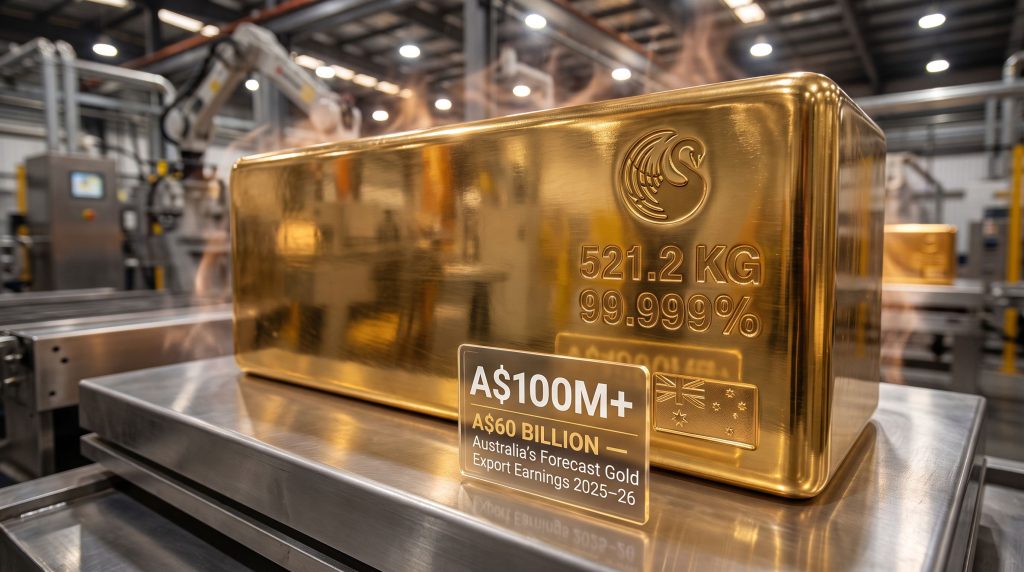
On 9 July 2026, the Perth Mint Refinery in Western Australia officially secured the Guinness World Records title for the world's largest gold bar, with a casting that weighed 521.2 kilograms and was refined to 99.999% purity. The previous record, set approximately two years earlier by a mint in Dubai, stood at 300 kilograms.
That is not an incremental improvement. The Perth Mint's bar exceeds the Dubai record by more than 73% by mass, while simultaneously surpassing it on the purity dimension. The intersection of those two variables, extreme mass and extreme purity achieved simultaneously, is what transforms this from a headline into a genuine metallurgical milestone.
How the Record Compares to Previous Benchmarks
| Record Holder | Weight | Purity | Year |
|---|---|---|---|
| Perth Mint (current) | 521.2 kg | 99.999% | July 2026 |
| Dubai Mint (previous) | 300 kg | 99.99% | ~2024 |
| Perth Mint (one-tonne coin) | 1,000 kg | 99.99% | 2011 |
The one-tonne coin from 2011 demonstrates that the Perth Mint has long possessed the infrastructure for large-scale gold objects. What the 2026 bar adds, however, is the five-nines purity threshold, a distinction the Mint's CEO noted very few facilities globally can achieve even at standard bar sizes, let alone at half a tonne.
Understanding Five-Nines Gold: A Purity Standard Few Can Meet
The global investment gold market operates predominantly at 99.99% purity, what the industry calls "four-nines" gold. This is the benchmark recognised by the London Bullion Market Association (LBMA) for Good Delivery bars, the internationally traded standard used by central banks and institutional investors. Consequently, understanding LBMA gold markets is essential context for appreciating why four-nines gold is considered investment-grade perfection for most practical purposes.
Five-nines gold, at 99.999% purity, requires the removal of an additional order of magnitude of contaminants. The challenge is not simply doing more of the same refining process. At this purity level, trace elements that are chemically stable and commercially irrelevant at four-nines become problematic. Elements like silver, platinum group metals, copper, and even atmospheric gases absorbed during handling can push a batch below the five-nines threshold.
Which Refineries Can Achieve This Standard?
Very few institutions globally operate at five-nines capability with any consistency. Among those with documented capacity at smaller scales:
- Perth Mint (Australia): Now verified at five-nines purity at 521.2 kg scale
- Royal Canadian Mint: Has produced five-nines gold maple leaf coins at smaller individual weights
- PAMP Suisse (Switzerland): Known for ultra-high purity investment products but primarily at standard bar sizes
- Rand Refinery (South Africa): Historically one of the largest by throughput volume, operating at four-nines standard
The key differentiator is not merely achieving five-nines in a laboratory setting, but sustaining that purity level across the thermal and chemical stresses involved in casting a mass of this size.
Step-by-Step: How the World's Largest Gold Bar Was Made
The production process involved a sequence of engineering decisions, each of which had to succeed in order for the final result to be valid. A failure at any stage, a temperature deviation, a contamination event, or a cooling irregularity, would have invalidated the attempt.
Stage 1: Raw Material Sourcing and Pre-Refining
Australian-origin gold was selected as the feedstock. This is significant from both a logistical and quality-control perspective. Australian gold is predominantly sourced from Western Australian operations, where the ore characteristics and existing refining infrastructure align well with the Mint's processing capabilities. For instance, approximately 1.5 tonnes of raw gold material was processed to yield the 521.2 kg final bar, reflecting the material losses inherent in achieving five-nines purity through successive refining passes. Global gold production patterns help explain why Australian feedstock is particularly well-suited to this kind of high-precision refining.
Stage 2: Electrolytic Refining and Chemical Purification
Reaching five-nines requires multiple refining cycles. The primary method used by leading refineries is electrolytic refining, where gold is dissolved in an acid solution and selectively deposited onto a cathode, leaving impurities behind in the electrolyte. This process may be repeated multiple times, with chemical precipitation steps used to target specific residual contaminants between cycles. Each pass increases purity but also increases processing time, energy input, and the risk of recontamination.
Stage 3: Custom Mould Engineering and Casting Chamber Design
Standard gold bar moulds are engineered for bars in the range of 400 troy ounces (approximately 12.4 kg), the LBMA Good Delivery standard. Scaling to 521.2 kg requires a purpose-built mould capable of handling the thermal and hydrostatic pressure of that volume of molten gold without deforming, cracking, or introducing contaminants from mould surface reactions.
Critically, the Perth Mint used a flameless casting chamber for this process. Open-flame environments introduce combustion gases, including carbon monoxide and hydrocarbons, that can be absorbed by molten gold at high temperatures, creating microscopic inclusions that compromise both purity and structural integrity. The controlled, oxygen-managed atmosphere of a flameless chamber is a prerequisite for five-nines casting at this scale. The casting temperature reached approximately 1,400°C, just above gold's melting point of 1,064°C, with the elevated temperature necessary to ensure complete fluidity across the full volume of the mould.
Stage 4: The Sequential Pour
Rather than attempting to melt 521.2 kg of gold in a single furnace charge, the process involved loading six large intermediate bars plus several smaller bars sequentially into the mould. This approach manages the thermal load on the casting equipment while ensuring the mould fills progressively without cold-junction formation, which occurs when partially solidified gold is contacted by a new pour and creates a structural boundary plane within the bar.
Stage 5: Controlled Cooling
Cooling a half-tonne gold casting is not simply a matter of waiting. The cooling rate must be managed precisely to prevent:
- Thermal cracking from differential contraction between the bar's outer surface and its still-molten core
- Internal voids caused by volumetric shrinkage if the outer shell solidifies before the interior
- Surface defects from rapid atmospheric contact with the still-hot metal
The cooling process extended over many hours under controlled conditions, with the bar monitored continuously throughout.
Stage 6: Guinness World Records Verification
Guinness World Records officials were present on-site for every stage of the process, which spanned up to three days of continuous observation. The verification process included documentation of the weighing methodology, purity certification, and the chain of custody for all materials used. The breadth of this oversight is unusual even for major record attempts and reflects the complexity of establishing an unambiguous benchmark for an object of this nature.
Stage 7: The Practice Run Nobody Talks About
One of the lesser-discussed elements of this project is that the Perth Mint conducted a full-scale rehearsal before the official record attempt. This is not standard practice for industrial casting operations and indicates the degree to which the team treated this as an engineering project rather than a promotional exercise. The practice run allowed the 35-strong specialist team to observe real thermal behaviour in the mould, identify any issues with sequential loading, and refine the cooling protocol before the certified attempt.
What Is the Perth Mint World's Largest Gold Bar Actually Worth?
| Metric | Value |
|---|---|
| Bar weight | 521.2 kg |
| Gold spot price (as of August 2026) | ~US$4,079 per troy ounce |
| Approximate metal value | Over A$100 million |
| Purity classification | Five-nines (99.999%) |
The metal value calculation is relatively straightforward. At approximately US$4,079 per troy ounce, with 521.2 kg equating to roughly 16,756 troy ounces, the intrinsic commodity value exceeds A$100 million at prevailing exchange rates. In addition, gold prices at record highs throughout this period have further amplified the bar's headline valuation.
However, commodity pricing is the floor, not the ceiling. Objects that are genuinely unique, certified by an independent authority, and irreproducible without extraordinary institutional resources occupy a separate valuation category. The Perth Mint's CEO acknowledged publicly that the bar's true market value cannot be determined through standard pricing models, precisely because no comparable sale has ever occurred.
The absence of comparable sales data is itself a valuation signal. In collector and institutional markets, provenance, scarcity, and certification interact to produce premiums that commodity analysis cannot capture.
For context, the Perth Mint's 2011 one-tonne gold coin, which held its own Guinness World Record for a different category, has never been sold and continues to be held by the institution as a display asset. The commercial value of such objects is partly realised through the institutional credibility and marketing reach they generate, rather than through direct monetisation.
Australia's Gold Export Trajectory and Why This Matters Now
The timing of this achievement is not incidental to Australia's broader commodity export story. According to the Minerals Council of Australia, gold export earnings are forecast to grow from A$47 billion in 2024-25 to A$60 billion in 2025-26, a trajectory that would position gold as Australia's second-largest export earner behind iron ore.
| Export Metric | 2024-25 | 2025-26 Forecast |
|---|---|---|
| Gold export earnings | A$47 billion | A$60 billion |
| Projected export ranking | Third | Second |
Several macroeconomic factors are driving this. Gold prices at approximately US$4,079 per troy ounce as of August 2026 reflect sustained safe-haven demand in an environment of geopolitical uncertainty and persistent inflationary pressure in major economies. The gold market outlook further underscores how these dynamics are reshaping Australia's export priorities.
What the Perth Mint world's largest gold bar adds to this picture is a value-added dimension. Raw gold exports command commodity prices. Refined gold products, particularly those bearing certification and institutional provenance, attract premiums in sovereign and institutional markets. The ability to demonstrate five-nines refining capability at unprecedented scale directly supports the commercial positioning of Australian refined gold in international markets.
The next major ASX story will hit our subscribers first
The Perth Mint's Place in Global Refinery Rankings
LBMA accreditation is the internationally recognised benchmark for gold refinery credibility. Accredited refineries are permitted to produce gold that is accepted without further testing by LBMA-member bullion banks, central banks, and exchange-traded gold instruments globally. The Perth Mint holds this accreditation, placing it among the world's most credible refining institutions.
What the 2026 record achievement adds is a demonstrated operational capability that differentiates the Mint from other LBMA-accredited refiners. Furthermore, those considering physical gold vs ETFs as investment vehicles will recognise that provenance and refinery credibility play a significant role in determining the premium commanded by physical gold products.
Public Display: When and Where You Can See It
The bar is scheduled for intermittent public display at the Perth Mint beginning 21 September 2026, as part of the institution's Gold Tour programme. It will be exhibited alongside the 2011 one-tonne gold coin, creating what will effectively be a dual world-record display at a single institution.
The logistical challenges of displaying an object of this value and weight are substantial. Security specifications, structural load requirements for display flooring, insurance valuations, and climate control all contribute to why display schedules must be intermittent rather than permanent. These constraints are common to major institutional gold objects globally and are not unique to the Perth Mint.
Frequently Asked Questions: Perth Mint World's Largest Gold Bar
How much does the world's largest gold bar weigh?
The Perth Mint's certified world record bar weighs 521.2 kilograms, surpassing the previous record of 300 kilograms by more than 200 kilograms.
What purity is the bar?
It was refined to 99.999% purity, the five-nines standard, which exceeds the global investment-grade benchmark of 99.99% used for LBMA Good Delivery bars.
When was the record officially set?
The Guinness World Records title was achieved on 9 July 2026 at the Perth Mint Refinery in Western Australia.
How much is it worth?
Based on a gold spot price of approximately US$4,079 per troy ounce as of August 2026, the metal value alone exceeds A$100 million. The bar's status as a one-of-a-kind certified world record object means its actual market value, if it were ever offered for sale, would likely be substantially higher and cannot be determined through commodity pricing alone.
How many specialists were involved?
More than 35 specialists participated in the project, which also included a full practice run prior to the official certified attempt.
How was the gold processed?
Approximately 1.5 tonnes of raw Australian gold material was refined through multiple electrolytic and chemical purification stages. Six large intermediate bars plus several smaller bars were loaded sequentially into a custom mould, heated to approximately 1,400°C in a flameless casting chamber, and cooled over many hours under controlled conditions.
When can the public see it?
Intermittent public display is scheduled to begin 21 September 2026 at the Perth Mint, where the bar will be shown alongside the institution's one-tonne gold coin from 2011.
Key Facts at a Glance
- 521.2 kg — bar weight, exceeding the previous record by more than 73%
- 99.999% purity — five-nines standard, surpassing the global four-nines benchmark
- ~1,400°C — casting temperature in a purpose-built flameless chamber
- 1.5 tonnes — approximate raw input material required to produce the finished bar
- 35+ specialists — the multidisciplinary team behind the project
- Three days — the duration of Guinness World Records on-site verification
- A$100M+ — minimum metal value based on August 2026 spot prices
- A$60 billion — Australia's forecast gold export earnings for 2025-26
- 21 September 2026 — scheduled start of public display via the Gold Tour programme
This article contains forward-looking statements regarding gold export forecasts and market valuations. These projections are based on data published by the Minerals Council of Australia and LSEG as cited in publicly available reporting, and should not be construed as financial advice. Commodity prices and export trajectories are subject to change based on global market conditions.
Want to Know Which ASX Gold Explorers Could Be Behind the Next Major Discovery?
Discovery Alert's proprietary Discovery IQ model delivers real-time alerts on significant ASX mineral discoveries, instantly translating complex geological data into actionable investment insights — so subscribers can identify high-potential opportunities the moment they are announced. Explore historic discoveries and their extraordinary returns, then begin your 14-day free trial to position yourself ahead of the broader market.