June 12, 2026
When Physical Markets Become Geopolitical Instruments
Commodity benchmarks rarely transform overnight. They typically evolve across cycles, shaped by incremental shifts in trade flows, freight economics, and industrial demand patterns. Yet occasionally, a single sustained disruption compresses years of structural change into months, forcing markets to reprice not just the commodity itself, but the risk embedded in accessing it.
That is precisely what has unfolded in the Asia-Pacific aluminium market across the first half of 2026. The Japan aluminium premium surge, centred on the Japan Main Port quarterly-settled reference price, has undergone a fundamental repricing that extends well beyond normal market cycles. Understanding why this has happened, and what it signals for global supply chains, requires examining the mechanics of the premium itself before tracing the chain of events that drove it to its highest point in over a decade.
When big ASX news breaks, our subscribers know first
What the Japan Main Port Premium Actually Measures
The MJP premium is not the price of aluminium. It is the additional cost paid above the London Metal Exchange cash price for physical delivery of primary aluminium, specifically P1020 and P1020A standard ingot grades, into Japanese port facilities. This distinction matters enormously. The LME price reflects global supply and demand expectations. The physical premium reflects something more granular: the real-world cost of actually obtaining metal, in a specific form, in a specific location, at a specific time.
For decades, the premium's key drivers were straightforward:
- Regional freight rates between producing nations and Japanese ports
- LME warehouse stock levels and metal availability in the seaborne market
- Seasonal fluctuations in Japanese industrial demand, particularly from the automotive and packaging sectors
- Producer pricing strategies based on their cost structures and contract book positions
What made the MJP premium particularly significant beyond Japan's borders was its adoption as a reference point across the broader Asia-Pacific region. South Korean, Taiwanese, and Southeast Asian buyers, lacking their own equivalent settlement mechanisms, aligned physical purchasing contracts to MJP settlements. This transmission function transformed a bilateral Japan-producer negotiation into the region's de facto primary aluminium pricing benchmark.
The quarterly negotiation structure adds another layer of significance. Unlike spot pricing, which adjusts continuously, MJP settlements are agreed approximately six to eight weeks before the relevant quarter commences. This means the premium encodes market participants' forward expectations about supply availability, freight costs, and geopolitical conditions, making it a leading indicator rather than a lagging one. Furthermore, the aluminum and alumina markets have both been subject to broader structural pressures that amplify the significance of each quarterly MJP outcome.
"The MJP premium has quietly functioned as Asia-Pacific's physical aluminium risk barometer for years. The 2026 escalation has simply made that function visible to a much wider audience of market participants who previously treated it as a niche logistics adjustment."
A Repricing Without Recent Precedent: Tracing the Quarterly Escalation
To appreciate the scale of the Japan aluminium premium surge that has defined the first half of 2026, it is necessary to examine the quarterly data in sequence rather than simply comparing endpoints.
The Three-Quarter Trajectory
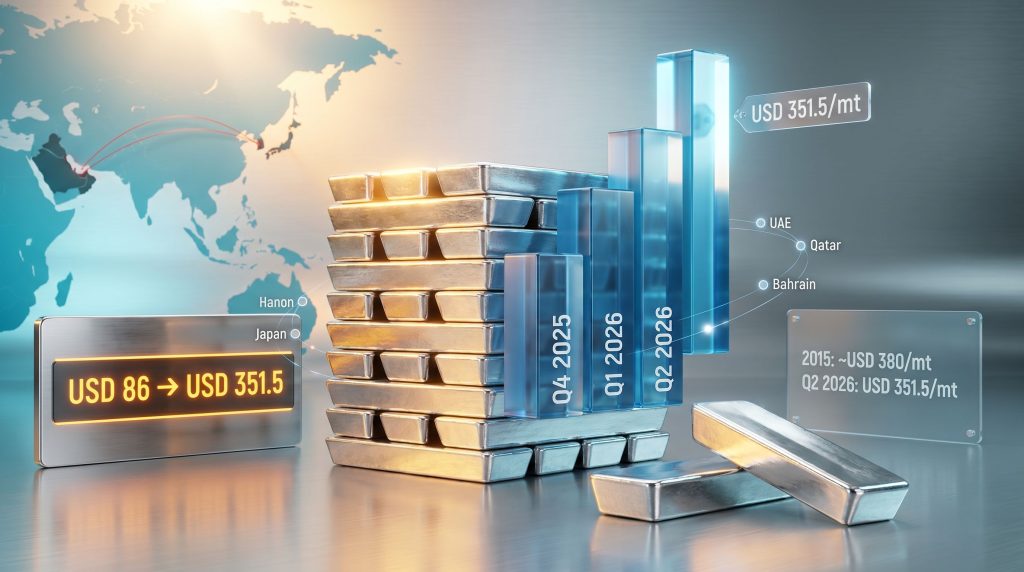
| Quarter | Settled Premium (USD/mt) | Quarter-on-Quarter Change |
|---|---|---|
| Q4 2025 | ~USD 86 | Baseline |
| Q1 2026 | USD 195 | +127% |
| Q2 2026 | USD 351.5 (range: USD 350–353) | +80% |
The Q4 2025 settlement at approximately USD 86 per metric tonne occurred despite producer offers that opened between USD 95 and USD 110 per metric tonne. Buyers successfully negotiated discounts to those initial positions, reflecting a market environment where supply adequacy allowed for price resistance.
The Q1 2026 negotiation produced a dramatically different outcome. Producers opened between USD 190 and USD 225 per metric tonne. Final settlements at USD 195 per metric tonne represented a near-capitulation by buyers, who accepted terms close to the lower end of producer offers. The 127 percent quarter-on-quarter jump from Q4 2025 to Q1 2026 was itself extraordinary by historical standards.
Yet Q2 2026 exceeded even that benchmark. Initial producer offers for April-to-June shipments opened between USD 220 and USD 250 per metric tonne in February 2026, signalling that producers anticipated further tightening. What followed was one of the most compressed repricing sequences in the market's modern history.
How the Q2 2026 Settlement Was Constructed
The Q2 2026 settlement was not a single transaction. It was built from nine separate trades, each reflecting the specific negotiating positions of individual producers and buyer groups:
- Four transactions concluded at USD 350 per metric tonne, covering a combined volume of approximately 10,000 tonnes per month
- Five transactions concluded at USD 353 per metric tonne, covering approximately 5,000 tonnes per month
- The resulting weighted average settlement: USD 351.5 per metric tonne
- The final settlement represented a near-40 percent uplift from the opening producer positions of USD 220–250 per metric tonne
The catalyst for this acceleration was Rio Tinto's decision to revise its Q2 2026 offer upward to USD 350 per metric tonne in mid-March. This single repricing by a major producer functioned as a market-resetting event, compressing negotiation timelines and eliminating buyer leverage. When the largest and most creditworthy producers are offering at USD 350 per metric tonne and buyers cannot source competitively priced metal elsewhere, settlement at or near that level becomes mathematically inevitable.
The delivered cost consequence for Japanese industrial buyers is significant: with LME base prices incorporated, aluminium was trading above USD 3,800 per metric tonne for Q2 2026 delivery. For context, the total premium escalation from Q4 2025 to Q2 2026, at more than USD 265 per metric tonne within two consecutive quarterly cycles, represents a procurement cost increase that would be material even for companies with healthy operating margins. According to Reuters, these Q2 premiums represent an 11-year high, driven significantly by Middle Eastern supply fears.
"The fact that the bulk of the Q2 premium jump occurred in the final weeks of March, rather than across the full negotiation window, is diagnostically important. Rapid end-of-period repricing is a hallmark of a market where buyers have run out of alternatives, not a market where demand has simply increased."
The Causal Chain: Middle Eastern Supply and Global Premium Contagion
Gulf Aluminium and the Strait of Hormuz Factor
Japan imports every tonne of primary aluminium it consumes. The country has no domestic smelting capacity of meaningful scale, making it entirely dependent on seaborne supply from producing nations. Approximately 20 percent of those imports originate from Middle Eastern producers, concentrated in the Gulf Cooperation Council states of Qatar, Bahrain, and the United Arab Emirates.
This geographic concentration of supply creates acute vulnerability to any disruption affecting the Persian Gulf or its critical maritime transit points. The Strait of Hormuz, through which Gulf-origin aluminium cargo must pass en route to Asian markets, became a focal point for elevated cargo risk during the geopolitical escalation that accelerated through early 2026. The consequences were threefold:
- Freight cost inflation: War-risk insurance premiums and vessel diversion costs added material expense to cargo transiting the Strait
- Cargo availability reduction: At least one major Gulf smelter curtailed output, while another declared force majeure on shipments, removing tonnes from the seaborne market
- Uncertainty premium: Even cargoes that were physically available became harder to contract as sellers and buyers disagreed on risk allocation
The Middle East accounts for an estimated 9 percent of global primary aluminium production, concentrated in GCC smelters that were designed and built to serve export markets. Unlike Chinese production, which is largely consumed domestically, GCC aluminium is structurally export-oriented, making any disruption to its production or transit routes immediately felt in the seaborne P1020 market.
Cross-Regional Contagion: Why Western Premiums Amplified Asian Tightness
The Middle Eastern supply disruption did not occur in isolation. Simultaneously, European and US Midwest physical aluminium premiums were elevated, reflecting their own supply-demand dynamics. In addition, the broader context of US aluminium tariffs has continued to reshape trade flow patterns across the Pacific, redirecting metal away from Asian buyers who might otherwise have benefited from US-bound cargo diversions.
When Western premiums are high, producers face a straightforward opportunity cost calculation: metal that can be sold at strong European or US Midwest premiums generates better economics than metal diverted to Asia at more competitive terms. The practical result is that seaborne P1020 ingot that might otherwise have been available for redirection to Japan, South Korea, or Southeast Asia was absorbed by Western buyers willing to pay elevated premiums.
This cross-regional dynamic represents a structural evolution in global aluminium markets. Physical premiums across major trading blocs are no longer isolated regional signals; they interact continuously, with stress in one region amplifying constraints in another. The simultaneous elevation of European, US Midwest, and MJP premiums in Q1 and Q2 2026 was not coincidental. It reflected a globally tight seaborne P1020 market in which supply could not be easily redistributed. Consequently, the global commodity tariff impacts of the past two years have materially contributed to the structural rigidity now visible in premium settlements.
Historical Benchmarking: Where the 2026 Surge Sits in Context
| Period | Approximate Peak MJP Premium (USD/mt) | Primary Market Driver |
|---|---|---|
| 2015 | ~USD 380 | Broad supply tightness, strong global demand |
| 2016–2019 | USD 80–120 | Oversupply conditions, LME stock normalisation |
| 2020–2022 | USD 100–180 | Post-COVID restocking demand, freight inflation |
| Q4 2025 | ~USD 86 | Demand softness, adequate supply conditions |
| Q2 2026 | USD 351.5 | Geopolitical disruption, Gulf supply shock |
The 2015 precedent is instructive for understanding both the severity and potential trajectory of 2026 premiums. When MJP premiums approached USD 380 per metric tonne in 2015, the primary drivers were broad supply tightness and strong global demand growth, not geopolitical disruption. The 2026 escalation is more analogous to a supply shock than a demand cycle, which has different implications for duration and normalisation.
Supply shock premiums can reverse sharply when the supply constraint resolves. They can also persist or worsen if the underlying disruption is structural rather than temporary. The ambiguity of geopolitical risk, which can escalate, plateau, or resolve unpredictably, makes the 2026 premium environment particularly difficult to forecast.
How the MJP Benchmark Transmits Risk Across Asia-Pacific
Regional Price Cascades
The MJP premium's role as a regional benchmark means that its escalation does not stay contained within Japan. South Korean aluminium premiums move in correlation with Japanese settlements, as do those in Taiwan and increasingly across Southeast Asia. Downstream manufacturers in these markets, spanning automotive components, construction materials, consumer electronics, and packaging, face input cost increases that are directly linked to MJP negotiation outcomes.
For manufacturers operating in low-margin segments such as packaging and commodity construction products, a USD 265 per metric tonne increase in physical procurement costs within two quarterly cycles creates substantial margin compression. Unlike aerospace or speciality applications where aluminium costs represent a smaller fraction of total product value, these sectors have limited ability to absorb raw material inflation without passing it downstream to customers. The leading aluminium market leaders are, however, well-positioned to capitalise on elevated premium environments through their diversified production footprints.
The European Natural Gas Parallel
The transformation of the MJP premium from a logistics cost recovery mechanism to a geopolitical risk pricing instrument mirrors what happened to European natural gas benchmarks after 2022. Prior to that period, European gas benchmarks reflected regional supply and demand balances, storage levels, and seasonal consumption patterns. The supply disruption that followed transformed them into proxies for energy security risk, geopolitical tension levels, and supply-chain resilience premiums.
The MJP is undergoing a comparable conceptual evolution. Its quarterly settlements now incorporate not just freight and inventory signals, but assessments of supply-chain disruption probability, cargo insurance escalation, producer force majeure risk, and the availability of alternative sourcing in non-disrupted regions. Furthermore, trade wars and supply chains have added an additional layer of complexity that makes traditional premium modelling less reliable as a forecasting tool.
The next major ASX story will hit our subscribers first
Scenario Pathways for Q3 2026 and Beyond
The following represents scenario analysis based on market conditions as of May 2026. These are not forecasts, and actual outcomes will depend on geopolitical, macroeconomic, and supply-chain developments that cannot be predicted with certainty. Investors and procurement professionals should not rely on this analysis as the basis for financial or commercial decisions.
Three broad scenarios can be identified for the Q3 2026 MJP negotiation cycle, which typically commences in May:
Scenario 1: Sustained Disruption
If Middle Eastern supply constraints remain unresolved, producers are likely to open Q3 2026 offers at or above the USD 350 per metric tonne level already established. Combined with potential restocking demand from Japanese manufacturers who deferred purchases amid Q2 price uncertainty, premiums could approach or potentially test the 2015 record near USD 380 per metric tonne.
Scenario 2: Partial Resolution
A partial easing of Strait of Hormuz transit risk, without full production normalisation at curtailed Gulf smelters, could see Q3 premiums stabilise in the USD 250–300 per metric tonne range. This would represent a meaningful reduction from Q2 levels without a full market correction.
Scenario 3: Diplomatic Resolution
A substantive reduction in Middle Eastern geopolitical tensions that restores normal cargo flows and producer operations could trigger a rapid premium correction, potentially bringing Q3 settlements below USD 200 per metric tonne. Historical precedent from other commodity markets suggests geopolitical risk premiums can deflate as quickly as they inflated when the supply threat is credibly removed. As SP Global reports, the quarter-on-quarter rise of nearly 80 percent underscores just how rapidly conditions can shift within a single negotiation cycle.
Procurement Strategy and Market Positioning Implications
The current premium environment creates distinct strategic pressures and opportunities depending on market position:
For industrial buyers and manufacturers:
- The case for long-term offtake agreements with non-Gulf producers, including those in Australia, Canada, and Norway, has strengthened materially
- Supply diversification strategies that reduce concentration exposure to Gulf-origin aluminium are likely to receive increased capital allocation
- Procurement teams may accelerate evaluation of aluminium recycling and secondary metal use as a partial substitute for primary ingot
For commodity traders and metal holders:
- Elevated regional premiums create arbitrage potential between delivery locations and quarters
- Holders of physical P1020 inventory in Asian warehouses are positioned advantageously relative to buyers without committed supply
- The thin settlement basis for Q2 2026, nine trades covering roughly 15,000 tonnes per month, suggests that modest additional supply could meaningfully shift the premium trajectory
For policy analysts and governments:
- The speed of the premium repricing raises legitimate questions about Japan's strategic aluminium stockholding policy and its adequacy as a buffer against supply shocks of this duration and magnitude
- Import diversification policy frameworks that appeared adequate when the MJP premium was at USD 86 per metric tonne in Q4 2025 may require reassessment given the structural vulnerability exposed by Gulf supply disruption
Frequently Asked Questions
What is the Japan aluminium premium at in 2026?
For Q2 2026 shipments, the Japan Main Port aluminium premium settled at an average of USD 351.5 per metric tonne within a range of USD 350–353 per metric tonne, representing the highest quarterly settlement in approximately a decade.
Why is the Japan aluminium premium surging?
The primary driver is geopolitical disruption in the Middle East, which has constrained Gulf aluminium supply and elevated freight and insurance costs for seaborne cargo. The simultaneous elevation of European and US Midwest premiums has reduced the availability of competitively priced metal for Asian buyers, compounding the regional tightness.
How does the 2026 Japan premium compare to historical levels?
The Q2 2026 settlement of USD 351.5 per metric tonne is the highest since 2015, when premiums approached approximately USD 380 per metric tonne. It represents more than a fourfold increase from the Q4 2025 level of approximately USD 86 per metric tonne. The Japan aluminium premium surge over this period has few modern equivalents in terms of speed and magnitude.
How much of Japan's aluminium comes from the Middle East?
Based on 2025 trade flow data, approximately 20 percent of Japan's primary aluminium imports originate from Middle Eastern producers, making Japan particularly exposed to Gulf supply disruptions.
What sectors are most affected by the premium surge?
Japanese and regional manufacturers in automotive, packaging, construction, and consumer electronics face direct input cost increases. Lower-margin sectors such as packaging have the least capacity to absorb the USD 265 per metric tonne increase that has occurred over two quarterly cycles.
This article is intended for informational purposes only and does not constitute financial, investment, or procurement advice. Scenario projections and market analysis reflect conditions as of May 2026 and are subject to change. Readers should conduct independent research and consult qualified advisors before making commercial or investment decisions based on commodity market conditions.
Want to Stay Ahead of the Next Major Commodity Market Shift?
Discovery Alert's proprietary Discovery IQ model delivers real-time alerts on significant ASX mineral discoveries, transforming complex commodity data into actionable investment insights — explore the historic returns that major mineral discoveries have generated and begin your 14-day free trial to position yourself ahead of the market.