August 6, 2026
The Invisible Bottleneck Reshaping Global Industrial Power
The rare earth supply chain is unlike almost any other commodity system on earth. Its concentration is not a function of geology alone, but of decades of deliberate industrial policy, patient capital deployment, and an underestimated willingness among Western nations to outsource critical processing capacity to a single dominant supplier. That supplier is China, and the asymmetry it has created is now forcing resource-importing economies into increasingly urgent strategic calculations.
Japan's planned Japan delegation to Greenland rare earth extraction evaluation mission, scheduled for summer 2026, is the latest visible signal of how deeply that urgency has penetrated institutional decision-making. But to understand what this delegation actually represents, it is necessary to move past the headline and examine the structural forces, geological realities, and geopolitical dynamics that give this mission its weight.
When big ASX news breaks, our subscribers know first
China's 76% Market Share: Understanding the Asymmetry
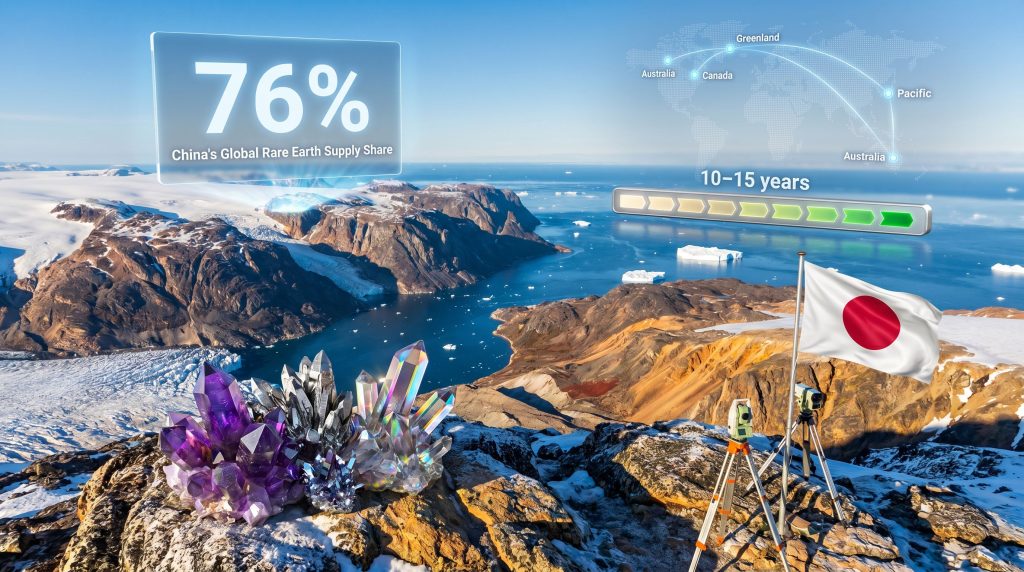
China controls approximately 76% of global rare earth supply, a figure that encompasses not just mining output but the far more strategically critical stages of separation, refining, and alloy production. This distinction matters enormously. A country can possess vast rare earth deposits in the ground and still remain functionally dependent on Chinese processing infrastructure to convert ore into usable material.
The situation differs fundamentally from historical oil dependency in one key structural dimension: oil refining capacity is geographically distributed across dozens of nations, and alternative suppliers can be accessed within weeks. Rare earth separation and processing, by contrast, requires highly specialised chemical engineering infrastructure that took China three decades and substantial state investment to build. Replicating even a fraction of that capacity in a new jurisdiction requires a minimum of 10 to 15 years.
Recent tightening of Chinese rare earth export restrictions, including measures specifically affecting categories of processed materials flowing toward Japan, has sharpened the urgency considerably. Japan, as a technology manufacturing powerhouse with intensive demand for rare earth-dependent components — including electric vehicle motors, wind turbine generators, and advanced defence electronics — sits near the top of the list of nations most exposed to Chinese supply leverage. Furthermore, understanding rare earth supply chains is increasingly essential for policymakers navigating this landscape.
"The real vulnerability is not at the mine mouth. It sits inside the refinery, the separation plant, and the alloy production facility, where physical ore is converted into the functional inputs that advanced manufacturing actually requires."
What Greenland Actually Holds Underground
Greenland's geological profile is one of the more compelling undeveloped rare earth stories on the planet, and not simply because of deposit size. The island's southern regions host formations with notable concentrations of heavy rare earth elements (HREEs), a subcategory of REEs that is disproportionately scarce outside of China and strategically more critical per unit of mass than the more widely distributed light rare earths. Consequently, Greenland critical minerals have attracted growing attention from allied nations seeking supply alternatives.
Why Heavy Rare Earths Matter More Than Volume Figures Suggest
The distinction between light and heavy rare earth elements is poorly understood outside specialist circles but has significant implications for supply strategy. Light rare earths such as cerium and lanthanum exist in reasonable concentrations across multiple global deposits. Heavy rare earths, including dysprosium and terbium, are concentrated in far fewer geological settings, and their functional roles are difficult or impossible to substitute.
- Dysprosium is added to neodymium-iron-boron (NdFeB) permanent magnets to maintain performance at high operating temperatures, a critical requirement in EV motors and wind turbine generators
- Terbium enables the high-efficiency green phosphors used in solid-state lighting and contributes to magnet performance alongside dysprosium
- Neodymium and praseodymium, often processed together as a mixed product called NdPr oxide, form the magnetic backbone of the permanent magnet industry
| Rare Earth Element | Primary Application | Supply Criticality | Primary Producer |
|---|---|---|---|
| Neodymium | EV motors, wind turbines | Very High | China (~85%) |
| Dysprosium | High-temp permanent magnets | Critical | China (~99%) |
| Terbium | Solid-state lighting, magnets | Critical | China (~99%) |
| Praseodymium | Aerospace alloys, magnets | High | China (~80%) |
Greenland's heavy rare earth profile is therefore not a generic resource story. The deposits with the highest strategic relevance are those containing meaningful concentrations of dysprosium and terbium, precisely the elements where Chinese market control approaches near-totality.
An additional geological factor that is rarely discussed in mainstream coverage involves the progressive exposure of previously glaciated mineral zones. As ice coverage retreats, geological survey access expands, and early evidence suggests that some of the most prospective HREE-bearing formations in Greenland's south may have been partially obscured under ice until relatively recently. This makes resource estimation an evolving exercise rather than a settled figure.
The Delegation's Composition and What It Signals
The planned mission includes representatives from Japan's Ministry of Economy, Trade and Industry (METI), major Japanese trading companies, and the Japan Organization for Metals and Energy Security (JOGMEC). Each of these institutional actors carries a distinct mandate that together signals more than a diplomatic courtesy visit. According to reporting from Japan Today, the mission reflects a formal elevation of rare earth security within Japan's national industrial policy.
METI drives Japan's industrial and energy policy framework, meaning its direct participation indicates that rare earth security has been formally elevated to a national industrial policy priority. Trading companies bring commercial evaluation expertise and the balance sheets to underwrite early-stage feasibility risk. JOGMEC's role is particularly significant because it functions as the institutional mechanism through which Japan de-risks exploration and development partnerships.
Planned discussions with Greenlandic local government officials reflect the autonomous territory's increasingly assertive posture in shaping its own resource development trajectory. Greenland retains control over subsoil rights and resource licensing under its self-governance framework, meaning any meaningful extraction pathway must secure genuine buy-in from Nuuk's institutions. In addition, Greenland mining politics have grown increasingly complex, adding another layer of consideration for delegations seeking long-term commitments.
The Regulatory Architecture: A Two-Layer Approval System
Foreign investors and government delegations engaging with Greenland's resource sector must navigate a governance structure that is less straightforward than it appears. As an autonomous territory within the Kingdom of Denmark, Greenland controls its own mineral licensing through the Bureau of Minerals and Petroleum (BMP). However, certain aspects of foreign policy and defence remain under Danish jurisdiction, creating a dual-layer approval dynamic that has historically complicated the pace of foreign investment decisions.
Politically, Greenland's domestic discourse around mining is genuinely contested. Segments of the population and political establishment prioritise environmental sovereignty and the pace of development above economic maximisation, a consideration that has materially affected the timeline of several prospective projects in recent years. Investors and governments treating Greenland purely as an untapped resource frontier tend to underestimate how much this internal political dimension shapes what actually advances.
Skepticism Is Warranted: The Delegation Track Record
Japan has dispatched multiple delegations to Greenland over a period of several years. The honest assessment of that track record is that binding extraction agreements have not materialised at the pace that the volume of diplomatic activity might suggest. This gap between engagement frequency and contractual outcomes invites a legitimate analytical question: does repeated delegation activity represent genuine convergence toward commercial agreements, or does it primarily function as visible signalling of strategic intent?
The case for genuine intent rests on the following:
- JOGMEC's institutional mandate is explicitly oriented toward securing long-term supply through investment, not just diplomatic relationship management
- The bilateral US-Japan critical minerals framework agreement creates a coordinated Western architecture that changes the incentive structure for both Japan and Greenland
- Chinese export restrictions have materially worsened Japan's supply position since earlier delegation cycles, increasing the commercial imperative to convert diplomacy into binding commitments
The skeptical case, however, is grounded in structural reality. Arctic mining operations carry capital cost premiums that are extreme by global standards. Environmental impact assessments in Arctic ecosystems are among the most rigorous on earth, frequently extending timelines by years. Furthermore, without nearby rare earth processing infrastructure, any material extracted in Greenland would need to travel to existing refineries — the majority of which are currently located inside China — recreating the very dependency the exercise is designed to escape.
The Processing Gap: Mining Without Refining Solves Only Half the Problem
This is perhaps the least understood dimension of the Greenland rare earth story among non-specialist audiences. Securing extraction rights to a deposit does not translate directly into supply security if the downstream processing corridor remains controlled by an adversarial or unreliable actor.
The rare earth value chain can be broken into discrete stages:
- Geological exploration and resource definition — establishing what exists and where
- Mining and ore extraction — physically removing material from the ground
- Ore cracking and initial processing — breaking down mineral matrices to release REE content
- Solvent extraction and separation — isolating individual rare earth elements from mixed concentrates
- Oxide and metal production — producing the functional forms required by manufacturers
- Alloy and magnet manufacturing — converting metals into components for end-use industries
The vast majority of the value, and the vast majority of the geopolitical leverage, sits in stages three through five. These are the stages where Chinese dominance is most entrenched and where Western capacity gaps are most severe. The US, Australia, and Canada are all working to develop separation and processing infrastructure, but operational timelines remain measured in years, not months.
"Building a mine without a sovereign processing corridor is like building a refinery without a pipeline. The physical asset exists, but the system remains broken."
The next major ASX story will hit our subscribers first
Japan's Broader Diversification Strategy: Greenland as One Node in a Larger Architecture
Understanding the Japan delegation to Greenland rare earth extraction mission requires placing it within Japan's multi-vector resource security strategy, which has evolved considerably over the past decade from crisis-reactive diplomacy toward a more deliberate portfolio approach.
Active or prospective Japanese rare earth partnerships now span Canada, Australia, Kazakhstan, India, and Greenland, reflecting a conscious effort to distribute supply exposure across geographies, political systems, and geological profiles. No single alternative source is expected to replace Chinese supply in volume terms. The strategy instead targets sufficient diversification to reduce the leverage any single supplier can apply. The broader surge in critical minerals demand is also accelerating the urgency behind this diversification push.
Japan has also invested heavily in research into deep-sea polymetallic nodules and rare earth-rich mud deposits within its exclusive economic zone in the Pacific. These deposits contain concentrations of heavy rare earth elements that could eventually be commercially significant. The US-Japan critical minerals framework explicitly includes potential cooperation on Pacific deep-sea extraction, signalling that Greenland sits alongside — rather than above — other elements of a broader supply architecture.
| Country | Primary REE Strategy | Key Partner Regions |
|---|---|---|
| Japan | JOGMEC bilateral partnerships + deep-sea R&D | Australia, Canada, Greenland, Pacific |
| United States | Domestic revival + allied partnerships | Canada, Australia, Africa |
| European Union | Critical Raw Materials Act + African partnerships | Africa, Canada, Greenland |
| South Korea | State-backed offtake agreements | Australia, Africa, Central Asia |
Realistic Timelines: What Development Actually Looks Like
One of the most important analytical corrections needed in public discussion of the Greenland opportunity concerns timeline realism. The distance between a delegation visit and commercial rare earth production is measured in decades, not years.
| Development Phase | Estimated Duration | Key Requirements |
|---|---|---|
| Feasibility and geological assessment | 2 to 3 years | Resource confirmation, environmental baseline surveys |
| Environmental impact assessment | 2 to 4 years | Regulatory approvals, community consultation processes |
| Infrastructure development | 3 to 5 years | Port construction, power systems, processing facilities |
| First commercial production | 10 to 15 years from initial assessment | Full operational ramp-up, logistics network establishment |
These timelines are not pessimistic projections but reflect the actual experience of comparable remote and Arctic-region mining projects globally. Investors and policymakers who treat a delegation announcement as a near-term supply catalyst are likely misreading the signal.
The strategic value of Japanese engagement in Greenland is therefore better understood as optionality creation and deterrence rather than near-term production planning. Establishing a credible presence, building institutional relationships, and advancing geological understanding collectively raise the probability of Greenland becoming a meaningful REE contributor over a 15 to 20 year horizon.
Geopolitical Complexity: Greenland at the Intersection of Multiple Power Interests
The Arctic island's strategic significance extends well beyond its rare earth geology. Its geographic position provides proximity to polar shipping routes that are progressively becoming navigable as Arctic ice retreats, offering potential advantages for both commercial logistics and military positioning. Multiple major powers have demonstrated active interest in expanding their influence over Greenland's future, adding a multilateral diplomatic dimension that complicates bilateral resource negotiations.
NATO allies in Europe have responded with concern to any unilateral moves that could alter Greenland's political status or resource access framework. This sensitivity creates an environment where Japan's engagement — framed within the allied US-Japan critical minerals partnership — may actually be viewed more favourably by Greenlandic and European stakeholders than purely bilateral Japanese approaches. Indeed, Australia's expanding cooperation on critical minerals with Japan similarly reflects how allied coordination lends legitimacy to shared resource security objectives.
The US-Japan critical minerals framework could therefore function as a legitimising architecture for the Japan delegation to Greenland rare earth extraction ambitions, providing political cover and potential joint venture structures that improve the probability of tangible outcomes beyond what Japan could achieve acting alone.
Long-Term Market Implications: Optionality Over Immediacy
Near-term rare earth market pricing is unlikely to respond materially to a delegation announcement given the multi-decade development timelines involved. However, the accumulation of sustained Western diplomatic and commercial engagement with Greenland does carry structural market implications that extend across a longer horizon.
A credible Western rare earth supply corridor, even one that delivers only a fraction of Chinese production volumes, would meaningfully constrain Beijing's ability to deploy export restrictions as geopolitical leverage. The deterrent value of supply diversification operates independently of actual production volume, because the credible threat of substitution reduces the coercive utility of restriction threats.
Over a 10 to 20 year horizon, if multiple allied nations establish extraction and processing footholds across Greenland, North America, and Australia simultaneously, the cumulative effect on Chinese rare earth pricing power could be substantial. This holds true not because any single project displaces Chinese supply, but because the collective architecture reduces the dependency that makes leverage possible in the first place.
Disclaimer: This article is intended for informational and educational purposes only. It does not constitute financial or investment advice. Forecasts, timelines, and market projections discussed herein involve inherent uncertainty and should not be relied upon as the basis for investment decisions. Readers are encouraged to conduct independent research and consult qualified financial advisers before making any investment decisions related to mining, critical minerals, or related sectors.
Want to Stay Ahead of the Next Major Mineral Discovery on the ASX?
Discovery Alert's proprietary Discovery IQ model scans ASX announcements in real time, delivering instant alerts on significant mineral discoveries — including critical minerals and rare earths — so subscribers can identify actionable opportunities before the broader market reacts. Explore how major discoveries have generated substantial returns and begin your 14-day free trial at Discovery Alert to position yourself ahead of the market.