May 21, 2026
The Hidden Resource War Reshaping Asia's Most Carbon-Intensive Industry
The global steel industry consumes more energy and produces more industrial carbon dioxide than almost any other manufacturing sector on earth. Yet within this heavyweight industry, a quiet but profound reordering is underway, and it is being driven not by a new ore discovery or a breakthrough smelting technology, but by something most people walk past every day: old steel. In Japan, the economics and politics of ferrous scrap have converged to create one of the most consequential raw material transitions in modern industrial history.
Understanding why Japan steel scrap decarbonization has become a national industrial priority requires looking beyond simple recycling narratives. This is a story about carbon obligations, supply chain sovereignty, capital reallocation at scale, and the uncomfortable reality that cleaner steelmaking depends heavily on a feedstock that is simultaneously being exported at record volumes.
When big ASX news breaks, our subscribers know first
From Byproduct to Strategic Resource: Why Scrap Now Matters
For most of the postwar industrial era, ferrous scrap occupied a secondary position in Japan's steelmaking hierarchy. Blast furnace operations running on coking coal and iron ore dominated, and scrap was largely a residual input processed by smaller electric arc furnace (EAF) producers making construction-grade long products. That hierarchy is now being dismantled.
The carbon arithmetic is unambiguous. Blast furnace-basic oxygen furnace (BF-BOF) steelmaking is among the most emissions-intensive industrial processes in existence, generating approximately 1.8 to 2.0 tonnes of CO₂ per tonne of steel produced. EAF steelmaking, drawing primarily on ferrous scrap and electricity, cuts that figure dramatically, with the World Steel Association estimating that the average EAF route uses approximately 70% ferrous scrap as its primary metallic input.
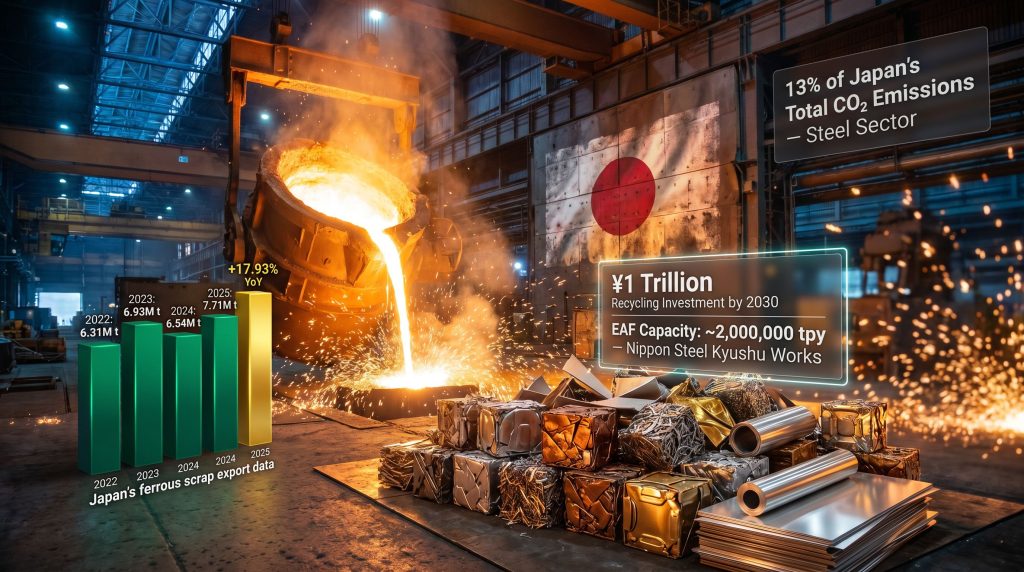
The implications for scrap demand are enormous. Japan's steel sector accounts for roughly 13% of the country's total CO₂ emissions, making it one of the highest-priority targets in the national decarbonisation agenda. Furthermore, shifting meaningful capacity from blast furnace routes to EAF production does not just require investment in new furnaces — it requires a reliable, high-quality, traceable supply of ferrous scrap at volumes Japan has never needed to secure domestically before.
Capital at Scale: Nippon Steel's EAF Transformation
No single development better illustrates the scale of Japan's EAF transition than Nippon Steel's simultaneous commitment to three major electric arc furnace projects across its domestic facility network.
| Facility | EAF Capacity | Investment | Production Start |
|---|---|---|---|
| Kyushu Works | ~2,000,000 tpy | ¥630.2 billion | H2 FY2029 |
| Setouchi Works | ~500,000 tpy | ~¥140 billion | H2 FY2029 |
| Yamaguchi Works | ~400,000 tpy | ¥98.5 billion | H2 FY2028 |
Combined, these three facilities represent a total capital commitment exceeding ¥868 billion, and at full utilisation with the 70% scrap input ratio referenced by the World Steel Association, they would collectively require approximately 2 million tonnes of ferrous scrap per year. The Kyushu Works project is particularly notable: Nippon Steel has positioned it as the world's first large-scale integrated system combining a high-capacity EAF with secondary refining and continuous casting, specifically designed for mass production of high-quality flat-rolled steel grades.
Tokyo Steel, Japan's largest EAF producer, has separately targeted a doubling of its capacity toward 6 million tonnes per year by 2030, further compounding the domestic demand trajectory. Taken together, these commitments signal that EAF steelmaking in Japan is no longer a niche or transitional strategy. It is becoming the dominant production model.
Why Scrap Grade and Traceability Are the Real Bottleneck
Does Scrap Quality Actually Limit Green Steel Ambitions?
A critical but underappreciated dimension of Japan's scrap challenge is that not all ferrous scrap is usable for advanced steel production. Standard construction scrap or mixed demolition material contains residual elements including copper, tin, and nickel that cannot be removed through conventional EAF processing. When present above threshold concentrations, these tramp elements degrade the mechanical properties of finished steel, making it unsuitable for demanding applications such as automotive body panels or electric vehicle structural components.
Producing high-specification flat-rolled steel in an EAF requires low-residual, high-purity scrap grades, typically sourced from industrial off-cuts, automotive shredder material with careful pre-sorting, or purpose-collected obsolete steel from controlled dismantling operations. Japan's government has specifically targeted the development of 2 million tonnes per year of capacity to upgrade domestic ferrous scrap to these higher-grade specifications.
This is precisely where the partnership between Mitsui and Co and Ibokin Co becomes strategically relevant. Ibokin's integrated demolition and recycling model, operating from its Hyogo Prefecture base, provides upstream control over material recovery, sorting, and quality verification. Mitsui contributes global distribution capability and metals value chain expertise. The partnership is focused on building the kind of traceable, verified scrap supply chain that EAF operators producing certified green steel pricing products will increasingly require.
Market participants have described partnerships of this type as foundational infrastructure for long-term supply chain development, with limited immediate effect on market pricing but significant structural intent for the decade ahead.
As green steel certification frameworks mature globally, demonstrating the origin, processing history, and residual content of scrap inputs is becoming commercially valuable rather than just operationally convenient. Traceability is evolving from a quality assurance tool into a commercial differentiator.
Japan's Supply-Demand Paradox: Exporting While Running Short
Perhaps the most striking tension in Japan's current scrap market is the simultaneous rise of export volumes alongside mounting evidence of future domestic supply constraints. Japan's ferrous scrap exports have climbed consistently, reaching 7.71 million tonnes in 2025, a year-on-year increase of nearly 18% from 6.54 million tonnes in 2024 and well above the 6.31 million tonnes recorded in 2022.
| Year | Ferrous Scrap Exports (million tonnes) |
|---|---|
| 2022 | 6.31 |
| 2023 | 6.93 |
| 2024 | 6.54 |
| 2025 | 7.71 |
The 2025 surge was driven primarily by intensifying import demand from Vietnam and Bangladesh, two of Asia's fastest-growing steel and iron ore market economies. Yet this export growth occurred against a backdrop of declining domestic steel output. Japan produced 80.7 million tonnes of steel in 2025, down 4% year on year, extending a structural decline that has persisted for five consecutive years. Lower crude steel production means less home scrap and prompt scrap being generated within mills, progressively tightening the available domestic pool.
Structural forecasts suggest domestic demand for ferrous scrap will exceed domestic supply by approximately 1.2 million tonnes by 2030 and potentially 2 million tonnes by 2050 as EAF capacity additions accelerate and industrial scrap generation continues to decline. Japan already operates one of the world's most efficient ferrous scrap recovery systems, meaning the scope for step-change improvements in collection rates is limited without sustained investment in new processing infrastructure.
One frequently overlooked metric in this context is Japan's obsolete scrap recovery rate, estimated at approximately 1.7%. This figure, representing the proportion of end-of-life steel products successfully recovered and returned to the supply chain in any given year, suggests meaningful headroom for improvement. However, realising that potential requires time, capital, and collection infrastructure that does not yet exist at the required scale.
The Policy Framework Driving Scrap Market Transformation
How Is Japan's Government Shaping the Transition?
Japan's industrial policy architecture around Japan steel scrap decarbonization is multidimensional. The Ministry of Economy, Trade and Industry's Green Transformation (GX) 2040 Vision frames low-carbon steel production as a strategic industrial competitiveness priority, not merely an environmental compliance exercise. The framework encompasses four parallel pathways:
- BF-to-EAF conversion using ferrous scrap as the primary metallic input
- Hydrogen iron reduction combined with EAF processing
- Hydrogen injection into blast furnaces as a bridging technology alongside carbon capture
- Green steel public procurement mandates to create demand-side pull for certified low-carbon products
Complementing this, the Japanese government has committed to mobilising ¥1 trillion (approximately $6.3 billion) in combined public and private capital by 2030 to expand domestic recycling infrastructure, including the 2-million-tonne annual high-grade scrap upgrading target. The decarbonisation economics of this investment are increasingly compelling as carbon obligations tighten.
The Japan Iron and Steel Federation has separately set a formal target to increase domestic scrap circulation by approximately 6.9 million tonnes by 2030, one of the most concrete supply-side commitments in Japan's decarbonisation planning.
A less-discussed but potentially market-moving policy dimension involves export controls. Japan's Ministry of the Environment has been actively exploring regulatory measures to limit the outflow of recyclable metals, including ferrous scrap. The legal framework remains incomplete, and the eventual scope is uncertain. However, if restrictions are implemented, the effects on regional scrap markets in Southeast Asia could be material, given Japan's central role as a supplier to Vietnamese and Bangladeshi steelmakers.
The next major ASX story will hit our subscribers first
Scrap Prices, Cost Headwinds, and the Electricity Question
Japan's ferrous scrap market has experienced notable price escalation through 2025, creating direct cost pressure for mills pursuing EAF conversion.
| Grade | January 7 Price (¥/tonne) | April 22 Price (¥/tonne) | Movement |
|---|---|---|---|
| H2 Export, FOB Main Port Japan | ¥44,000–44,500 | ¥54,000–55,000 | +¥10,000 |
| Shindachi Bara Export, FOB Main Port Japan | ¥48,500–49,500 | ¥58,000–59,500 | +¥9,500–10,000 |
The factors driving these increases include firm domestic demand from mills planning EAF transitions, geopolitical disruptions affecting regional supply chains, and competitive pressure from Southeast Asian import demand competing directly with domestic buyers. In addition, the US ferrous scrap outlook suggests that global scrap competition is intensifying beyond Asia alone.
A ¥10,000 per tonne increase in scrap input costs translates directly into higher EAF operating expenses, compressing the economic advantage of scrap-based steelmaking relative to blast furnace production in the near term. This creates a paradox: the raw material most critical to decarbonisation is becoming more expensive precisely because decarbonisation demand for it is rising.
Beyond scrap pricing, analysts have identified electricity cost as potentially the more fundamental long-term constraint on Japan's EAF pathway. EAF steelmaking is energy-intensive, consuming approximately 350 to 400 kilowatt-hours per tonne of steel produced. Japan's electricity grid remains significantly reliant on fossil fuel generation, meaning EAF output today is not inherently zero-carbon. The full decarbonisation case for Japan steel scrap decarbonization consequently depends on a credible pathway to affordable, low-carbon power — a challenge that the country's energy transition modelling has not yet fully resolved.
Three Scenarios for Japan's Scrap Market Through 2030
Disclaimer: The following scenarios represent analytical projections based on current trends and publicly available data. They are not financial forecasts and should not be treated as investment advice.
Scenario 1: Managed Transition. EAF investments proceed broadly on schedule, domestic scrap circulation increases in line with the JISF's 6.9-million-tonne target, and export volumes gradually taper as domestic demand absorbs available supply. Scrap prices stabilise at elevated but manageable levels. Japan remains a net exporter but by diminishing margins.
Scenario 2: Supply Crunch. EAF capacity additions outpace domestic scrap supply growth, export restriction policies are implemented, and Japan becomes a net scrap importer before 2030. International ferrous scrap prices rise as Japanese mill demand enters global markets, with direct consequences for Turkish, US, and European scrap pricing.
Scenario 3: Delayed Transition. Elevated scrap prices and electricity costs slow EAF investment timelines. Blast furnace operations are extended beyond planned closure dates, and Japan's decarbonisation targets are pushed toward 2035–2040. Export volumes remain elevated, providing supply continuity for Southeast Asian markets but delaying Japan's emissions reduction trajectory.
Japan in Global Context: How Does Its Strategy Compare?
| Dimension | Japan | Europe | China |
|---|---|---|---|
| Primary Strategy | BF-to-EAF conversion + hydrogen injection | Green hydrogen DRI + EAF | Incremental BF efficiency + selective EAF |
| Key Constraint | Scrap quality, supply, electricity cost | Hydrogen cost, infrastructure | Policy ambiguity, scale of BF fleet |
| Policy Mechanism | GX 2040 Vision, green procurement | EU ETS carbon pricing, CBAM | National carbon market, production caps |
| Major Transitions | 2028–2035 | 2027–2035 | 2030–2060 |
| Scrap Role | Increasing rapidly | High and growing | Moderate, constrained |
Japan ranked as the world's fourth-largest steel producer in 2025, behind China, India, and the United States. India's overtaking of Japan as the world's second-largest steel producer in 2018 marked a permanent shift in global steel demand geography. Japan's decline in absolute output since then reflects structural demographic contraction and shifting domestic construction cycles rather than competitiveness erosion. Notably, scrap supply constraints are increasingly recognised as a structural risk to the pace of Japan's overall transition.
The Strategic Outlook: Scrap as Japan's Industrial Decarbonisation Asset
The convergence of EAF investment commitments totalling over ¥868 billion from Nippon Steel alone, government recycling infrastructure pledges, formal JISF supply circulation targets, and rising scrap export volumes has created a set of conditions that have not previously coexisted in Japan's industrial landscape.
Key structural conclusions for market participants include:
- Domestic scrap demand is structurally set to rise, with supply constraints emerging as early as 2030 under accelerated EAF adoption scenarios
- Scrap quality and traceability are becoming competitive differentiators, not just operational requirements, as green steel certification frameworks develop
- The export-restriction policy risk is real and directionally clear, even if the legal architecture remains incomplete
- Rising scrap prices are creating near-term cost headwinds for EAF operators while simultaneously incentivising investment in collection and upgrading infrastructure
- Japan's potential transition from net scrap exporter to net importer would fundamentally reshape regional scrap market dynamics across Vietnam, Bangladesh, and other Southeast Asian consuming nations
Ferrous scrap is no longer a peripheral recycling question in Japan's industrial economy. It sits at the intersection of Japan steel scrap decarbonization strategy, resource security policy, capital allocation decisions worth hundreds of billions of yen, and regional commodity market dynamics that extend well beyond Japanese borders. How Japan manages the gap between its scrap ambitions and its scrap realities over the next decade will be one of the defining industrial stories of Asia's green transition.
Want to Stay Ahead of the Next Major Mineral Discovery Driving the Green Steel Transition?
As demand for low-carbon metals and critical minerals intensifies alongside Japan's multi-billion-yen EAF transformation, Discovery Alert's proprietary Discovery IQ model delivers real-time alerts on significant ASX mineral discoveries — instantly translating complex data into actionable investment opportunities. Explore historic discoveries and their market returns, then begin your 14-day free trial to position yourself ahead of the broader market.