May 21, 2026
When Diplomacy Moves Markets: Understanding Oil's Geopolitical Sensitivity
Energy markets occupy a unique psychological space among global asset classes. Unlike equities or bonds, crude oil prices respond not just to supply and demand fundamentals, but to the perceived probability of supply disruption, sometimes weeks or months before any physical shortage materialises. This forward-looking anxiety is precisely what makes geopolitical flashpoints so powerful in shaping benchmark prices.
The events of May 19, 2026 demonstrated this dynamic with unusual clarity. US delays Iran attack oil prices fell from multi-week highs when news emerged that a scheduled US military strike against Iran had been postponed in favour of diplomatic engagement. The moves reflected a partial unwinding of the risk premium that had accumulated during the preceding escalation period.
When big ASX news breaks, our subscribers know first
The Mechanics of a Risk Premium: How Conflict Probability Moves Crude
To understand why US delays on Iran attack oil prices matter so significantly, it helps to understand how energy traders actually incorporate geopolitical uncertainty into their pricing models. Furthermore, examining these mechanics reveals just how sensitive crude benchmarks are to even temporary diplomatic signals.
Futures markets are fundamentally probability-weighted instruments. When traders assess an elevated likelihood of supply disruption, they bid prices above fundamental levels to compensate for the expected loss of physical availability. This excess pricing above the supply-demand equilibrium is what analysts call the geopolitical risk premium. This dynamic also connects closely to the broader trade war oil impact on global energy benchmarks.
In the days leading up to May 19, Brent crude climbed to its highest level since May 5, while the front-month WTI contract reached its strongest point since April 30. These multi-week highs were not driven by new physical supply data. They were driven by the compounding probability that military action against Iran could further disrupt, or permanently sever, supply routes through the Strait of Hormuz.
The four-stage transmission mechanism that typically governs these cycles operates as follows:
- Threat escalation phase – military posturing and credible conflict signals drive speculative buying, inflating risk premiums across all major crude benchmarks.
- Peak anxiety pricing – benchmarks reach multi-week or multi-month highs as market participants assign maximum probability to conflict scenarios.
- De-escalation signal – diplomatic announcements, delays, or negotiation frameworks trigger profit-taking and partial risk premium unwinding.
- Residual uncertainty floor – prices stabilise above pre-conflict baselines because the physical supply disruption remains unresolved even as the diplomatic environment improves.
This fourth stage is critically important. Monday's price retreat was real, but incomplete. Markets did not price in a resolution, only a deferral.
Benchmark Snapshot: Where Crude Prices Stood on May 19
The precise moves across the three major crude reference points provide a quantitative picture of how the diplomatic signal translated into market action.
| Benchmark | Contract Month | Price | Change | % Move |
|---|---|---|---|---|
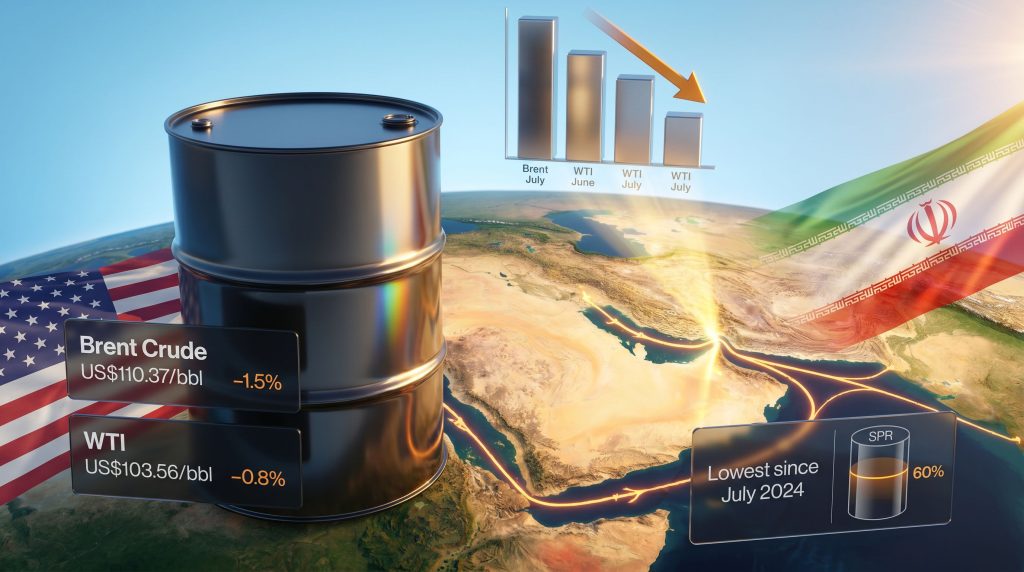
| Brent Crude | July delivery | US$110.37/bbl | -US$1.73 | -1.5% |
| WTI (expiring) | June delivery | US$108.03/bbl | -US$0.63 | -0.6% |
| WTI (active) | July delivery | US$103.56/bbl | -US$0.82 | -0.8% |
Despite the pullback, all three contracts remained at historically elevated levels, a clear signal that the market's assessment of structural supply risk had not fundamentally changed. De-escalation reduced anxiety; it did not eliminate the underlying supply problem.
One technical nuance worth noting: the June WTI contract was expiring on May 19, which creates a mechanical distortion in price signals. During contract rollover periods, the front-month price can diverge significantly from the active trading position due to the mechanical compression of time value. Consequently, the July WTI contract at US$103.56/bbl is the more meaningful forward indicator for analysts assessing where crude is actually headed.
How Does This Compare to Previous Oil Price Shocks?
The scale of these moves becomes clearer when placed in historical context. Similar oil price shock events have repeatedly demonstrated that geopolitical risk premiums can inflate benchmarks by 10% to 25% above fundamental levels during peak anxiety periods. The current episode follows that established pattern.
The Strait of Hormuz: Why One Waterway Commands a Global Premium
No analysis of US-Iran tensions and their impact on crude pricing is complete without examining the physical geography that makes this conflict so consequential for energy markets.
The Strait of Hormuz is a narrow maritime passage, approximately 33 kilometres wide at its narrowest navigable point, separating Iran from the Arabian Peninsula. Through this single corridor passes roughly 20% of the world's combined oil and liquefied natural gas supply, making it arguably the single most strategically significant waterway in the global energy system.
The ongoing conflict has resulted in the closure of the Strait, and the International Energy Agency has characterised the resulting supply disruption as one of the most severe in the modern history of global oil markets. The cascading effects of this blockage extend well beyond immediate crude pricing:
- Asian importers, including Japan, South Korea, India, and China, face acute pressure to secure alternative supply volumes at elevated spot prices.
- European refiners are competing for the same diverted Atlantic Basin and West African barrels, driving regional premiums higher.
- Emerging market economies with limited foreign reserve buffers face the combined stress of higher import costs and weakening currencies against the US dollar.
A key insight often underappreciated in mainstream analysis is that the Hormuz chokepoint cannot be easily bypassed at scale. While Saudi Arabia maintains the East-West Pipeline (Petroline) with a capacity of approximately 5 million barrels per day, and the UAE operates the Abu Dhabi Crude Oil Pipeline (ADCOP) with around 1.5 million barrels per day of bypass capacity, total global Hormuz throughput has historically exceeded 17 to 20 million barrels per day. The bypass infrastructure covers a fraction of that volume, leaving the majority of dependent supply chains genuinely constrained.
Analysts broadly agree that a breakdown in US-Iran diplomatic negotiations could rapidly reverse any price declines, with Brent and WTI potentially surging well beyond current levels if military action resumes and the Strait closure becomes protracted.
Iran's Peace Proposal: What Was Actually Submitted
Iran transmitted a formal peace framework to Washington through state media channels. According to reporting from TRT World, the proposal contained three core demands:
- An immediate cessation of hostilities across all active conflict fronts, including Lebanon.
- The withdrawal of US military forces from proximity zones near Iranian territory.
- Financial compensation for damages sustained during the conflict period.
These terms reflect a maximalist opening position rather than a negotiated middle ground, which is standard diplomatic practice in high-stakes conflict resolution. The US response was conditional: President Trump disclosed via social media that the Tuesday strike had been postponed specifically to allow peace negotiations to continue, while simultaneously making clear that US military capability remained fully activated and ready to respond if talks produced no result.
This conditional diplomacy framework is precisely what prevents markets from pricing in a durable resolution. Until formal terms are established and verified, oil traders are effectively modelling a probability distribution across multiple outcomes rather than pricing for any single scenario. The oil price rally seen in preceding weeks reflects exactly this kind of escalating uncertainty being priced progressively into benchmarks.
The Strategic Petroleum Reserve: A Buffer Running Low
What Does the SPR Drawdown Mean for Policy?
One of the less-discussed but critically important dimensions of this crisis is the condition of America's emergency crude stockpile. Government data confirmed a drawdown of 9.9 million barrels from the Strategic Petroleum Reserve during the most recent reporting period, bringing the total stockpile to approximately 374 million barrels, the lowest level recorded since July 2024.
| Metric | Status |
|---|---|
| Recent SPR Drawdown | 9.9 million barrels |
| Current SPR Level | ~374 million barrels |
| Historical Comparison | Lowest since July 2024 |
| Policy Implication | Reduced emergency price intervention capacity |
A depleted SPR limits Washington's ability to suppress oil prices through emergency releases, a tool used effectively during previous supply crises including the 2022 release of 180 million barrels following the Russian invasion of Ukraine. This structural constraint amplifies the urgency of achieving a diplomatic resolution.
At its post-Second World War design capacity of around 714 million barrels, the SPR represented roughly 75 days of US import cover. At the current drawdown trajectory, that buffer has compressed substantially, reducing the policy toolkit available to the administration during a prolonged supply emergency.
The next major ASX story will hit our subscribers first
The Russian Oil Waiver: Sanctions Pragmatism Under Supply Stress
Simultaneously with the diplomatic developments in the US-Iran channel, US Treasury Secretary Scott Bessent extended a 30-day waiver permitting nations classified as energy-vulnerable to continue purchasing Russian seaborne crude oil without triggering sanctions enforcement.
The logic is straightforward: nations that ordinarily sourced Gulf oil transiting through Hormuz found themselves unable to access those volumes due to the blockage. Forcing those countries to simultaneously comply with Russian oil sanctions while their primary supply route was closed would have created acute energy crises across multiple economies, generating political pressure that Washington was not positioned to absorb.
This decision reflects a broader tension in US energy sanctions policy. Sanctions frameworks are designed to impose economic costs on adversaries, but their effectiveness depends on the availability of alternative supply. When physical supply constraints eliminate those alternatives, enforcement becomes politically untenable. The waiver extension is a pragmatic acknowledgment of this reality, not an abandonment of the broader sanctions architecture.
The countries most directly benefiting are those in South and Southeast Asia with heavy dependence on Middle Eastern crude, where the dual pressure of Hormuz closure and sanction compliance would have forced either severe economic pain or outright non-compliance. Live Mint's analysis of the Strait of Hormuz impact outlines precisely how exposed these import-dependent economies have become.
Scenario Analysis: Three Pathways for Crude Prices
With the situation remaining fluid, market participants are modelling a range of outcomes. The table below outlines the three primary scenarios and their likely directional impact on crude benchmarks, taking into account OPEC's market influence as an additional variable.
| Scenario | Trigger | Likely Price Direction |
|---|---|---|
| Diplomatic breakthrough | Formal US-Iran agreement, Hormuz reopens | Significant downside correction toward pre-conflict levels |
| Negotiation stalemate | Talks stall without resolution | Prices hold at structurally elevated levels |
| Military escalation resumes | Diplomatic breakdown, strikes proceed | Sharp upside spike, potential supply crisis pricing |
Gulf state diplomacy adds a further variable. Qatar, Saudi Arabia, and the UAE have each reportedly urged restraint and prioritised a negotiated pathway to resolution. These states face a genuinely complex calculus: elevated oil prices improve sovereign revenue and fiscal positions, but regional instability directly threatens infrastructure security and foreign direct investment flows.
Australia's Exposure and the $14.8 Billion Fuel Security Commitment
Is Australia Adequately Insulated From This Supply Shock?
From an Australian perspective, the Hormuz disruption is not an abstract geopolitical event. Australia imports a significant proportion of its refined liquid fuels from Middle Eastern refineries and producers, and the country's domestic refining capacity has been substantially reduced over the past decade. Furthermore, the broader analysis of crude oil geopolitics makes clear that Australia's exposure is both structural and ongoing.
The federal government's allocation of $14.8 billion for solid fuel security reflects a recognition that Australia's liquid fuel supply chain contains meaningful vulnerability to exactly this type of supply shock. Whether that investment proves sufficient will depend in part on how long the Strait of Hormuz remains closed and how quickly diplomatic resolution can be achieved.
The Hormuz crisis has effectively stress-tested Australia's fuel supply architecture in real time, revealing both the strategic rationale for domestic stockpiling investments and the limits of what any single nation can do to insulate itself from a disruption of this magnitude.
Frequently Asked Questions
Why Did Oil Prices Fall When the US Delayed Its Iran Strike?
The postponement reduced the immediate probability of further military escalation, triggering profit-taking among traders who had purchased crude as a hedge against supply disruption. Prices retreated because the risk premium component of the price fell, even though the physical supply disruption through Hormuz remained fully in place.
What Makes the Strait of Hormuz So Critical to Global Energy Pricing?
The Strait functions as the single exit point for the majority of Gulf producer crude exports. Approximately 20% of global oil and LNG supply transits this corridor, and the available overland bypass infrastructure can only substitute a fraction of that volume. Any closure creates an immediate and largely unavoidable physical shortage for dependent importers.
What Does a Depleted US Strategic Petroleum Reserve Mean for Markets?
At approximately 374 million barrels, the SPR is at its lowest level since July 2024 following a 9.9 million barrel drawdown. This reduces the US government's capacity to dampen price spikes through emergency releases, effectively removing one of the most powerful demand-side price management tools from Washington's near-term toolkit.
Could Oil Prices Spike Sharply if Diplomacy Fails?
Yes. With the Strait still closed, the SPR at reduced levels, and global importers already scrambling for alternative supply, any resumption of military action would likely trigger a rapid and significant upside move across all major crude benchmarks. The market has limited buffers against renewed escalation.
What Is the Russian Oil Sanctions Waiver and Why Was It Extended?
The 30-day waiver allows energy-vulnerable nations to continue purchasing Russian seaborne crude without sanctions penalties. It was extended because the Hormuz blockage left many of these countries unable to access their primary Gulf supply routes, and forcing simultaneous sanctions compliance under those conditions would have created acute economic crises in multiple nations.
This article contains forward-looking analysis and scenario modelling based on publicly available information as of May 19, 2026. Oil price forecasts and geopolitical outcome scenarios involve inherent uncertainty and should not be construed as financial advice. Readers should seek independent professional guidance before making investment decisions based on energy market conditions.
For ongoing coverage of global energy market developments, Middle East energy policy, and Australian fuel security, visit Petroleum Australia.
Want to Stay Ahead of the Next Major Resource Discovery Driven by Commodity Volatility?
When geopolitical shocks send energy and resource prices surging, the investors who act earliest on significant ASX mineral discoveries stand to gain the most — Discovery Alert's proprietary Discovery IQ model delivers real-time alerts the moment major discoveries are announced, turning complex commodity data into clear, actionable opportunities. Explore how historic mineral discoveries have generated substantial returns on Discovery Alert's dedicated discoveries page, and begin your 14-day free trial today to position yourself ahead of the broader market.