August 22, 2026
The Energy Equation That Uranium Alone Can Solve
The modern electricity grid is facing a stress test unlike anything seen since the post-war industrial boom. Demand is not merely growing — it is accelerating across multiple vectors simultaneously. Artificial intelligence data centres are consuming power at extraordinary rates, with some hyperscale facilities requiring as much electricity as a small city. Understanding John Borshoff uranium nuclear energy requires grasping this broader context first, because few figures have shaped this sector as profoundly or as consistently.
Electric vehicle fleets are expanding rapidly across Europe, North America, and Asia. Industrial electrification programmes are pulling manufacturing away from gas and diesel. Against this backdrop, the intermittent nature of wind and solar generation is no longer an abstract engineering problem — it is becoming a tangible constraint on economic growth.
This convergence of pressures has forced a fundamental reassessment of nuclear energy's role in the global power mix. For decades, nuclear occupied an uncomfortable political space — too associated with Cold War anxieties and high-profile accidents to attract mainstream policy enthusiasm. That narrative is shifting decisively, and the uranium market dynamics are beginning to price in a structural demand cycle that could extend well into the second half of this century.
Few individuals have spent longer preparing for this moment than John Borshoff — a figure whose career in uranium mining spans nearly five decades and multiple complete commodity cycles.
When big ASX news breaks, our subscribers know first
Why Nuclear Energy Cannot Be Ignored Any Longer
Baseload Power in a Renewables-Dominated World
The central tension in modern energy policy is the gap between decarbonisation ambition and grid reliability. Wind and solar have achieved remarkable cost reductions over the past fifteen years, but their output is inherently variable. A calm night provides no solar or wind generation regardless of demand levels.
Nuclear energy resolves this problem directly. Operating at capacity factors consistently between 90% and 93%, nuclear plants generate electricity around the clock, independent of weather conditions. This characteristic — known in the industry as firm baseload generation — makes nuclear uniquely valuable in grids that must balance intermittent renewables with guaranteed supply.
The energy density of uranium further distinguishes it from every other fuel source. A single uranium fuel pellet, roughly the size of a human fingertip, contains energy equivalent to approximately 17,000 cubic feet of natural gas or 1,780 pounds of coal. This extraordinary concentration of energy means that uranium mines produce enormous power output from comparatively modest volumes of extracted material — a critical advantage in an era of growing resource nationalism and supply chain fragility.
The Institutional Consensus Is Shifting
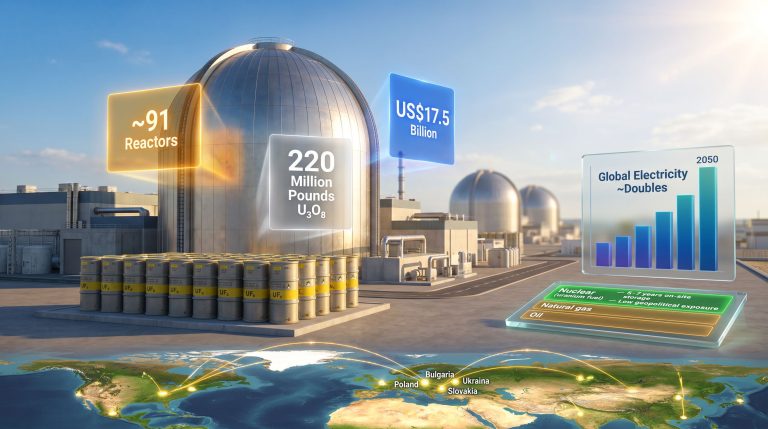
The repositioning of nuclear energy is no longer confined to the resource sector. Both the International Energy Agency and the World Nuclear Association have concluded that global nuclear capacity must roughly double by 2050 to align with credible net-zero emissions pathways. This is not a fringe projection — it represents the institutional consensus of the world's most credible energy analytical bodies.
Governments across the United States, France, Japan, South Korea, and several Central European nations have moved from nuclear phase-out policies toward active capacity extension and new-build programmes. The United Kingdom has committed to new large-scale nuclear construction for the first time in decades. This policy reversal creates a demand floor for uranium that is largely independent of short-term commodity price movements. Furthermore, current uranium market trends suggest this structural realignment is only beginning.
John Borshoff: The Man Who Never Stopped Believing in Uranium
A Career Built Across Multiple Market Cycles
John Borshoff's engagement with the uranium sector began in the 1970s, placing his career formation during the original nuclear energy buildout. He has since navigated the post-Three Mile Island contraction, the prolonged post-Chernobyl bear market, the extraordinary mid-2000s bull run, the post-Fukushima collapse, and the more recent price recovery — a sequence of cycles that would have driven most executives toward other commodities.
His persistence reflects a core analytical conviction rather than institutional inertia: uranium is chronically undervalued relative to its strategic importance to global electricity generation. Across every phase of the commodity cycle, Borshoff has maintained that the market systematically misprices uranium because most investors focus on current spot prices rather than the 10-to-15-year lead times required to bring new mine supply online.
This long-duration thinking is relatively rare in the resources sector, where quarterly earnings expectations and short-term price momentum tend to dominate capital allocation decisions. In numerous interviews and public appearances, Borshoff has emphasised that patience and structural conviction are the defining requirements for success in uranium investment.
Building Paladin Energy: From Junior Explorer to Global Producer
In 1993, Borshoff founded Paladin Energy, at a point when the uranium market was deeply depressed and institutional interest in the sector was minimal. The strategic insight behind Paladin's formation was that uranium's eventual return to favour — driven by the inescapable physics of nuclear power generation — would reward those who had positioned themselves in advance.
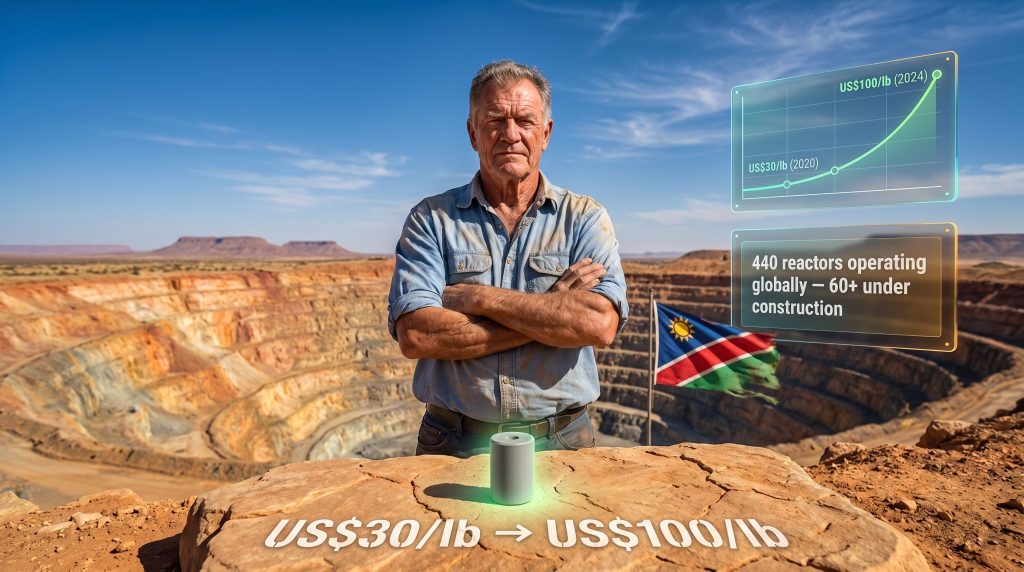
Under Borshoff's leadership, Paladin developed producing uranium assets in Namibia and Malawi, bringing African deposits into the global nuclear fuel supply chain at a time when most development capital was focused on established jurisdictions like Canada and Kazakhstan. The Langer Heinrich mine in Namibia and the Kayelekera uranium project in Malawi became operational during the mid-2000s uranium price surge, when spot prices climbed above US$130 per pound — a level that validated Borshoff's long-cycle thesis in dramatic fashion.
Paladin's development trajectory demonstrated that greenfield uranium projects in frontier African markets could be brought into commercial production by teams with sufficient technical competence and conviction — a proof of concept with direct relevance to the current supply gap debate.
What made Paladin's model particularly instructive was the challenge of operating in jurisdictions with limited existing mining infrastructure. Borshoff's teams had to solve problems of power supply, water management, and logistical complexity that would have deterred less committed operators. The institutional knowledge accumulated through those challenges now represents a genuine competitive advantage. However, Paladin's Namibian uranium mine has also illustrated how even well-established operations face ongoing operational and market pressures.
Leading Deep Yellow: Advancing Namibian Uranium Toward Development
Borshoff returned to executive leadership in 2016, taking the chief executive role at Deep Yellow Limited, an ASX-listed uranium developer focused on Namibia. During his tenure, Deep Yellow advanced its flagship Tumas uranium project through successive stages of resource definition and engineering assessment, positioning it as a credible future contributor to global uranium supply. Information on the full Deep Yellow board and management team provides further context on the leadership structure Borshoff helped build.
The Tumas project is notable for its calcrete-hosted uranium mineralisation — a deposit style that is geologically distinct from the hard-rock uranium systems that dominate Canadian production. Calcrete deposits typically present lower mining costs due to their near-surface, soft-rock character, though they require specific processing approaches. Borshoff's operational experience with this deposit type, developed across multiple Namibian projects, represents specialist knowledge that is not widely distributed across the industry.
Borshoff stepped down from Deep Yellow's chief executive role in late 2024, transitioning to an advisory capacity before completing his handover at the end of November that year.
The Supply-Demand Thesis That Has Defined Borshoff's Career
Understanding the Uranium Supply Gap
The concept of a uranium supply gap is central to Borshoff's analytical framework, but it is frequently misunderstood by generalist investors. The gap is not simply a question of whether existing mines can match current reactor demand — it is a forward-looking calculation that accounts for the cumulative fuel requirements of an expanding global reactor fleet over the next two to three decades.
The key variables in this calculation include:
- The number of reactors currently operating and their annual fuel consumption
- The pipeline of reactors under construction that will require fuel once commissioned
- The production capacity of existing uranium mines and their projected depletion profiles
- The volume of secondary supply (enrichment tails, government stockpiles) available to supplement primary mine production
- The lead time required to advance new greenfield projects from discovery to first production
When these variables are modelled over a 20-to-30-year horizon, a significant imbalance emerges. As of 2026, approximately 440 nuclear reactors are operating globally, with more than 60 additional reactors under active construction. The World Nuclear Association projects further expansion beyond these figures as countries pursue both new large-scale plants and emerging Small Modular Reactor programmes. Consequently, understanding uranium supply and demand has never been more critical for energy planners and investors alike.
Why Restart Projects Cannot Solve the Problem
An important distinction that Borshoff draws — and one that is often overlooked in mainstream uranium commentary — is the difference between mine restarts and genuine greenfield development.
Mine restarts involve reopening previously closed or idled operations. They offer faster timelines to production, sometimes as short as two to four years, and carry lower pre-production capital requirements because infrastructure already exists. However, restarts are bounded by the resource footprint of the original mine. They cannot expand global uranium supply beyond the deposits that were previously identified and partially depleted.
Greenfield uranium projects, by contrast, start from newly discovered or undeveloped resources. The timeline from initial discovery through exploration, resource definition, feasibility study, permitting, construction, and commissioning is typically 10 to 15 years or longer. The capital requirements are substantially higher, and the technical and execution risks are greater.
The practical implication is that decisions about greenfield uranium development made today will not translate into additional supply until the mid-to-late 2030s at the earliest. Any uranium mine that the world needs in 2035 should arguably already be in advanced development by 2026.
This temporal reality is what makes Borshoff's long-cycle perspective relevant. The market's tendency to focus on short-term price signals systematically underinvests in the long-duration development projects that are the only mechanism for sustainably closing the supply gap.
The Chronic Underfunding Problem
The decade following the Fukushima Daiichi accident in 2011 was catastrophic for uranium sector investment. Spot prices collapsed from above US$70 per pound to below US$20 per pound at the cycle's trough, and exploration and development budgets were slashed across the industry. Junior developers lost access to capital markets entirely. Several significant uranium projects were shelved indefinitely.
The consequence was a severe depletion of the development pipeline. Projects that would have been advancing through feasibility and permitting during the 2010s were instead mothballed, leaving a thin portfolio of near-production assets entering the current demand cycle. This pipeline deficit is structural — it cannot be corrected quickly regardless of uranium price levels, because the physical timelines of mine development are not compressible beyond certain limits.
Forsys Metals and the Next Phase of Borshoff's Namibian Strategy
Returning to the Corporate Arena
In June 2026, Borshoff accepted an executive leadership role at Forsys Metals, a TSX-listed uranium development company with assets in Namibia. The move is consistent with a career pattern of identifying underdeveloped uranium assets in Namibia and applying the technical and operational expertise needed to advance them toward production.
| Factor | Detail |
|---|---|
| Exchange Listing | TSX (Toronto Stock Exchange) |
| Primary Asset Location | Namibia |
| Development Stage | Uranium project development |
| Strategic Relevance | Potential greenfield uranium supply contributor |
| Borshoff's Role | Executive leadership (announced June 2026) |
| Key Borshoff Experience | Paladin Energy (Namibia), Deep Yellow (Tumas, Namibia) |
Namibia's Strategic Position in Global Uranium Supply
Namibia's emergence as a tier-one uranium jurisdiction is not accidental. The country hosts two of the world's largest operating uranium mines — Rössing (majority-owned by China National Uranium Corporation) and Husab (operated by Swakop Uranium, a Chinese-controlled entity) — as well as the Langer Heinrich mine previously developed under Borshoff's Paladin Energy.
Namibia ranks among the world's top five uranium-producing countries, and its geological endowment suggests significant additional resource potential remains to be developed. The country's comparative political stability within the African mining landscape, its established regulatory framework for uranium specifically, and its existing export infrastructure give it material advantages over other frontier uranium jurisdictions.
A factor that is less commonly appreciated outside specialist circles is the significance of Namibia's alaskite-hosted and calcrete-hosted uranium deposit styles. These deposit types are not typically pursued by Canadian or Kazakhstani operators. Borshoff's team-level expertise in Namibian deposit geology is genuinely specialised knowledge that has direct operational value.
The Concentration Risk That Makes Namibia More Valuable
The global uranium supply chain carries a concentration risk that rivals any other critical mineral. Kazakhstan's state-owned producer Kazatomprom accounts for approximately 45% of world uranium production — a dominance that creates significant systemic vulnerability. Kazakhstan's primary uranium export routes transit through Russia, adding a geopolitical dimension that Western utilities and governments have become increasingly uncomfortable with since 2022.
This supply chain exposure has prompted serious efforts to develop uranium production in geopolitically stable, non-Russian-aligned jurisdictions. Namibia, Canada, and Australia are the primary beneficiaries of this diversification imperative. The strategic value of Namibian uranium assets has therefore increased substantially independent of spot price movements — a structural tailwind that reinforces Borshoff's decision to concentrate his efforts there.
The Uranium Market in 2026: Where Prices and Sentiment Stand
A Price Recovery That Validates the Structural Case
Uranium spot prices spent most of the 2010s in a prolonged bear market, touching lows below US$18 per pound in late 2016. The recovery that followed was gradual until approximately 2023, when a combination of utility re-engagement with long-term contracting and reduced secondary supply availability drove prices sharply higher.
By early 2024, spot uranium had surged above US$100 per pound — the highest level in approximately 16 years. Prices subsequently moderated from those peaks, but the broader trend reflects a genuine shift in market fundamentals rather than speculative excess alone.
Key drivers behind the current price environment include:
- Utility buyers re-entering the long-term contract market after years of drawing down existing inventories
- Kazatomprom's production guidance reductions due to sulphuric acid supply constraints
- Growing institutional investor interest in uranium as a commodity with structural demand underpinning
- Conversion and enrichment capacity constraints that have amplified spot market price signals
- Reduced secondary supply availability as government stockpiles and enrichment tails inventories diminish
Small Modular Reactors: The Next Demand Wave
Beyond conventional reactor construction, the advancement of Small Modular Reactor technology represents an additional demand vector for uranium that was not material to previous market cycles. SMRs are compact nuclear generating units, typically rated at 300 megawatts or less, designed for faster factory-based construction and deployment in locations unsuitable for conventional large-scale plants.
Designs from developers including NuScale Power, Rolls-Royce, and GE Hitachi are advancing through regulatory processes in the United States, United Kingdom, and Canada. While commercial SMR deployment at scale remains a medium-term prospect, the incremental uranium demand that even a modest SMR buildout would generate is meaningful relative to the current supply pipeline.
*SMRs are not simply smaller versions of existing reactors — many designs use different fuel enrichment levels and fuel cycle configurations. Some advanced SMR concepts require high-assay low-enriched uranium (HALEU), a fuel type for which dedicated production capacity is only beginning to be established in Western countries.*
The next major ASX story will hit our subscribers first
Nuclear Energy as a Climate Tool: The Scientific Case
Lifecycle Emissions: The Numbers That Matter
One of the most persistent misconceptions about nuclear energy is that its carbon footprint — when construction, fuel processing, and decommissioning are included — is comparable to fossil fuels. The lifecycle analysis data does not support this position.
Over its full operating cycle, nuclear energy produces approximately 12 grams of CO₂ equivalent per kilowatt-hour — a figure that sits alongside offshore wind as one of the lowest of any electricity generation technology. This is roughly 40 times lower than natural gas combined cycle generation and approximately 70 to 85 times lower than coal.
| Energy Source | Lifecycle CO₂ (g/kWh) | Capacity Factor | Land Use Intensity |
|---|---|---|---|
| Nuclear | ~12 | 90-93% | Very Low |
| Offshore Wind | ~12-14 | 35-45% | Moderate |
| Utility Solar (PV) | ~20-50 | 15-25% | High |
| Natural Gas (CCGT) | ~490 | 50-60% | Low |
| Coal | ~820-1,050 | 50-70% | Moderate |
Sources: IPCC, World Nuclear Association, IEA lifecycle emissions assessments
Addressing the Waste and Safety Arguments
The waste management and safety concerns associated with nuclear power are legitimate subjects of public policy debate, and they deserve engagement rather than dismissal. However, several facts are frequently absent from public discourse on these topics.
On waste volumes: The total volume of high-level nuclear waste produced by all the world's reactors over six decades of commercial operation would, if consolidated, fit within a surprisingly modest physical footprint. The high energy density of uranium means that waste generation per unit of electricity produced is orders of magnitude lower than combustion-based generation.
On safety statistics: When electricity generation deaths are measured per terawatt-hour of output — including mining accidents, air pollution mortality, and operational incidents — nuclear energy consistently records among the lowest fatality rates of any energy source. The statistical record, while counterintuitive given the cultural weight of accidents like Chernobyl and Fukushima, places nuclear alongside wind and solar as a demonstrably safe technology at the population level.
On modern reactor design: Third and fourth-generation reactor designs incorporate passive safety systems that eliminate the operator-dependent failure modes associated with earlier accidents. The physics of these designs make core damage events substantially less probable than in first or second-generation plants.
Key Risks Investors and Analysts Should Monitor
What Could Disrupt the Uranium Bull Case
The structural case for uranium is compelling, but responsible analysis requires clear identification of the risks that could alter the trajectory.
Supply-side risks:
- A faster-than-expected ramp-up of Kazakhstani production capacity could temporarily soften spot markets
- New uranium discoveries or resource upgrades in established jurisdictions could expand the development pipeline more rapidly than anticipated
- Advances in uranium recycling and mixed-oxide fuel technology could reduce primary mine demand at the margin
Demand-side risks:
- Construction delays or cost overruns at planned reactor projects — a recurring challenge in the nuclear industry — could defer demand growth
- A major nuclear incident at any global facility would likely trigger political pressure on nuclear programmes, repeating the post-Fukushima demand destruction
- SMR deployment timelines have consistently slipped in early regulatory assessments, and further delays are possible
Financial and structural risks:
- The long capital cycle of uranium project development conflicts with institutional investor return horizons, limiting the pool of available development finance
- Permitting complexity in many Western jurisdictions adds time and cost uncertainty to project schedules
- Currency and sovereign risk in African and Central Asian uranium jurisdictions creates additional investment risk for equity holders
This article does not constitute financial advice. Statements regarding commodity markets, company strategies, and investment themes involve assumptions and forecasts that may not be realised. Readers should conduct independent due diligence before making any investment decisions.
Frequently Asked Questions About John Borshoff, Uranium, and Nuclear Energy
Who is John Borshoff?
John Borshoff uranium nuclear energy expertise spans close to 50 years of sector experience. He founded Paladin Energy in 1993, developing it into a major uranium producer with operations in Namibia and Malawi. He subsequently led Deep Yellow Limited from 2016 until late 2024, advancing the Tumas uranium project in Namibia. In June 2026, he accepted an executive role at TSX-listed Forsys Metals. He is widely regarded as one of the most technically experienced and outspoken advocates for uranium development and nuclear energy globally.
What is Forsys Metals and why did Borshoff join?
Forsys Metals is a TSX-listed uranium development company with assets in Namibia. Borshoff's decision to join the company in June 2026 extends his decades-long operational focus on Namibian uranium development, applying specialist geological and operational knowledge accumulated across Paladin and Deep Yellow to a new development opportunity.
Why does uranium supply matter for nuclear energy?
Nuclear reactors require a continuous supply of uranium fuel to operate. Unlike coal or gas-fired plants, which can source fuel from numerous global markets, uranium fuel requires a multi-stage supply chain involving mining, conversion, enrichment, and fuel fabrication. Disruptions at any stage — including insufficient mine production — can create fuel security challenges for reactor operators. This is why long-term uranium supply development is considered a critical infrastructure priority by energy planners.
Is nuclear energy genuinely low-carbon?
Yes, based on lifecycle analysis. Nuclear energy produces approximately 12 grams of CO₂ equivalent per kilowatt-hour across its full lifecycle, which is comparable to offshore wind and dramatically lower than any fossil fuel generation technology. This figure accounts for construction, fuel processing, and decommissioning.
What is the uranium supply gap?
The uranium supply gap refers to the projected shortfall between global reactor demand for uranium fuel and the volume that existing and near-term mines can realistically deliver. The gap emerges from the combination of growing reactor numbers, depleting existing mine resources, and a thin development pipeline resulting from a decade of underinvestment following the 2011 Fukushima accident. Closing the gap requires substantial new greenfield mine development with lead times of 10 to 15 years or more.
Want to Position Yourself Ahead of the Next Major Uranium Discovery?
Discovery Alert's proprietary Discovery IQ model delivers real-time alerts on significant ASX mineral discoveries — including uranium — instantly translating complex resource data into actionable investment insights for traders and long-term investors alike. Explore how historic discoveries have generated substantial returns on Discovery Alert's dedicated discoveries page, and begin your 14-day free trial today to secure your market-leading advantage.