July 20, 2026
The Hidden Bottleneck Holding Back the DLE Revolution
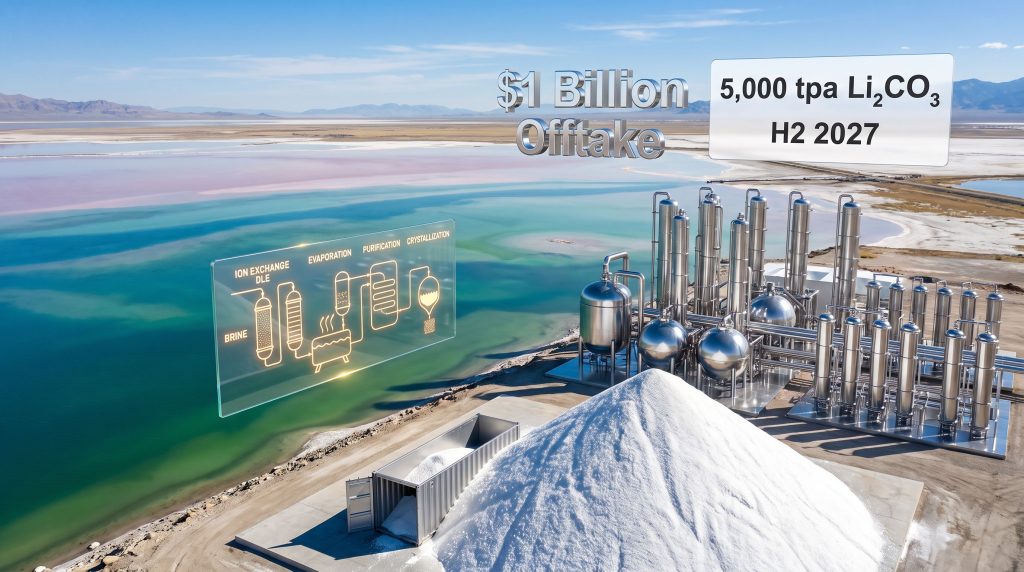
Battery-grade lithium does not simply emerge from a brine lake. The elegant chemistry of direct lithium extraction technology, which has attracted billions in capital and reshaped the strategic calculus of western critical mineral supply chains, solves only one part of the production puzzle. What happens after the brine is processed, after the lithium ions are selectively captured and released into a concentrated solution, is where many projects quietly stumble. Downstream conversion, the sequence of evaporation, purification, and crystallisation that transforms a dilute lithium sulfate eluate into a specification-grade product, is technically demanding, brine-specific, and cannot be resolved with commodity engineering. It is precisely this bottleneck that makes the JordProxa wins Lilac Great Salt Lake work announcement one of the most technically consequential contractor appointments in U.S. lithium development this year.
When big ASX news breaks, our subscribers know first
Why Downstream Processing Defines Commercial Viability in Brine Lithium Projects
The Problem With Eluate
Most public discussion of direct lithium extraction focuses on the front end: the selectivity of the sorbent or ion exchange media, the speed of lithium capture relative to evaporation ponds, and the water and land use advantages. What receives far less attention is the condition of the product stream that exits the DLE stage.
The output of an ion exchange DLE system is a lithium sulfate eluate, a solution that is enriched in lithium relative to the source brine but is not remotely close to a sellable product. It still contains dissolved impurities including sodium, potassium, magnesium, and sulfate species, all of which must be reduced to parts-per-million concentrations before the lithium qualifies as battery-grade lithium carbonate. Furthermore, understanding lithium brine processing at this stage is essential to appreciating why downstream engineering is so demanding.
Battery-grade Li₂CO₃ carries a purity threshold of 99.5% or higher, and cathode material manufacturers increasingly demand purity specifications closer to 99.9%. Impurity tolerance varies by cathode chemistry, with lithium iron phosphate and nickel-manganese-cobalt formulations carrying different but uniformly strict impurity budgets. Failing to meet these thresholds does not produce a discounted product; it produces a product that cannot enter the battery supply chain at all.
The Crystallisation Science That Most Engineers Underestimate
Beyond purity, the physical characteristics of the final lithium carbonate crystals matter enormously to cathode manufacturers. Particle size distribution, bulk density, and solubility behaviour all influence how the material behaves during subsequent processing steps. A lithium carbonate product with incorrect morphology may be chemically pure but still commercially unusable for premium cathode applications.
Crystallisation process design controls these physical parameters. The cooling rate profile, seeding strategy, residence time distribution, and mother liquor handling all interact to determine the final crystal habit. This is not a commodity engineering problem. It requires proprietary process design matched to the specific brine chemistry of the source material, which is why off-the-shelf equipment configurations routinely fail when applied to novel brine compositions.
Crystallisation in lithium carbonate production is simultaneously a chemistry problem, a thermodynamics problem, and a materials science problem. The interaction between impurity speciation in the eluate and crystal growth kinetics is unique to every brine source, making prior validation against actual site brine a non-negotiable requirement.
JordProxa Wins Lilac Great Salt Lake Work: What the Contract Actually Covers
Specialist Credentials in Evaporite Mineral Processing
JordProxa occupies a specialised position within industrial mineral processing engineering. Its core competencies, crystallisation, evaporation, and solid-liquid separation, are directly applicable to lithium, potash, soda ash, and other evaporite mineral systems. This is not a general-purpose engineering firm adapting its capabilities to lithium; it is a company whose existing technology portfolio maps directly onto the downstream processing requirements of brine-derived lithium production.
The appointment followed a competitive technical evaluation process and, critically, direct testing using actual Great Salt Lake brine eluate rather than synthetic reference solutions. This distinction is important. Synthetic testing can validate a process concept but cannot account for the specific impurity fingerprint of a real brine source.
Scope, Performance Guarantees, and FEL-3 Validation
The JordProxa contract covers the complete downstream conversion package: evaporation concentration, multi-stage purification, and controlled crystallisation. The agreement includes performance guarantees tied to both conversion efficiency and final product quality specifications, a contractual structure that transfers meaningful technical risk from the project developer to the technology supplier.
The contract award followed successful completion of front-end loading phase 3 testing, commonly abbreviated as FEL-3. This validation stage sits at the boundary between engineering concept and construction-ready design. Its significance is often misunderstood outside specialist project development circles.
FEL-3 explained in context:
-
FEL-1 establishes conceptual feasibility and order-of-magnitude cost estimates.
-
FEL-2 advances to pre-feasibility level, developing process flow diagrams and preliminary equipment sizing.
-
FEL-3 is the most rigorous pre-engineering validation stage, producing definitive process design criteria, equipment specifications, and capital cost estimates accurate to within approximately ±10 to 15%.
Completing FEL-3 using actual Great Salt Lake brine eluate and successfully producing battery-grade lithium carbonate is not a minor technical footnote. It is the demonstration that the process works as designed when confronted with the real chemical environment it will face during commercial operations. It closes the gap between promising laboratory results and bankable engineering.
The Great Salt Lake Project: Structure, Scale, and Commercial Architecture
Project Parameters at a Glance
| Parameter | Detail |
|---|---|
| Location | Great Salt Lake, Utah, United States |
| Extraction Technology | Proprietary ion exchange DLE |
| Phase 1 Production Capacity | 5,000 tonnes per annum LCE |
| Target Commercial Production | Second half of 2027 |
| Final Product | Battery-grade lithium carbonate |
| EPCM Contractor | Hatch |
| Downstream Technology Partner | JordProxa |
| Total Project Funding Secured | $145 million |
| Offtake Partner | Traxys North America |
| Offtake Contract Duration | 10 years |
| Offtake Contract Value | ~$1 billion |
| Final Investment Decision Target | 2026 |
Why Great Salt Lake Brine Is Chemically Challenging
Great Salt Lake presents one of the most demanding brine compositions for lithium extraction encountered in North American resources. The lake is characterised by an exceptionally high magnesium-to-lithium ratio, a parameter that makes conventional solar evaporation pond technology economically unworkable. Evaporation ponds operate by concentrating all dissolved species together before selective precipitation; when magnesium concentrations are high relative to lithium, the economics of achieving selective lithium concentration deteriorate rapidly.
This chemistry is the fundamental reason DLE is not merely preferred at Great Salt Lake but is essentially the only commercially rational extraction pathway. Lilac Solutions' ion exchange beads selectively bind lithium ions from the raw brine stream, rejecting magnesium and other competing cations, producing a lithium-enriched eluate without the years-long evaporation pond cycle that characterises operations in the Lithium Triangle of South America.
An additional, less widely discussed aspect of Great Salt Lake brine is its sulfate speciation. The lithium species released by the ion exchange process exits as lithium sulfate rather than lithium chloride, which has downstream processing implications. Consequently, the lithium salts conversion pathway required here differs markedly from chloride-dominant brines. JordProxa's selection and FEL-3 validation were conducted specifically for this sulfate-based chemistry, meaning the downstream system is engineered for the actual chemical species it will process, not a generic lithium brine.
The $1 Billion Offtake: Why It Matters Beyond Revenue
The 10-year offtake agreement with Traxys North America covering 100% of Phase 1 production at an estimated ~$1 billion in contracted value is structurally significant for reasons that extend beyond the headline revenue figure.
Project lenders evaluating a Final Investment Decision require revenue certainty before committing debt capital. A fully contracted Phase 1 output, with an established commodity trading counterparty in Traxys, satisfies the primary revenue risk condition that project finance banks typically require. Combined with the $145 million equity funding from investors including Breakthrough Energy Ventures, the project carries a capital structure that is unusually well-prepared for FID-stage financing.
A 10-year, 100%-volume offtake agreement representing approximately $1 billion in contracted revenue is among the most commercially de-risked first-phase structures seen in a U.S. lithium brine project to date. For project financiers, this substantially compresses the revenue risk component of their credit assessment.
Contractor Sequencing and the Path to Final Investment Decision
How Procurement Timing Affects Capital Cost Certainty
One of the less-discussed dynamics in large mineral processing project development is the relationship between contractor appointment timing and the accuracy of capital cost estimates presented to project finance lenders.
When major technology and equipment packages remain unawarded at FID stage, capital cost estimates carry contingency allowances that can span ±20 to 30%. Lenders applying standard debt service coverage ratio requirements to a project with that level of capital cost uncertainty will either decline to participate or demand equity cushions that dilute project economics substantially.
By confirming both Hatch as EPCM contractor and JordProxa as downstream technology partner before reaching FID, the Great Salt Lake project eliminates the two largest sources of capital cost uncertainty in its facility design. The result is a materially tighter capital cost estimate, which is a direct enabler of competitive project financing terms.
Contractor milestones on the path to FID:
-
Hatch appointed as EPCM contractor, responsible for engineering, procurement, and construction management across the full facility.
-
JordProxa appointed as downstream technology and equipment supplier following FEL-3 validation.
-
Final Investment Decision targeted for the latter part of 2026.
-
Construction commencement anticipated following FID, targeting H2 2027 commercial production.
U.S. Domestic Lithium Supply: The Broader Strategic Picture
The Import Dependency Problem
The United States imports the substantial majority of its battery-grade lithium, with the processing concentration sitting heavily in China's refining sector. South American producers, primarily in Chile and Argentina, supply raw material, but a significant proportion of the value-adding conversion occurs offshore. The practical consequence is that U.S. battery manufacturers sit multiple supply chain steps removed from domestically controlled lithium production.
This concentration has been a consistent concern within critical minerals supply chains policy discussions. Domestic brine-based DLE projects targeting battery-grade output represent one structural response. A 5,000 tpa Phase 1 operation is modest at global scale, but the strategic value of first-phase execution extends beyond its tonnage. A successfully commissioned DLE-to-battery-grade-lithium-carbonate processing chain, validated at commercial scale in a U.S. regulatory and operating environment, creates the replicable template for subsequent capacity additions.
DLE's Scalability Advantage Over Hard Rock Mining
The modular architecture of ion exchange DLE systems provides a scalability characteristic that hard rock spodumene mining cannot replicate at equivalent capital efficiency. Expanding throughput at an established DLE operation conceptually involves adding ion exchange capacity and scaling the downstream processing train, rather than developing additional mine workings and ore processing circuits.
JordProxa's crystallisation and evaporation technology is engineered to accommodate phased capacity additions without requiring comprehensive facility redesign. This modularity is not merely an operational convenience; it is a capital allocation advantage that allows project sponsors to validate the processing chain at Phase 1 scale before committing the capital required for full expansion.
Where Great Salt Lake Sits in the U.S. DLE Competitive Landscape
The shifts occurring at Great Salt Lake are also being felt across the global lithium market, as nations and investors increasingly assess which domestic DLE projects can credibly reach commercial scale. The comparison below illustrates how this project sits relative to its peers.
| Project | Location | Technology Approach | Development Stage |
|---|---|---|---|
| Lilac Solutions, Great Salt Lake | Utah | Ion exchange DLE | Pre-FID, targeting 2026 |
| Controlled Thermal Resources, Hell's Kitchen | California | DLE plus geothermal | Advanced development |
| EnergySource Minerals, Imperial Valley | California | DLE from geothermal brine | Pilot and early commercial |
| Standard Lithium, South Arkansas | Arkansas | DLE from oilfield brine | Feasibility stage |
The next major ASX story will hit our subscribers first
Frequently Asked Questions
What exactly has JordProxa been contracted to do?
JordProxa will supply the complete technology and equipment package for the downstream conversion stage at the Great Salt Lake Phase 1 facility. This encompasses the evaporation, purification, and crystallisation unit operations that convert lithium sulfate eluate, produced by Lilac's ion exchange DLE system, into finished battery-grade lithium carbonate. The contract includes performance guarantees covering conversion efficiency and final product quality specifications.
Why is Great Salt Lake brine unsuited to conventional evaporation pond processing?
The brine at Great Salt Lake contains an elevated ratio of magnesium to lithium. Conventional solar evaporation pond operations concentrate all dissolved species together before selective precipitation, which becomes economically marginal when magnesium concentrations are high relative to lithium. Ion exchange DLE bypasses this problem by selectively binding lithium directly from the raw brine, rejecting magnesium without requiring evaporation pond concentration.
What is FEL-3 and why does it matter for this contract award?
Front-end loading phase 3 is the most advanced pre-engineering validation stage in process plant development. It produces process design criteria and equipment specifications sufficient for bankable capital cost estimation. JordProxa's completion of FEL-3 using actual Great Salt Lake brine eluate, with successful battery-grade lithium carbonate production confirmed, provides the technical foundation required to advance to construction-level engineering and to structure project financing around a reliable capital cost estimate.
When is commercial production expected?
The Phase 1 facility is targeting commercial production in the second half of 2027, subject to the Final Investment Decision proceeding as anticipated in 2026 and construction commencing on schedule following that decision. However, as with all major infrastructure projects of this nature, timelines remain subject to regulatory and financing conditions.
Key Takeaways for Industry Observers
-
JordProxa wins Lilac Great Salt Lake work closes one of the two most critical technology procurement gaps required before the project can advance to Final Investment Decision.
-
FEL-3 validation using site-specific brine eliminates the primary technical risk in the downstream conversion process, providing a level of process confidence that synthetic testing cannot replicate.
-
The sulfate speciation of Great Salt Lake eluate creates a specific downstream chemistry requirement that distinguishes this project from chloride-dominant brine operations and underscores the importance of brine-matched technology selection.
-
A fully contracted Phase 1 output via a 10-year, ~$1 billion offtake agreement with Traxys substantially reduces the revenue risk component of project financing assessment ahead of FID.
-
Successful Phase 1 execution would establish the first commercially validated DLE-to-battery-grade-lithium-carbonate processing chain in a U.S. operating environment, creating a replicable model for domestic critical mineral supply development.
-
The modular architecture of the JordProxa crystallisation system supports phased capacity expansion without facility redesign, a capital efficiency advantage relevant to the project's long-term growth trajectory. In addition, this scalability positions the Great Salt Lake resource as a potential cornerstone of U.S. battery supply chain policy over the coming decade.
This article contains forward-looking statements regarding project timelines, production targets, and financing outcomes. These statements are based on information available at the time of writing and are subject to change. Readers should not rely on projected timelines or production figures as guarantees of future performance. Independent professional advice should be sought before making any investment decisions.
Want to Capitalise on the Next Major Mineral Discovery Before the Market Moves?
Discovery Alert's proprietary Discovery IQ model scans ASX announcements in real time, instantly identifying significant mineral discoveries across lithium and more than 30 other commodities — converting complex geological data into clear, actionable opportunities for both traders and long-term investors. Explore how historic discoveries have generated substantial returns on Discovery Alert's dedicated discoveries page, and begin your 14-day free trial today to position yourself ahead of the broader market.