August 8, 2026
The Monetary Policy Fault Line: How a Shifting Fed Is Reordering Energy Market Priorities
Central banks rarely move in straight lines. The Federal Reserve's policy trajectory through 2026 has illustrated this principle with unusual clarity, evolving from an extended period of rate stability into something that increasingly resembles a renewed tightening cycle. For energy professionals, commodity traders, and macro investors, understanding why JPM expects the Fed to hike rates in December matters not just for fixed income positioning but for how crude oil price trends could behave across the next 12 to 18 months.
The intersection of monetary policy and energy markets is rarely simple, and the current environment is no exception. Geopolitical supply disruptions, shifting demand from major importers, and now a recalibrating Federal Reserve are all competing for dominance in the oil price equation simultaneously.
When big ASX news breaks, our subscribers know first
Inside the FOMC's July 29 Decision: More Than a Simple Hold
On July 29, the Federal Open Market Committee voted to keep the federal funds rate target unchanged at 3.50% to 3.75%, a decision broadly consistent with market expectations. However, the surface-level read of an unchanged rate obscured a more significant development beneath it.
Three voting members of the FOMC broke from the consensus and cast dissenting votes in favour of an immediate 25-basis-point rate increase. Those members were Beth M. Hammack, Neel Kashkari, and Lorie K. Logan. The addition of Kashkari as a dissenter was described as a modest surprise in institutional analysis, given his historical positioning within the committee's ideological spectrum.
The official FOMC statement offered context for the hold, noting that:
- Economic activity is continuing to expand at a solid pace despite elevated uncertainty partly attributable to Middle East conflict
- Productivity growth and capital investment remain strong
- Job gains have broadly kept pace with workforce growth, leaving the unemployment rate relatively stable
- Inflation remains elevated relative to the committee's 2% target, with supply shocks in the energy sector cited as a contributing factor
The statement also reaffirmed the committee's policy of maintaining ample reserves in the banking system while committing to deliver price stability.
What Three Dissents Actually Signal
In the context of modern FOMC dynamics, dissents are not routine noise. When three voting members simultaneously advocate for immediate tightening, it communicates a meaningful shift in the internal balance of the committee. Markets have historically interpreted multi-member hawkish dissents as a forward signal rather than an isolated policy disagreement.
Key Insight: Multiple simultaneous dissents in favour of tightening often precede a formal policy shift within one to two subsequent meetings. This pattern reflects how internal committee pressure tends to build before translating into an official rate change.
Compounding this signal was the post-meeting behaviour of U.S. Treasury markets. Following the July 29 announcement, there was a notable twist steepening in the Treasury yield curve. This occurs when short-end rates rise while longer-dated yields also climb, producing an unusual curve shape. Coinciding with this was a sharp increase in medium-term inflation breakeven rates, a market-derived measure of expected future inflation. Analysts characterised this combination as a highly unusual post-FOMC market reaction, suggesting investors were repricing the probability of sustained inflationary pressure.
JPM Expects the Fed to Hike Rates in December: The Revised Forecast Explained
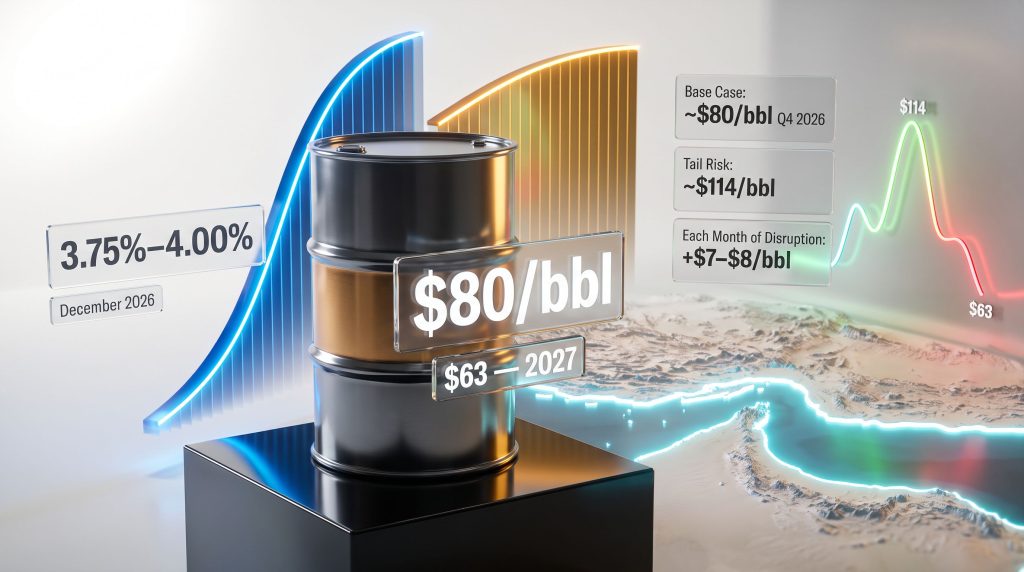
Against this backdrop, J.P. Morgan's commodities and macro strategy teams revised their Federal Reserve rate outlook in a significant way. The bank's previous base case had placed the next rate hike in the second half of 2027. That timeline has now been pulled forward substantially, with J.P. Morgan's revised forecast placing a 25-basis-point hike in December 2026, which would lift the federal funds rate target to 3.75% to 4.00%.
The analytical basis for this revision rested on several converging inputs:
- The three hawkish dissenting votes at the July 29 meeting, one more than anticipated
- Natural language processing (NLP) analysis of Fed Chair Warsh's prepared remarks, which skewed hawkish in tone
- The Chair's failure to endorse a well-defined inflation target, which undermined confidence in the Fed's forward guidance framework
- The unusual post-meeting spike in inflation breakevens, reinforcing the view that markets are pricing in persistent price pressures
The credibility dimension of this analysis deserves particular attention. When a central bank communicates tough rhetoric on inflation without anchoring it to a specific numerical target, it creates a framework gap. That gap raises doubt about whether tough language will translate into decisive action, and ironically, this doubt can accelerate the timeline for rate moves as the institution feels pressure to prove its commitment. Furthermore, the Powell inflation projections framework remains a key reference point for understanding how guidance credibility shapes market expectations.
Credibility Risk: A central bank that signals inflation-fighting intent without a clearly defined target risks eroding the forward guidance credibility that underpins modern monetary policy. This dynamic can force earlier-than-planned rate action as a means of restoring institutional authority.
The September Risk Scenario
While December is J.P. Morgan's primary call, the bank explicitly identifies September 2026 as a live risk scenario. If inflation data released in August or early September shows renewed acceleration, the committee may have both the justification and the institutional pressure to move earlier.
| Scenario | Trigger Condition | Expected Timing | Post-Hike Rate |
|---|---|---|---|
| Base Case | Gradual inflation cooling continues | December 2026 | 3.75%–4.00% |
| Early Risk Scenario | Inflation re-accelerates in August/September | September 2026 | 3.75%–4.00% |
| Extended Pause | Inflation moderates faster than expected | 2H 2027 (prior forecast) | 3.50%–3.75% |
The Rate-Oil Relationship: Why It Is More Complicated Than It Looks
The conventional understanding of how interest rate hikes affect oil prices follows a reasonably clear transmission mechanism. Higher rates strengthen the U.S. dollar, which creates headwinds for dollar-denominated commodities. Elevated borrowing costs slow economic activity, which reduces industrial energy consumption. The result, in most historical cycles, is some degree of downward pressure on crude prices.
However, the relationship is non-linear and heavily context-dependent. In environments where geopolitical supply disruptions are the dominant variable, the rate-oil inverse correlation can break down entirely. In addition, OPEC's market influence continues to act as a structural overlay that can override conventional monetary transmission effects.
J.P. Morgan's analysis reflects this hierarchy explicitly. In the current environment, the bank's analytical framework ranks oil price drivers as follows:
- Strait of Hormuz flow rates (primary driver)
- Chinese oil import demand (secondary driver)
- U.S. monetary policy and interest rates (tertiary influence)
This ordering has significant practical implications. It means that for energy market participants, the August and September CPI data releases matter less for near-term oil price trajectory than daily shipping intelligence on Hormuz transit volumes and monthly Chinese customs import figures.
J.P. Morgan's Oil Price Forecast: Bearish Base Case With a Significant Tail
J.P. Morgan's oil price outlook for the remainder of 2026 and into 2027 is characterised as fundamentally bearish at the base case level, but with a meaningful upside tail risk that cannot be dismissed.
The base case rests on the assumption of a gradual recovery in Middle East oil supply through the balance of 2026. Under this scenario:
- Brent crude averages $80 per barrel in Q4 2026
- Brent averages $63 per barrel in 2027, as significant oversupply conditions reassert themselves
- Inventory normalisation proceeds broadly in line with recovering Strait of Hormuz flows
The Strait of Hormuz Variable
The Strait of Hormuz is one of the world's most critical oil transit chokepoints, with roughly 20% of global petroleum liquids passing through it at normal operating conditions according to the U.S. Energy Information Administration. When flow rates through this passage are disrupted, the effects on global oil supply are immediate and difficult to buffer through alternative routes. Consequently, the China demand outlook becomes equally critical, as reduced Chinese absorption of diverted cargoes would amplify price volatility further.
The $7–$8 Per Barrel Rule: J.P. Morgan's modelling indicates that each additional month of below-expected flows through the Strait of Hormuz, combined with depressed Chinese import demand, adds approximately $7 to $8 per barrel to the fair value of Brent crude.
The compound effect of extended disruption is striking when modelled across multiple months:
| Disruption Duration | Estimated Brent Fair Value Impact | Implied Monthly Average Price |
|---|---|---|
| Disruption resolves quickly | Base case holds | ~$80/bbl (Q4 2026) |
| 1 additional month of low flows | +$7–$8/bbl above base | ~$87–$88/bbl |
| 2 additional months | +$14–$16/bbl above base | ~$94–$96/bbl |
| 3 months of extended disruption | +$21–$24/bbl above base | ~$114/bbl monthly average |
The critical swing variable in this framework is inventory buffer levels. When global oil stockpiles are well-supplied, markets can absorb modest supply disruptions without dramatic price responses. But as buffers shrink, the same supply shortfall produces a much larger price impact because there is less storage cushion to draw down while alternative supply arrangements are made.
J.P. Morgan identifies the scenario of shrinking inventory buffers becoming suddenly stressed by a more prolonged Hormuz disruption as the primary bullish tail risk in the near-term outlook. The $114 per barrel monthly average price under a three-month disruption scenario is not the bank's base case, but it represents a credible outcome that energy markets need to price as a non-trivial probability.
Three Strategic Scenarios for Investors and Energy Professionals
Scenario A: December Hike Proceeds as Forecast
The Fed executes a 25-basis-point increase in December, moving the target rate to 3.75%–4.00%. Oil markets absorb the rate signal without major disruption, as geopolitical factors continue to dominate price formation. Brent stabilises around $80 per barrel in Q4 2026 before oversupply pressure builds through 2027, pulling the annual average toward $63 per barrel.
Scenario B: September Early Move
August or September inflation data surprises to the upside, prompting the Fed to act two meetings ahead of schedule. The U.S. dollar strengthens on the accelerated tightening signal. Near-term commodity headwinds increase modestly, though the degree to which this affects oil prices and trade war dynamics depends heavily on whether Hormuz flow rates are simultaneously recovering or deteriorating.
Scenario C: Extended Disruption and Delayed Oversupply
Strait of Hormuz flows remain suppressed for three or more months. Inventory buffers become stressed and the 2027 oversupply thesis is delayed or invalidated as production cannot reach global markets at expected volumes. Brent approaches $114 per barrel on a monthly average basis. In this scenario, the Fed's rate decisions become essentially irrelevant to oil price formation relative to the magnitude of the supply shock premium.
Strategic Note for Energy Sector Participants: In the current macro environment, monetary policy is a secondary variable for crude oil pricing. Near-term price modelling should weight operational and geopolitical intelligence on Strait of Hormuz transit volumes and Chinese import data more heavily than Fed rate timing signals.
The next major ASX story will hit our subscribers first
Frequently Asked Questions
What is J.P. Morgan's current forecast for the next Fed rate hike?
JPM expects the Fed to hike rates in December 2026 by 25 basis points, bringing the federal funds rate target to approximately 3.75%–4.00%. This represents a significant pull-forward from the bank's prior view that the next hike would occur in the second half of 2027. For further context, Reuters reporting on this forecast revision provides useful institutional background.
Why did J.P. Morgan revise its Fed rate hike timeline?
The revision followed the July 29 FOMC meeting, where three voting members dissented in favour of an immediate rate increase. This, combined with hawkish signals in the Fed Chair's language and an unusual post-meeting spike in inflation breakeven rates, led J.P. Morgan to conclude the committee is moving toward tightening sooner than previously anticipated.
Could the Fed hike rates as early as September 2026?
Yes. J.P. Morgan explicitly identifies September as a credible risk scenario if inflation data in August or early September shows renewed acceleration. However, December remains the bank's primary base case forecast.
What is J.P. Morgan's Brent crude price forecast for 2027?
Under its base case, which assumes gradual Middle East supply recovery and no prolonged Strait of Hormuz disruption, J.P. Morgan forecasts Brent crude to average $63 per barrel in 2027, reflecting a return of significant oversupply conditions to global oil markets.
What happens to oil prices if Strait of Hormuz disruptions continue?
J.P. Morgan's modelling suggests each additional month of below-expected Hormuz flows adds roughly $7 to $8 per barrel to Brent's fair value. If disruptions extend to three months, monthly average prices could reach approximately $114 per barrel.
Key Takeaways
- JPM expects the Fed to hike rates in December 2026 by 25 basis points, with September identified as an upside risk
- The revised call is driven by hawkish FOMC dissent from three voting members, unusual post-meeting Treasury market behaviour, and credibility concerns around the Fed's inflation framework
- For oil markets, Strait of Hormuz flow rates and Chinese import demand are the dominant price drivers; interest rates are a secondary consideration
- J.P. Morgan's base case sees Brent at $80/bbl in Q4 2026 and $63/bbl in 2027, but a $114/bbl tail risk exists under a three-month Hormuz disruption scenario
- Energy participants should monitor August and September CPI releases alongside Strait of Hormuz transit data as the two key parallel indicators for both monetary policy timing and oil price trajectory
This article reflects publicly available institutional analysis and macro data. It does not constitute financial advice. Forecasts and scenario projections are subject to material uncertainty and should not be relied upon as the sole basis for investment decisions.
Want to Stay Ahead of Commodity Market-Moving Discoveries?
While macro forces like Fed rate decisions and Hormuz flow disruptions dominate oil price narratives, significant mineral discoveries on the ASX can generate equally transformative returns — and timing is everything. Discovery Alert's proprietary Discovery IQ model delivers real-time alerts the moment major ASX mineral discoveries are announced, turning complex data across 30+ commodities into clear, actionable insights — explore the historic returns that major discoveries have delivered and begin your 14-day free trial today to position yourself ahead of the broader market.