June 9, 2026
The Supply Chain Logic Behind Zambia's Copper Renaissance
Copper's role in the global energy transition has fundamentally altered the economics of African mining. As demand projections for the red metal climb in response to accelerating electric vehicle adoption, grid modernisation programmes, and renewable energy infrastructure build-out, the Zambian Copperbelt is attracting a new generation of operators willing to pursue integrated, vertically structured business models. The rationale is straightforward: in a market where copper quality, traceability, and production continuity are becoming as important as volume, controlling the full value chain from pit to refined metal offers a structural competitive advantage.
It is within this context that the news of Jubilee restarts deliveries from Molefe mine to Sable refinery carries significance well beyond a routine operational update. This development signals the beginning of a meaningful production ramp-up for an operation designed from the ground up as a replicable template for district-scale copper development across central Africa. Furthermore, the broader copper supply crunch continues to make such integrated operations increasingly valuable to global markets.
When big ASX news breaks, our subscribers know first
Understanding the Hub-and-Spoke Architecture Driving Jubilee's Zambia Strategy
The conventional single-asset mining model, where one mine feeds one processing facility, has well-known limitations in terms of scalability and capital efficiency. Jubilee's approach in Zambia inverts this constraint by anchoring operations around centralised refining infrastructure at the Sable refinery and progressively feeding it from multiple mine sources across the region.
This hub-and-spoke structure offers several compounding advantages:
- Centralised capital expenditure on processing infrastructure is spread across a growing number of feed sources, reducing the per-tonne cost of refining as throughput increases.
- Individual mines can be brought online, scaled, or temporarily curtailed without threatening the operational continuity of the refinery.
- The model supports a mine-while-you-explore philosophy, allowing resource base expansion to run concurrently with active production rather than sequentially.
- Replication across additional copper targets in the same jurisdiction leverages existing permitting knowledge, workforce capabilities, and logistics networks.
Jubilee's Pillar 2 business model, which encompasses its integrated mine-to-metals operations at Sable refinery and associated mining activities, is built on precisely this framework. The Molefe mine represents the first full implementation of this scalable copper growth model in Zambia, making its operational trajectory a critical proof-of-concept for the broader regional strategy.
Molefe Mine: Geological Setting and Resource Configuration
Molefe mine is situated within the Zambian Copperbelt, one of the world's most mineralised copper corridors, which stretches across northern Zambia and into the Democratic Republic of Congo. The geological setting is characterised by sediment-hosted stratiform copper deposits, a deposit style known for relatively predictable grade continuity compared to porphyry or skarn systems, which makes mine planning and feed scheduling more reliable.
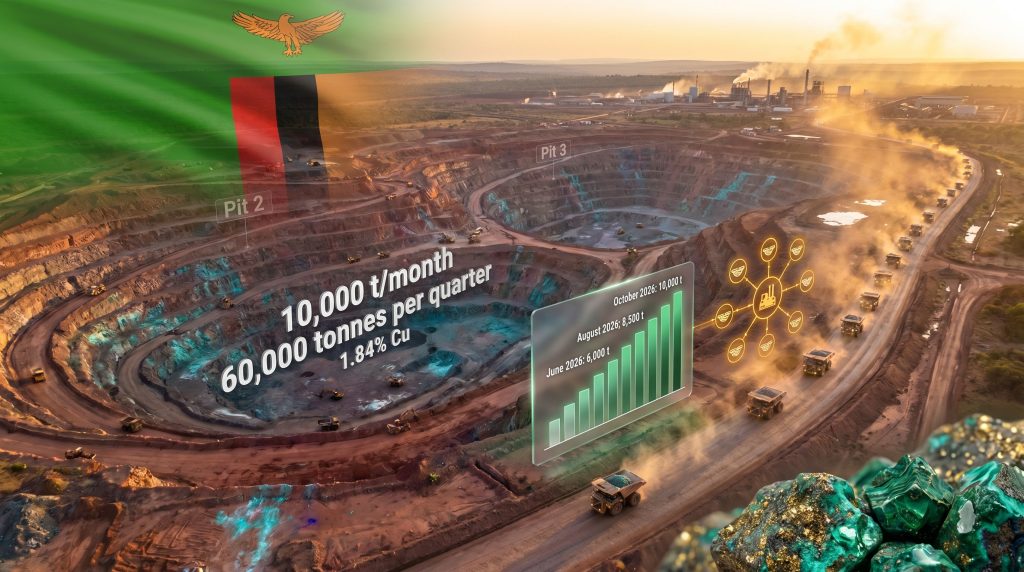
The mine currently operates across two pit configurations, Pit 2 and Pit 3, with a plan to combine these into a single integrated operation. Pre-stripping at Pit 2 has been completed under an updated mine plan, unlocking access to deeper ore horizons and enabling the feed restart to Sable refinery. The combination of the two pits is designed to achieve:
- Improved ore feed flexibility to the refinery by drawing from a larger combined resource envelope.
- Grade continuity across a broader mining face, reducing the variability of material sent for processing.
- A target combined mined copper reef output of 60,000 tonnes per quarter upon full integration completion.
- An average stripping ratio of 6:1, meaning six tonnes of waste rock must be removed for every tonne of ore extracted.
Grade Context: The copper reef being delivered to Sable carries an average grade of 1.84% Cu. For reference, the global average copper ore grade across producing mines has declined steadily over recent decades and now sits below 0.6% Cu at many large-scale operations. A grade of 1.84% Cu represents a materially higher-quality feed than the global average, which has direct implications for processing economics and recovery rates at the refinery.
During the reported period, 9,130 tonnes of copper reef at this 1.84% Cu grade were transported from Molefe to the Sable refinery, marking the operational restart following a disruption caused by heavy seasonal rainfall that damaged road and bridge infrastructure used for ore haulage.
Why Stripping Ratio Matters More Than Most Investors Realise
The stripping ratio is one of the most consequential yet underappreciated metrics in open-pit mining economics. At a ratio of 6:1, the economics at Molefe are within a range that is operationally manageable for a Copperbelt asset of this type, particularly given the ore grade being accessed. However, the significance of this metric extends beyond simple cost-per-tonne calculations.
A well-managed pre-stripping programme, as has been executed at Pit 2, determines the operational calendar for months in advance. By completing the heavy waste removal work upfront, the operation unlocks a period of more consistent ore extraction, which is precisely the conditions needed to support the phased delivery ramp-up now underway.
The Delivery Ramp-Up: Targets, Timelines, and What They Reveal
Jubilee restarts deliveries from Molefe mine to Sable refinery not as a one-time event but as the beginning of a structured, phased volume increase. The ramp-up schedule is designed to progressively increase refinery utilisation while managing operational risk at each step. Consequently, understanding copper investment strategies in this context becomes especially relevant for those watching this operation closely.
| Delivery Period | Monthly RoM Target | Cumulative Growth vs. Restart |
|---|---|---|
| June 2026 | 6,000 t/month | Baseline restart volume |
| August 2026 | 8,500 t/month | Approximately 42% increase |
| October 2026 | 10,000 t/month | More than 100% increase |
This schedule is notable for several reasons. A more than 100% increase in run-of-mine (RoM) delivery volumes across a four-month window is not a marginal operational adjustment. It represents a structural re-rating of the mine's contribution to Sable refinery's total feed throughput.
Production Milestone: Achieving 10,000 tonnes per month of RoM deliveries by October 2026 would place Molefe on an annualised delivery trajectory of approximately 120,000 tonnes of copper reef per year at the peak ramp rate, before the quarterly combined pit output target of 60,000 tonnes is fully factored in.
The phased nature of this ramp-up also reflects sound operational logic. Attempting to maximise throughput immediately following an infrastructure disruption carries risks related to road condition reliability, equipment availability, and workforce scheduling. The staggered targets build operational confidence at each volume level before the next step is attempted.
Managing Ore Grade and Stockpile Strategy Simultaneously
Not all material mined at Molefe follows the same pathway. The current operational approach directs high-grade copper reef to Sable refinery for immediate processing, while lower-grade material is stockpiled on-site for future treatment. This bifurcated approach serves two strategic purposes.
First, it maximises the economic value of refinery capacity by ensuring the highest-grade feed is prioritised through the processing circuit. Second, it preserves lower-grade material as a future processing inventory rather than treating it as waste, extending the useful resource life of the operation without requiring additional mining.
Technology Deployment: Ore Sorting and Modular Processing as the Next Value Layer
The operational optimisation roadmap at Molefe extends well beyond the current delivery ramp-up. Two technology deployments are planned for the next development phase that could materially improve project economics.
On-Site Ore Sorting
X-ray ore sorting technology uses sensor-based analysis, including X-ray transmission, electromagnetic sensing, and optical detection systems, to evaluate individual fragments of rock in real time and separate them by grade before they enter the processing circuit. The practical effect is a reduction in the volume of low-value material consuming refinery capacity, which improves the average grade of feed entering the circuit and reduces per-unit processing costs.
At Molefe, the planned deployment of on-site ore sorting is expected to achieve:
- More precise segregation of high-grade copper reef from lower-grade and barren material at the mine face.
- Improved copper recovery rates at Sable refinery by reducing feed dilution.
- A reduction in haulage costs, since lower-grade material identified at the sorter does not need to be transported to the refinery.
- Enhanced overall project economics through the compounding effect of better feed quality and lower processing volumes.
Ore sorting remains underutilised across much of the African copper sector, partly because the technology requires consistent ore hardness and fragment size to function reliably. Its deployment at Molefe suggests the ore characteristics of the deposit are well suited to this approach, which is itself a positive indicator of mineralogical consistency.
Modular Processing for Stockpiled Lower-Grade Material
Complementing the ore sorting deployment is a plan to install an on-site modular processing plant capable of treating the stockpiled lower-grade copper reef. Modular processing infrastructure differs from conventional fixed-plant construction in that it requires lower upfront capital commitment, can be deployed incrementally, and can be redeployed to different sites if required.
This approach is particularly well suited to the hub-and-spoke model, as it allows lower-grade material to generate value without diverting refinery capacity away from higher-grade RoM feed.
Resource Expansion: The Phase 2 Drilling Programme and JORC Compliance
While production operations ramp up, a parallel resource definition programme is underway across the greater Molefe district and additional exploration tenements. The active drilling programs are targeting the delivery of a JORC-compliant mineral resource estimate following programme completion, currently targeted for Q4 2026, subject to timely receipt of laboratory assay results.
| Resource Development Stage | Current Status | Expected Milestone |
|---|---|---|
| Phase 2 Drilling | In progress | Q4 2026 completion |
| JORC Resource Estimate | Pending assay results | Post-Q4 2026 |
| District-Wide Exploration | Active across Molefe district | Ongoing |
| Modular Processing Plant | Planning phase | Post-resource confirmation |
The Joint Ore Reserves Committee (JORC) code is the internationally recognised standard for the public reporting of mineral exploration results, mineral resources, and ore reserves. JORC compliance requires that estimates be prepared by a qualified competent person, that reporting criteria meet defined technical thresholds, and that the basis for classification be independently verifiable. For a project at Molefe's stage of development, the delivery of a JORC-compliant resource estimate would transform it from an exploration-stage asset with operational activity into a bankable resource capable of supporting formal financing structures, joint venture negotiations, and long-term production planning.
Investor Note: In junior mining, the gap between an exploration project and a bankable asset is often described as a credibility threshold. JORC compliance is one of the most recognised mechanisms for crossing that threshold, as it signals to institutional investors, lenders, and potential partners that the resource has been evaluated to a standard that can withstand independent scrutiny.
The next major ASX story will hit our subscribers first
Zambia's Copper Sector: Structural Tailwinds and Competitive Positioning
Zambia's geological endowment within the Central African Copperbelt places it among a small number of jurisdictions globally capable of contributing meaningfully to future copper supply growth. The country has historically produced between 700,000 and 800,000 tonnes of copper per year at its peak, and government and industry initiatives have sought to restore and expand output levels in recent years. In addition, the favourable copper price outlook continues to support increased investment across the Copperbelt region.
Several structural factors support junior and mid-tier operators pursuing development in Zambia:
- The Zambian Copperbelt's deposit types are generally amenable to the open-pit and heap leach or conventional flotation processing methods that junior operators can deploy without the capital intensity required by underground block caving or deep-level operations.
- Proximity to the DRC's copper belt creates a regional ecosystem of mining services, logistics infrastructure, and technical expertise that reduces greenfield development costs.
- Growing buyer preference for responsibly sourced copper, driven by ESG requirements across European and North American supply chains, creates a premium opportunity for transparent, traceable producers.
- AIM-listed operators are increasingly filling the development pipeline left by major diversified miners that have concentrated capital on mega-scale assets, leaving the mid-tier development space less competitive.
The hub-and-spoke model being developed at Sable refinery and Molefe mine offers a potential blueprint for addressing precisely this market gap. By establishing centralised refining infrastructure and progressively adding mine feed sources, the model reduces the per-project development cost while leveraging sunk capital in processing assets. According to Mining Weekly, Jubilee has demonstrated consistent progress in growing its copper production figures, reinforcing the credibility of this operational approach.
Speculative Perspective: If the Molefe mine template proves replicable across two or three additional copper targets in the Zambian Copperbelt, the compounding throughput effect on Sable refinery could shift the operation from a developing producer into a mid-tier copper supplier with annual output that would attract attention from offtake partners and strategic investors. This is not confirmed by any current announcement but represents a logical extension of the stated strategic intent.
Furthermore, Jubilee Metals and Galileo's collaborative development of the Molefe project adds an additional layer of strategic depth, combining technical expertise and regional knowledge to accelerate the mine's path towards full production capacity.
Frequently Asked Questions: Jubilee Metals, Molefe Mine, and Sable Refinery
What caused the temporary disruption to deliveries from Molefe mine to Sable refinery?
Heavy seasonal rainfall caused damage to road and bridge infrastructure used for ore haulage between Molefe mine and the Sable refinery. Access routes have since been restored, enabling the resumption and phased ramp-up of RoM deliveries.
What is the target monthly delivery volume from Molefe mine to Sable refinery?
The phased ramp-up targets 6,000 tonnes per month in June 2026, rising to 8,500 tonnes per month by August 2026, and reaching 10,000 tonnes per month by October 2026, representing more than a 100% increase from pre-ramp delivery levels.
What is a JORC-compliant resource and when is it expected for Molefe mine?
A JORC-compliant resource is a mineral resource estimate prepared in accordance with the Joint Ore Reserves Committee reporting code, widely recognised as the international standard for resource disclosure. Molefe mine's JORC resource estimate is expected following the completion of the Phase 2 drilling programme, currently targeted for Q4 2026.
What is ore sorting and how will it benefit Molefe mine operations?
Ore sorting is a sensor-based technology that separates ore by grade before it enters the processing circuit. At Molefe, on-site ore sorting is planned to improve segregation of high-grade copper reef from lower-grade material, enhancing copper recovery rates at the Sable refinery and improving overall project economics.
What is the combined quarterly output target for Molefe mine once Pits 2 and 3 are fully integrated?
Following the completion of the Pit 2 and Pit 3 combination, combined mined copper reef is targeted to reach 60,000 tonnes per quarter at an average stripping ratio of 6:1.
Key Takeaways
- Jubilee restarts deliveries from Molefe mine to Sable refinery following completion of pre-stripping at Pit 2 and remediation of weather-damaged haulage infrastructure.
- 9,130 tonnes of copper reef at 1.84% Cu average grade were delivered to Sable during the reported period, establishing the baseline for the ramp-up.
- Monthly RoM deliveries are targeted to reach 10,000 tonnes by October 2026, representing a more than 100% increase from the June 2026 restart level.
- Full integration of Pits 2 and 3 is expected to deliver 60,000 tonnes per quarter of combined copper reef at a 6:1 stripping ratio.
- On-site ore sorting and modular processing infrastructure represent the next technological layer of operational and economic optimisation.
- A JORC-compliant mineral resource estimate is targeted for delivery following Phase 2 drilling completion in Q4 2026.
- The hub-and-spoke mine-to-metals model positions Molefe as a replicable template for district-scale copper development across the Zambian Copperbelt.
Disclaimer: This article is intended for informational purposes only and does not constitute financial advice. Statements regarding production targets, resource estimates, and timelines are forward-looking and subject to operational, geological, regulatory, and market risks. Investors should conduct their own independent research before making investment decisions.
Want to Stay Ahead of the Next Major Copper Discovery on the ASX?
Discovery Alert's proprietary Discovery IQ model delivers real-time alerts on significant ASX mineral discoveries, instantly translating complex geological data into actionable investment insights — ideal for both short-term traders and long-term investors watching the copper sector. Explore how historic mineral discoveries have generated substantial returns by visiting Discovery Alert's dedicated discoveries page, and begin your 14-day free trial today to position yourself ahead of the broader market.