
May 19, 2026
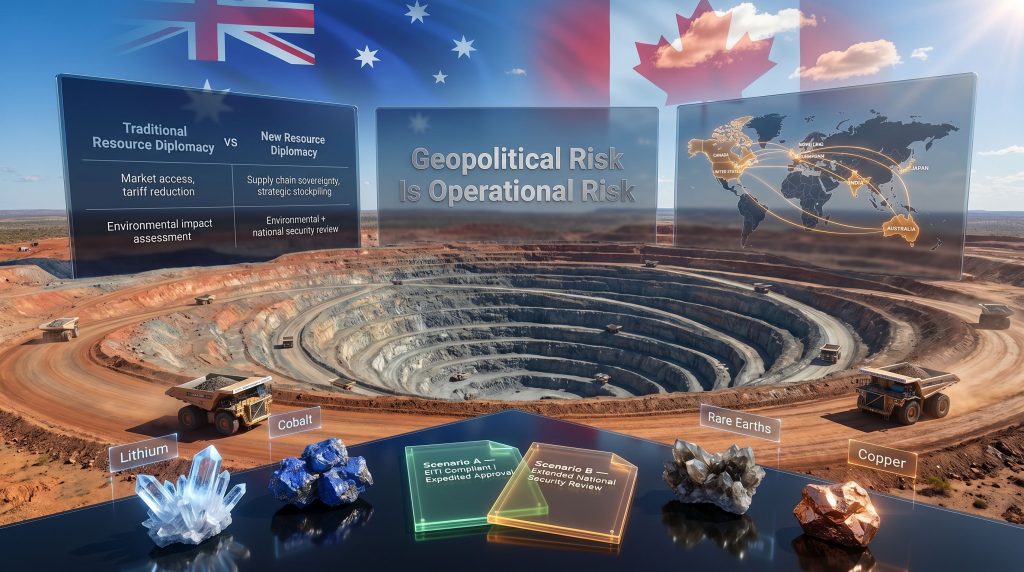
When Minerals Became Weapons: The Geopolitical Transformation Reshaping Global Mining
For most of the post-war era, a mine was evaluated on what lay beneath the ground. Ore grade, extraction cost, metallurgical recovery, proximity to infrastructure, and commodity price trajectories formed the backbone of every feasibility study and investment committee presentation. The world above ground, by contrast, was assumed to be broadly stable, governed by a rules-based international order constructed since 1945 and held, with occasional turbulence, for roughly eight decades. Julie Bishop resource diplomacy for miners was not yet a phrase that needed to exist.
That assumption no longer holds. The geopolitical environment in which mining companies operate has undergone a structural transformation that no amount of ore grade optimisation or cost discipline can offset if left unaddressed. Understanding this shift, and building the capabilities to navigate it, has become one of the defining strategic challenges for resource companies across every commodity and jurisdiction.
When big ASX news breaks, our subscribers know first
Three Tectonic Forces Rewriting the Rules for Miners
The Fracturing of the Post-War International Order
The institutional architecture that structured global trade and investment since the mid-twentieth century, built around multilateral bodies such as the World Trade Organization, the World Bank, and the International Monetary Fund, provided a broadly predictable operating environment for cross-border resource investment. Disputes were resolved through recognised frameworks. Investment protections were enforceable. Capital moved on commercial logic.
That architecture is now under significant strain. Great power competition between the United States and China, the re-emergence of transactional foreign policy approaches in major economies, and the erosion of multilateral consensus on trade and security have collectively weakened the predictability that miners once relied on. Former Australian Foreign Minister Julie Bishop, speaking at the GRX26 mining conference in Western Australia in May 2026, characterised this as the fracturing of the world's eighty-year-old rules-based order, a framework that had underpinned global economic integration since the end of the Second World War. Understanding geopolitical risks in mining has consequently become an essential board-level responsibility.
The practical consequence for mining companies is that decisions made in Washington, Beijing, Moscow, and Canberra are now directly shaping which projects receive approval, which financing structures are viable, and which supply chain relationships are permissible.
The Weaponisation of Mineral Resources
The second structural shift is the deliberate deployment of mineral access, export controls, and processing capacity as instruments of statecraft. Resource transactions that a decade ago would have been assessed purely on commercial and environmental grounds are now being blocked, delayed, or restructured because of their geopolitical implications.
This is not a marginal phenomenon. Regulatory approvals in major resource jurisdictions now incorporate national security reviews alongside, and in some cases above, environmental impact assessments. The identity of investors, the nationality of joint venture partners, and the strategic sensitivity of the commodity in question can each independently determine whether a transaction proceeds.
Critical Insight: The weaponisation of resources is not limited to state-owned enterprises or authoritarian governments. Democratic nations are equally active in deploying mineral access and investment screening as foreign policy tools, reshaping the landscape for every company regardless of its domicile.
The Fourth Industrial Revolution and Minerals at the Centre of Competition
The third force is structural demand. The convergence of electrification, digitisation, and decarbonisation, what many analysts describe as a fourth industrial revolution, has placed a narrow set of minerals at the epicentre of great power competition. Lithium, cobalt, nickel, copper, rare earth elements, and a range of specialist industrial minerals are simultaneously the building blocks of electric vehicles, renewable energy infrastructure, defence electronics, and advanced manufacturing.
Furthermore, the geographic concentration of both extraction and, critically, downstream processing capacity creates leverage for those who control it. Surging critical minerals demand driven by the energy transition means the countries and companies that command the extraction and processing of these materials will hold disproportionate influence over industrial and security outcomes for the decades ahead.
Julie Bishop Resource Diplomacy: Five Rules That Every Miner Needs to Understand
At the GRX26 conference in Perth, Julie Bishop addressed the mining sector on what she described as the new rules of engagement. Bishop, who served as Australia's Foreign Minister from 2013 to 2018 and now leads a corporate advisory practice, articulated five new rules of resource diplomacy that collectively represent a practical governance framework for mining companies operating in the current environment.
Rule One: Geopolitical Risk Is Operational Risk
The traditional separation between geopolitical analysis, regarded as the domain of foreign policy professionals, and operational risk management within mining companies is no longer defensible. Bishop's central argument was that geopolitical intelligence must be treated with the same rigour and institutional seriousness as financial modelling, metallurgical assessment, and environmental compliance.
In practice, this means embedding geopolitical scenario analysis into board-level risk reporting, project feasibility assessments, and capital allocation decisions. A project that scores well on every conventional metric but sits in a jurisdiction subject to shifting alliance dynamics, or that depends on a processing route concentrated in a geopolitically exposed country, carries risk that will not appear in a standard sensitivity analysis.
Rule Two: The Source of Capital Matters as Much as Its Cost
The cost of capital has long been central to investment decision-making in mining. What has changed is that the source of capital is now scrutinised by governments at every level. The identity of investors and joint venture partners is being evaluated through a national security lens in Australia, the United States, Japan, Canada, and across the European Union.
This has elevated development finance institutions (DFIs), export credit agencies, and government-backed loan guarantee programmes as preferred financing channels for projects in strategic mineral sectors. The availability of this type of financing is, in turn, conditional on the project's alignment with the strategic preferences of the relevant government, creating a feedback loop between capital structure and geopolitical positioning.
Rule Three: Industry Must Have a Seat at the Diplomatic Table
Critical mineral strategies, trade agreement structures, investment screening frameworks, and development finance mechanisms are being designed in government offices, not in mining boardrooms. Bishop's warning was unambiguous: companies that are absent from these policy formation processes risk having frameworks imposed upon them that do not reflect operational realities.
Canadian Consul General Ghislain Robichaud, who joined the GRX26 discussion, reinforced this point with the observation that those who are not present at the table risk becoming what is served on it. As Mining Monthly reported, this is a practical call to action: engagement with government trade and investment agencies, participation in industry association consultations, and executive presence in multilateral mining forums are no longer optional for companies with strategic ambitions.
Rule Four: Community and Country Relationships Are Strategic Assets
Social licence has long been recognised as a prerequisite for project development. What has changed is the strategic weight attached to it in an era of supply chain scrutiny. Host government relationships and project-level community partnerships are now evaluated not only for their role in securing local regulatory approval, but as indicators of a company's reliability and trustworthiness within broader government-to-government negotiations.
Companies that have invested in genuine, deep partnerships at the project level carry a form of diplomatic credibility that strengthens their position when allied governments are deciding which private sector operators to support through loan guarantees, diplomatic backing, or preferential regulatory treatment.
Rule Five: Transparency Is a Competitive Advantage
Bishop was direct on this point: frameworks such as the Extractive Industries Transparency Initiative (EITI), which requires companies and governments to publicly disclose revenues, contracts, and beneficial ownership information, are not temporary compliance obligations. They represent permanent governance commitments that build the credible track record of transparent dealing that governments and development finance institutions increasingly use as a baseline requirement for project support.
A verifiable history of transparent governance creates a commercial and reputational premium in a geopolitically charged market, improving financing access, regulatory approval timelines, and positioning within allied supply chains.
The Old and New Frameworks: A Structural Comparison
The scale of the shift in Julie Bishop resource diplomacy for miners becomes clearest when the two frameworks are placed side by side.
| Dimension | Traditional Resource Diplomacy | New Resource Diplomacy |
|---|---|---|
| Primary focus | Market access, tariff reduction | Supply chain sovereignty, strategic stockpiling |
| Regulatory trigger | Environmental impact assessment | Environmental plus national security review |
| Capital sources | Cost-driven, commercial markets | Source and alignment-driven, DFIs and loan guarantees |
| Partner selection | Commercial best fit | Geopolitically vetted, allied relationships |
| Community relations | Compliance obligation | Strategic diplomatic asset |
| Transparency | Governance requirement | Competitive differentiator |
| Government role | Regulator | Active supply chain partner |
The Australia-Canada Partnership: What Allied Resource Diplomacy Looks Like in Practice
The March 2026 announcement linking Australian and Canadian critical minerals stockpiling regimes provides a concrete illustration of how allied resource diplomacy operates at the government-to-government level. Both nations share resource abundance, deep technical expertise, stable legal systems, and established trade relationships grounded in shared strategic interests.
Bishop was clear that Australia and Canada are commercial competitors in the global minerals market. That competition, however, is not adversarial. It strengthens both sectors and their respective positions as preferred partners for allied nations seeking to diversify away from geopolitically concentrated supply chains. In this context, Australia's strategic minerals reserve has emerged as a significant mechanism for demonstrating supply reliability to partner governments.
The broader ambition articulated at GRX26 was equally significant: the recognition that supply chain sovereignty is an illusion as long as the majority of mineral refining and processing remains concentrated in a single country. Onshoring downstream processing capacity within allied jurisdictions is a prerequisite for genuine resource independence, for governments and the companies operating within their supply chains.
Strategic Observation: The argument for onshoring processing is not purely economic. It is a security argument. Nations that can extract, refine, and manufacture within allied frameworks hold a qualitatively different form of strategic resilience than those dependent on a single processing hub regardless of the commodity price environment.
What This Means for Mining Investment Strategy
Reframing the Capital Allocation Model
The conventional investment framework for mining, centred on ore grade, extraction cost, metallurgical recovery, and commodity price forecasts, remains necessary but is no longer sufficient. Project feasibility assessments now require an additional layer of geopolitical scenario modelling that evaluates:
- The jurisdiction's position within current alliance frameworks
- The nationality and strategic alignment of proposed financing partners
- The geopolitical sensitivity of the target commodity
- The concentration risk embedded in the proposed processing route
- The project's potential exposure to national security review in one or more jurisdictions
The Strategic Premium on Trusted Supply Chain Participation
Projects embedded within recognised, allied supply chains are increasingly accessing commercial advantages that extend beyond conventional economics. These include improved financing costs, more predictable regulatory approval timelines, and offtake pricing that reflects the strategic value of supply security rather than spot market dynamics alone.
The divergence between projects positioned within trusted supply chains and those reliant on geopolitically exposed partnerships is likely to widen as allied governments become more explicit about directing investment flows. Both US critical minerals policy and the European critical raw materials facility are actively reshaping where capital and political support are directed.
Scenario Illustration: Two Lithium Projects, Two Geopolitical Profiles
Scenario A: An Australian lithium developer with Japanese and South Korean offtake partners, EITI-compliant governance, and active engagement with the Australian critical minerals policy process receives access to Export Finance Australia loan guarantees and faces a streamlined regulatory pathway.
Scenario B: An equivalent project with a majority offtake agreement tied to a state-owned enterprise from a jurisdiction outside allied frameworks faces extended national security review, investor scrutiny, and potential restructuring requirements before financing can be secured.
This illustration demonstrates that geopolitical alignment has become a primary variable in project competitiveness, not a background condition.
The next major ASX story will hit our subscribers first
Building a Resource Diplomacy Capability: Practical Steps for Mining Companies
Mining companies seeking to embed geopolitical intelligence into their operations can structure their approach around six practical actions:
-
Map the policy landscape across all operating jurisdictions, identifying the government agencies, bilateral frameworks, and multilateral bodies that are shaping the regulatory and diplomatic environment for each project.
-
Engage industry associations as vehicles for participating in critical mineral strategy consultations, trade agreement negotiations, and investment screening framework reviews.
-
Build government relations capacity through in-house expertise or specialist advisory relationships that bridge commercial strategy and foreign policy engagement.
-
Align capital structures with strategic preferences by prioritising financing partners and joint venture structures that are consistent with the strategic objectives of both host and home governments.
-
Demonstrate transparency credentials through EITI participation, supply chain due diligence reporting, and verifiable ESG governance records that create a trackable history of reliable dealing.
-
Invest in host country relationships that go beyond regulatory compliance into genuine community development and government partnership programmes that build long-term trust.
Mining conferences and multilateral forums, including events such as IMARC and Resourcing Tomorrow, are increasingly functioning as genuine diplomatic venues where policy is shaped in real time. Executive participation in these settings is a mechanism for influence, not merely a networking opportunity.
Frequently Asked Questions: Resource Diplomacy and the Mining Sector
What is resource diplomacy in the context of mining?
Resource diplomacy refers to the use of mineral assets, supply chain relationships, and investment flows as instruments of foreign policy and national security strategy, alongside their traditional role as commercial commodities. In the current environment, it encompasses how governments deploy mineral access, export controls, and processing capacity as leverage in diplomatic and security negotiations.
Why are critical minerals central to current geopolitical competition?
The electrification of transport, the expansion of renewable energy infrastructure, and the digitisation of industrial systems all depend on a narrow set of minerals, including lithium, cobalt, rare earths, nickel, and copper, that are unevenly distributed globally. Control over extraction, processing, and distribution confers significant strategic leverage to those who hold it.
How does national security review affect mining project approvals?
In an increasing number of jurisdictions, foreign investment in mineral assets is subject to national security screening in addition to environmental and planning approvals. The identity of investors, the nationality of offtake partners, and the strategic sensitivity of the commodity involved can each influence whether a transaction proceeds, is restructured, or is blocked entirely.
What is the EITI and why does it matter strategically?
The Extractive Industries Transparency Initiative is an international standard requiring companies and governments to publicly disclose information about revenues, contracts, and beneficial ownership in the extractive sector. Participation signals governance credibility to development finance institutions and allied governments, and is increasingly treated as a baseline requirement for project support rather than an optional certification.
How can smaller mining companies engage with resource diplomacy?
Smaller operators can engage through industry associations, align their capital and partnership structures with government strategic preferences, pursue transparency certifications, and actively participate in bilateral and multilateral mining forums where policy is being shaped.
The Competitive Divide Ahead
The companies that treat geopolitical intelligence as a core business function, embedded in governance structures, capital allocation frameworks, and partnership strategies, will be better positioned to access government support, secure financing on favourable terms, and advance projects through increasingly complex regulatory environments.
Those that continue to treat geopolitics as background noise, something to be managed by external advisers when a problem arises rather than integrated into strategic planning from the outset, face a growing risk of exclusion from the supply chains, financing structures, and diplomatic frameworks that will define the next generation of mineral development. As Mining News Net has noted, the principles underlying Julie Bishop resource diplomacy for miners are no longer aspirational. They are operational necessities for companies with serious ambitions.
The minerals beneath the ground have not changed. What has changed, irrevocably, is the world above it. For mining executives, that world now demands the same rigorous analytical attention as the ore body itself.
Readers seeking ongoing analysis at the intersection of resource geopolitics and mining strategy can explore further coverage from Mining Beacon at miningbeacon.com.
This article contains forward-looking observations and scenario analysis intended for informational purposes. It does not constitute financial or investment advice. Readers should conduct independent due diligence before making investment decisions.
Want to Stay Ahead of the Next Major ASX Mineral Discovery?
As geopolitical forces reshape which mineral projects attract capital and government backing, identifying significant discoveries the moment they are announced has never been more critical — Discovery Alert's proprietary Discovery IQ model delivers real-time ASX mineral discovery alerts, turning complex data across 30-plus commodities into actionable insights for traders and investors at every level. Explore historic discoveries and the returns they generated to understand the opportunity, then begin a 14-day free trial to position yourself ahead of the broader market.