July 26, 2026
The Screening Problem That Costs Junior Mining Investors Real Money
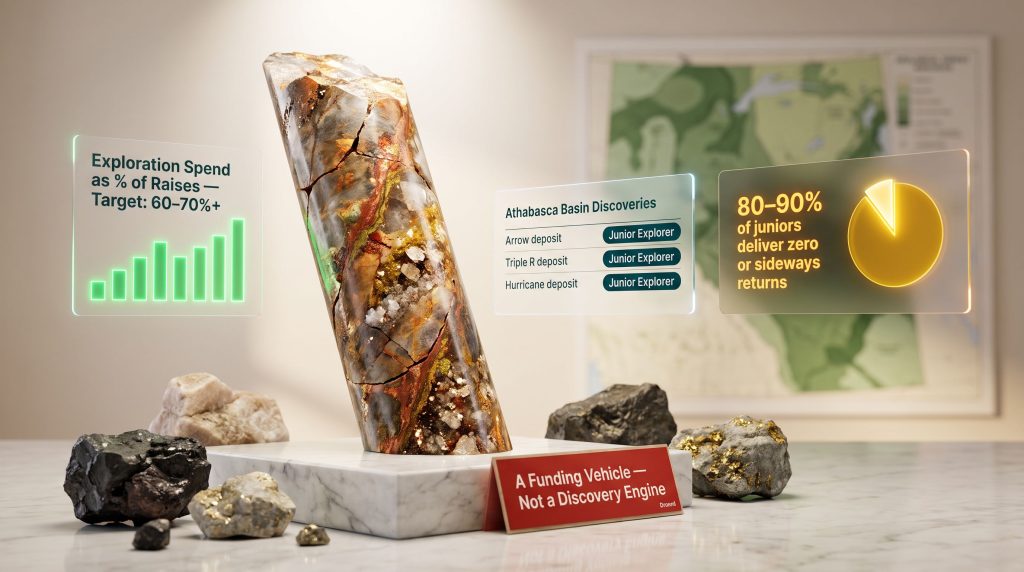
Most retail investors approaching the junior mining sector for the first time encounter a version of the same warning: most of these companies are lifestyle businesses, not real exploration operations. The statistic that usually accompanies this warning, that somewhere between 80% and 90% of junior miners deliver zero or sideways returns, is cited as though it settles the question entirely. Walk away. The sector is a trap.
However, here is the problem with that framing. The same base rate logic applies to early-stage venture capital, where the majority of portfolio companies also fail to return meaningful capital. The institutional response to that reality was not to abandon the asset class. It was to build better screening tools, apply them rigorously, and size positions to reflect the odds. The junior mining investment landscape has never developed that same institutional discipline at the retail level, and the junior mining lifestyle company label sits at the centre of that failure.
When a shorthand term designed to identify a specific, identifiable type of bad actor gets applied to an entire sector, it stops functioning as a screen. It becomes a rhetorical exit from the harder work of telling companies apart.
When big ASX news breaks, our subscribers know first
What the Junior Mining Lifestyle Company Label Was Actually Built to Do
The term originated as a precise investor criticism, not a broad sector verdict. It described a recognisable pattern: a small exploration company that raises equity from retail shareholders, pays its directors and executives competitive or above-market salaries, allocates minimal capital to actual geological work, and repeats the cycle indefinitely. The asset on paper, a mining claim or exploration licence, provides the promotional vehicle. The real business model is the recurring salary.
In this original, narrow sense, the label carries genuine diagnostic weight. The behaviours it targets are observable and auditable:
- General and administrative costs that consistently exceed direct exploration expenditure
- Compensation packages that do not move downward during commodity bear markets
- Option exercises followed immediately by share sales, rather than long-term holding
- An investor relations budget that rivals or exceeds the drilling budget
- No third-party technical validation, such as a joint venture partner committing its own capital
The minimum cost structure of a legitimate early-stage explorer provides a useful baseline. Regulatory compliance and exchange listing obligations typically consume somewhere between $50,000 and $80,000 annually. Add basic public company overhead, and a bare-bones operation sits at roughly $215,000 in annual fixed costs before a single dollar of capital reaches fieldwork. A company where G&A routinely surpasses exploration spend is almost certainly not running a research operation. It is running a funding vehicle.
That is what the label was built to find. The problem, consequently, is what happened to it after it escaped that specific context.
When Investor Shorthand Becomes Analytical Noise
Over time, the junior mining lifestyle company label drifted from a precise screen into a generalised dismissal. The logical leap from some juniors exist purely to pay salaries to all juniors without cash flow are suspect is not supported by the structure of the mining industry. It collapses a meaningful distinction: the difference between a company designed to enrich its management and a company designed to make a geological discovery.
Investors who conflate the two are not being rigorous. They are substituting a label for analysis, and that substitution carries a real cost. The part of the mining value chain where the largest return multiples are generated, five times, ten times, occasionally twenty times an initial position, is the exploration stage. Walking past it because of an imprecisely applied label means walking past the sector's highest-variance opportunities. Understanding the junior mining risks and rewards is essential before dismissing the sector outright.
Why Exploration Is a Distinct Asset Class, Not a Failed Form of Production
The mining industry operates on a clearly defined division of labour. Producers deliver yield. Developers deliver optionality on known deposits. Explorers deliver what neither producers nor developers can efficiently generate internally: discovery leverage. Judging an early-stage explorer by production metrics is analytically equivalent to evaluating a pharmaceutical research laboratory by its drug sales.
Over the past two decades, major mining companies have systematically reduced their internal exploration capacity. This was not accidental. Discovery risk is expensive, long-cycle, and does not sit comfortably inside quarterly reporting structures. The majors shed that risk deliberately, and it was absorbed, by design, into the junior sector. Junior explorers now function as the outsourced research and development division of the global mining industry.
Every mine that will matter to global supply in 2040 exists today as a geological concept in a junior company's project portfolio, or it does not exist yet at all. There is no other stage of the value chain where that future supply can be accessed as an investment.
This structural reality has a direct implication for how exploration companies should be assessed. The relevant question is not when does production begin. It is whether the company is running a disciplined geological research operation capable of making a discovery and transferring value through the discovery-to-development hand-off that defines how basins like Saskatchewan's Athabasca Basin have functioned for decades.
The Athabasca Basin as a Case Study in Junior-Led Discovery
The most persistent counterargument to the claim that exploration no longer works is the evidence from high-grade uranium discovery in the Athabasca Basin. Three significant finds within the past fifteen years all originated with junior explorers:
| Discovery | Company | Basin | Outcome |
|---|---|---|---|
| Arrow deposit | NexGen Energy | Athabasca Basin | Advancing through development stage |
| Triple R deposit | Fission Uranium | Athabasca Basin | Acquired by Paladin Energy in 2024 |
| Hurricane deposit | IsoEnergy | Athabasca Basin | Highest-grade indicated uranium resource globally |
Each of these discoveries followed the classic junior-to-developer hand-off. Paladin Energy's 2024 acquisition of Fission Uranium and its Patterson Lake project is a recent, concrete example of how that exit pathway functions when a junior explorer generates a legitimate discovery. The Hurricane deposit at IsoEnergy's Hurricane project stands as the highest-grade indicated uranium resource in the world, found by a company that had never produced a single pound of uranium.
The argument that declining discovery rates per dollar spent invalidate the exploration model confuses an average with a distribution. Furthermore, discovery is becoming harder and more expensive across the industry as a whole. That scarcity does not reduce the value of the discoveries that are made. It increases it. The premium commanded by genuine discovery is a direct function of how rarely it occurs. Understanding the mineral discovery curve helps investors contextualise where value is actually created in this process.
The Four Questions That Separate Real Explorers From Salary Vehicles
If the lifestyle company label is too blunt to be useful, what replaces it? Four operational questions, all answerable from public filings, do the work more precisely:
-
Does each drill program generate data that materially redesigns the next one? A geological research operation produces results that either vector toward discovery or eliminate a target, freeing capital for a better one. A company recycling the same geological story year after year without discarding failed targets is not running a research program.
-
Has the company ever killed a target? Systematic target elimination is a marker of scientific discipline. A portfolio of perpetually active targets with no historical eliminations is a warning sign, not evidence of thoroughness.
-
Who else has capital at risk on this ground? When a major producer like Cameco or Orano commits its own technical teams and funding to a junior's project through a joint venture, that commitment functions as independent due diligence that cannot be manufactured through marketing.
-
What fraction of each raised dollar reaches the drill bit? A junior allocating less than 60 to 70% of capital raised to direct exploration activity, drilling, assaying, geophysics, is structurally operating as a promotion and administration business, regardless of what its press releases say.
Reading the Financial Statements, Not the Press Releases
The treasury flow test is the most reliable single screen available to retail investors and requires no specialist geology background to apply:
| Financial Signal | What to Measure | What It Reveals |
|---|---|---|
| Exploration spend as % of raises | Target: 60–70%+ | Capital discipline and operational intent |
| G&A trend vs. commodity price | Should contract in bear markets | Degree of management alignment |
| IR and marketing spend relative to drilling | Should not dominate budget | Promotion vs. genuine research operation |
| Source of overhead funding | Partner fees vs. treasury drawdown | Who bears the cost of operations |
Why the 10-20% Insider Ownership Rule Fails Basic Arithmetic
One of the most widely repeated screening rules in junior mining holds that a credible CEO should own between 10% and 20% of the company and should participate in every equity raise. The alignment principle underlying this rule is valid. The metric used to measure it is not.
Junior exploration companies raise equity continuously, often across decades of operation. Dilution is not a failure; it is structurally unavoidable. For a CEO drawing a market salary, which in a well-run company should decline during bear markets, participating meaningfully in every placement requires substantial independent wealth. The test does not measure commitment to the project. It measures how wealthy the CEO was before joining the company.
The deeper problem is what this filter selects for in practice:
- High ownership at inception often reflects a prior successful capital raise elsewhere, not operational competence in building exploration companies from scratch
- Career operators who have spent decades building technical teams and drilling programs in exploration face structural disadvantages under this screen compared to well-capitalised first-time promoters
- The filter may systematically reward those who already had capital and penalise those who built their careers through technical discipline rather than promotional success
Insider ownership percentage measures a CEO's starting wealth and a company's dilution history. It tells an investor almost nothing about the executive's current conviction or the quality of the exploration program being funded.
Genuine alignment shows up on the other side of the ledger. The auditable signals that matter are whether compensation contracts when the commodity price falls, whether options that have been exercised are held or sold immediately, and whether overhead costs are being borne by the treasury or offset by management fees paid by joint venture partners.
| Alignment Signal | How to Verify | Why It Matters |
|---|---|---|
| Compensation trend vs. share price | Annual reports, MD&A sections | Reveals whether pay moves with investor outcomes |
| Options exercised and held vs. immediately sold | SEDI or insider filing databases | Indicates genuine long-term conviction |
| Salary benchmarked to market and cycle | Financial statements across multiple years | Identifies above-market extraction |
| Overhead funded by partner fees vs. treasury | JV agreements and financial statements | Shows whether cost burden falls on shareholders or validating majors |
The next major ASX story will hit our subscribers first
An Eight-Point Due Diligence Framework for Junior Explorer Investors
Replacing the junior mining lifestyle company label with a functional screening process requires discipline, but every element of the following framework is accessible through public filings. For instance, interpreting drill results is one skill that can markedly improve how investors evaluate exploration progress:
-
Audit the treasury flow across three years of financial statements. Calculate exploration spend as a percentage of total capital raised. The target benchmark is 60 to 70% or above.
-
Track management compensation against the commodity price cycle. Misalignment is most visible during bear markets, when aligned management accepts reduced compensation alongside declining shareholder value.
-
Examine the full insider transaction history. Static ownership percentages carry less information than the pattern of whether options are exercised and held or exercised and immediately sold.
-
Weight joint ventures with major producers heavily. A major committing its own capital and technical review to a junior's ground represents the closest thing to independent due diligence available in this sector.
-
Evaluate whether drill programs have ever eliminated targets. A disciplined geological operation kills concepts when the data warrants it. Perpetual optimism across every historical target is a promotional posture, not a scientific one.
-
Size positions to reflect the sector's base rate. With 80 to 90% of juniors delivering zero or sideways returns, no single name, however compelling the thesis, should represent a portfolio-moving position.
-
Monitor dilution against value creation. Raises are structurally unavoidable. The test is whether resource growth, partner commitments, and technically de-risked ground are expanding faster than the share count.
-
Define the discovery-to-development thesis before entering a position. Know in advance whether the realistic exit for this specific company is acquisition by a producer, a joint venture buy-in, or standalone development, and revisit that thesis at every material news event.
The Venture Capital Parallel
The institutional venture capital industry operates with comparable or worse odds than the junior mining sector. The response was not to abandon the asset class. It was to develop a rigorous, repeatable screening discipline, apply appropriate position sizing, and build portfolio construction practices that account for the base rate while positioning to capture the outliers that generate outsized returns.
Retail investment publishing has never developed that equivalent discipline for junior mining, and for understandable commercial reasons. A single poor recommendation in a retail newsletter generates subscriber losses that outweigh the subscription gains from a well-researched successful call. Declining to cover the sector is rational self-preservation for publishers. It is not an evidence-based verdict on whether the asset class has merit.
The investors who benefit from that coverage gap are those willing to apply the auditable framework above to public filings, rather than waiting for a label to do the analytical work for them. Resources such as Investing News Network's guidance on spotting quality junior miners and Stockhead's checklist for ASX junior mining caps can further supplement a disciplined due diligence approach.
FAQ: Understanding the Junior Mining Lifestyle Company Label
What is a lifestyle company in junior mining?
A junior mining lifestyle company is an early-stage exploration firm that raises equity primarily to sustain management salaries and overhead rather than to advance a mineral asset toward discovery or create shareholder value. It is an investor criticism, not a formal regulatory classification.
How can I identify a lifestyle company in the junior mining sector?
The most reliable indicators are G&A and salary costs that consistently exceed exploration expenditure, compensation that rises or holds steady during commodity bear markets, a pattern of option exercises followed immediately by share sales, and an absence of third-party technical validation such as a joint venture with a major producer.
Is insider ownership percentage a reliable screen for junior mining companies?
Not as a standalone metric. Ownership percentage is mechanically distorted by decades of necessary dilution and reflects a CEO's starting capital position more than ongoing conviction. Compensation history against the commodity cycle, option-holding behaviour, and the fraction of raised capital reaching the drill bit are more reliable indicators of alignment.
Why do major miners partner with junior explorers rather than exploring themselves?
Major producers systematically reduced internal exploration capacity over the past two decades, primarily because discovery-stage risk does not fit their balance sheet and reporting structures. Partnering with juniors through joint ventures allows them to access discovery-stage assets and share technical risk. When a major commits its own capital and technical staff to a junior's ground, it represents genuine independent assessment of geological merit.
What percentage of junior mining companies fail to deliver returns?
Industry estimates consistently place the proportion of junior mining companies delivering zero or sideways returns at 80 to 90%. This base rate makes position sizing and portfolio diversification the primary risk management tools for investors operating in this sector, rather than a basis for avoiding it entirely.
Disclaimer: This article is for informational and educational purposes only and does not constitute financial, investment, or professional advice. Junior mining exploration is a high-risk asset class. Past performance of individual companies or sectors does not guarantee future results. Investors should conduct their own due diligence and consider seeking independent financial advice before making investment decisions. All forecasts, projections, and sector-level statistics referenced in this article represent estimates and involve inherent uncertainty.
Want to Know Which ASX Junior Explorers Are Making Real Discoveries Right Now?
Discovery Alert's proprietary Discovery IQ model instantly identifies significant ASX mineral discoveries the moment they are announced, delivering real-time alerts that separate genuine exploration breakthroughs from promotional noise — explore the historic returns major mineral discoveries have generated and begin your 14-day free trial to position yourself ahead of the broader market.