July 27, 2026
Why the Kabanga Nickel Project FID Is a Supply-Side Inflection Point for Battery Metals
The global race to secure battery-grade nickel supply outside of Chinese and Indonesian processing networks has intensified considerably over the past three years. Structural demand from electric vehicle manufacturers, combined with tightening ESG mandates from institutional investors and Western government procurement frameworks, has fundamentally altered how capital allocators evaluate early-stage critical mineral projects. Against this backdrop, the progression of the Kabanga Nickel Project FID toward a mid-2026 decision gate represents something far more significant than a single corporate milestone.
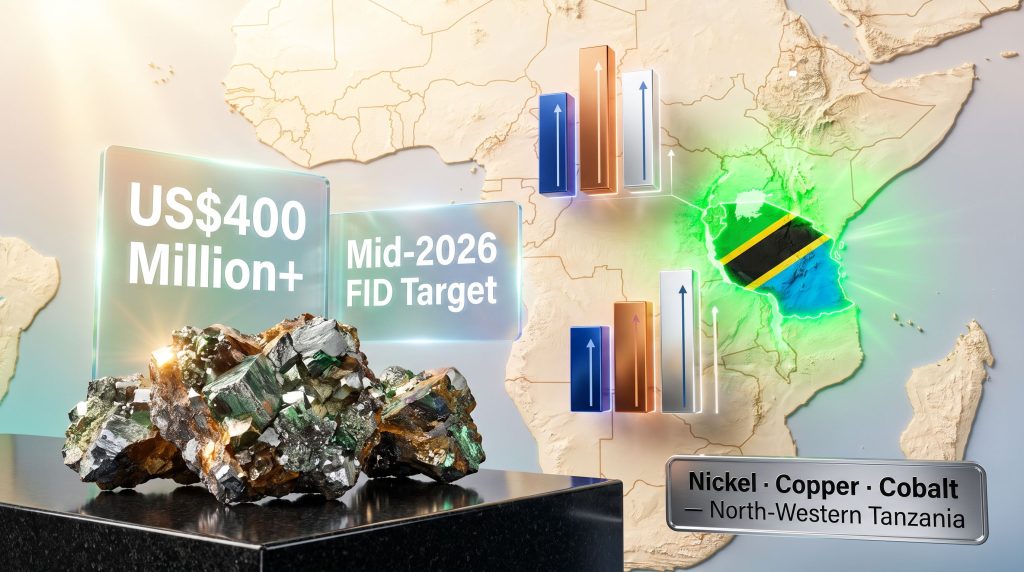
Kabanga sits in north-western Tanzania and has been characterised by its developer, Lifezone Metals, as one of the largest undeveloped nickel sulfide deposits anywhere on earth. With more than US$400 million committed to the project across its full development history and a NYSE-listed vehicle advancing execution-readiness activities, Kabanga occupies a unique position in the global battery metals development pipeline.
What a Final Investment Decision Actually Means in Large-Scale Mining
The term FID is widely used but frequently misunderstood outside of project finance and mining circles. A Final Investment Decision is the formal commitment by a project's board and its financing syndicate to deploy full construction capital. It is the point at which a development-stage asset transitions into an execution-stage programme, triggering contractor mobilisation, debt drawdown schedules, and the activation of binding offtake arrangements.
A Final Investment Decision in mining is the formal approval by a project's board and financiers to commit full construction capital. It marks the transition from development-stage to execution-stage, triggering contractor mobilisation, debt drawdown, and binding offtake activation.
Critically, FID is not synonymous with feasibility completion or permitting approval. Projects can satisfy both of those conditions and still fail to reach FID if financing markets are closed or offtake counterparties are unwilling to commit. The distinction matters enormously for investors assessing execution risk.
When big ASX news breaks, our subscribers know first
Project Fundamentals: Scale, Geology, and Ownership
Why Sulfide Deposits Command a Premium Over Laterite Alternatives
Understanding Kabanga's strategic value requires a working knowledge of nickel deposit geology. The world's nickel resources are broadly divided into two categories: sulfide deposits and laterite deposits. Laterites account for the majority of global nickel resources by tonnage but are processed using energy-intensive and technically complex methods, most notably High-Pressure Acid Leaching (HPAL). HPAL plants carry significant capital cost overruns historically and produce elevated carbon emissions per tonne of refined nickel.
Nickel sulfide deposits like Kabanga, by contrast, are amenable to conventional flotation and smelting technology. This produces Class I battery-grade nickel at meaningfully lower energy cost, lower capital intensity per unit of output, and substantially lower carbon intensity. For battery supply chain buyers operating under Scope 3 emissions targets, the provenance and processing pathway of nickel inputs has become a genuine procurement criterion.
| Attribute | Detail |
|---|---|
| Location | North-western Tanzania |
| Primary Commodities | Nickel, Copper, Cobalt |
| Project Type | Integrated mine-to-metal operation |
| Cumulative Investment to Date | More than US$400 million |
| Previous Owner | BHP (divested 2021) |
| Current Developer | Lifezone Metals |
| NYSE Listing | Yes (Lifezone Metals) |
Kabanga's sulfide mineralogy means the ore can be processed via flotation to produce a concentrate, which is then refined into battery-grade nickel, copper, and cobalt products. The integrated mine-to-metal model pursued by Lifezone is designed to capture value across the full processing chain rather than simply selling a concentrate to third-party smelters, which is the conventional approach for junior mining developers.
From BHP's Portfolio to Lifezone's Development Mandate
BHP's decision to divest Kabanga in 2021 reflected the major miner's broader portfolio strategy during a period of commodity price volatility and internal capital allocation discipline. At the time, BHP was consolidating around its core iron ore, copper, and potash growth pillars. Kabanga, while recognised as a world-class deposit, required a scale of patient capital and execution commitment that sat outside BHP's strategic priorities at the time.
Lifezone Metals subsequently acquired the project and has advanced it systematically through feasibility work and into pre-FID execution-readiness. The significance of a junior developer carrying forward an asset relinquished by one of the world's largest mining companies should not be underestimated. It reflects both the depth of conviction Lifezone has placed in the project's economics and the growing appetite of capital markets for non-Chinese battery metal exposure within the broader battery metals investment landscape.
Tanzania as a Mining Jurisdiction: Context Investors Cannot Ignore
Tanzania's regulatory environment for large-scale foreign mining investment has undergone meaningful evolution over the past decade. The country experienced a period of resource nationalism in the late 2010s, most visibly through export restrictions and royalty renegotiations that unsettled foreign investors. Since then, the government has worked to rebuild investor confidence through revised mining legislation and more structured frameworks for foreign project development.
For Kabanga specifically, the Tanzanian government participates in the project's ownership and financing architecture. This participation structure is a standard feature of large-scale Tanzanian resource development and reflects the government's policy of capturing economic benefit from national resource endowments. Lender due diligence on any project financing package will scrutinise the stability and enforceability of these arrangements as a core jurisdictional risk variable.
The 2026 FID Timeline: Where Execution-Readiness Stands
Key Milestones Between 2025 and the Mid-2026 Decision Window
Lifezone has been executing a structured pre-FID programme funded by a US$75 million capital raise completed in the second half of 2025. This capital has been deployed across geotechnical mobilisation, procurement workstreams, and the advancement of engineering studies necessary to satisfy lender technical due diligence requirements. Furthermore, Lifezone Metals has publicly outlined how these execution milestones are progressively reducing development risk ahead of the decision gate.
Key Milestone Sequence:
- H2 2025: US$75 million raise completed, fully funding pre-FID activities through to the decision point
- Q1 2026: Geotechnical mobilisation and procurement workstreams formally initiated
- Mid-2026: Targeted window for FID and financing close
The deployment of US$75 million specifically to fund pre-FID activities signals a serious institutional commitment to reaching the decision gate. Pre-FID capital of this magnitude is not easily written off, and its deployment creates organisational and financial momentum that increases the cost of deferral.
The Four Critical Dependencies That Must Be Resolved Before FID
Despite the progress made, the Kabanga Nickel Project FID cannot be declared until four interdependent conditions are satisfied:
- Project Financing Close – The debt and equity financing package must be fully committed. This is universally identified as the primary gating item. Without lender commitment, no other workstream is sufficient to trigger FID.
- Binding Offtake Agreements – Commercial arrangements with downstream nickel buyers or battery material processors must be formalised. Lenders require offtake certainty to underpin revenue assumptions in their project finance models.
- Final Regulatory and Environmental Approvals – In-country permitting and environmental clearance from Tanzanian authorities must be complete, satisfying both regulatory and lender compliance requirements.
- EPC Contractor Engagement – Engineering, procurement, and construction contractor selection must reach a stage where mobilisation readiness is confirmed, providing lenders with construction execution confidence.
Critical Path Note: Project finance specialists consistently identify the financing package as the single most consequential gating item ahead of FID. Until debt commitments are formalised, all other workstreams remain conditional, regardless of their individual completion status.
The Economics Behind the Kabanga FID Decision
Nickel Market Conditions and Their Influence on Project Economics
The nickel price environment entering 2026 has been shaped substantially by the rapid expansion of Indonesian nickel supply, driven by Chinese-backed HPAL processing investment. This supply surge compressed spot nickel prices significantly from their 2022 peaks, creating a challenging economic backdrop for projects still seeking financing close.
Kabanga's economics are anchored to the Class I nickel price rather than the broader Class II market. Class I nickel commands a premium over Class II because it meets the purity specifications required for lithium-ion battery cathode manufacturing. This premium provides partial insulation from the broader price compression driven by Indonesian Class II-equivalent supply, however the structural relationship between the two markets means Class I pricing is not immune to the downward pressure.
Three FID Outcome Scenarios and Their Market Implications
| Scenario | Trigger Conditions | Market Impact |
|---|---|---|
| Base Case: FID Declared Mid-2026 | Financing close achieved; nickel price stabilises above project breakeven threshold | Positive signal for African critical mineral development; tightening in Class I offtake market |
| Delayed FID: H2 2026 or Beyond | Financing package requires restructuring; lender conditions unmet on schedule | Re-entry into market uncertainty; Tanzania jurisdiction confidence tested |
| FID Deferred Indefinitely | Sustained nickel price weakness below project economics; financing market closes | Supply gap widens for battery-grade sulfide nickel; strategic acquirer interest increases materially |
The third scenario carries a counterintuitive implication: an indefinite deferral would likely increase Kabanga's attractiveness to a strategic acquirer, particularly a major miner or battery manufacturer seeking to secure long-duration Class I nickel exposure at a depressed entry valuation. BHP's original exit from the asset does not preclude re-entry interest from other majors under changed circumstances.
Kabanga Within Africa's Critical Minerals Investment Landscape
The Demonstration Effect of a Successful African Nickel FID
Africa hosts a substantial proportion of the world's undeveloped critical mineral resources, yet the continent remains underrepresented in funded, construction-ready battery metals projects. Financing risk premiums associated with African jurisdictions, combined with infrastructure deficits and complex permitting environments, have historically constrained the conversion of exploration success into operational mines. Consequently, the link between critical minerals and energy security has made resolving these constraints an increasingly urgent policy priority for Western governments.
A positive Kabanga Nickel Project FID would carry a meaningful demonstration effect for the broader African critical minerals development pipeline. It would validate that large-scale, integrated battery metal development in sub-Saharan Africa is bankable under current financing market conditions, creating a precedent that subsequent project developers could reference in their own debt discussions.
Western Supply Chain Reorientation and the Geopolitical Premium on Tanzanian Nickel
Legislative frameworks including the US Inflation Reduction Act and the EU Critical Raw Materials Act have created structural demand incentives for battery supply chains that source materials from jurisdictions outside China's processing sphere. Kabanga's mine-to-metal model, producing traceable, low-carbon Class I nickel outside of Chinese or Indonesian refining infrastructure, positions the project as a potential beneficiary of this demand-side reorientation. In addition, the accelerating pace of battery storage expansion globally is intensifying downstream demand for precisely the kind of ethically sourced, high-purity nickel that Kabanga is designed to produce.
The geopolitical premium attached to non-Indonesian, non-Chinese nickel sulfide supply is not simply theoretical. Western original equipment manufacturers assembling battery supply chains that satisfy IRA content requirements have a direct commercial interest in the existence of alternative Class I nickel sources. Whether Kabanga can satisfy the specific traceability and content requirements of IRA-compliant supply chains will depend on the project's final ownership and processing arrangements.
The next major ASX story will hit our subscribers first
Investment Risk Framework: Pre-FID vs. Post-FID Exposure
Key Risks That Could Derail the Kabanga FID Timeline
Risk Register Summary:
- Financing market conditions – Rising cost of project finance debt in a higher-for-longer interest rate environment increases the required equity return hurdle and may alter the project's financing structure
- Nickel price trajectory – Sustained price weakness below the project's breakeven threshold directly undermines lender confidence in revenue assumptions
- Jurisdictional risk – Regulatory or political changes in Tanzania affecting royalty terms, export conditions, or government participation structures
- Execution complexity – The integrated mine-to-metal model introduces multi-stage technical risk beyond conventional mine development, including hydromet processing performance
- Offtake market dynamics – Battery supply chain restructuring, OEM demand forecasting revisions, or the entry of competing Class I nickel sources may alter demand-side commitment timelines
The NYSE listing of Lifezone Metals provides one meaningful structural advantage in managing these risks: it creates ongoing public market transparency, broadens the institutional investor base available for equity capital raises, and imposes reporting disciplines that build lender confidence in management governance. Independent project analysts have noted that the systematic completion of execution milestones has progressively de-risked the development pathway.
Who Stands to Benefit Most from a Positive FID
The beneficiaries of a successful Kabanga FID extend well beyond Lifezone's own shareholder register:
- Battery manufacturers and OEMs seeking traceable, low-carbon Class I nickel supply outside Chinese processing networks
- Development finance institutions with African industrialisation mandates and critical mineral supply chain objectives
- Engineering and construction contractors with African mining project execution capability seeking large-scale contract awards
- The Tanzanian government and local communities through royalty revenues, employment creation, and infrastructure co-investment
Frequently Asked Questions: Kabanga Nickel Project FID
When Is the Kabanga Nickel Project FID Expected?
Lifezone Metals has targeted mid-2026 as the planned FID and financing close window, supported by pre-FID execution-readiness activities that commenced in Q1 2026.
How Much Has Been Invested in the Kabanga Nickel Project to Date?
More than US$400 million has been committed across the project's full development history, including the pre-FID capital programme funded through the US$75 million raise completed in H2 2025.
What Commodities Will Kabanga Produce?
Kabanga is structured as an integrated mine-to-metal operation targeting nickel, copper, and cobalt, all critical inputs for lithium-ion battery cathode manufacturing.
Why Did BHP Sell the Kabanga Project?
BHP divested Kabanga in 2021 as part of a broader portfolio rationalisation strategy during a period of internal capital allocation prioritisation. Lifezone Metals subsequently acquired the project and has advanced it through feasibility and into pre-FID execution-readiness.
What Is the Biggest Risk to the Kabanga FID?
Project financing is consistently identified as the primary gating dependency. Until the debt and equity financing package is fully committed, the FID cannot be formally declared regardless of the status of other workstreams.
Is Kabanga One of the World's Largest Nickel Sulfide Deposits?
Lifezone Metals has characterised Kabanga as one of the world's largest undeveloped nickel sulfide deposits, a classification that underpins its strategic value to battery supply chain investors and offtake counterparties.
The Three Variables That Will Define the Kabanga FID Outcome
Regardless of the broader narrative around African critical mineral development or Western supply chain reorientation, the Kabanga Nickel Project FID will ultimately be determined by three interconnected variables:
| Variable | Current Status | FID Impact |
|---|---|---|
| Financing Package | Primary gating item; the defining question as of mid-2026 | Must close for FID to proceed |
| Nickel Price Environment | Compressed by Indonesian supply; Class I premium provides partial offset | Must remain above project breakeven threshold |
| Tanzanian Regulatory Framework | Broadly supportive; government participation structures in place | Stability required to satisfy lender due diligence |
If all three variables align, a positive Kabanga FID would represent more than a single project reaching construction. It would signal that large-scale, integrated battery metal development in sub-Saharan Africa has crossed the threshold of commercial viability in a risk-averse lending environment, and that the Western battery supply chain diversification agenda has a credible new anchor asset to build around.
This article is intended for informational purposes only and does not constitute financial advice. Statements regarding project timelines, financing outcomes, and commodity price assumptions involve inherent uncertainty and should not be relied upon as predictions of future performance. Investors should conduct independent due diligence before making any investment decisions related to the companies or projects discussed.
Want to Stay Ahead of the Next Major Battery Metals Discovery?
Discovery Alert's proprietary Discovery IQ model scans ASX announcements in real time, instantly identifying significant mineral discoveries across nickel, copper, cobalt, and more than 30 other commodities — translating complex data into clear, actionable insights for investors at every level. Explore historic discoveries and the returns they generated, then begin your 14-day free trial to ensure you're positioned before the broader market moves.