July 27, 2026
The Structural Forces Reshaping How Critical Minerals Projects Reach Public Markets
Something fundamental is changing in the way mineral development companies approach capital formation. Across the ASX and other exchanges, a pattern is emerging where diversified exploration portfolios are being disaggregated into focused, single-thesis vehicles before they reach public markets. This is not merely a financial engineering exercise. It reflects a deeper recognition that commodity-specific investor bases, distinct risk profiles, and divergent development timelines make bundled assets structurally inefficient at attracting the right capital at the right price.
The BRE Brazil bauxite-gallium project IPO, executed through the spin-out of Alurion Resources, is one of the clearest recent examples of this structural shift in action. However, to understand why this transaction matters beyond its headline figures, it is worth examining what it reveals about investor appetite, commodity convergence, and the changing geography of global mineral supply chains.
When big ASX news breaks, our subscribers know first
Why Demergers Are Becoming the Preferred Capital Tool in Critical Minerals
The logic of separating a bauxite-gallium asset from a rare earths portfolio is rooted in how institutional investors allocate capital. Rare earths and bauxite-gallium are governed by different demand cycles, different end-use industries, and different geopolitical risk narratives. When both assets sit within a single listed vehicle, neither receives the full attention of specialist capital.
By carving out Alurion Resources as a standalone ASX-listed entity, Brazilian Rare Earths created a structure where the Amargosa asset can attract investors whose thesis is specifically tied to bauxite supply diversification, aluminium feedstock security, or the gallium criticality narrative. Meanwhile, BRE itself can sharpen its identity around rare earths development, most immediately through the Monte Alto Scoping Study anticipated in August 2026.
This demerger approach has several practical advantages over a traditional capital raise within an existing vehicle:
- It creates a clean, traceable valuation for each asset independently
- It allows separate management teams to develop asset-specific expertise
- It reduces the conglomerate discount that often suppresses the market capitalisation of multi-commodity explorers
- It opens access to different investor registries without diluting the parent's share structure unnecessarily
- It signals a level of asset maturity that warrants independent governance
The shareholder response was unambiguous. At the general meeting held on 10 July 2026, the demerger proposal received a 99.94% approval vote, one of the highest endorsement rates recorded for a transaction of this kind on the ASX in recent memory.
Inside the Alurion IPO Structure: How the Numbers Work
Understanding the mechanics of the Alurion Resources IPO requires looking at both the demerger ratio and the capital raise simultaneously, since they together determine the post-listing ownership architecture.
Structure at a Glance:
BRE shareholders received 0.5607 Alurion shares for every BRE share held, establishing a broad and distributed initial register. The IPO itself issued 47,619,048 fully paid ordinary shares at A$1.05 per share, raising approximately A$50 million (USD 24.5 million). Following the IPO, BRE retains a strategic ~16% stake in Alurion, maintaining an economic interest in the asset while enabling independent governance. Alurion is expected to trade on the ASX under the ticker ALU, with trading commencement targeted around 3 August 2026, subject to regulatory conditions.
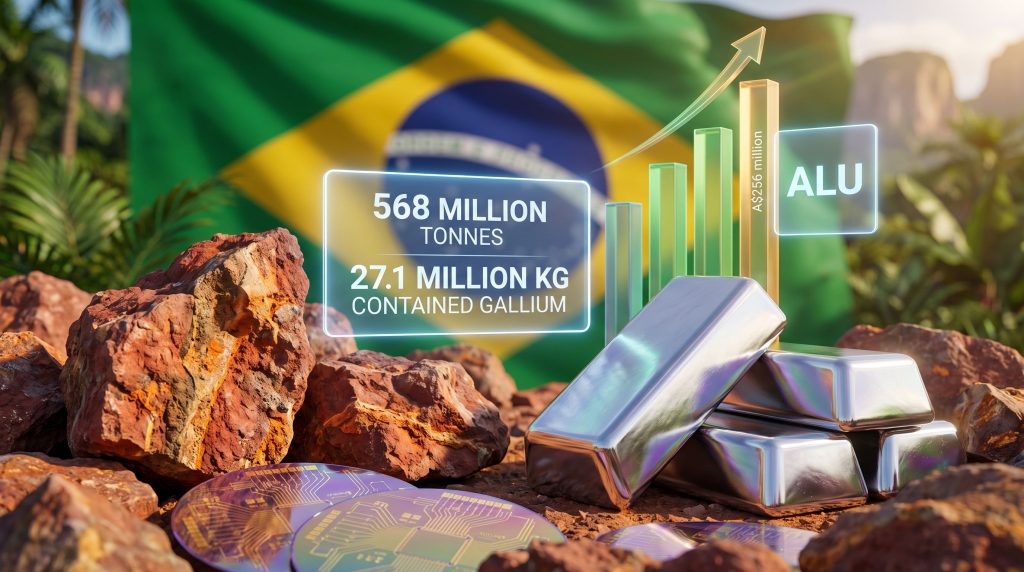
At the A$1.05 offer price, the implied undiluted equity market capitalisation of Alurion at IPO sits at approximately A$256 million, a figure that commands attention given the project is pre-production and pre-feasibility. The fact that the raise was oversubscribed suggests institutional and sophisticated retail investors placed a meaningful premium on the forward value of both the bauxite resource and, critically, the gallium endowment.
The A$50 million in proceeds is allocated across a range of near-term priorities:
- Land acquisition and tenure consolidation across the Amargosa footprint
- Technical feasibility and preliminary engineering studies
- Environmental licensing and Brazilian regulatory compliance processes
- Community engagement programmes and social licence development
- Exploration drilling to extend and refine the existing resource
- Equipment procurement and site safety infrastructure
What the Amargosa Project Actually Represents
The Amargosa Bauxite-Gallium Project is located in the state of Bahia, in northeastern Brazil, a region that has become increasingly prominent in global critical minerals discussions. The project carries more than a decade of exploration history, having been initially worked by Rio Tinto before Brazilian Rare Earths recognised its broader strategic potential and advanced the asset further.
The JORC-compliant resource figures are among the most significant aspects of this project:
| Resource Metric | Reported Figure |
|---|---|
| Total JORC Resource | 568 million tonnes |
| Contained Gallium | ~27.1 million kg |
| Estimated Project Capex | USD 119 million |
| Distance to Export Port | ~160 km (Porto de Enseada) |
| Exploration History | 10+ years |
The 568 million tonne JORC resource places Amargosa firmly within the scale range of globally significant bauxite developments. However, what genuinely differentiates this asset from comparable bauxite projects is the 27.1 million kilograms of contained gallium, a figure that has no meaningful equivalent in the conventional bauxite development pipeline.
Gallium is not mined directly. It is recovered as a byproduct during the processing of bauxite through the Bayer process, which refines bauxite into alumina. This means bauxite deposits with elevated gallium concentrations carry an embedded critical minerals optionality that is rarely priced into early-stage resource valuations. At Amargosa, that optionality is significant in scale.
The project's proximity to established export infrastructure further reduces the logistics risk profile. At approximately 160 kilometres by road to Porto de Enseada, Amargosa has access to bulk commodity export capacity without requiring the kind of greenfield infrastructure investment that can make remote deposits economically marginal.
Gallium's Growing Strategic Importance: Why This Mineral Changes the Investment Thesis
To understand why the gallium component of the BRE Brazil bauxite-gallium project IPO attracted so much investor attention, it is necessary to understand what gallium actually does and why its supply geography has become a focal point for governments and technology companies alike.
Gallium is an essential input across several high-growth technology sectors:
- Semiconductors: The role of gallium in semiconductors, particularly gallium nitride (GaN), enables more efficient energy conversion in devices ranging from smartphone chargers to electric vehicle inverters
- Defence systems: Gallium arsenide (GaAs) is integral to radar systems, electronic warfare platforms, and satellite communications
- LED lighting and solar cells: Gallium compounds underpin the efficiency characteristics of high-performance photovoltaic and lighting technologies
- 5G infrastructure: GaN-based components are central to the radio frequency amplification systems used in 5G base stations
Why gallium supply concentration matters: China currently accounts for the dominant share of global gallium refining capacity, estimated at well over 80% of world production according to multiple industry and government sources. In 2023, China implemented export controls on gallium and germanium, citing national security considerations. This action sent an immediate signal to Western governments and technology supply chains about the risks of single-source dependency for materials with no commercially viable substitutes in many applications.
Furthermore, critical mineral export controls have become an increasingly prominent geopolitical tool, and China's export control strategy has prompted governments across North America, Europe, and the Indo-Pacific to accelerate domestic and allied-nation sourcing programmes. For a project like Amargosa, which hosts 27.1 million kilograms of contained gallium within its bauxite resource, the strategic positioning is considerable.
It is worth noting that gallium recovery from bauxite processing is technically well understood, having been practiced at scale in alumina refineries in China, Germany, and elsewhere. The incremental capital cost of adding gallium recovery circuits to an alumina refinery is modest relative to the total project capital, making the economics of co-production genuinely compelling at elevated gallium prices.
Comparing Amargosa to the Broader Bauxite Development Landscape
To contextualise the Amargosa asset within the global bauxite development pipeline, the following comparison highlights key differentiating factors:
| Comparison Factor | Amargosa (Alurion) | Typical Tier-1 Bauxite Project |
|---|---|---|
| Resource Scale | 568 Mt JORC | 200 to 800 Mt range |
| Secondary Critical Mineral | Gallium (27.1M kg) | Typically absent |
| Export Port Proximity | ~160 km | Varies widely |
| Development Stage | Pre-feasibility / IPO stage | Varies by project |
| Listed Vehicle | ASX: ALU | Multiple exchanges |
| Exploration Pedigree | Originally Rio Tinto | Varies |
The dual-commodity structure is the standout differentiator. Most large-scale bauxite projects are evaluated solely on aluminium content, recovery rates, and logistics economics. Amargosa carries an additional investment thesis layer that creates a secondary demand signal from technology and defence sector offtake interest, a category of buyer that does not typically engage with conventional bauxite project developers.
The next major ASX story will hit our subscribers first
Brazil's Position in the Global Bauxite Supply Chain
Brazil is already one of the world's largest bauxite producers and exporters, with significant established infrastructure across the Para and Minas Gerais regions. The Bahia state, where Amargosa is located, represents an emerging frontier within Brazil's broader bauxite geography, with the benefit of existing port infrastructure at Porto de Enseada capable of handling bulk mineral exports.
Global bauxite production patterns are shifting as demand grows alongside aluminium consumption in electric vehicle components, packaging, and construction materials. Brazil's bauxite exports serve refineries across Asia, the Middle East, and Europe, and the country's geological endowment in aluminium-bearing laterites is among the deepest in the world.
From a broader supply chain perspective, a Brazilian gallium source carries strategic appeal for Western technology companies and their governments, who are actively working to reduce exposure to China's export control strategy over critical mineral supply. While no specific offtake agreements have been publicly disclosed at this stage of the project's development, the combination of scale, location, and gallium endowment creates a credible foundation for future commercial discussions.
What Investors Need to Understand Before Evaluating Junior Critical Minerals IPOs
The Alurion IPO's oversubscription reflects genuine investor enthusiasm, but it also serves as a useful moment to examine the risk framework that should accompany any investment evaluation of a development-stage critical minerals company. In addition, the broader critical minerals demand surge creates both opportunity and heightened competition for capital across the sector.
Key risk factors specific to Alurion and comparable junior critical minerals listings include:
- No production revenue at IPO: The company is entirely pre-revenue, with the full USD 119 million project capex yet to be deployed and a feasibility study not yet completed
- Commodity price exposure: Both bauxite and gallium prices are subject to demand cycles, trade policy shifts, and technological substitution over multi-year development timelines
- Brazilian permitting complexity: Environmental licensing in Brazil operates through a multi-tiered federal and state system that has historically introduced schedule uncertainty for mineral projects
- Currency risk: Capital is raised in Australian dollars, project development costs are largely in Brazilian reais, and commodity revenues would be denominated in US dollars, creating a three-currency exposure
- Single-asset concentration: Alurion is entirely dependent on the Amargosa project succeeding, with no producing operations or diversifying revenue streams at the time of listing
A note for readers: This article is informational in nature and does not constitute financial advice. Investment in junior mining and exploration companies carries material risk, including the possibility of total capital loss. Readers should seek independent financial advice before making any investment decisions.
The Path Forward: What Happens After the ASX Listing
With the IPO capital secured and ASX listing imminent, Alurion's immediate priorities are well-defined. Environmental licensing will be the critical regulatory gating item, as Brazilian law requires comprehensive environmental impact assessments before mining leases can be converted to operational tenements. This process involves engagement with federal and state environmental agencies and can extend across several years for large-scale projects.
In parallel, technical studies will progress toward a formal pre-feasibility study, which will define mining methods, processing flowsheet options including potential gallium recovery circuits, infrastructure requirements, and refined capital cost estimates. The USD 119 million capex estimate currently on record is a pre-feasibility level figure and will be refined through this process.
Exploration drilling to extend the existing 568 million tonne JORC resource represents another near-term capital deployment priority. The current resource footprint may not fully reflect the extent of the mineralised system, and resource growth through systematic drilling could materially enhance the project's economic profile ahead of a feasibility study.
For BRE, the successful completion of the Alurion demerger and IPO represents a strategic pivot point. With the Monte Alto Scoping Study expected in August 2026, the company's rare earths narrative in Bahia is approaching a key technical milestone. The capital discipline demonstrated through the Alurion spin-out reinforces management's commitment to creating focused, appropriately capitalised development vehicles rather than managing an undifferentiated portfolio.
Frequently Asked Questions
What is the Alurion Resources IPO?
Alurion Resources is a newly listed ASX company formed through the demerger of the Amargosa Bauxite-Gallium Project from Brazilian Rare Earths. The IPO raised A$50 million at A$1.05 per share to fund the development of the Amargosa project in Bahia, Brazil.
What is the Amargosa project's JORC resource?
The project hosts a maiden JORC-compliant resource of 568 million tonnes containing approximately 27.1 million kilograms of gallium, making it one of the most significant known dual-commodity bauxite-gallium deposits currently in development globally.
Why is gallium considered a critical mineral?
Gallium is used in semiconductors, defence electronics, LED systems, solar panels, and 5G infrastructure. With China controlling the majority of global gallium refining capacity and having implemented export controls, Western nations are actively seeking alternative supply sources.
What stake does BRE retain in Alurion post-IPO?
Brazilian Rare Earths retains approximately 16% of Alurion Resources following the demerger and IPO process, maintaining an economic interest whilst enabling the new entity to operate with independent governance.
When does Alurion begin trading?
Trading on the ASX under the ticker ALU is expected to commence around 3 August 2026, subject to regulatory approvals and listing conditions.
What are the funds from the IPO being used for?
The A$50 million raised will be directed toward land acquisition, environmental licensing, technical and feasibility studies, exploration drilling, community engagement, and equipment procurement.
For broader context on global bauxite and alumina supply-demand dynamics, trade flows, and price trajectories, readers can explore the Global Bauxite and Alumina Market Forecast to 2036 published by AL Circle, which provides detailed coverage of the sector's structural evolution through the coming decade.
Want to Know When the Next Major ASX Critical Minerals Discovery Gets Announced?
Discovery Alert's proprietary Discovery IQ model delivers real-time alerts the moment significant mineral discoveries hit the ASX, transforming complex commodity data into actionable insights for both short-term traders and long-term investors — explore historic discoveries and their returns to understand the scale of opportunity, then start your 14-day free trial to position yourself ahead of the broader market.