
May 23, 2026
Why Nickel Supply Chain Geography Is Reshaping Project Economics
The global mining industry is navigating a structural inflection point in how critical mineral supply chains are evaluated, financed, and built. For nickel specifically, the fault line runs along geography and metallurgy: laterite deposits dominate production volumes but carry higher processing costs and greater carbon footprints, while high-grade nickel sulfides remain comparatively rare, deeply sought after, and disproportionately financeable. Understanding this distinction is the first step to appreciating why the Kabanga Nickel Project FID process has attracted institutional attention from sovereign investors, major mining companies, development finance institutions, and export credit agencies simultaneously.
The nickel demand profile has bifurcated in ways that matter enormously for project selection. Battery manufacturers require Class I nickel, the high-purity refined product derived predominantly from sulfide processing routes. Industrial alloy producers require similar specifications. Laterite-derived nickel, processed through high-pressure acid leach or rotary kiln electric furnace routes, carries substantially higher energy intensity and capital cost per unit of output. The sulfide advantage is structural, not cyclical, and it explains why undeveloped high-grade sulfide deposits command attention far exceeding what their reserve tonnage alone would justify.
When big ASX news breaks, our subscribers know first
Kabanga's Geological Position Within the Global Nickel Landscape
Why High-Grade Sulfide Deposits Are Structurally Rare
Nickel sulfide deposits form through a specific magmatic process in which nickel-bearing magma intrudes into the crust and undergoes sulfide saturation, concentrating nickel, copper, and cobalt into dense ore bodies. The conditions required are geologically uncommon, which is why the inventory of large, undeveloped high-grade nickel sulfide resources worldwide is extremely limited. Kabanga, located in northwestern Tanzania, sits within the East African Rift system and represents one of the most significant undeveloped sulfide nickel resources identified globally.
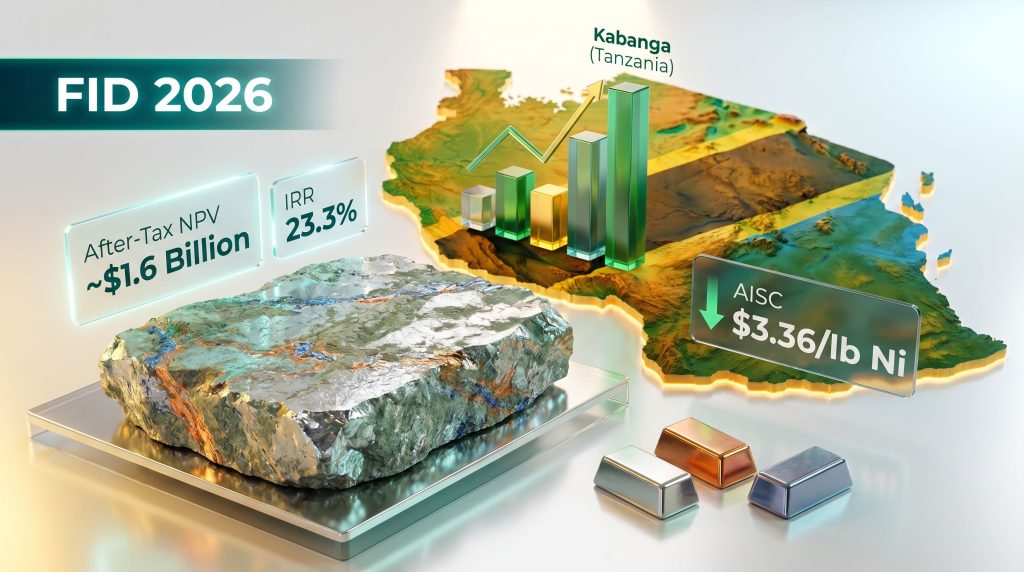
The deposit's multi-metal character adds meaningful economic depth. Copper and cobalt byproducts are recovered alongside nickel, and their credit values reduce the all-in sustaining cost of nickel production to $3.36 per pound on a net byproduct basis. This figure positions Kabanga within the lower cost quartile of global nickel producers, a structural cost advantage that persists across a wide range of nickel price scenarios.
Furthermore, the critical minerals demand landscape amplifies the strategic value of projects like Kabanga, as policymakers and manufacturers increasingly prioritise secure, low-carbon supply chains. The feasibility study completed in July 2025 quantified the project's economics as follows:
| Economic Metric | Kabanga Value |
|---|---|
| After-Tax NPV | ~$1.6 billion |
| Internal Rate of Return | 23.3% |
| AISC (net of byproduct credits) | $3.36/lb nickel |
| Primary Byproducts | Copper, Cobalt |
| Mine Life | ~18 years |
An IRR of 23.3% places Kabanga above the typical range of 10–18% observed across peer mining projects at comparable development stages, a reflection of both ore grade advantage and the byproduct revenue diversification that laterite-only projects cannot replicate.
How Kabanga Compares Across Key Project Metrics
| Metric | Kabanga (Tanzania) | Typical Peer Projects |
|---|---|---|
| Deposit Type | High-grade sulfide | Laterite or lower-grade sulfide |
| After-Tax NPV | ~$1.6 billion | Variable |
| IRR | 23.3% | Typically 10–18% |
| AISC (net of byproducts) | $3.36/lb Ni | Generally higher |
| Primary Byproducts | Copper, Cobalt | Limited or none |
| Mining Licence Status | Special Mining Licence secured | Often pending |
High-grade nickel sulfide deposits generate above-average debt service capacity relative to their capital requirement compared to laterite projects, creating a structurally more financeable project at equivalent scale. This is the core thesis underpinning the approximately 60/40 debt-to-equity structure being advanced with project financing institutions.
What FID Actually Means in Large-Scale Mining Development
The Threshold Between Planning and Committed Capital
The definitive feasibility study is one critical precursor, but Final Investment Decision itself is one of the most consequential governance events in the lifecycle of a large mine. It marks the formal transition from study-phase planning, where capital is being spent to evaluate whether to build, to construction-phase execution, where capital is committed to building. The distinction carries profound implications for project governance, lender obligations, off-take partner commitments, and equity investor exposure.
Before FID, a project can be abandoned at relatively bounded cost. After FID, sunk capital grows rapidly and the cost of abandonment escalates accordingly. This asymmetry is why every major stakeholder in the financing ecosystem — lenders, strategic equity investors, off-take counterparties, and government partners — requires their respective conditions to be satisfied before FID can be authorised.
It is also why tracking a project's distance from FID provides more analytically useful information than tracking its distance from permitting completion or feasibility sign-off. Both of those milestones are necessary but insufficient. FID is the moment at which the probability of construction commencing moves from conditional to committed.
What Must Align Before FID Can Be Authorised?
FID requires simultaneous readiness across four dimensions:
- Technical readiness — subsurface data completeness, engineering design advancement to construction-specification level, and procurement pipeline activation.
- Financial readiness — lender financial model completion, debt-to-equity structure confirmation, and strategic equity placement concluded.
- Regulatory readiness — government framework agreements, operating licences, power supply agreements, and environmental compliance certification.
- Social readiness — resettlement completion, community agreements signed, and affected household compensation distributed.
The Kabanga Nickel Project FID pathway is currently advanced across all four dimensions, with three specific, bounded conditions remaining before authorisation can proceed.
Q1 2026 Execution Progress: A Multi-Front Readiness Assessment
Subsurface Data: The Foundation of Construction Cost Certainty
The geotechnical field programme completed in Q1 2026 delivered 163 geotechnical test pits across the full project footprint. Boreholes were completed for the North and Tembo boxcuts and all eight ventilation raises covering both underground mines. LiDAR and topographical surveys advanced across the project area, and potable water borehole drilling commenced, including a 132-metre deep production borehole capable of yielding 28,000 litres per hour.
A materially complete subsurface dataset is not an administrative formality. It is the technical input that allows engineers to finalise underground access design, waste rock dump geometry, ventilation shaft positioning, and milling circuit specifications with confidence. The project team has developed a comprehensive understanding of underground access, topography, entry geometry, rock stability characteristics, and open stoping suitability across the full 18-year mining period. This pre-existing knowledge base accelerates the translation of geotechnical field data into engineering deliverables.
The Five-Pillar Execution Framework: Governance Built for Construction Readiness
The outline Project Execution Plan organises pre-FID activities across five operational pillars, each addressing a distinct delivery domain:
- Project Setup and Governance — establishing decision-making authority, cost oversight structures, and reporting frameworks.
- Engineering and Technical Delivery — advancing Front-End Engineering Design toward construction-ready specifications.
- Procurement and Contracting — managing the contractor selection pipeline from Expression of Interest through to contract award.
- Construction, Commissioning and External Delivery — defining the physical build sequence and managing external interface delivery.
- Project Controls and Risk — cost management, schedule control, and risk register governance throughout the execution phase.
Seven senior Owner's team roles were filled during Q1 2026, and the Project Labour Plan received internal approval before being formally submitted to the Tanzanian Labour Commissioner. A Local Skills Survey was completed to establish in-country workforce availability, an important input for both labour planning and the social licence framework.
Procurement Pipeline: $380 Million of Contractor Engagement Activated
The procurement milestone achieved in Q1 2026 is among the most concrete indicators of construction readiness in the public record. 52 critical path Expressions of Interest received Mining Commission approval, of which 45 were officially released to market, representing approximately $380 million in aggregate contract value.
According to Lifezone Metals' official project update, releasing EOIs to market is not a capital expenditure commitment but rather a contractor qualification and market-testing exercise that establishes which firms have the capability and interest to bid on specific construction packages. However, its significance lies in what it signals: the procurement pipeline is sufficiently mature and institutionally approved to support a construction-start decision once FID is authorised.
Contract forms and templates were advanced to final review stage during the quarter, establishing the legal and commercial infrastructure for post-FID contractor selection. This level of procurement readiness is unusual at the pre-FID stage and reflects a deliberate strategy to compress the timeline between FID authorisation and construction commencement.
Permitting Status: What Has Been Secured and What Remains Active
The permitting baseline for early works commencement is substantively established:
- Special Mining Licence — the primary regulatory instrument granting mining rights, secured.
- Water use and abstraction permit — secured, supported by the production borehole programme.
- Resettlement Action Plan — completed with 97% household agreement and full cash compensation distributed; remaining funds deposited into escrow.
- ISO-compliant Life Cycle Assessment — completed, confirming low climate change emission impact for nickel concentrate production.
Advancing permits include early works authorisations and the Implementation Agreement and Power Supply Agreements for the 220kV TANESCO overhead line, which provides the primary grid power connection. LiDAR and topographical survey work for the TANESCO line route commenced during Q1 2026.
It is important to note that the Framework Agreement is a separate instrument from the Special Mining Licence. The Licence grants the right to mine; the Framework Agreement governs the fiscal and commercial relationship between the project and the Tanzanian government, including profit-sharing, tax structures, and staging arrangements. Both instruments are required for construction to proceed, and the Framework Agreement is currently under active renegotiation.
The Capital Structure: Three Concurrent Financing Workstreams
Bridge Financing: Funding the Pre-FID Execution Phase
Taurus Mining Finance provided a $60 million senior secured bridge loan facility, from which $16.7 million was drawn in April 2026. The drawn capital is specifically designated for pre-FID early works, development activities, and progression of the project financing workstream. The bridge facility provides financial runway for the three concurrent financing workstreams to reach completion without interruption to field activities or procurement timelines.
Project Finance: Société Générale-Led Debt Workstream
The project financing workstream, led by Société Générale, progressed materially during Q1 2026:
- Roadshows conducted with Development Finance Institutions and Export Credit Agencies.
- Pathfinder selection for DFI and ECA lenders described as largely complete.
- Site visits by potential lenders completed during the quarter.
- Final independent engineer reports received covering technical, logistics, environmental, social, and commodity market dimensions.
- US Development Finance Corporation due diligence completed during the quarter.
The project's high ore grade generates above-average profitability relative to capital cost, supporting debt service coverage ratios that allow a higher leverage ratio than most comparable mining projects. The expected capital structure is approximately 60% debt and 40% equity, a structure that reflects lender confidence in the project's cash generation capacity across the commodity price cycle.
| Component | Estimated Share |
|---|---|
| Debt (project finance) | ~60% |
| Equity (strategic and other) | ~40% |
Strategic Equity: Term Sheet Stage With Major Mining and Sovereign Investors
The strategic equity workstream, led by Standard Chartered Bank, has received multiple offers from a range of investor categories including major mining companies, sovereign investors, and private equity funds. Term sheet negotiations are described as completed. $75 million was raised in H2 2025 to fund pre-FID workstreams, providing additional evidence of institutional capital conviction ahead of FID authorisation.
In addition, the broader context of Indonesian nickel supply dominance in laterite-based production has reinforced the strategic premium placed on undeveloped sulfide assets such as Kabanga by sovereign and institutional investors seeking supply chain diversification. As analysed by mining industry observers, this dynamic has materially shaped the investor interest surrounding the project's equity workstream.
The next major ASX story will hit our subscribers first
The Three Gating Conditions for Kabanga FID Authorisation
The Kabanga Nickel Project FID is separated from its current status by three specific, interdependent conditions rather than open-ended planning uncertainty. Understanding their interdependency is critical to assessing the timeline risk accurately.
Gating Condition 1: Framework Agreement Renegotiation
The Framework Agreement is a legally binding bilateral instrument governing the fiscal relationship between Lifezone Metals and the Tanzanian government. Active renegotiation covers amendment of existing terms, alignment on staging concept details, and finalisation of a joint financial model defining the long-term sharing of fiscal benefits. Negotiations are described as constructive. Completion of this renegotiation is a prerequisite for all downstream financial close activities.
Gating Condition 2: TANESCO Power Agreements
The 220kV TANESCO overhead line is the project's primary grid power connection. The Implementation Agreement and Power Supply Agreements governing this connection remain under active negotiation. Power supply certainty is a standard lender requirement, and power cost assumptions feed directly into the operating cost inputs of the lender financial model.
Gating Condition 3: Lender Financial Model Completion
The lender financial model is the debt underwriting instrument. Its completion is contingent on the Framework Agreement finalisation, which determines the fiscal regime inputs, and the TANESCO power agreements, which determine the operating cost structure. Once both upstream conditions are resolved, the lender financial model can be completed and financial close can proceed.
These three conditions form a defined critical path rather than a collection of independent uncertainties. The Framework Agreement and power agreements are parallel inputs that both feed into the lender model. Resolving them unlocks FID. The FID target remains late 2026.
Ownership Structure and Sovereign Alignment
Consolidated Control Following BHP Stake Acquisition
Lifezone Metals finalised its acquisition of BHP's stake in Kabanga Nickel Limited, giving Lifezone full ownership of the project vehicle at the holding company level. The Government of Tanzania retains an interest at the operating company level, creating a sovereign alignment structure in which Tanzanian fiscal and developmental interests are tied directly to project performance.
This consolidated ownership removes the joint-venture governance complexity that previously existed, consequently simplifying decision-making authority and eliminating the potential for divergent partner priorities to complicate FID authorisation. The joint financial model being finalised as part of the Framework Agreement renegotiation will define the long-term fiscal benefit-sharing arrangement between the project and the Tanzanian state.
Key Risk Factors: Bounded Uncertainty Rather Than Open-Ended Exposure
The investment risk profile of the Kabanga Nickel Project FID pathway has changed materially over the past 12 months. The transition from open-ended planning risk to bounded execution risk is itself a de-risking event.
| Risk Factor | Current Status | Risk Nature |
|---|---|---|
| Framework Agreement renegotiation | Active, described as constructive | Sovereign and commercial negotiation |
| TANESCO power agreements | Under negotiation, survey commenced | Infrastructure and regulatory |
| Lender financial model completion | Pending upstream inputs | Structural dependency |
| Nickel price environment | Market-dependent | Commodity price cycle |
| Construction execution | Post-FID risk | Capital cost and schedule |
The risks that remain are real but identifiable. The Framework Agreement renegotiation carries sovereign negotiation risk, which is present in varying degrees across virtually all large-scale mining projects in resource-endowed jurisdictions. The TANESCO power agreements carry infrastructure and regulatory risk, bounded by the fact that survey work has commenced and the negotiation is active. Commodity price risk is inherent to the asset class and mitigated by Kabanga's low-cost positioning.
Disclaimer: This article contains forward-looking statements, financial projections, and analysis based on publicly available information. It does not constitute financial advice. Readers should conduct their own due diligence before making any investment decisions. Mining projects carry material execution, regulatory, commodity price, and financing risks.
Frequently Asked Questions: Kabanga Nickel Project FID
When Is the Kabanga FID Expected?
The FID is targeted for late 2026, with mid-2026 cited in earlier guidance as the target for financial close. Q1 2026 execution progress has defined the remaining distance to FID as three specific, bounded conditions.
What Makes Kabanga Economically Distinctive Among Undeveloped Nickel Projects?
An after-tax NPV of approximately $1.6 billion, an IRR of 23.3%, and an AISC of $3.36 per pound net of byproduct credits combine to position Kabanga as one of the most financially robust undeveloped nickel sulfide projects in the global development pipeline.
Who Are the Key Financing Partners?
The financing structure involves Taurus Mining Finance for the bridge facility, Société Générale leading the project financing workstream, the US Development Finance Corporation as a DFI participant, additional DFI and ECA lenders with pathfinder selection largely complete, and strategic equity investors with term sheets completed, with that process led by Standard Chartered Bank.
What Permits Has Kabanga Already Secured?
Kabanga holds a Special Mining Licence and water use and abstraction permit, and has completed its Resettlement Action Plan with 97% household agreement and full cash compensation distribution. An ISO-compliant Life Cycle Assessment is also complete. Early works permits and TANESCO power agreements are advancing.
Want to Know When the Next Major Nickel Discovery Hits the ASX?
Discovery Alert's proprietary Discovery IQ model scans ASX announcements in real time, instantly identifying significant mineral discoveries — including high-grade nickel sulfide finds — and translating complex data into actionable investment insights for subscribers. Explore historic discoveries and the returns they generated, then begin your 14-day free trial to position yourself ahead of the broader market.