June 4, 2026
The Capital Allocation Calculus Reshaping West African Gold Development
In gold mining, the hardest decisions rarely involve geology. They involve arithmetic. When a producer weighs the capital required to bring a development-stage asset into production against the returns available from an already-operating mine, the numbers frequently tell a story that strategic language cannot soften. Across West Africa's gold belt, this arithmetic is playing out in real time as mid-tier producers systematically separate their core producing portfolios from legacy development assets that have consumed capital without generating returns.
Endeavour seeks local partners for Mali's Kalana gold project, and that single development carries more strategic weight than a routine asset transfer. It marks the intersection of portfolio rationalisation, regulatory transition, sovereign resource nationalism, and a potentially transformative cross-company transaction that could redraw the map of Malian gold production entirely.
When big ASX news breaks, our subscribers know first
Why Kalana No Longer Fits Endeavour's Capital Hierarchy
Endeavour Mining has built one of West Africa's most substantial gold portfolios through disciplined acquisition and development, operating mines across Côte d'Ivoire, Burkina Faso, and Senegal. That geographic breadth is also a capital management challenge. Every dollar allocated to a development-stage project in one jurisdiction is a dollar unavailable for high-conviction producing assets elsewhere.
The Assafou project in Côte d'Ivoire, where Endeavour already operates two producing mines, has become the clearest expression of where the company believes development capital generates the highest risk-adjusted returns. Assafou offers the company the ability to layer new production onto existing infrastructure, established community relationships, and a regulatory framework the company understands intimately.
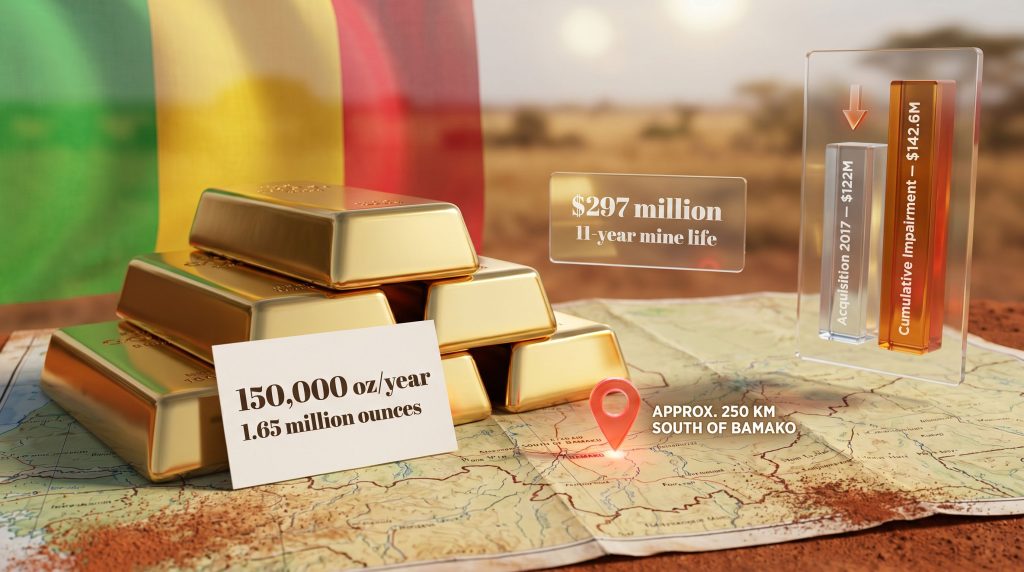
Kalana offers none of those adjacency benefits. Located approximately 250 km south of Bamako in southern Mali, it is geographically isolated from Endeavour's operating base, requires $297 million in construction capital from a standing start, and sits within a regulatory environment that has undergone material transformation since the company first acquired the asset.
The concept of portfolio triage in mid-tier gold mining describes exactly this dynamic: producers with constrained balance sheets and competing development opportunities must rank assets by probability of return, then actively seek exit pathways for those ranked lowest. Kalana is the product of that ranking exercise.
Furthermore, this dynamic reflects broader gold M&A activity reshaping how producers manage their development portfolios globally.
Kalana's Asset Profile: History, Geology, and Development Potential
From Soviet-Era Operations to a 21st-Century Feasibility Study
Kalana holds a distinction that few undeveloped gold projects in West Africa can claim: it has actually produced gold. Operations commenced in 1984 with technical assistance from Soviet engineers, yielding approximately 500 kilograms per year until political and economic disruptions halted production in 1991. That three-decade dormancy left behind underground workings, open-pit infrastructure, and a gravity processing plant that remain part of the site's asset base today.
Endeavour acquired an 80% interest in the project in June 2017 for $122 million, paid as consideration within its acquisition of Avnel Gold. The Malian state retained the remaining 20%. A 2021 pre-feasibility study subsequently provided the most detailed technical picture of what Kalana could become under modern development conditions.
| Metric | Detail |
|---|---|
| Location | Approx. 250 km south of Bamako, Mali |
| First Production Year | 1984 |
| Historical Output (Pre-1991) | ~500 kg of gold per year |
| Operations Suspended | 1991 |
| Endeavour Acquisition Year | 2017 (via Avnel Gold acquisition) |
| Acquisition Cost | $122 million |
| Endeavour Ownership Stake | 80% |
| Malian State Ownership Stake | 20% (rising to 35% under 2023 code) |
| Projected Annual Production | Up to 150,000 oz/year |
| Total Projected Output | ~1.65 million oz (51.3 tonnes) |
| Mine Life Estimate | 11 years |
| Estimated Construction Capital | $297 million |
The 2021 pre-feasibility study projected that Kalana could produce up to 150,000 ounces per year across an 11-year mine life, for a total output of approximately 1.65 million ounces, equivalent to 51.3 tonnes of gold. That scale would position Kalana among the more consequential undeveloped gold deposits in francophone West Africa, and it almost certainly explains why Endeavour was willing to accept revised state equity terms in mid-2025 rather than simply abandoning the project outright.
What the Gravity Processing Plant Actually Means for Development Economics
The presence of historic processing infrastructure at Kalana is more significant than it might appear from a headline asset summary. Gravity processing, which uses differences in mineral density to separate gold from host rock without the full chemical intensity of cyanide leaching circuits, is particularly well-suited to free-milling oxide ore zones that often characterise the upper portions of West African gold deposits.
For any incoming local partner, this means a portion of the site's metallurgical infrastructure may be serviceable or upgradable rather than requiring complete replacement. That distinction could meaningfully reduce the effective capital requirement below the $297 million headline figure cited in the pre-feasibility study, depending on the condition of existing equipment and the ore types targeted in any revised mine plan. Thorough mining feasibility studies would be essential before any such assumptions are formalised.
The Accounting Trail: What Successive Write-Downs Communicate
Two Impairments That Tell a Coherent Story
Endeavour's impairment history on Kalana is, in accounting terms, a formal record of receding confidence in the asset's viability under current ownership.
| Financial Event | Amount |
|---|---|
| Original Acquisition Cost (2017) | $122 million |
| 2024 Impairment | $133.1 million |
| 2025 Additional Write-Down | $9.5 million |
| Cumulative Impairment | ~$142.6 million |
The 2024 impairment of $133.1 million was the primary signal. A write-down of that magnitude against a $122 million acquisition cost communicates that the carrying value assigned to the asset at the time of purchase has been revised downward by more than the original purchase price, reflecting accumulated capitalised exploration and development expenditure that has since been deemed unrecoverable under Endeavour's ownership model.
The 2025 write-down of a further $9.5 million, attributed to a revision of project risk assumptions and a reassessment of economically recoverable resources, confirms the direction of travel. Cumulatively, Endeavour has written down approximately $142.6 million against the Kalana project.
Importantly, impairments in mining do not delete the underlying resource. They represent the current operator's risk-adjusted assessment of recoverability, which can differ substantially from the view taken by an operator with lower overhead structures, different financing access, or a stronger relationship with the host government. An asset that is uneconomic for one company at its required return threshold may be viable for another operating with different cost assumptions.
This distinction is critical for evaluating what any incoming local partner would actually be acquiring: not a stranded asset, but a project that failed the economic test of one particular operator, with a defined geological resource, existing infrastructure, and a completed pre-feasibility study as the foundation for further work.
Mali's 2023 Mining Code and the Equity Structure Any Partner Inherits
The Regulatory Shift That Narrows the Field of Viable Acquirers
Mali's 2023 mining code represents a structural renegotiation of the terms under which foreign companies access the country's mineral wealth. The key provisions relevant to Kalana are:
- The Malian state's equity entitlement rises from 20% to 35% across mining projects brought under the new code
- Of that 35%, a dedicated 5% allocation is ring-fenced specifically for Malian private investors, creating a legislated entry point for domestic capital
- These equity positions are non-negotiable structural features of any development agreement, not outcomes of commercial bargaining
In July 2025, Endeavour and the Malian government signed a memorandum of understanding to bring Kalana under this new code. At the time of signing, the director of Société des mines d'or de Kalana (Somika) indicated that construction was to begin within six months of signing and that the mine would be operational within eighteen months. Ten months on, no public disclosure of construction commencement, financing arrangements, or contractor appointments had been made.
A memorandum of understanding in the mining industry establishes intent and provides a negotiating framework. It carries no enforceable construction obligation under standard commercial law. The absence of follow-through within the MOU's own stated timelines is therefore legally unremarkable, but it constitutes a clear signal that Endeavour had already made an internal determination about the asset's place in its capital allocation hierarchy before the public announcement of a partner search.
For any incoming local partner, the inherited equity structure limits the maximum foreign ownership stake to 65% under the new code. Combined with the $297 million construction capital requirement, this creates a financing challenge that requires creative structuring, discussed below.
The Barrick-Endeavour Dimension: A Strategic Paradox Worth Examining
Exiting Kalana While Potentially Entering Loulo-Gounkoto
Reporting from June 2026 indicates that Barrick Mining and Endeavour Mining are engaged in discussions to create a jointly held entity consolidating Barrick's African assets. The proposed structure would involve a London-listed vehicle with a combined estimated valuation of approximately $30 billion. Barrick's reported rationale involves a strategic refocusing on its North American operations and a desire to reduce exposure to jurisdictions it considers higher-risk.
Neither company has formally confirmed the transaction. However, if completed, the deal would position Endeavour as the potential operator of Loulo-Gounkoto, Mali's largest gold mine by output and a significant contributor to Malian state revenues. The mine was effectively dormant through most of 2025 following a protracted dispute between Barrick and Malian authorities, before production resumed at year-end 2025 following a negotiated resolution.
| Dimension | Kalana | Loulo-Gounkoto |
|---|---|---|
| Development Stage | Pre-production (stalled) | Operating mine |
| Scale | Up to 150,000 oz/year (projected) | Mali's largest gold mine |
| Endeavour's Current Role | Asset holder seeking exit | Potential incoming operator |
| Regulatory Status | Under 2023 Mining Code | Separate Barrick-state agreement |
| Strategic Value to Endeavour | Non-core, written down | Core, if Barrick deal proceeds |
The apparent contradiction — exiting one Malian asset while potentially entering Mali's most significant producing mine — resolves cleanly when viewed through a portfolio quality lens. Endeavour is not retreating from Mali as a jurisdiction. It is trading a capital-intensive, pre-production asset with a questionable development timeline for an operating mine with established infrastructure, existing workforce, and a state relationship that has already been tested and formalised.
Endeavour's total production reached 1.21 million ounces in 2025, a 10% increase on the prior year, across its existing operations. Adding Loulo-Gounkoto's production would transform it from a company with no Malian production into the country's dominant gold producer, a qualitatively different strategic position. This reflects broader mining industry consolidation patterns reshaping how producers structure their West African portfolios.
The next major ASX story will hit our subscribers first
Financing Pathways for a Local-Led Kalana Development
How Domestic and Regional Capital Could Close the Funding Gap
The central challenge facing any local partner taking on Kalana is not geological or technical. It is financial. Securing $297 million in construction capital for a West African development-stage gold project, within an equity structure that limits foreign ownership to 65%, requires a financing approach that goes beyond conventional project finance.
Several pathways are available and worth examining:
- Development Finance Institutions (DFIs): Institutions including the African Development Bank and the International Finance Corporation maintain explicit mandates to support locally anchored resource development in Sub-Saharan Africa. A project structured with meaningful Malian equity participation, including the legislated 5% domestic investor allocation, would be a credible candidate for DFI co-financing.
- Royalty and streaming arrangements: These instruments allow a developer to monetise a portion of future gold production in exchange for upfront capital, effectively reducing the equity and debt requirement at the construction phase. For a project with a defined 11-year production profile and 1.65 million ounces of projected output, the royalty market calculus is reasonably favourable.
- Pan-African private equity: Regional mining private equity funds have demonstrated growing appetite for de-risked African gold assets that carry completed feasibility work, existing infrastructure, and state co-investment. Kalana's completed pre-feasibility study and existing site infrastructure reduce the technical risk premium that such funds typically price in.
- State equity as credit enhancement: Mali's 35% equity stake under the new code can function as implicit sovereign credit support in structured financing arrangements, potentially improving the terms available to private co-investors.
What Kalana's Handover Means for Malian Mining Development
The Proof-of-Concept Dimension of Local Ownership
Kalana carries significance beyond its individual economics. If successfully transferred to and developed by a locally anchored partnership, it would represent one of the first instances of a formerly foreign-controlled major gold development in Mali being advanced under domestic or regional leadership. That precedent matters for how international capital perceives the risk-return profile of similar transactions across francophone West Africa.
The 5% local investor ring-fence within Mali's revised mining code is a deliberate policy instrument designed to create exactly this kind of domestic wealth accumulation through the resource sector. Whether that mechanism generates meaningful Malian private sector participation, or whether it functions primarily as a regulatory checkbox, will depend substantially on how the Kalana transfer is structured and at what valuation local partners are asked to take their stake.
The broader trajectory of West African gold mining suggests that the Kalana handover is unlikely to be an isolated event. Rising capital costs globally have made pre-production assets in complex jurisdictions increasingly difficult to justify for producers with competing demands from existing operations. Endeavour's approach reflects an industry-wide recalibration where the development portfolio is increasingly separated from the operating portfolio and monetised through structured handovers. Investors tracking gold mining stocks across the region will recognise this pattern as a defining feature of the current cycle.
Frequently Asked Questions
What is the Kalana gold project and where is it located?
Kalana is an undeveloped gold project located approximately 250 km south of Bamako in southern Mali, featuring historic underground and open-pit workings and a gravity processing plant established during the project's initial Soviet-assisted production phase in the 1980s.
Why is Endeavour Mining not developing Kalana itself?
Endeavour has classified Kalana as a non-core asset, prioritising capital deployment toward the Assafou project in Côte d'Ivoire. Successive impairments totalling approximately $142.6 million reflect a revised assessment of the project's viability under Endeavour's ownership model and capital allocation framework.
How much gold could Kalana produce?
A 2021 pre-feasibility study estimated annual production of up to 150,000 ounces over an 11-year mine life, for a total output of approximately 1.65 million ounces (51.3 tonnes).
What is Mali's ownership stake in Kalana?
The Malian state currently holds a 20% interest. Under the 2023 Mining Code, this rises to 35%, with 5% of that total ring-fenced for Malian private investors.
Is the Barrick-Endeavour transaction confirmed?
As of June 2026, discussions between Barrick Mining and Endeavour regarding a jointly held African mining entity have been reported in the financial press but have not been formally confirmed by either company. Any analysis of its implications for Kalana or Loulo-Gounkoto remains speculative pending confirmation.
Disclaimer: This article contains forward-looking projections, financial estimates, and analysis of ongoing commercial discussions that have not been formally confirmed. All production figures, valuations, and transaction details referenced are derived from publicly available sources, company disclosures, and industry reporting. This content does not constitute financial or investment advice. Readers should conduct independent due diligence before drawing investment conclusions from any information contained herein.
Want To Spot The Next Major Mineral Discovery Before The Market Does?
Discovery Alert's proprietary Discovery IQ model scans ASX announcements in real time, instantly converting complex geological and commodity data into actionable investment insights — the same kind of transformative opportunities that historic discoveries like those from De Grey Mining and WA1 Resources once represented. Start your 14-day free trial today and explore how major mineral discoveries have historically delivered exceptional returns.