May 16, 2026
The Kangankunde Rare Earths Project emerges as a pivotal development within Africa's transformational mining landscape, establishing Malawi as a significant player in the global rare earth elements sector. This strategic realignment extends far beyond traditional commodity cycles, representing a generational shift in how critical materials flow through global markets. Furthermore, the convergence of technological advancement, geopolitical tensions, and climate transition imperatives has created unprecedented opportunities for resource-rich nations to reshape their economic trajectories.
Strategic Positioning in Global Critical Minerals Competition
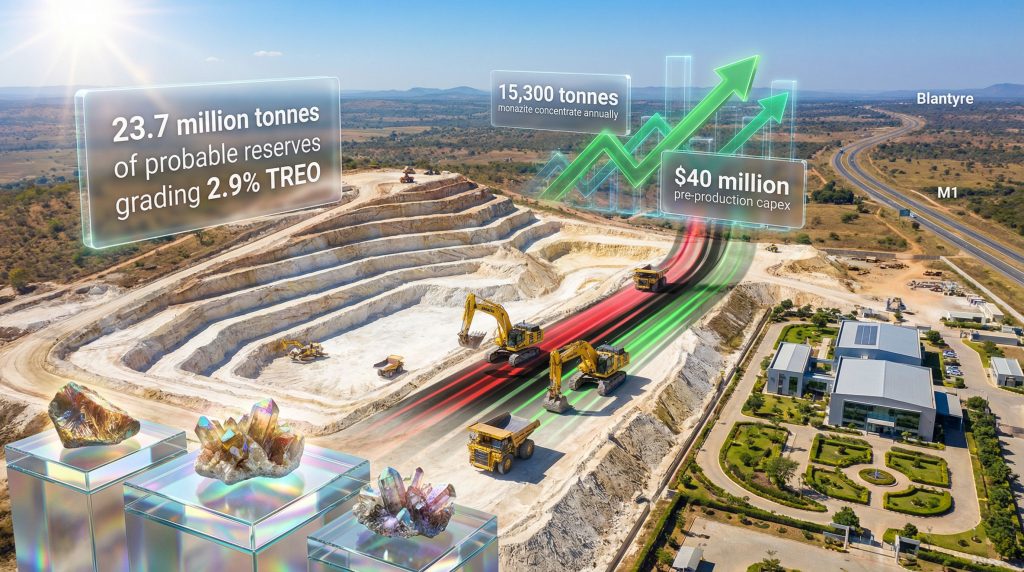
Located within the Chilwa Alkaline Province, this deposit represents one of Africa's most substantial undeveloped rare earth resources, containing 23.7 million tonnes of probable reserves grading 2.9% total rare earth oxides (TREO). The project's scale becomes apparent when contextualized against global reserves, positioning it among the world's largest undeveloped rare earth deposits.
According to the U.S. Geological Survey's 2024 Mineral Commodity Summaries, worldwide rare earth element reserves total approximately 120 million tonnes. Kangankunde's resource base represents roughly 20% of known global REE reserves, demonstrating its significance within the global mining landscape.
Technical Specifications and Operational Advantages
| Specification | Details |
|---|---|
| Reserve Grade | 2.9% TREO (679,000 tonnes contained NdPr) |
| Annual Production Target | 15,300 tonnes monazite concentrate (55% TREO) |
| Mine Life | 45 years (Stage 1) |
| Capital Requirements | $40 million pre-production capex |
| Strip Ratio | 0.2:1 (extremely low waste-to-ore ratio) |
| Production Timeline | Q4 2026 first production target |
The deposit's exceptional 0.2:1 strip ratio distinguishes it from competing global projects. This metric, representing 0.2 tonnes of waste rock per tonne of extracted ore, ranks among the industry's most favourable ratios. For comparison, Mountain Pass in the USA typically operates at a 1:1 ratio, while many Australian developments experience ratios ranging from 1.5:1 to 3:1.
When big ASX news breaks, our subscribers know first
Market Timing and Demand Convergence
The project's development timeline aligns strategically with accelerating global demand for rare earth elements across multiple sectors. Electric vehicle adoption continues expanding at unprecedented rates, with the International Energy Agency projecting approximately 35 million annual EV sales by 2030, representing roughly 50% of total global vehicle sales.
Each electric vehicle requires 1-2 kilograms of rare earth permanent magnets, primarily composed of neodymium and praseodymium-based NdFeB magnets. Consequently, this translates to substantial incremental demand for rare earth elements as automotive manufacturers scale production capabilities.
Wind Energy Infrastructure Requirements
Offshore wind energy development presents another significant demand driver for rare earth elements. The International Renewable Energy Agency's 2023 statistics indicate that offshore wind turbines require 200-600 kilograms of rare earth elements per MW of installed capacity.
Global offshore wind capacity targets of 370 GW by 2030 represent approximately 74,000-222,000 tonnes of rare earth elements required for offshore wind expansion alone. High-performance permanent magnet generators for offshore applications specifically require dysprosium and terbium additions to maintain magnetic properties at elevated operating temperatures.
Projected Growth Metrics:
- Neodymium-praseodymium demand: 7-9% annual growth through 2030
- Current global NdPr demand: approximately 70,000 tonnes annually (2024)
- Electric vehicle applications: 65% of incremental demand
- Wind energy applications: 20% of incremental demand
- Defense and aerospace: 10% of incremental demand
Geological Profile and Processing Advantages
The Kangankunde Rare Earths Project exists within a carbonatite complex characterised by alkaline igneous rock formations. This geological setting provides several operational advantages over competing global deposits, particularly regarding processing efficiency and environmental impact.
Monazite-Dominant Mineralogy Benefits
The deposit's monazite-dominant ore body offers distinct processing advantages compared to bastnäsite deposits, which constitute approximately 70% of current global rare earth production:
Processing Efficiency Advantages:
- Gravity separation and magnetic concentration techniques applicable
- Reduced chemical processing requirements compared to bastnäsite
- Lower sulfuric acid consumption in processing operations
- Minimised hydrometallurgical processing complexity
Environmental Profile Benefits:
- Significantly lower radioactive thorium content than typical monazite deposits
- Reduced radioactive waste generation compared to bastnäsite operations
- Physical separation methods for thorium management rather than chemical processing
- Lower overall environmental footprint from processing operations
Comparative Global Deposit Analysis
| Deposit | Location | Ore Type | Grade (TREO %) | Strip Ratio | Radioactivity Profile |
|---|---|---|---|---|---|
| Kangankunde | Malawi | Monazite | 2.9% | 0.2:1 | Low Th content |
| Mountain Pass | USA | Bastnäsite | 0.18-0.28% | 1:1 | Moderate |
| Bayan Obo | China | Bastnäsite/Monazite | 3-6% | 1.5:1 | Moderate-High |
| Nolans | Australia | Monazite | 2.2% | 1.8-2.5:1 | Low-Moderate |
The consistent grade distribution across the 200-metre hill formation enables standardised mining and processing protocols, reducing operational complexity and enhancing predictability for production planning.
Geopolitical Supply Chain Diversification
China currently controls approximately 85-90% of global rare earth element processing capacity, despite possessing only 37% of identified global reserves according to the U.S. Geological Survey. This processing monopoly creates strategic vulnerability for Western economies dependent on these critical materials and highlights the importance of energy transition security.
The Kangankunde Rare Earths Project addresses this supply chain concentration through several mechanisms:
Western Alignment Benefits:
- Alternative sourcing for defence and aerospace applications
- Reduced single-country dependency for critical materials
- Competitive pricing pressure on existing suppliers
- Enhanced supply security for renewable energy transition
Regulatory Framework Support
The U.S. government has explicitly identified rare earth elements as critical minerals essential for national security through the 2022 Critical and Strategic Mineral Mining and Recycling Research, Development, and Demonstration Act. The legislation allocated $140 million specifically for rare earth element mining and processing development outside China.
In addition, the European Union established strategic stockpiling requirements and supply chain diversification mandates through the Critical Raw Materials Act of 2023. Non-Chinese rare earth suppliers benefit from preferential procurement frameworks and premium pricing mechanisms under this regulatory structure, supporting initiatives like the European CRM facility.
"Supply Gap Analysis: Current global rare earth production capacity cannot meet 2030 demand projections. The U.S. Geological Survey projects a supply deficit of 15,000-25,000 tonnes of rare earth oxides annually by 2030 if new projects don't commence production."
Financial Structure and Development Strategy
Lindian Resources has structured a debt-free development model through a substantial $100 million institutional investor placement, eliminating traditional mining finance constraints that have historically delayed African projects. This financing approach provides operational flexibility and reduces execution risk.
Two-Phase Development Approach
| Funding Component | Amount | Purpose |
|---|---|---|
| Institutional Placement | $100 million | Stage 1 development (debt-free) |
| Iluka Resources Facility | $32 million | Strategic backup (unused) |
| Stage 1 Cash Flow | Self-funding | Stage 2 expansion (100,000 tpa) |
Stage 1 Operations (2026-2030):
- 15,300 tonnes annual concentrate production
- Cash flow generation for expansion funding
- Market entry and customer relationship development
- Operational optimisation and efficiency improvements
Stage 2 Expansion Potential (2030+):
- 100,000+ tonnes annual production capacity
- Enhanced processing infrastructure development
- Expanded mining operations across larger resource base
- Integration with downstream processing capabilities
The company's partnership structure with Obsideo for process plant engineering and Komatsu for mining equipment demonstrates commitment to proven technologies rather than experimental approaches, reducing technical risk profiles.
African Critical Minerals Triangle
Malawi's emergence as a rare earth producer creates a strategic triangular structure with South Africa and the Democratic Republic of Congo, establishing Africa as a credible alternative to Asian supply chains. This development enhances the continent's strategic importance in global critical minerals security and reflects broader aspects of the critical minerals strategy.
Regional Competitive Positioning
South Africa's Established Portfolio:
- Platinum group metals dominance (80% global reserves)
- Existing rare earth processing capabilities
- Advanced mining infrastructure and technical expertise
- Established export logistics networks
Democratic Republic of Congo's Leadership:
- Cobalt production (70% global supply)
- Copper mining excellence and infrastructure
- Strategic location for Central African logistics
- Established relationships with global commodity traders
Malawi's Emerging Advantages:
- High-grade rare earth deposits with favourable processing characteristics
- Political stability and mining-friendly regulatory policies
- Strategic positioning for Southern African export routes
- Proximity to existing infrastructure (M1 highway, 90km from Blantyre)
The next major ASX story will hit our subscribers first
Technology and Operational Framework
The project employs proven mining and processing technologies optimised for monazite ore bodies, minimising technical risks while maximising operational efficiency. The owner-operator mining approach with industry-standard equipment reduces dependency on contractor availability and cost volatility.
Mining Technology Implementation:
- Truck and shovel methods (industry standard approach)
- 5-metre bench heights for optimal grade control
- GPS-guided equipment for precision extraction
- Real-time ore grade monitoring systems
Processing Technology Framework:
- Monazite concentrate production achieving 55% TREO grade
- Minimal chemical processing requirements compared to bastnäsite operations
- Gravity separation and magnetic concentration primary methods
- Quality control systems ensuring consistent output specifications
Market Positioning and Customer Strategy
The Kangankunde Rare Earths Project targets premium market segments requiring high-grade, low-radioactivity rare earth concentrates. Specific focus on dysprosium and terbium production addresses identified supply gaps in permanent magnet manufacturing for electric vehicles and wind energy applications.
Target Application Analysis
| Application Segment | Key Elements | Market Growth |
|---|---|---|
| EV Permanent Magnets | Neodymium, Praseodymium | 12% CAGR to 2030 |
| Wind Turbine Generators | Dysprosium, Terbium | 15% CAGR to 2030 |
| Defence Applications | Multiple REEs | Stable, premium pricing |
| Electronics Manufacturing | Yttrium, Europium | 8% CAGR to 2030 |
The International Energy Agency's Net Zero by 2050 scenario projects that rare earth element demand will increase 7-fold from 2020 to 2050, with the majority driven by clean energy technologies including EVs and renewables.
Environmental and Social Development Framework
The project's environmental impact profile, combined with Malawi's regulatory framework, positions it favourably for ESG-conscious investors and customers seeking responsible sourcing alternatives. The low radioactive waste generation compared to typical rare earth operations addresses a primary environmental concern in the sector, supporting broader mine reclamation innovations.
Environmental Advantages:
- Minimal water usage requirements for processing operations
- Low radioactive waste generation from thorium separation
- Comprehensive rehabilitation planning for post-mining land use
- Biodiversity impact mitigation strategies for local ecosystems
Community Development Benefits:
- Direct employment opportunities (100+ positions)
- Skills development and technical training programmes
- Community infrastructure improvements and investment
- Economic diversification for traditionally agricultural region
Long-Term Strategic Implications
The Kangankunde Rare Earths Project development represents more than a single mining venture; it signifies Africa's evolving role in global critical minerals supply chains. The continent's combination of geological endowments, improving infrastructure, and strategic government policies positions it to capture increasing value from the global energy transition.
Beyond immediate production benefits, the project establishes technical expertise and processing knowledge within Africa that can be leveraged across other critical mineral developments. This knowledge transfer and capability building creates long-term competitive advantages for the continent's mining sector.
Future Expansion Potential:
- Additional rare earth deposits within the Chilwa Alkaline Province
- Downstream processing capability development for value addition
- Regional hub development for Southern African rare earth production
- Technology and expertise export to other African rare earth projects
The project's success could catalyse additional investment in African critical minerals, creating a self-reinforcing cycle of development, expertise building, and market credibility that positions the continent as an essential component of global supply chain resilience. Furthermore, detailed information about the Kangankunde project showcases its strategic significance within the broader rare earths development framework.
Investment considerations: This analysis contains forward-looking statements and projections that involve inherent risks and uncertainties. Rare earth market dynamics, regulatory changes, and operational challenges may significantly impact project outcomes. Potential investors should conduct independent research and consider professional advice before making investment decisions.
Ready to Capitalise on the Next Critical Minerals Discovery?
Discovery Alert's proprietary Discovery IQ model delivers real-time alerts on significant ASX mineral discoveries, instantly empowering subscribers to identify actionable opportunities ahead of the broader market. Understand why major mineral discoveries can lead to substantial returns by exploring historic examples of exceptional market outcomes, then begin your 14-day free trial to position yourself ahead of the next breakthrough.