
June 26, 2026
The Hidden Vulnerability in Post-Soviet Energy Architecture
Long before drone warfare reshaped the calculus of industrial conflict, energy planners understood that infrastructure interdependence created risks that no amount of military preparation could fully neutralise. The Soviet Union, in designing its vast hydrocarbon processing network, optimised for economic efficiency rather than geopolitical resilience. Pipelines crossed what were then administrative boundaries without consequence. Processing plants served fields in neighbouring republics as a matter of engineering logic.
When the USSR dissolved, those administrative lines became international borders, but the physical infrastructure remained exactly where it had always been, embedding a structural vulnerability into the energy sovereignty of every successor state.
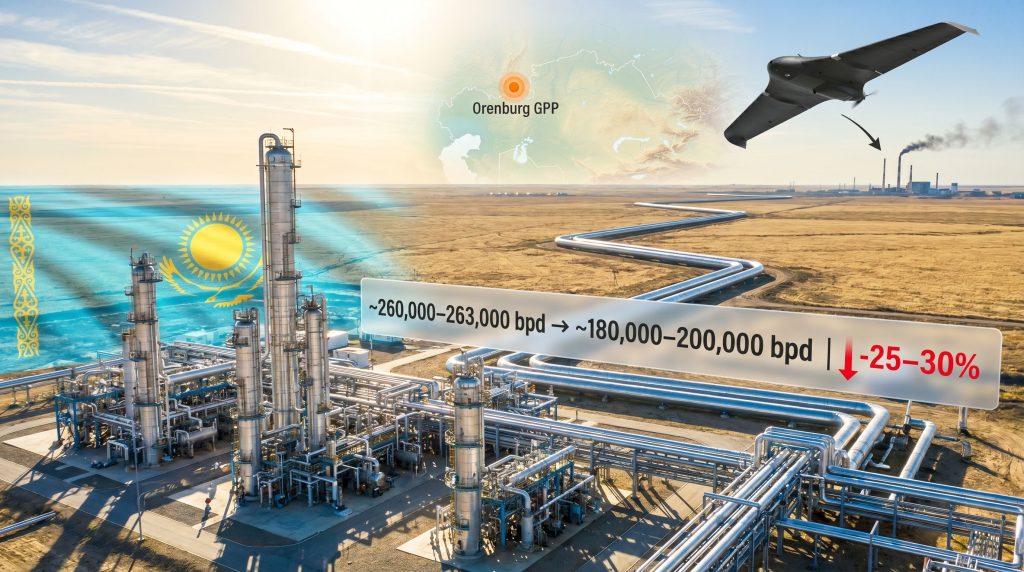
That inherited fragility moved from theoretical concern to operational crisis when a drone strike on the Orenburg Gas Processing Plant in Russia triggered an immediate and significant production cut at Kazakhstan's Karachaganak oil and gas field, hundreds of kilometres from any active battlefield. The Karachaganak oil field drone attack is not simply an energy news story. It is a case study in how conflict can propagate through transnational supply chains to produce economic damage in nations that are not party to the underlying dispute.
When big ASX news breaks, our subscribers know first
Why Karachaganak's Production Architecture Makes It Uniquely Exposed
To understand what happened, it helps to first understand what Karachaganak actually is and how it functions. Located in northwestern Kazakhstan, the field is one of the country's three flagship hydrocarbon projects, sitting alongside Tengizchevroil and Kashagan as a cornerstone of national energy output. It contributes approximately 10% of Kazakhstan's total crude production, operating at a baseline of roughly 34,000 to 35,500 metric tons of crude per day, which translates to approximately 260,000 to 263,000 barrels of oil equivalent per day.
The field is operated by Karachaganak Petroleum Operating (KPO), a consortium in which Eni and Shell serve as co-managing partners alongside other international stakeholders. What makes Karachaganak particularly complex from an operational standpoint is its integrated oil-and-gas production structure. Furthermore, the crude oil market dynamics surrounding Central Asian assets make this kind of disruption especially consequential for global supply chains.
Associated Gas: The Technical Dependency That Connects Two Countries
Karachaganak produces what the industry terms associated gas, meaning natural gas that emerges from the reservoir alongside crude oil during the extraction process. This is not a design choice that operators can easily reverse. The physics of the reservoir dictate that oil and gas come up together, which means any constraint on gas processing capacity directly limits how much crude can be produced. You cannot simply cap the gas and keep pumping oil.
This co-production reality creates a critical dependency chain:
- Raw hydrocarbons are extracted at the Karachaganak field in Kazakhstan.
- The raw gas stream travels approximately 170 kilometres north via pipeline into Russian territory.
- The Orenburg Gas Processing Plant (GPP) in Russia separates and processes the raw gas into commercial-grade product.
- Processed gas is returned to Kazakhstan for domestic distribution and export.
- Only when this cycle functions without interruption can the field sustain normal crude output volumes.
The Orenburg GPP is not simply a convenience in this architecture. It is the only viable processing route for Karachaganak's gas stream. No alternative processing infrastructure exists within Kazakh territory that could absorb this volume at short notice. That is the single point of failure.
The Strike and Its Immediate Production Consequences
The drone attack on the Orenburg Gas Processing Plant was confirmed by Ukraine's military command as part of an extended long-range strike campaign, with Ukrainian leadership characterising the operation as evidence of the growing reach and precision of its drone capabilities. According to reporting by Reuters, the plant suspended all gas intake and processing operations immediately following the strike.
The downstream effect on Karachaganak was rapid and quantifiable. Kazakhstan Energy Minister Yerlan Akkenzhenov confirmed via Interfax that production had fallen sharply, with KPO characterising the curtailment as a managed, controlled reduction rather than an emergency shutdown. The numbers, however, are significant.
| Metric | Normal Operations | Post-Attack Level | Reduction |
|---|---|---|---|
| Daily crude output (metric tons) | ~34,000 t/day | ~25,000 t/day | ~26% |
| Daily oil equivalent (bpd) | ~260,000–263,000 bpd | ~180,000+ bpd | ~25–30% |
| Share of Kazakhstan's national output | ~10% | Materially reduced | Significant |
Kazakh authorities moved quickly to reassure domestic consumers, stating that reserve mechanisms had been activated to prevent disruption to household and industrial gas supply within Kazakhstan. The focus of uncertainty shifted instead to when the Orenburg plant would resume operations, a question that as of the time of reporting had no confirmed answer.
Russia confirmed that repair works were underway at the facility, but Kazakhstan's energy ministry acknowledged it had no visibility into the resumption timeline. That information asymmetry is itself a form of operational risk.
How Drone Warfare Produces Economic Casualties Across Borders
The Karachaganak oil field drone attack illustrates a dimension of modern conflict that receives less analytical attention than battlefield outcomes: the capacity of precision strikes on processing nodes to generate economic disruption in third-party nations that have no formal involvement in the conflict.
Key Insight: When a country's energy output depends on processing infrastructure located in a foreign jurisdiction engaged in active armed conflict, the operational risk profile of that asset changes fundamentally. The risk is no longer bounded by the host country's own security environment.
This matters because the approximately 80,000 to 83,000 bpd removed from Kazakhstan's output did not result from any decision made in Astana or any security failure within Kazakh borders. It was a consequence of a strike in Russia, conducted by Ukraine, affecting a facility whose purpose is to service a Kazakh energy asset. The geopolitical geometry is striking: Kazakhstan is, in a meaningful operational sense, exposed to the risk profile of a conflict it has carefully avoided taking sides in.
Kazakhstan's foreign policy doctrine of multi-vector diplomacy, maintaining balanced relationships with Russia, China, the European Union, and the United States, has served the country well politically. However, that diplomatic neutrality offers no protection when the physical infrastructure underpinning national energy production crosses into the territory of a conflict participant. The broader geopolitical risk landscape facing resource-dependent nations has rarely been more complex or consequential.
The Soviet Legacy Infrastructure Problem
This is not a unique situation to Karachaganak. Across the former Soviet space, energy infrastructure was designed to serve the integrated economy of a single state. Processing plants, pipelines, and transmission networks were built to optimise throughput across what are now independent nations, without any consideration for the geopolitical complications that would follow dissolution.
The result is that multiple post-Soviet states carry what analysts sometimes call asymmetric geopolitical exposure, where the operational continuity of domestically located assets depends on infrastructure controlled by a foreign government. For Kazakhstan, the absence of redundant processing capacity within its own territory for Karachaganak's gas stream is a direct product of this inherited architecture. Consequently, energy export challenges of a similar structural nature are being examined by resource exporters in other regions as well.
National Production Targets and the Resilience Narrative
Despite the production curtailment, Kazakhstan's government maintained its annual output target of 98 million metric tons of oil for 2026, signalling confidence that the Karachaganak disruption would not derail the broader national production plan. The implication is that output from Tengiz and Kashagan, Kazakhstan's other two major fields, could partially compensate for the volume shortfall during the curtailment period.
This messaging serves a dual purpose: reassuring domestic audiences and signalling stability to international energy buyers and investors. However, the resilience narrative carries a caveat that officials have been candid about: the duration of the disruption is entirely outside Kazakhstan's control.
Scenario Modelling: Duration Risk Is the Critical Variable
The market and economic impact of the Karachaganak disruption depends almost entirely on how long the Orenburg GPP remains out of service. Two broad scenarios frame the range of outcomes:
- Short-duration outage (days to two weeks): Manageable within Kazakhstan's production buffer. National output targets remain achievable. Global supply impact is marginal and likely absorbed by market variance.
- Extended outage (weeks to months): Cumulative production loss becomes material. The gap may exceed the compensating capacity of Tengiz and Kashagan. Downstream buyers relying on Karachaganak crude, shipped primarily via the Caspian Pipeline Consortium (CPC) route to European and Asian markets, face supply uncertainty. National output targets come under pressure.
Historical precedent across Central Asian energy infrastructure disruptions suggests that repair timelines for major processing facilities are frequently longer than initial optimism implies, particularly when the damaged infrastructure is located within a country managing an active conflict and competing repair priorities.
Global Market Implications and Investor Risk Reassessment
From a global supply perspective, an ~80,000 bpd reduction is meaningful but not independently capable of moving Brent crude pricing in a sustained way, particularly within a market context already shaped by OPEC+ supply management decisions and evolving demand signals. The more significant concern is the compounding effect: Karachaganak's curtailment adds to a pre-existing environment of supply uncertainty rather than arriving in isolation. In addition, the trade war oil markets dynamic has already introduced considerable pricing volatility that amplifies the impact of any further supply disruption.
For international operators with Central Asian upstream exposure, the episode accelerates a risk reassessment that was already quietly underway. Several dimensions of that reassessment are worth tracking:
- Force majeure implications: Production curtailments caused by third-country infrastructure events sit in legally ambiguous territory within many upstream contracts. Whether a strike on a Russian processing plant constitutes a force majeure event for a Kazakh field operator is a question that KPO's legal teams are almost certainly examining.
- Political risk insurance: The relevance of geopolitical risk coverage products for assets with transnational processing dependencies has grown substantially. The Karachaganak case provides a concrete data point for underwriters reassessing Central Asian exposure pricing.
- ESG and governance risk ratings: Infrastructure vulnerability to conflict-zone adjacency is an emerging dimension of ESG risk assessment for upstream assets. Rating frameworks that do not capture cross-border processing dependency may be underpricing the actual risk profile of affected assets.
Furthermore, upstream industry analysis confirms that the operational and commercial implications of this strike extend well beyond a single field's production numbers, with broader questions emerging about the resilience of post-Soviet energy infrastructure across the region.
The next major ASX story will hit our subscribers first
The Long-Term Strategic Imperative: Processing Sovereignty
The most enduring lesson from the Karachaganak oil field drone attack is structural rather than tactical. Kazakhstan's energy sector has long recognised the need to reduce infrastructural dependence on Russian-controlled facilities, and various Trans-Caspian routing options and domestic processing expansion proposals have been discussed over the years. The events at Orenburg provide the clearest demonstration yet of why that diversification is not merely a strategic preference but an operational necessity.
Building redundant processing capacity within Kazakh territory for Karachaganak's gas stream would require significant capital investment and extended development timelines. It would also require navigating the geopolitical sensitivities of openly reducing economic integration with Russia, a relationship that Kazakhstan manages with considerable care. Neither path is straightforward. But the cost of inaction is now visible in real-time production data.
An oil price rally driven by supply disruptions of this nature could, however, provide a partial economic argument for accelerating domestic processing investment, as higher revenue during curtailment periods might fund the infrastructure diversification that would prevent future episodes.
For energy investors and operators, the Karachaganak case is a reminder that infrastructure maps do not respect conflict boundaries, and that the risk premium assigned to assets with cross-border processing dependencies must be priced accordingly.
Frequently Asked Questions: Karachaganak Oil Field Drone Attack
What caused the production cut at Karachaganak oil field?
A drone strike targeted the Orenburg Gas Processing Plant in Russia, forcing a full suspension of operations. Because Karachaganak's raw gas must be transported to Orenburg for processing before the field can sustain normal output, the plant shutdown triggered an immediate and proportional reduction in co-produced crude volumes, cutting daily output by roughly 25 to 30%.
Where is the Karachaganak oil field located?
The field is situated in northwestern Kazakhstan and ranks as one of the country's three largest hydrocarbon projects alongside Tengiz and Kashagan.
How much did Karachaganak's output fall after the drone attack?
Daily crude production fell from approximately 34,000 metric tons to around 25,000 metric tons, equivalent to a drop from roughly 260,000 bpd to just over 180,000 bpd, representing a decline of approximately 25 to 30%.
Who operates Karachaganak?
The field is managed by Karachaganak Petroleum Operating (KPO), a joint venture consortium that includes Eni and Shell as co-managing partners among other stakeholders.
Why does damage to a Russian facility reduce Kazakh oil output?
Karachaganak's integrated gas-and-oil production system requires the raw gas stream to be processed at the Orenburg GPP before commercial-grade supply can be distributed. Without that processing step, gas output cannot be sustained, and because oil and gas are co-produced from the same reservoir, crude production must also fall.
Is Kazakhstan's annual oil production target still intact?
As of the most recent government statements, Kazakhstan has maintained its 2026 annual production target of 98 million metric tons, indicating confidence that output from other fields can partially offset the Karachaganak shortfall.
When will Karachaganak return to full production?
No confirmed timeline has been provided by either Russia or Kazakhstan. Resumption depends entirely on the completion of repair works at the Orenburg GPP, a facility under Russian operational control, meaning Kazakhstan has no direct influence over the schedule.
Want to Stay Ahead of Major Commodity Supply Disruptions Like the Karachaganak Crisis?
Discovery Alert's proprietary Discovery IQ model delivers real-time alerts on significant ASX mineral discoveries, transforming complex resource data into actionable investment insights — explore historic examples of exceptional discovery returns to understand the scale of opportunity available. Begin your 14-day free trial at Discovery Alert today and position yourself ahead of the market before the next major resource event unfolds.