May 21, 2026
The Engineering Architecture Behind a Bankable Critical Mineral Project
Across the global mining industry, the gap between a study that looks good on paper and one that survives institutional due diligence is rarely about the ore. It is almost always about the execution assumptions baked into the engineering design. Lenders do not simply underwrite reserves and commodity prices. They underwrite operational pathways, and projects with unresolved method risk, non-compliant tailings designs, or speculative power supply assumptions consistently fail to advance through project finance processes regardless of their headline economics.
Understanding the Sovereign Metals Kasiya DFS requires starting from this premise. The study is not a routine refinement of prior work. It is a structured response to three categories of financing risk embedded in the 2023 Preliminary Feasibility Study, each of which was replaced rather than optimised. The result is a project design that looks materially different from its predecessor in ways that matter most to the institutions being asked to finance it.
When big ASX news breaks, our subscribers know first
What the Sovereign Metals Kasiya DFS Actually Confirms at Scale
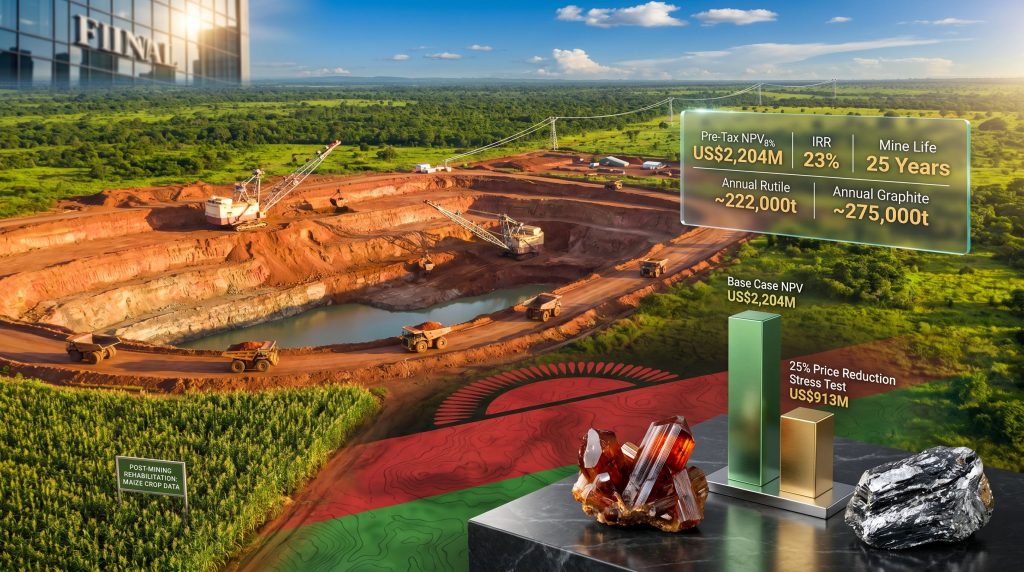
Before examining the engineering changes, it is worth anchoring the scale context. Kasiya is not a mid-tier project incrementally improving its economics. The Kasiya DFS confirms a 25-year operation processing 24 million tonnes per annum at steady state, producing approximately 222,000 tonnes of rutile and 275,000 tonnes of natural graphite concentrate annually. These are not figures that sit comfortably in the middle of any peer comparison table for either commodity.
| Metric | DFS Confirmed Figure |
|---|---|
| Mine Life | 25 years |
| Processing Rate (Steady State) | 24 million tonnes per annum |
| Annual Rutile Output | ~222,000 tonnes |
| Annual Graphite Output | ~275,000 tonnes |
| Total Life-of-Mine Revenue | ~US$16.2 billion |
| Annual Free Cash Flow (Steady State) | ~US$452 million |
| Pre-Tax NPV8% | US$2,204 million |
| Pre-Tax IRR | 23% |
| Payback Period (from first production) | 6.2 years |
| Initial Capex | US$727 million |
Natural rutile supply globally is structurally constrained. The dominant producer base is ageing, and no comparable greenfield projects have entered production in decades. Flake graphite faces a different but equally structural challenge: synthetic graphite substitution economics have placed downward pressure on pricing, but the cost advantage of large-scale natural graphite in battery anode applications remains meaningful when supply is priced competitively. Kasiya's output profile sits at the intersection of both constraints.
The phased construction model is itself a capital risk management tool. The South Plant is operational from Year 1. The North Plant commences from Year 5. This distributes capital exposure across a phased development profile rather than requiring full committed capital before a single tonne of product is shipped. Phase 1 construction spans 30 months prior to first production.
From Hydro-Mining to Dry Mechanical Extraction: What Changed and Why It Matters
The Technical Logic of the Mining Method Switch
Hydro-mining involves the use of high-pressure water jets to disaggregate ore and slurry it toward a collection point. When the orebody sits below the natural water table, this requires production equipment to operate in a permanently wet, below-groundwater environment. The operational complexity this introduces is not theoretical. It is a category of execution risk that project financiers treat as a structural financing barrier because the failure modes are both unpredictable and difficult to insure against at a project scale.
Kasiya's soft saprolite orebody does not require drilling, blasting, crushing, or milling. This free-dig characteristic makes it genuinely suited to dry mechanical extraction using a dragline and rigid dump truck fleet. The DFS design employs 12.7m³ draglines and 100-tonne rigid dump trucks operating in open-cut conditions across a two-bench configuration: a five-metre top cut and a fifteen-metre bottom cut. All equipment operates above the water table at all times.
Key Technical Insight: The saprolite mineralisation at Kasiya is unconsolidated enough that it responds to mechanical disaggregation without any of the comminution processes that dominate the cost structure of most hard-rock operations. This is what makes the dry extraction economics work at this scale.
The only processing circuit addition required by the method change was a scrubber at the front end. This is a defined addition, not a redesign of the back-end concentration process.
How the Pilot Programme Removed Execution Uncertainty
The transition was not implemented on modelled assumptions alone. A 120m x 110m test pit was excavated to a depth of 20 metres, mining 170,000 m³ of material using a conventional excavator fleet, with Rio Tinto providing technical input throughout. The programme validated geology, mining method performance, and rehabilitation assumptions before the definitive feasibility study was finalised.
This distinction matters enormously in financing contexts. A validated method transition carries materially different due diligence weight than a modelled assumption. Lenders can point to real operational data rather than engineering projections when assessing execution risk.
In-Pit Co-Disposal: Eliminating the Conventional Tailings Facility
How the System Works in Practice
Conventional tailings storage facilities represent one of the most scrutinised elements of any mining project's environmental and social governance profile. Post-2019, following several high-profile tailings dam failures globally, the industry moved to formalise tailings management standards under the Global Industry Standard on Tailings Management (GISTM). Compliance with GISTM has since become a near-universal precondition for institutional project lending at the scale of IFC-aligned transactions.
Kasiya's DFS design eliminates the above-surface tailings storage facility entirely. Processed tailings are placed hydraulically back into mined-out pits at a 50:50 fines-to-sand ratio, compared with the 65:35 ratio used in the PFS. The adjustment increases annual water demand from 16.7 million cubic metres (2023 PFS) to 17.3 million cubic metres (DFS). This is a contained trade-off.
The removal of above-surface tailings infrastructure reduces the project's surface footprint, eliminates a major environmental liability from the post-closure profile, and brings the entire tailings approach into GISTM compliance. A 12-month consolidation period is incorporated into the backfill schedule to manage trafficability of backfilled areas before mining equipment can re-occupy them. This is an engineered control built into the mining sequence that prevents unpredictable settlement behaviour.
What Rehabilitation Data Shows About Land Productivity
The post-mining rehabilitation trial results provide something that lenders and permitting agencies rarely receive at feasibility stage: empirical, site-specific data rather than modelled projections.
- Maize yields of 5.2 tonnes per hectare were documented within six months of backfilling
- Local community agricultural averages are approximately 1 tonne per hectare
- Giant Bamboo and maize intercropping demonstrated carbon sequestration potential estimated at 12 to 50 tonnes of CO₂ per hectare per annum
For a project located in an agricultural community, the demonstration that mined land can outperform pre-mining productivity within six months of rehabilitation transforms what is often a community relations liability into a substantive social licence asset.
Power Supply Architecture: The Cost and Risk Implications of Grid Connection
Why Replacing the IPP Assumption Matters Beyond Cost
An independent power producer arrangement requires a project to either develop its own generation capacity or contract a third party to do so, then manage the operational and pricing risk of that arrangement across a multi-decade mine life. In project financing terms, this is not simply a cost line. It is a financing complexity category that lenders must model and hedge, adding layers of due diligence, covenant structure, and sensitivity analysis to the financing package.
| Power Supply Parameter | PFS Assumption | DFS Design |
|---|---|---|
| Supply Source | Independent Power Producer | Malawi National Hydropower Grid |
| Connection Infrastructure | Project-specific generation | 132kV overhead line (97km to Nkhoma substation) |
| Relative Power Cost | Higher | Substantially lower |
| Operational Complexity | Project-specific generation risk | Grid reliability risk |
Connecting to Malawi's national hydropower grid via a 132kV overhead line running 97 kilometres to the Nkhoma substation removes that entire complexity category. The relevant supply reliability anchor is the Electricity Supply Corporation of Malawi Limited's confirmed grid expansion programme, which includes the 375MW Mpatamanga hydropower station funded by the IFC and the World Bank, targeted for 2030.
It is important to note this represents national infrastructure investment. It is not project-specific support or a commitment made to Kasiya. It reflects a national energy development trajectory that provides a credible backdrop for long-term grid reliability assessments in lender due diligence.
The project's diesel price sensitivity confirms how insulated the operating cost structure is from energy cost volatility. A 10% increase in diesel costs reduces pre-tax NPV8% from US$2,204 million to US$2,186 million, a change of less than 1%.
Capital and Operating Cost Profile: Where the Numbers Move and Why
What Drove the Capex Increase
Initial capex to first production rises from US$665 million in the optimised PFS to US$727 million in the DFS, a difference of US$62 million. The composition of that increase is important:
- US$43 million is embedded contingency, not project scope
- The remaining delta reflects engineering changes across mining method, tailings infrastructure, site layout, and the scrubber addition
- Total life-of-mine sustaining capital is US$431 million: US$289 million for the southern area and US$142 million for the northern area
Framing this as a cost increase without examining what it funded misses the analytical point. The capex delta bought the elimination of below-water-table operational risk, GISTM-compliant tailings infrastructure, and a power supply design that is simpler to finance. These are not amenities. They are the conditions under which institutional lenders will engage.
Operating Cost Trajectory
| Cost Metric | Optimised PFS | DFS | Change |
|---|---|---|---|
| Incremental Graphite Production Cost | US$241/tonne | US$216/tonne | ↓ US$25/tonne |
| Operating Cost (FOB Nacala) | US$423/tonne | US$450/tonne | ↑ US$27/tonne |
| Life-of-Mine Average Graphite Price | US$1,290/tonne | US$1,288/tonne | Effectively unchanged |
The incremental graphite production cost reduction from US$241/t to US$216/t is attributable to lower grid power costs and the operational simplification from dry mining. The DFS graphite price assumption is held constant between studies at effectively US$1,288/t, confirming that per-unit improvement is a product of engineering decisions rather than revised commodity price inputs. This is the kind of confirmation that financing teams look for when they need to distinguish between genuine efficiency gains and assumptions-driven economics.
The next major ASX story will hit our subscribers first
Project Economics Under Stress: What the Sensitivity Analysis Reveals
The 25% Dual-Commodity Price Reduction Test
The base case economics confirm a pre-tax NPV8% of US$2,204 million at a 23% IRR with a 6.2-year payback from first production. These are strong headline numbers. However, for institutional lenders, the more relevant test is what the economics look like when the commodity cycle turns against the project.
Stress Test Benchmark: Under a simultaneous 25% reduction in both rutile and graphite concentrate prices relative to DFS-selected levels, Kasiya retains a pre-tax NPV8% of US$913 million and a pre-tax IRR of 15.2%. IFC-aligned lenders typically require that a project's financing case remains viable under commodity price scenarios materially below the base case. A retained positive NPV8% of this magnitude under that scenario places Kasiya within those parameters.
This retained margin structure is a function of the low-cost mining method, the grid power advantage, and the absence of a conventional tailings storage facility in the operating cost base. The engineering substitutions are not cosmetic. They produce real margin resilience that survives commodity price stress testing at a level calibrated to what institutional lenders actually require.
Financing Structure: How the Institutional Framework Is Being Built
IFC Collaboration and the Transmission Line MOU
Two institutional arrangements define the current financing architecture:
- A Collaboration Agreement with the International Finance Corporation as a potential co-lead and mandated lead arranger
- A non-binding Memorandum of Understanding with a European-backed Private Equity Fund for approximately US$40 million to fund the 132kV transmission line development
The transmission line MOU is structurally significant beyond its dollar value. By separating power infrastructure capital from the main project financing package, it reduces the headline financing requirement presented to project lenders and simplifies the capital structure that lenders must underwrite. This is a deliberate financing architecture decision, not an ad hoc arrangement.
The parallel advancement of technical de-risking and financing structure development is an important signal. Sequential project development approaches, where technical work is completed before financing conversations begin, consistently produce longer timelines and more compressed valuation windows. The concurrent approach demonstrated here reflects a project team that understands what institutional capital markets require and when.
IFC Performance Standards alignment was established as a baseline requirement throughout the DFS process. This is both a compliance framework and a financing pre-condition, providing the documentation architecture for the ESIA submission targeted for Q2 2026. Furthermore, the broader context of critical minerals demand continues to strengthen the strategic case for projects of this scale and quality.
Residual Risks: Two Defined Workstreams Before Construction
Acid Mine Drainage Classification
The acid mine drainage risk classification at Kasiya sits at intermediate. Sulphide content falls below the 0.3% threshold that would trigger automatic high-risk classification under standard geochemical assessment protocols. However, near-zero neutralising capacity in the host rock prevents threshold-based closure of the risk assessment. Long-term kinetic leach testing is required to verify the intermediate classification and confirm the geochemical models on which that determination rests.
This is a methodologically well-understood workstream with established testing protocols. It is not a re-evaluation of project viability. It is the final validation step in a defined risk assessment framework.
Environmental Permitting Timeline
The Environmental and Social Impact Assessment submission to the Malawi Environmental Protection Agency is targeted for Q2 2026. The IFC Performance Standards-aligned documentation workstreams completed during the DFS process provide the supporting framework for that submission. Rehabilitation trial data, water demand assessments, and community land productivity outcomes developed through the DFS are directly applicable to the ESIA documentation requirements.
Risk Context: Neither the acid mine drainage question nor the pending ESIA represents an open-ended project-level uncertainty. Both are time-bounded workstreams with defined methodologies and established documentation bases. Their resolution is a prerequisite for construction authorisation, not a signal of unresolved project viability.
The Monazite Layer: Value Not Captured in the DFS Economics
One dimension of Kasiya's value profile that sits entirely outside the DFS economics is monazite recovery. Monazite is a phosphate mineral that typically carries concentrations of heavy rare earth elements, including dysprosium and terbium, both of which are critical inputs for high-performance permanent magnets used in electric motors and wind turbines.
The economic contribution of monazite recovery was not incorporated into the DFS financial model. This makes it a genuine optionality component. If ongoing metallurgical and commercial work supports a viable recovery pathway, the value layer it adds sits above the US$2,204 million base case NPV8%, not within it.
In the current context of tightening rare earth supply chains, particularly following China's 2025 rare earth and critical mineral export restriction measures, the strategic pricing environment for heavy rare earth materials has shifted materially. Whether this repricing proves durable enough to alter the monazite recovery economics at Kasiya remains speculative, but the underlying resource exposure is real and unpriced in the current study.
Kasiya's Position in the Western Critical Mineral Supply Chain
The structural argument for Kasiya extends beyond the project's own economics. Natural rutile supply from established production regions has been declining for years. Synthetic rutile and titanium slag can substitute in some applications, but neither fully replicates the processing characteristics of natural rutile in premium titanium metal and high-specification pigment manufacturing. New large-scale natural rutile production capacity has genuine strategic significance for Western critical minerals supply chains.
On the graphite side, the synthetic graphite substitution debate has evolved. Battery anode manufacturers have demonstrated the technical viability of synthetic graphite, but at a cost premium relative to competitively priced natural flake graphite at scale. Kasiya's cost structure, at US$216 per tonne incremental graphite production cost under the DFS, positions it within a competitive range for anode supply chains seeking to diversify away from Chinese-dominated supply.
The combination of rutile and graphite from a single operation creates a dual-commodity exposure profile that is structurally uncommon at this scale. For offtake partners and downstream manufacturers seeking to simplify their critical mineral procurement, this combination reduces counterparty complexity while providing meaningful volume at both products. In addition, emerging extraction technologies across the broader sector continue to inform best-practice approaches to processing efficiency.
Frequently Asked Questions: Sovereign Metals Kasiya DFS
What Does the Sovereign Metals Kasiya DFS Confirm?
The Definitive Feasibility Study confirms the technical, environmental, and economic parameters for a 25-year mining operation producing approximately 222,000 tonnes of rutile and 275,000 tonnes of graphite annually at steady state. Three key assumptions from the prior PFS were replaced: mining method, tailings infrastructure approach, and power supply basis.
What Is the Pre-Tax NPV of the Kasiya Project?
The DFS confirms a pre-tax NPV at an 8% discount rate of US$2,204 million, with a pre-tax IRR of 23% and a payback period of 6.2 years from first production.
Why Did the Mining Method Change from Hydro-Mining to Dry Mechanical Extraction?
Hydro-mining requires production equipment to operate below the water table, introducing execution complexity and representing a structural barrier to project financing. Dry mechanical extraction keeps all equipment above the water table at all times. The transition was validated through a 170,000 m³ pilot mining programme completed with Rio Tinto technical input.
What Is In-Pit Co-Disposal and Why Was It Chosen?
Processed tailings are hydraulically placed back into mined-out pits at a 50:50 fines-to-sand ratio, eliminating the need for a conventional above-surface tailings storage facility. The approach is designed to comply with the Global Industry Standard on Tailings Management and reduces the project's surface footprint.
What Is the Initial Capital Cost for Kasiya?
Initial capex to first production is US$727 million under the DFS, compared with US$665 million in the optimised PFS. The US$62 million difference includes a US$43 million contingency and reflects engineering changes across mining method, tailings infrastructure, and site layout.
What Risks Remain Before Construction Can Proceed?
Two workstreams require resolution: acid mine drainage risk, classified as intermediate pending long-term kinetic leach testing, and the ESIA submission to the Malawi Environmental Protection Agency, targeted for Q2 2026.
What the Kasiya DFS Means for Project Bankability
The Sovereign Metals Kasiya DFS delivers something that is genuinely uncommon in the current critical mineral development landscape: a project design where the three most consequential execution risk categories have been replaced, validated, and documented to institutional standards before the financing mandate has been formally awarded.
The economics are compelling in isolation. A pre-tax NPV8% of US$2,204 million, a 23% IRR, and a retained US$913 million NPV under a simultaneous 25% dual-commodity price reduction represent a financing-ready profile. However, the more important message is structural. The engineering substitutions that produced the incremental graphite cost reduction from US$241/t to US$216/t are the same decisions that brought the tailings approach into GISTM compliance, eliminated below-water-table operational risk, and simplified the power supply financing structure.
The two remaining workstreams, kinetic leach testing for acid mine drainage classification and the Q2 2026 ESIA submission, are defined milestones on a critical path. They are not open uncertainties about project viability. The IFC Collaboration Agreement and the European-backed PE Fund MOU confirm that institutional financing conversations are already advancing in parallel with these final technical workstreams. Furthermore, independent analysis from Mining Weekly has highlighted the project's potential to become the world's largest combined rutile and graphite producer, reinforcing the significance of this milestone, and Proactive Investors has similarly noted Kasiya's positioning as a potential world-leading supplier.
This article is for informational purposes only and does not constitute financial advice or a recommendation to buy or sell any security. All financial projections, NPV figures, IRR estimates, and sensitivity analyses referenced are drawn from company-released feasibility study documentation. Investors should conduct their own due diligence and consult a licensed financial adviser before making investment decisions. Critical mineral project timelines, commodity prices, and financing outcomes are subject to material uncertainty.
Ready to Identify the Next Major Critical Mineral Discovery Before the Market Does?
Discovery Alert's proprietary Discovery IQ model instantly analyses ASX announcements across 30-plus commodities, delivering real-time alerts on significant mineral discoveries so investors can act ahead of the broader market — explore historic discoveries and their extraordinary returns, then begin a 14-day free trial to secure a genuine market-leading edge.