May 21, 2026
The Quiet Revolution in Power Infrastructure Nobody Is Talking About
The global electricity grid was not designed for the age of artificial intelligence. Built over decades to support predictable, linear consumption patterns, traditional power infrastructure now faces a fundamentally different challenge: facilities that can swing between minimal and extreme power draw within fractions of a second. Managing this volatility is not optional. It is the engineering precondition for AI infrastructure to exist at all, and it has quietly created one of the most structurally significant new demand categories for lithium batteries in history.
Understanding this dynamic is the starting point for appreciating why lithium miners ETF and AI data center demand has attracted growing attention from portfolio managers seeking exposure to a thematic opportunity that extends well beyond the electric vehicle narrative that originally defined the sector.
When big ASX news breaks, our subscribers know first
AI Data Centers and the Hidden Battery Demand Nobody Priced In
When investors hear the phrase lithium demand growth, their instincts typically reach for electric vehicles. That association is reasonable given how the EV adoption cycle dominated lithium market coverage throughout the mid-2010s and early 2020s. However, the sector's demand profile is diversifying in ways that most portfolio models have not yet fully captured.
AI data centers represent the most structurally interesting of these emerging demand vectors. Modern AI accelerators, including the high-density GPU clusters used for large-scale model training, draw enormous amounts of power in highly variable, unpredictable patterns. When a facility initiates a major training run or shifts between computational tasks, the resulting power surges can destabilise local grid connections.
The solution is straightforward from an engineering perspective but staggering in scale: deploy large lithium battery arrays that function as buffers between the facility and the external grid. These systems do not power the data center in the conventional sense. Instead, they absorb and release energy dynamically to smooth the interaction between the facility's consumption profile and the grid's capacity to respond.
The result is that a single large-scale AI data center may require battery storage installations measured in the hundreds of megawatt-hours. As noted by KBR's analysis of AI energy demand, this translates into lithium content requirements that existing supply forecasts may not have adequately modelled.
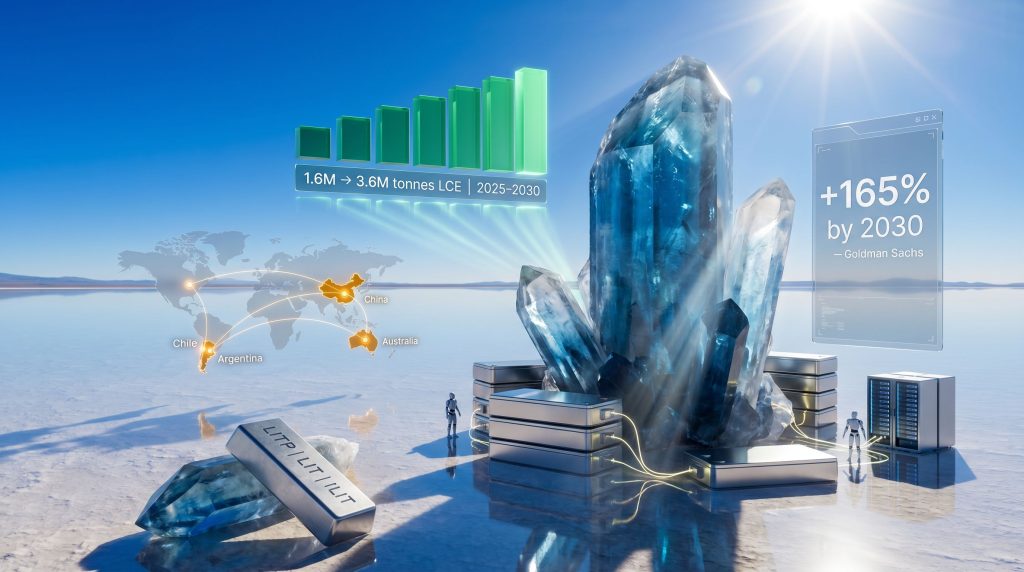
Goldman Sachs projects that global data-center power demand will grow by approximately 165% between 2023 and 2030. McKinsey estimates annual data-center capacity growth of 19% to 22% through the same period. These figures translate directly into lithium battery deployment at a scale that existing supply forecasts may not have adequately modelled.
Why This Demand Is Structurally Different From EV Demand
Electric vehicle batteries are manufactured, installed, and then cycle slowly over years of use. AI data center battery arrays operate in a fundamentally different mode. They cycle frequently, responding to the moment-by-moment power demands of computational workloads, which means replacement cycles may be shorter and aggregate demand more continuous than the EV parallel suggests.
Furthermore, the deployment of AI infrastructure is not constrained by the consumer adoption curves that govern EV uptake. Corporate and government investment in AI computing capacity is driven by competitive and strategic imperatives that operate on different timelines and with different price sensitivity than retail vehicle purchases. This distinction matters for lithium demand forecasting because the two drivers respond to different economic conditions, potentially providing a more resilient aggregate demand base.
| Demand Category | Lithium Per Unit or Application | Demand Maturity | Market Pricing Status |
|---|---|---|---|
| EV batteries | ~8 to 10 kg per vehicle | Established | Largely priced in |
| Grid-scale energy storage | Varies by installation size | Growing | Partially priced in |
| AI data center battery arrays | Tonnes per large facility | Emerging | Not fully priced in |
| Humanoid robotics | ~2 to 2.5 kg per unit | Early-stage | Not priced in |
The Case for Mining-Focused Lithium ETFs Over Broader Battery Chain Exposure
The lithium supply chain spans multiple distinct industrial segments, from geological exploration through extraction, chemical processing, refining, and eventually battery cell manufacturing. Each segment has a different economic character, different competitive dynamics, and a different relationship to the underlying commodity price. Not all of these segments are equally attractive as investment propositions.
The mining segment sits at the point of greatest scarcity within this chain. Unlike downstream battery manufacturers who face multiple simultaneous input cost pressures, miners generate revenue that is primarily determined by what they can realise for extracted material. This makes the mining layer the most direct and margin-sensitive expression of lithium demand fundamentals.
When scarcity increases in the lithium market, pricing power concentrates at the extraction layer. Downstream manufacturers can face cost compression even as upstream miners benefit from rising realised prices, making the mining segment the most leveraged expression of lithium price appreciation.
This structural insight explains why certain ETF products have been designed to focus specifically on the mining and extraction segment rather than covering the full battery value chain. Products covering the entire chain, from miners through battery manufacturers, include companies whose profitability is partially insulated from lithium price movements, diluting the thematic exposure that many investors are seeking.
The 40% Revenue Filter: Why It Matters
A critical methodological feature of pure-play lithium miners ETF products is the revenue threshold applied to potential holdings. Requiring that constituent companies derive at least 40% of their revenue from lithium-related activities serves a specific purpose: it filters out names that represent speculative pre-revenue ventures or highly diversified miners for whom lithium is a minor and incidental activity.
This threshold is important because the lithium mining universe includes a significant number of early-stage companies whose value is based primarily on prospective resource estimates rather than demonstrated production and cash generation. Including these names can introduce speculative risk that is inconsistent with the investment thesis of capturing structural lithium demand growth through proven operators.
Comparing Major Lithium ETF Structures
| ETF | Focus | Geographic Exposure | Supply Chain Coverage |
|---|---|---|---|
| Sprott Lithium Miners ETF (LITP) | Pure-play lithium miners | Global | Mining only |
| Global X Lithium & Battery Tech ETF (LIT) | Full lithium cycle | Global | Mining, refining, battery production |
| iShares Lithium Miners and Producers ETF (ILIT) | Mining and production | Global | Mining and production |
Where Lithium Actually Comes From: A Supply Chain Geography
The global lithium supply chain exhibits pronounced geographic clustering by extraction methodology, a characteristic that has significant implications for both supply security and investment risk management.
Hard Rock Mining: Australia's Dominant Role
Australia represents the world's largest source of hard rock lithium production, primarily through spodumene extraction, a process involving lithium-bearing silicate minerals. Hard rock operations involve conventional mining techniques adapted to crystalline rock formations, producing a concentrate product that is then shipped to refining facilities. The concentration of hard rock production in Australia reflects both the geological endowment of the Western Australian craton and the country's established mining regulatory framework.
Brine Operations: The South American Dimension
Chile and Argentina, along with Bolivia, form the so-called Lithium Triangle, hosting some of the world's largest known lithium brine deposits. Lithium brine extraction involves pumping lithium-rich subsurface water into evaporation ponds where solar energy gradually concentrates the lithium content over a period of months. This process has a significantly lower direct operating cost than hard rock mining but involves longer production timelines and greater sensitivity to weather and evaporation conditions.
Importantly, there is currently no consensus on which extraction methodology, hard rock or brine, represents the superior technical and economic approach. Both methods have meaningful proponents and both face ongoing development challenges, meaning that exposure to a basket spanning both geographies and methodologies reduces process-specific technology risk. In addition, direct lithium extraction technologies are emerging as a potential third pathway that could reshape the competitive landscape further.
The China Refining Bottleneck
Perhaps the most consequential geographic concentration in the lithium supply chain is not in extraction but in refining. China processes a dominant share of the world's lithium into battery-grade material, a position built over decades of targeted industrial investment. This concentration creates a structural vulnerability for markets seeking to reduce dependence on any single processing geography.
Regional Clustering Reality: Hard rock extraction concentrates in Australia, brine evaporation in Chile and Argentina, and chemical refining overwhelmingly in China. This geographic fragmentation means that investors in lithium miners ETF and AI data center demand-focused products gain exposure to a supply chain with multiple distinct geopolitical risk dimensions, some of which can move in opposing directions simultaneously.
Understanding Lithium Market Volatility: Not Like Gold or Silver
Investors approaching lithium for the first time frequently attempt to apply the analytical frameworks developed for precious metals like gold or silver. This analogy fails in important ways.
Gold and silver trade on centralised exchanges with continuous price discovery, high liquidity, and global price transparency. Lithium does not. A significant proportion of lithium transactions occur through private bilateral contracts between producers and end users, often with prices set for extended periods rather than reflecting real-time market conditions.
Compounding this is the fact that the lithium carbonate market represents just one of several chemically distinct lithium compounds that trade simultaneously, each with its own pricing dynamics, end-use applications, and geographic demand centres. Price divergences between these forms can create confusing signals for investors attempting to assess the overall health of the market.
The 2022 Peak and the 80% Correction: A Case Study in Supply Response
The lithium price cycle of the early 2020s offers a sharp illustration of these dynamics. A combination of accelerating EV adoption forecasts and constrained short-term supply drove lithium prices to historic highs in 2022. The elevated prices attracted substantial new mining investment globally. The resulting supply additions, combined with a moderation in EV adoption growth rates relative to peak expectations, produced a severe oversupply condition.
The lithium market downturn drove prices approximately 80% lower from the 2022 peak to lows reached in late 2025. This correction, while painful for investors who entered at peak valuations, may represent exactly the type of structural reset that creates more attractive entry conditions for long-duration investors.
Lithium prices operate on long investment cycles. New mining capacity takes years from discovery through permitting and construction to first production. This means that demand increases cannot be met immediately with supply, creating conditions for price spikes that can be more extreme than in commodities with shorter response timelines.
Quantifying the Demand Outlook: From EVs to Robots
Global lithium demand, measured in lithium carbonate equivalent (LCE), is projected to grow from approximately 1.6 million tonnes in 2025 to roughly 3.6 million tonnes by 2030, according to Global X projections. International Energy Agency scenarios aligned with net-zero emissions pathways suggest demand could reach approximately 13 times 2024 levels by 2050. These projections carry inherent uncertainty but represent the consensus direction among major institutional forecasters.
What most demand models have been slower to incorporate, however, is the robotics dimension.
Humanoid Robotics: The Demand Variable Most Models Have Missed
Each humanoid robot unit requires approximately 2 to 2.5 kilograms of lithium in its battery systems. At limited production volumes, this demand is inconsequential relative to EV or grid storage requirements. But the projections for humanoid robot deployment over the next decade are not modest. Multiple technology and manufacturing forecasters have cited potential production targets of tens of millions of units annually within the next decade.
If even a fraction of these projections materialise, the aggregate lithium requirement for humanoid robotics would represent a measurable new demand category. Consequently, this demand is not yet incorporated into mainstream commodity price models, meaning that the upside scenario for lithium prices includes a variable that current market pricing does not reflect.
The Refining Capacity Constraint: A Supply Side Risk That Cannot Be Solved Quickly
On the supply side, the period of low lithium prices since 2022 has been characterised by underinvestment not just in new mining capacity but specifically in refining infrastructure. Chemical refining of raw lithium into battery-grade material requires substantial capital investment, specialised engineering expertise, and years of construction and commissioning time.
The implication is that even if new mining projects advance on schedule, the bottleneck in converting raw lithium into usable battery material could constrain effective supply for an extended period after demand accelerates. Furthermore, as highlighted by Global X's analysis of AI and battery demand, this dynamic represents a structural factor that long-duration investors should incorporate into their demand-supply analysis.
| Forecast Source | Metric | Projection |
|---|---|---|
| Goldman Sachs | Global data-center power demand growth | +165% by 2030 vs. 2023 |
| McKinsey | Annual data-center capacity demand growth | 19% to 22% through 2030 |
| Global X | Lithium demand in LCE | 1.6M tonnes (2025) to 3.6M tonnes (2030) |
| IEA net-zero scenario | Lithium demand vs. 2024 baseline | ~13x by 2050 |
The next major ASX story will hit our subscribers first
Investment Risk Framework: What Lithium Miners ETF Investors Must Understand
Investing in lithium miners, whether through individual securities or basket-based ETF structures, involves a distinct risk profile that differs meaningfully from broad equity market exposure. Understanding these risks is essential for appropriate portfolio sizing and expectation management.
| Risk Category | Description | Mitigation via ETF Structure |
|---|---|---|
| Political and sovereign risk | Ownership rights disputes in developing economies | Geographic diversification across multiple jurisdictions |
| Technical and process risk | No dominant extraction method established | Exposure across hard rock and brine operators |
| Project delay risk | Common in mining; materially impacts individual valuations | Basket approach dilutes single-project concentration |
| Price transparency risk | Lithium trades via private contracts with limited visibility | Broad exposure smooths pricing discovery gaps |
| Commodity cycle risk | Prices fell approximately 80% from 2022 peak | Entry timing and diversification remain critical |
The political risk dimension is particularly important for investors accustomed to mining within stable, well-governed jurisdictions. Disputes over mineral rights, royalty arrangements, and export restrictions have materially affected mining projects in various jurisdictions over recent decades.
The technical risk around extraction methodology is a subtler but equally important consideration. Given that neither hard rock nor brine extraction has established clear technical and economic dominance, investors face genuine uncertainty about which methodology will define the industry at scale over the long term. A basket approach that includes operators using both methods provides natural hedging against this technological uncertainty.
Portfolio Positioning: Where a Lithium Miners ETF Fits
Investors holding diversified global equity portfolios are unlikely to have meaningful existing exposure to dedicated lithium miners. The largest lithium producers represent a small fraction of broad market indices, meaning that thematic exposure to the lithium demand cycle requires a deliberate allocation decision rather than emerging naturally from index investing.
A lithium miners ETF functions most logically as a satellite allocation, complementing a broad equity core without duplicating existing holdings. This positioning acknowledges the high-conviction, concentrated nature of thematic commodity investing while managing its contribution to overall portfolio risk.
Earnings growth expectations for lithium miners over the medium term are above-trend relative to broad equity benchmarks. If demand projections for AI data center battery arrays, EV adoption, grid-scale storage, and humanoid robotics all advance simultaneously, the operating leverage in mining operations could generate outsized profit growth compared to the broader market.
The stock overlap between a dedicated lithium miners ETF and AI data center demand-linked investment and a typical global equity index fund is minimal. This low overlap is both the reason for including the allocation and the source of its genuine portfolio diversification benefit.
Frequently Asked Questions: Lithium Miners ETF and AI Data Center Demand
Do AI Data Centers Directly Consume Lithium?
Not in the same way as EV batteries. AI data centers use large lithium battery systems for grid stabilisation and power surge management rather than as a primary energy source. However, the scale of these installations creates meaningful incremental lithium demand.
How Is a Lithium Miners ETF Different From a Clean Energy ETF?
A lithium miners ETF targets the upstream extraction layer of the battery supply chain specifically. Clean energy ETFs typically cover solar, wind, and utility-scale energy infrastructure, with minimal direct exposure to lithium mining operations.
What Caused the Approximately 80% Decline in Lithium Prices From the 2022 Peak?
The 2022 price spike attracted significant new mining investment, which flooded the market with supply at a time when EV adoption growth was also moderating. The resulting oversupply drove prices sharply lower through to late 2025, before a market reset began to stabilise conditions.
Why Does Refining Concentration in China Matter for Lithium ETF Investors?
China processes a dominant share of the world's lithium into battery-grade material. Any disruption to that refining capacity, through trade policy, energy constraints, or geopolitical tension, could create upstream price effects that impact miners' realised revenues.
What Is the 40% Revenue Filter Used in Some Lithium Miners ETFs?
This threshold requires that a company derive at least 40% of its revenue from lithium-related activities. It is designed to exclude highly diversified miners or early-stage speculative ventures that lack demonstrated production capacity or cash flow generation.
Is the Current Market a Better Entry Point Than 2022?
The approximately 80% correction from the 2022 peak has reset valuations across the sector. While past price corrections do not guarantee future returns, the combination of lower entry prices, improving supply discipline, and structural demand growth from multiple emerging application categories may present a more favourable risk-reward profile than was available at peak cycle prices. This does not constitute financial advice, and investors should conduct their own due diligence.
Key Structural Takeaways for Long-Duration Investors
- Global lithium demand is projected to grow from approximately 1.6 million to 3.6 million metric tonnes LCE between 2025 and 2030
- AI data center expansion creates large-scale battery demand tied to grid stabilisation, not direct energy storage
- The mining segment captures the highest margins and most direct commodity price exposure within the lithium value chain
- Humanoid robotics represents an emerging demand category, with each unit requiring approximately 2 to 2.5 kg of lithium, that is not yet reflected in mainstream price models
- Refining capacity underinvestment means supply cannot respond quickly to demand acceleration, creating structural price support potential
- A basket-based ETF approach reduces single-project and single-jurisdiction risk while maintaining thematic purity
- Post-correction market conditions represent a materially different entry context than the peak cycle of 2022
This article is intended for informational purposes only and does not constitute financial advice. Investments in commodity-linked equities and ETFs involve significant risks including capital loss, commodity price volatility, and geopolitical exposure. Past performance and projected demand scenarios are not reliable indicators of future results. Investors should consult a qualified financial adviser before making investment decisions.
Want To Know When The Next Major Lithium Discovery Hits The ASX?
Discovery Alert's proprietary Discovery IQ model delivers real-time alerts on significant ASX mineral discoveries, instantly cutting through complex geological and commodity data to surface actionable opportunities in lithium and beyond — explore the historic returns major mineral discoveries have generated and begin your 14-day free trial at Discovery Alert to position yourself ahead of the broader market.