July 22, 2026
The Geography of Vulnerability: How Landlocked Oil Powers Lose Control of Their Exports
When energy analysts model supply disruption risk, they tend to focus on chokepoints: the Strait of Hormuz, the Suez Canal, the Bab-el-Mandeb. What receives comparatively little attention is the structural fragility embedded in the export architecture of landlocked hydrocarbon producers. These nations cannot independently access global shipping lanes. Kazakhstan suspends oil exports from the Black Sea CPC terminal, and this decision has brought that structural exposure into sharp, costly focus, illustrating how dependent these producers are on transit states and fixed infrastructure corridors.
When big ASX news breaks, our subscribers know first
The CPC Pipeline: More Than a Transport Corridor
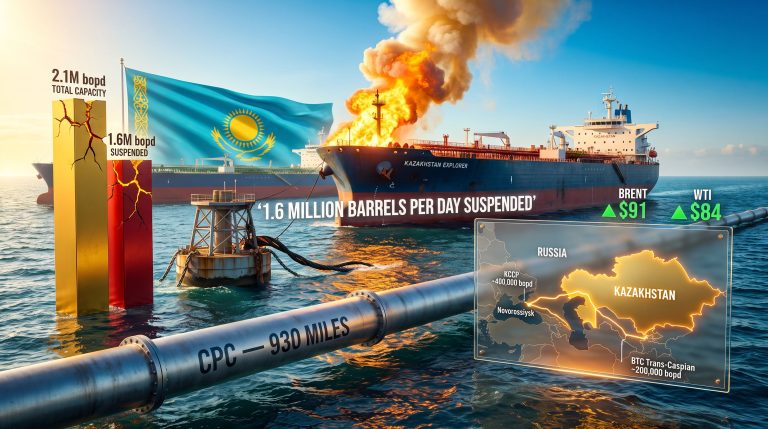
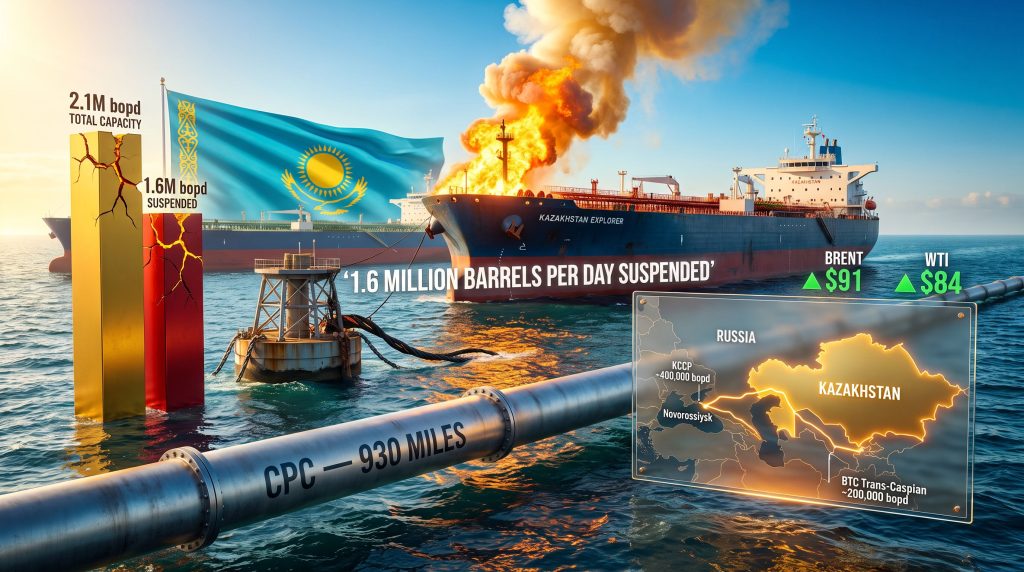
To understand why the situation carries implications far beyond a temporary logistical disruption, it is necessary to grasp the singular importance of the Caspian Pipeline Consortium infrastructure. Stretching over 930 miles from western Kazakhstan's oil-producing heartland and offshore Caspian fields to a marine terminal at Novorossiysk on Russia's Black Sea coast, the CPC system is not simply a pipeline. It is the financial circulatory system of Kazakhstan's entire upstream oil sector.
The numbers define the stakes clearly:
- The CPC consortium handles approximately 80% of Kazakhstan's total crude oil export volume
- Total throughput capacity reaches roughly 2.1 million barrels per day (bopd)
- The suspended volume represents approximately 1.6 million bopd, accounting for more than three-quarters of all Kazakh crude exports
- The pipeline also carries a portion of Russian production, giving the terminal significance for multiple sovereign producers simultaneously
For a landlocked nation with no independent maritime access, there is no workaround that does not involve either a significant reduction in export volumes or a lengthy, expensive, and infrastructure-constrained rerouting exercise. Furthermore, crude oil price trends globally suggest that any sustained reduction in Kazakh output would reverberate well beyond the immediate region.
Kazakhstan's geographic position means that disruptions to the CPC terminal do not merely reduce export throughput. They directly threaten the financial justification for continued upstream production at fields that collectively represent one of the largest hydrocarbon accumulations outside the Middle East.
Drone Strikes and the Mechanics of the Suspension
The trigger for this disruption was a sequence of naval drone attacks on oil tankers operating at and near the Novorossiysk terminal. The vessels Asia and Nissos IOS were struck during the initial wave, with the Asia catching fire before emergency crews extinguished the blaze. The international crew of 22 aboard one stricken vessel was evacuated using CPC tugboats, with the captain and chief officer remaining on the bridge. The tanker stayed afloat, and CPC confirmed publicly that no oil spill occurred and that cargo tank ignition was successfully prevented.
Following a brief resumption of flows, a subsequent strike on the tanker Nelsa forced a second halt to loading operations. According to reports covering the attacks, the cumulative damage assessment is instructive:
| Infrastructure Element | Post-Attack Status |
|---|---|
| CPC Mooring 2 | Significantly damaged, non-operational |
| SPM-1 (Single Point Mooring 1) | Reported undamaged |
| SPM-3 (Single Point Mooring 3) | Reported undamaged |
| Terminal Oil Loading Operations | Fully suspended pending assessment |
| Cargo oil spill | Confirmed absent |
With Mooring 2 offline, the terminal has been reduced to roughly half its normal loading capacity, relying on a single operational mooring. However, the physical infrastructure damage, significant as it is, tells only part of the story. The more consequential dynamic is behavioural: tanker operators have concluded that the security risk at Novorossiysk is now too high to justify routing their vessels there. No amount of functional mooring capacity matters if commercial shipping companies refuse to enter the port.
This represents a qualitative shift in the effectiveness of drone warfare as an energy disruption instrument. The threat of attack has become sufficient to halt operations even where physical destruction remains partial. The parallel with tanker operator hesitancy in the Strait of Hormuz is not coincidental. In both cases, commercial risk aversion is amplifying the strategic impact of military action far beyond what the physical damage alone would justify.
Russia's Refining Capacity and the Compounding Pressure
The CPC suspension does not exist in isolation. Analysts tracking Ukraine's broader drone campaign against Russian energy infrastructure have noted that Russia's oil refining output has declined to its lowest level in more than two decades as a result of sustained strikes. This matters for global markets because it compounds the supply-side pressure already created by the CPC halt.
Kazakhstan, for its part, occupies a diplomatically awkward position. The country has maintained formal neutrality in the Russia-Ukraine conflict, yet it is absorbing direct economic damage through infrastructure it depends on but does not control. Kazakhstan's Foreign Ministry has responded by reserving all rights available under international law to pursue full compensation for damages caused.
Russia expressed solidarity with Kazakhstan's condemnation, with Moscow's Foreign Ministry characterising the attacks as part of a deliberate effort to destabilise global energy markets and framing them as strikes against civilian infrastructure primarily carrying Kazakh, not Russian, crude. This framing carries a pointed subtext: the attacks implicate a neutral third party in a conflict it has no direct role in, complicating Ukraine's diplomatic positioning in Central Asia.
Global Market Implications: A Multi-Vector Supply Shock
The timing of the CPC suspension compounds an already stressed global supply environment. Brent crude has been trading above $91 per barrel with WTI above $84 per barrel, and Goldman Sachs has flagged the potential for oil prices to reach $120 per barrel if Middle Eastern conflict continues to compound supply-side disruptions. Consequently, the oil price shock reverberating through energy markets is being felt far beyond Kazakhstan's borders.
The convergence of active disruption events is notable:
- Black Sea: CPC terminal suspension removing approximately 1.6 million bopd of Kazakh crude from export flows
- Strait of Hormuz: Tanker operators pausing transits amid conflict escalation, with a Kuwaiti tanker struck as Brent briefly topped $90
- Red Sea: Houthi naval threats continuing to deter conventional shipping routes and raising insurance costs across the entire basin
This is a genuine multi-vector supply shock, affecting three of the world's most strategically significant maritime energy corridors simultaneously. The interaction effects are not additive — they are multiplicative. Each disruption raises insurance premiums across all routes, tightens available tanker capacity globally, and pushes marginal cargo onto increasingly constrained alternative pathways. In addition, the scale of oil market disruption being witnessed in 2025 underscores how interconnected global energy security has become.
Kazakhstan's Upstream Production: The Hidden Pressure
A dimension of this crisis that receives insufficient attention is the knock-on effect on upstream production. Pipeline-dependent export systems cannot simply store excess crude indefinitely. Without continuous terminal offtake, upstream operators face a binary choice: curtail wellhead output, or risk saturating available storage infrastructure.
Kazakhstan's Energy Ministry has acknowledged that if the suspension extends through the end of the working week, mandatory reductions in domestic oil production may become necessary. The three major fields at risk are among the most significant in the world:
- Tengiz: Produces approximately 700,000 bopd, making it one of the largest single oil fields outside the Middle East. Operated by Tengizchevroil, a consortium including Chevron and ExxonMobil.
- Kashagan: One of the largest oil discoveries globally in the past five decades, with complex reservoir geology involving high hydrogen sulphide content that makes production technically demanding and expensive to restart if shut in.
- Karachaganak: A major condensate and gas field in northwestern Kazakhstan with significant oil production.
The Kashagan dimension is particularly worth understanding from a technical perspective. Its wells produce crude with extremely high hydrogen sulphide concentrations, classified as sour crude. Shutting in sour crude production is not operationally neutral. Restarting after an unplanned shutdown carries significant mechanical risk, and the infrastructure required to handle H2S safely creates additional constraints on how quickly output can be modulated. This makes production curtailment at Kashagan a genuinely costly last resort, not a routine operational adjustment.
The next major ASX story will hit our subscribers first
Alternative Export Routes: A Capacity Gap That Cannot Be Closed Quickly
Kazakhstan has activated emergency export rerouting plans, but the arithmetic of alternative pathways reveals the structural problem immediately:
| Export Route | Approximate Capacity | Key Constraints |
|---|---|---|
| CPC Pipeline to Novorossiysk | ~1.6 million bopd (suspended) | Drone attack risk; tanker operator refusal |
| Kazakhstan-China Pipeline (KCCP) | ~400,000 bopd | Limited expansion headroom; single-destination dependency |
| Trans-Caspian route via Azerbaijan (BTC) | ~100,000-200,000 bopd | Requires Caspian crossing infrastructure; constrained throughput |
| Rail export via Russia | Low volume | Expensive, slow, not scalable at pace |
The capacity shortfall is stark. Even maximising throughput on every available alternative simultaneously, Kazakhstan cannot replace more than roughly 35-40% of the volumes previously flowing through CPC. The Baku-Tbilisi-Ceyhan pipeline via Azerbaijan represents a longer-term diversification pathway, but scaling it meaningfully requires Caspian Sea crossing infrastructure that does not currently exist at the necessary capacity.
What Do the Current Crude Oil Prices Tell Us?
Monitoring current crude oil prices reveals how quickly markets are pricing in these supply-side risks. However, analysts caution that price movements may not yet fully reflect the longer-term structural consequences of sustained CPC disruption.
Energy Infrastructure as a Theatre of Hybrid Warfare
This incident is not an anomaly. The CPC terminal was also targeted in a November 2025 drone strike that temporarily disabled a key section of the pipeline near Novorossiysk, establishing a documented pattern of repeat targeting. What has evolved since then is the precision and persistence of the campaign, and crucially, the behavioural response of commercial maritime operators.
The weaponisation of commercial shipping risk has become one of the most effective tools of modern hybrid warfare. By making tanker operators unwilling to call at a port, an adversary can functionally neutralise export infrastructure without destroying it, avoiding the escalation threshold of direct infrastructure demolition while achieving comparable economic disruption.
For energy-dependent economies globally, the lesson is structural. Nations that rely on single-corridor export or import pathways carry asymmetric vulnerability in any conflict environment proximate to those corridors. The cost of multi-route export architecture, long dismissed as economically unjustifiable compared to optimised single-corridor systems, now needs to be re-evaluated against the demonstrated cost of corridor closure.
How Should Investors Respond to This Disruption?
For investors monitoring oil markets, oil geopolitics analysis provides essential context for interpreting these rapidly evolving dynamics. The key variables to watch are the duration of the tanker operator risk aversion, the pace of CPC Mooring 2 repairs, and whether Kazakhstan's upstream operators are forced into production curtailments at Tengiz or Kashagan. Furthermore, analysis of the broader situation suggests that each of these outcomes carries meaningfully different implications for both Kazakh oil revenue and global crude price trajectories in the near term.
Disclaimer: This article is for informational purposes only and does not constitute financial or investment advice. Oil price forecasts and market projections referenced herein involve uncertainty and should not be relied upon as predictions of future outcomes. Readers should conduct their own due diligence before making any investment decisions.
Want to Stay Ahead of Energy Market Disruptions Like the CPC Shutdown?
Discovery Alert's proprietary Discovery IQ model delivers real-time alerts on significant ASX mineral discoveries, instantly translating complex market signals into actionable opportunities — explore historic discoveries and their returns to understand the scale of what early positioning can achieve, then begin your 14-day free trial at Discovery Alert to ensure you're never caught flat-footed by the next major market shift.