July 29, 2026
The Structural Shift Reshaping How Energy Conglomerates Manage Legacy Assets
For decades, the prevailing model for large industrial conglomerates holding offshore drilling equipment was straightforward: own the rigs, operate or lease them, and carry the associated capital weight on the balance sheet. That model is now changing in fundamental ways. Across global energy markets, the separation of asset ownership from asset management has accelerated, driven by private capital's growing appetite for hard infrastructure and the financial logic of recurring fee income over lumpy divestiture gains.
The Keppel Offshore Fund represents one of the clearest examples yet of this structural transition playing out in real time, combining a Singapore-headquartered industrial conglomerate, a globally recognised alternative asset manager, and a legacy offshore rig portfolio into a vehicle that redefines how these assets generate value for their original owner.
When big ASX news breaks, our subscribers know first
The Architecture of the Keppel Offshore Fund: Structure, Scale, and Stakeholders
Breaking Down the Fund's Investment Framework
At its core, the Keppel Offshore Fund is a private investment vehicle established to acquire, hold, and manage offshore drilling rigs that were previously sitting within Keppel's indirect subsidiary, Rigco Holding. Rather than pursuing a conventional asset sale, Keppel has engineered a structure that preserves its ongoing involvement while attracting external institutional capital at scale.
The key structural elements include:
- Fund type: Private investment vehicle designed to hold and manage offshore energy assets
- Asset source: Legacy offshore rig portfolio transferred from Keppel's indirect subsidiary, Rigco Holding
- Keppel's retained role: Fund manager, earning advisory fees, recurring management fees, and a share of distributions
- Co-investor: Apollo Global Management-managed funds, accounts, and entities
Key Financial Parameters at a Glance
| Metric | Value |
|---|---|
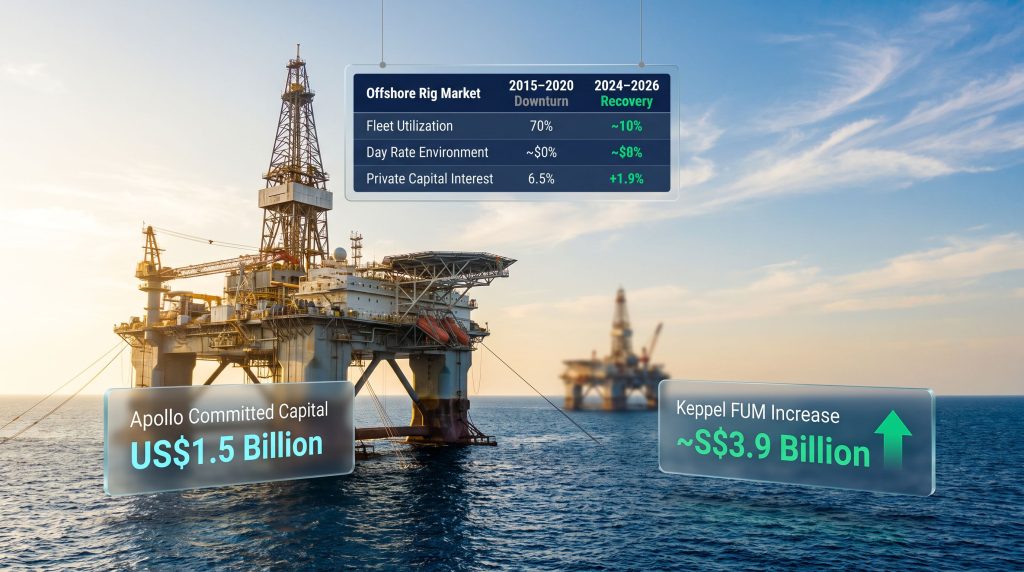
| Apollo's committed capital | US$1.5 billion |
| Phase 1 rig acquisition value (2026) | |
| Rigs transferred in Phase 1 | 6 operational rigs |
| Additional rigs planned (2027–2028) | Up to 4 rigs |
| Potential additional cash proceeds (Phase 2) | ~US$988 million |
| Estimated increase in Keppel's FUM |
Key Insight: The S$3.9 billion increase in funds under management does not represent cash received. It reflects the gross asset value of the rig portfolio now sitting within Keppel's managed fund ecosystem, amplifying Keppel's fee-generating capacity without requiring full divestiture.
What Is the Difference Between S$1.2 Billion in Sale Value and S$3.9 Billion in FUM?
Clarifying the Financial Mechanics for Investors and Analysts
This distinction deserves careful unpacking, because conflating the two figures leads to a significant misreading of what this transaction actually delivers for Keppel.
- S$1.2 billion is the transactional price at which the six Phase 1 rigs transfer from Keppel's balance sheet into the fund structure. This is the number most directly comparable to a traditional asset sale.
- S$3.9 billion reflects the total gross asset value of the fund portfolio now captured within Keppel's funds under management reporting. This figure is a measure of Keppel's expanded footprint as a capital allocator, not a cash inflow number.
- The gap between these two values illustrates how private fund structures create a leverage effect on AUM: a relatively contained asset transfer can dramatically expand a manager's reported assets under management, unlocking fee income streams that are recurring, scalable, and not dependent on further asset sales.
Why This Matters: For Keppel's long-term earnings architecture, the S$3.9 billion FUM expansion is arguably more strategically significant than the S$1.2 billion in Phase 1 proceeds. It repositions Keppel from a rig owner carrying capital risk to a fund manager earning predictable, compounding fee income from assets it no longer fully owns.
How Does the Keppel Offshore Fund Transaction Work? A Phase-by-Phase Breakdown
Phase 1 (2026): Six Operational Rigs Enter the Fund
- Keppel transfers six operational offshore rigs from Rigco Holding into the Keppel Offshore Fund
- Apollo-managed entities commit US$1.5 billion to the fund at inception
- The rig acquisition is valued at approximately S$1.2 billion (US$925 million)
- Keppel retains an ownership stake in the fund alongside Apollo
- The transaction contributes approximately S$1.2 billion toward Keppel's 2026 asset monetisation target
- Keppel's FUM increases by approximately S$3.9 billion upon fund establishment
Phase 2 (2027–2028): Conditional Expansion of the Portfolio
- Keppel holds the option to complete and transfer up to four additional rigs into the fund during this window
- These transfers remain contingent on the satisfaction of specified conditions prior to execution
- Full execution of Phase 2 could generate approximately US$988 million in additional cash proceeds for Keppel
- Three further legacy rigs remain outside the current transaction scope entirely, with Keppel continuing to assess separate monetisation pathways for those assets
Why Is Apollo Global Management Investing US$1.5 Billion in Offshore Rigs?
The Macro Case for Offshore Drilling Assets in 2026
Apollo's willingness to commit US$1.5 billion into a concentrated offshore rig portfolio is not an impulsive bet. It reflects a carefully constructed investment thesis built on supply-side constraints that have been compounding for nearly a decade. Furthermore, the commodity price impact on rig valuations has reinforced institutional confidence in the asset class.
The structural drivers underpinning that thesis include:
- Nearly a decade of suppressed newbuild activity has left the global offshore rig fleet structurally under-supplied relative to operator demand
- Rising steel costs, extended shipyard lead times, and constrained project financing are collectively limiting the pace at which new rigs can be added to the global fleet
- High fleet utilisation rates signal persistent demand from upstream operators, particularly in deepwater and high-specification jack-up drilling segments
- An ageing global rig supply creates a structural premium for modern, operational rigs with verified performance track records and existing operator relationships
Why Private Capital Is Moving Into Offshore Energy Infrastructure
Offshore drilling rigs have increasingly begun exhibiting characteristics that institutional capital traditionally associates with infrastructure rather than cyclical energy: long-term charter contracts, day-rate revenue visibility across multi-year periods, and extraordinarily high barriers to new entry given shipyard backlogs and capital requirements.
This shift in how the asset class is perceived has accelerated deployment from private equity and alternative asset managers. Apollo's investment in the Keppel Offshore Fund signals institutional conviction that the offshore drilling market has entered a sustained upcycle supported by durable structural conditions, not merely a temporary post-downturn rebound. In addition, commodity trading giants have similarly begun repositioning around hard infrastructure vehicles.
Investor Perspective: When alternative asset managers of Apollo's scale commit capital at this magnitude into a single asset-class vehicle, it typically reflects proprietary conviction in multi-year cash flow visibility. The US$1.5 billion commitment is less about near-term day rate optimism and more about the structural impossibility of rapidly replacing ageing rig supply.
Is the Keppel Offshore Fund a Sign of a Broader Offshore Drilling Market Recovery?
Reading Market Signals Through the Lens of Capital Flows
The offshore drilling market has undergone one of its most severe and prolonged contractions in history between 2015 and 2020, with a wave of rig retirements, operator bankruptcies, and near-complete cessation of newbuild orders reshaping the competitive landscape. What has emerged from that period is a fleet that is simultaneously older, smaller, and more concentrated among fewer well-capitalised operators.
Comparing Offshore Rig Market Conditions: Then vs. Now
| Market Factor | 2015–2020 Downturn | 2024–2026 Recovery |
|---|---|---|
| Fleet utilisation | Low — significant oversupply | High — structural undersupply |
| Newbuild activity | Minimal but still present | Near-zero over extended period |
| Day rate environment | Depressed | Elevated and rising |
| Financing availability | Constrained | Selectively improving |
| Private capital interest | Limited | Accelerating |
Demand-side fundamentals remain anchored by deepwater exploration commitments from major oil producers, particularly across the Middle East, West Africa, and offshore South America. The structural absence of meaningful newbuild competition over the preceding decade means that existing high-specification operational rigs command disproportionate pricing power in contract negotiations. Broader crude oil price trends have also played a meaningful role in underpinning operator confidence and capital allocation decisions.
Keppel's own characterisation of the deal's timing points to improving offshore rig market fundamentals, with high fleet utilisation and structural supply constraints underpinning demand for precisely the type of modern drilling rigs included in the fund portfolio. Moreover, oil price movements in the current geopolitical environment have introduced further complexity into how operators time their contracting decisions.
The Day Rate Premium for High-Specification Rigs
One nuance often overlooked in broad offshore drilling market commentary is the bifurcation between standard-specification and high-specification rigs. While overall fleet utilisation figures capture the market direction, the day rate premium commanded by technically advanced, recently upgraded rigs has widened considerably during the current upcycle.
High-specification rigs offer operators:
- Superior drilling efficiency in complex deepwater and ultra-deepwater environments
- Compliance with evolving regulatory and environmental requirements without costly retrofitting
- Enhanced automation capabilities that reduce crew requirements and operational risk
- Proven track records with major operators, reducing contract negotiation friction
This specification premium is a critical component of why legacy rigs with strong operational histories carry meaningful valuation premiums over older, lower-specification assets facing potential early retirement.
The next major ASX story will hit our subscribers first
What Does This Mean for Keppel's Asset-Light Business Transformation?
Keppel's Strategic Repositioning as a Fund Manager and Capital Allocator
The Keppel Offshore Fund is not an isolated transaction. It is a deliberate expression of a broader strategic evolution in which Keppel is reducing its exposure to capital-intensive asset ownership while building a scalable, recurring-fee fund management platform. Consequently, this mirrors approaches adopted across the sector through joint ventures and asset sales that similarly seek to separate operational risk from capital ownership.
The financial logic of this repositioning is compelling:
- Balance sheet concentration in legacy offshore assets is reduced, freeing capital for deployment into higher-growth opportunities
- Management and advisory fees generated on the fund's gross asset value create income streams that compound with FUM growth rather than depending on market timing
- Retaining an equity stake in the fund preserves upside participation in rig market appreciation without carrying the full capital burden of direct ownership
- The phased structure of the transaction provides optionality: Keppel can execute Phase 2 transfers when market conditions or internal readiness are optimal
How Keppel Earns Revenue From the Fund Without Full Divestiture
The revenue architecture Keppel has constructed through the Keppel Offshore Fund is worth examining in detail, as it illustrates how industrial conglomerates are increasingly adopting financial institution-style earnings models. Keppel's infrastructure fund management platform provides the institutional framework underpinning this approach.
- Advisory fees: Earned for structuring and ongoing management of the fund's investment strategy and capital deployment decisions
- Recurring management fees: Generated on total assets under management, meaning the S$3.9 billion FUM expansion directly translates into a larger fee base
- Distribution participation: Keppel's retained equity stake entitles it to a share of cash flows generated by the rig portfolio, including day rate income and any capital gains on eventual asset disposals
- Future monetisation optionality: Three legacy rigs not included in the current transaction preserve flexibility for future deal structures, whether through fund inclusion, bilateral sales, or other vehicles
How Significant Is This Transaction for Southeast Asian Private Capital Markets?
Contextualising the Deal Within Regional Investment Trends
Transactions of this scale and structural sophistication remain relatively uncommon in Southeast Asian private capital markets. The combination of a Singapore-headquartered industrial conglomerate with a global alternative asset manager of Apollo's calibre, structured through a purpose-built private fund vehicle, represents a meaningful evolution in how regional energy assets are accessed by international institutional capital.
Several broader market dynamics make this deal worth examining beyond its individual financial parameters:
- Global institutional investors have increasingly sought exposure to Southeast Asian energy infrastructure through fund vehicles, which offer regulatory efficiency and structural protections not available through direct equity stakes
- The deal demonstrates that offshore rig portfolios, historically viewed as difficult to securitise or fund-structure due to their operational complexity, can be packaged into investable vehicles attractive to top-tier private capital
- Singapore's position as a financial and industrial hub amplifies the deal's signal value, suggesting that further transactions of this type are structurally feasible for other conglomerates managing legacy energy asset portfolios in the region
- The fund model also carries implicit tax and regulatory efficiency advantages relative to a conventional bilateral asset sale, which may influence how similar transactions are structured across the region going forward
Frequently Asked Questions: Keppel Offshore Fund
What is the Keppel Offshore Fund?
The Keppel Offshore Fund is a newly established private investment vehicle created to hold and manage legacy offshore drilling rigs from Keppel's portfolio. It enables Keppel to progressively monetise these assets while retaining a fund management role and an ongoing ownership stake in the portfolio.
Who is investing in the Keppel Offshore Fund?
Funds, accounts, and entities managed by Apollo Global Management have committed US$1.5 billion to the Keppel Offshore Fund as the primary external investor.
How many rigs will be transferred to the fund?
Up to 10 offshore rigs in total. Six operational rigs are targeted for transfer in 2026, with up to four additional rigs potentially added between 2027 and 2028, subject to conditions being met.
How much will Keppel receive from the transaction?
The Phase 1 transfer is valued at approximately S$1.2 billion (US$925 million). Full execution of Phase 2 transfers could generate approximately US$988 million in additional cash proceeds.
What happens to Keppel's remaining three legacy rigs?
Three legacy rigs are not included in the current fund transaction. Keppel has confirmed it will continue evaluating separate monetisation strategies for these assets.
Why is the FUM increase larger than the sale proceeds?
The S$3.9 billion increase in Keppel's funds under management captures the total gross asset value of the fund portfolio, not the transactional sale price alone. This figure reflects the full economic footprint of assets now managed by Keppel on behalf of external investors, which directly expands Keppel's fee-generating capacity.
Key Takeaways: What the Keppel Offshore Fund Signals for the Industry
- The creation of the Keppel Offshore Fund marks a structural evolution in how major energy conglomerates manage legacy asset portfolios, favouring private fund vehicles over outright disposals
- Apollo's US$1.5 billion commitment validates the investment thesis that offshore drilling assets, constrained by supply and supported by sustained operator demand, represent a compelling yield opportunity for institutional capital
- Keppel's dual position as both investor and fund manager creates a scalable, fee-generating platform with earnings potential that extends far beyond the current rig portfolio
- The phased transaction structure, with Phase 2 contingent on specified conditions, introduces risk management discipline and optionality that distinguishes this deal from simpler bilateral asset sales
- For the broader offshore energy sector, a transaction of this scale reinforces the view that the post-downturn recovery has matured into a structurally supported market environment capable of attracting the most sophisticated private capital globally
Disclaimer: This article is intended for informational purposes only and does not constitute financial or investment advice. Forward-looking statements, including projections relating to Phase 2 cash proceeds, FUM growth, and offshore market conditions, are subject to material risks and uncertainties. Readers should conduct independent due diligence and consult qualified financial advisers before making investment decisions. Transaction completion remains subject to customary closing conditions, including regulatory approvals.
Want to Identify the Next Major Resource Discovery Before the Broader Market?
Discovery Alert's proprietary Discovery IQ model delivers real-time alerts on significant ASX mineral discoveries, instantly transforming complex data into actionable investment insights — explore historic discoveries and their returns to understand the opportunity, then begin your 14-day free trial to position yourself ahead of the market.