June 21, 2026
Gold's Two-Decade Distortion: Why the Fed Became the Metal's Invisible Landlord
Investor psychology around gold has long been shaped by a paradox. The metal is widely understood as a hedge against inflation, a store of value that rises when purchasing power erodes. Yet for the better part of two decades, hot inflation prints have frequently triggered gold selloffs rather than rallies. The reason is not a flaw in economic theory. It is the architecture of Federal Reserve communication itself.
Understanding how the Kevin Warsh Fed gold impact might unfold requires stepping back from the day-to-day noise of rate decisions and looking at the machinery that has systematically distorted gold's price discovery since the early 2000s. That machinery is now, for the first time in a generation, being disassembled.
When big ASX news breaks, our subscribers know first
The Communication Regime That Rewired Gold Markets
Forward Guidance as an Artificial Price Ceiling
The Federal Reserve did not always telegraph its intentions. The shift toward explicit forward guidance began incrementally, with a pivotal early step occurring in August 2003, when the FOMC began inserting language about the likely direction of future rate decisions into its official statements. What followed was a structural transformation in how gold-futures traders operated.
Rather than pricing gold against the direct implications of incoming economic data, speculators began trading based on a second-order question: how will the Fed react to this data? This subtle but profound shift severed gold's classical link to inflation and real interest rates, replacing it with a reflexive loop anchored to central bank commentary.
The result was predictable and well-documented across dozens of market cycles. A stronger-than-expected CPI print would trigger a gold selloff, not because inflation was falling, but because traders assumed the Fed would respond with higher rates, which would lift the U.S. dollar, which would pressure gold-futures positions held with extreme leverage. The metal was no longer pricing inflation. It was pricing anticipated Fed reactions to inflation.
The Dot Plot: A Forecasting Tool With a Track Record of Distortion
The Summary of Economic Projections (SEP), introduced in late October 2007, compounded this problem dramatically. The SEP aggregates individual FFR outlooks from FOMC members into what markets refer to as the dot plot, a visual representation of where each participant expects the federal funds rate to go over a one-to-three year horizon.
The dot plot has one well-documented characteristic: it is notoriously inaccurate. Top Federal Reserve officials, including multiple Fed chairs, have repeatedly downplayed its significance. Yet the gap between what policymakers say the dots represent and how markets trade them is vast.
The dot plot functions in practice as a forward commitment, not as the probabilistic range of independent estimates it was designed to be. This misreading has repeatedly amplified gold's response to FOMC meetings far beyond what underlying fundamentals would justify.
Gold analysts who have tracked FOMC cycles over many years have observed that the vast majority of sharp gold selloffs triggered by dot-plot shifts subsequently failed to materialise as actual rate changes. Markets sold gold on projections that never came to pass, creating artificial downside pressure and masking the metal's genuine fundamental trajectory. Furthermore, understanding gold and bond dynamics helps contextualise why these distortions have proven so persistent across multiple economic cycles.
Kevin Warsh's Fed Debut: Reading the Hawkish Surface and the Structural Signal Below It
What the Numbers Said on Day One
Kevin Warsh, who previously served as a Federal Reserve Governor from 2006 to 2011 and built a reputation as a vocal critic of central bank over-communication, helmed his inaugural FOMC meeting in June 2026. The surface-level read was unambiguously hawkish.
| Metric | Prior FOMC | Warsh's First FOMC |
|---|---|---|
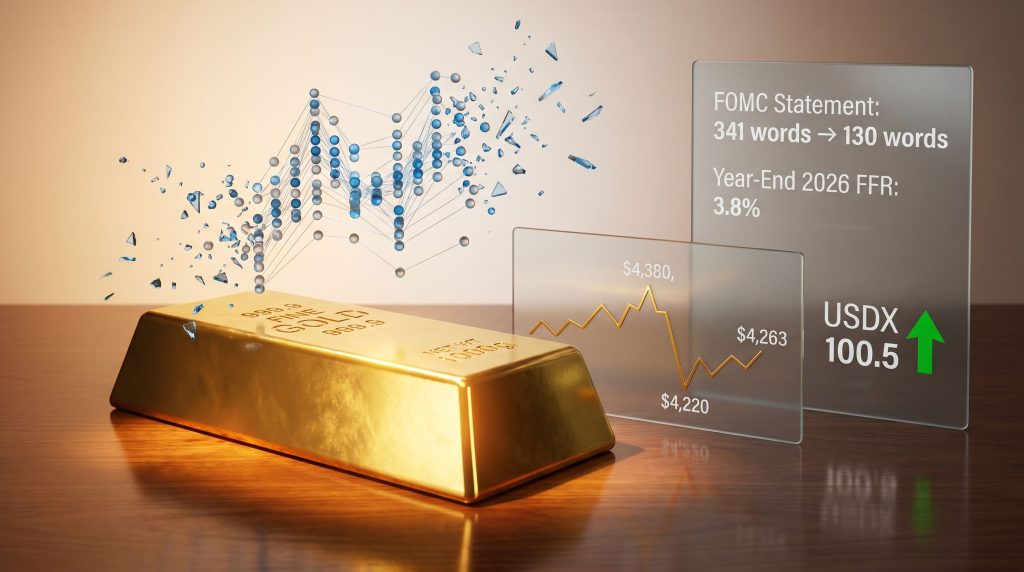
| FOMC Statement Length | 341 words | 130 words |
| Year-End 2026 FFR Dot | ~3.4% | 3.8% (+40bp) |
| Officials Expecting Rate Cuts (2026) | 9 | 1 |
| Officials Expecting Rate Hikes (2026) | 0 | 8 |
| Dots Submitted | 19 | 18 (Warsh withheld his own) |
| USDX Daily Move | – | +0.9% to 100.5 |
| Gold Intraday Peak | ~$4,380 | Declined to ~$4,220 low |
| Gold Close Change | – | -1.6% to ~$4,263 |
The closing line of Warsh's abbreviated FOMC statement carried unusual weight: the Committee committed to delivering price stability. It was a declaration of singular purpose, one that markets interpreted as signalling an elevated rate-for-longer posture. For broader context on how central banks influencing gold prices operate across different regimes, this moment represents a notable inflection point.
Why the Selloff Followed a Predictable Pattern
Gold entered the session rallying approximately 1.1% intraday to around $4,380 before the 2:00 PM decision release. Within minutes of the statement's publication, the metal dropped roughly 2.3% to approximately $4,280. Critically, this happened before Warsh's press conference even began. Gold later reached an intraday low near $4,220 during the press conference before partially recovering to close down approximately 1.6%.
The dollar's reaction was equally telling. The U.S. Dollar Index surged approximately 0.9% to 100.5, its sharpest single-session rally since early March 2026. The inverse relationship between dollar strength and gold pricing played out textbook-style, driven by gold-futures speculators responding to Fed-hawkish signals through leveraged selling.
The pattern was familiar to seasoned gold watchers. Less than two weeks before the FOMC meeting, a stronger-than-expected U.S. jobs report had already driven gold down approximately 3.7%, with federal funds futures already pricing in a single 25 basis point hike by year-end. The dot-plot shift confirming that same trajectory should have carried little new information for markets. That it moved gold sharply again illustrates the irrationality embedded in Fed-reactive gold trading.
The Structural Bull Case: Why Warsh's Philosophy Could Fundamentally Change Gold's Behaviour
Scenario 1: Eliminating the Dot Plot
Warsh's decision to withhold his own FFR projection at his first FOMC meeting was a deliberate signal. He simultaneously announced five new task forces to evaluate Federal Reserve communications, with the first explicitly tasked with assessing the form and function of the SEP framework, including the dot plot.
If FFR projections are eliminated or substantially restructured by late 2026, gold-futures traders lose their primary mechanism for pricing anticipated rate trajectories. Without the dot plot:
- Pre-FOMC gold selloffs driven by shifting implied FFR paths would diminish in frequency and severity.
- Gold's price action would more directly track actual inflation and real-rate data.
- The leverage-amplified volatility cycle would lose one of its main triggers.
Scenario 2: Forward Guidance Effectively Abolished
The dramatic compression of the FOMC statement from 341 words to 130 words was not just a stylistic choice. It functionally removed the rate-bias language that has characterised Fed communications since August 2003. Without forward guidance embedded in official statements, traders lose a key directional cue for positioning ahead of meetings.
Warsh's stated philosophy supports this reading. He has argued publicly that financial markets function most efficiently when they are reacting to real economic data rather than attempting to anticipate how central bankers will respond to that data. In his view, when markets spend all their energy reflecting central bank commentary back to policymakers, it destroys the very market-price signals that should be guiding monetary policy decisions. This creates a self-defeating feedback loop. Indeed, gold's safe-haven role becomes more coherent when central bank signalling no longer overrides fundamental drivers.
Scenario 3: A More Flexible Inflation Tolerance Band
Warsh's comment that he focuses on what sits to the left of the decimal point in inflation readings introduced a layer of deliberate ambiguity. If taken at face value, it suggests he may not be particularly reactive to inflation readings that land anywhere between 2.0% and 2.9%, a significant implied widening of the effective tolerance band.
The Fed's explicit 2% inflation target has only been formally in place since January 2012. Before that, the Fed did not publicly disclose a specific target at all. A return to greater ambiguity around that figure would reduce the binary trading significance of monthly CPI, PCE, and PPI releases for gold-futures markets, which would structurally improve gold's trend stability.
Scenario 4: Jobs Data Loses Its Power as a Gold Catalyst
Monthly U.S. employment reports have been among the most powerful short-term drivers of gold volatility. A strong payrolls beat routinely triggers gold selloffs as traders reprice the Fed's likely response. Warsh has signalled scepticism about the reliability of these figures, noting that initial estimates undergo substantial subsequent revision and may not accurately reflect real-time labour market conditions.
One of his new task forces is specifically evaluating the data inputs used in monetary policy decisions. If jobs reports lose their status as primary Fed-reaction triggers, the pattern of sharp gold selloffs on strong payroll beats would structurally diminish.
Bull vs. Bear Scenario Framework: Quantified Outlook
| Scenario | Key Driver | Gold Implication | Probability |
|---|---|---|---|
| Dot Plot Eliminated | SEP reform removes FFR projection volatility | Structurally bullish | High |
| Forward Guidance Abolished | Shorter statements reduce anticipatory positioning | Moderately bullish | Already initiated |
| Inflation Tolerance Widens to ~3% | Less binary reaction to inflation data | Bullish (real rates compress) | Medium |
| Hawkish Rate Hike Cycle Materialises | Dollar strength pressures non-yielding assets | Bearish near-term | Medium |
| Jobs Data Deprioritised | Payroll-driven gold volatility structurally reduced | Neutral to bullish | Medium-high |
| Fed Independence Uncertainty | Political appointment creates policy unpredictability | Volatile, cuts both ways | Ongoing |
The Leverage Problem That Amplifies Everything
How Gold-Futures Mechanics Create Oversized Reactions
A critical and under-appreciated dimension of this entire dynamic is the role of leverage in the gold-futures market. Gold-futures speculators operate with leverage ratios that amplify dollar-correlated moves to degrees that have no basis in underlying physical supply and demand fundamentals.
When the U.S. Dollar Index moves 0.7% to 0.9% on a Fed-hawkish signal, as it did on the recent Jobs Friday and again on Warsh's FOMC debut, the leveraged response in gold futures can produce 2% to 4% price moves within hours. These are not moves driven by changes in jewellery demand, central bank buying, or mining supply. They are mechanical reactions to currency movements triggered by Fed communication.
This leverage dynamic means that even a modest reduction in the frequency or clarity of Fed forward signals could have an outsized positive effect on gold's trend stability. Fewer triggers mean fewer leveraged selloffs, which means smoother price action, which attracts a broader class of institutional and long-duration investors who currently view gold's intraday volatility as a deterrent. Analysis of the gold market outlook suggests that structural reforms to Fed communication could represent a meaningful regime shift for the metal.
A gold market that prices inflation data directly, rather than through a Fed-reaction filter, would behave in the way economic theory has always suggested it should: rising on hot inflation prints rather than falling on implied rate-hike fears.
Analysts at Business Times have noted that Trump's Fed chair selection has already created significant ripple effects across precious metals markets, with the initial appointment announcement alone generating substantial price volatility.
The next major ASX story will hit our subscribers first
Key Risks: The Bull Case Is Conditional, Not Guaranteed
Short-Term Hawkish Headwinds Are Real
A year-end 2026 FFR of 3.8% with one implied rate hike creates genuine near-term pressure on gold through both dollar strength and elevated opportunity cost for a non-yielding asset. The market's initial response to Warsh's appointment had already incorporated some of this downside, with gold estimated to have declined in the range of 3.2% to 11.4% across the appointment and confirmation period depending on the timeframe measured.
Reform Requires Internal FOMC Consensus
Warsh does not unilaterally control the FOMC's 19 participants. Eliminating the dot plot or restructuring the SEP requires genuine consensus-building among Fed governors and regional bank presidents who may have different views on communication transparency. Markets may also develop alternative proxy measures for Fed-reaction anticipation even if the dot plot is removed, partially preserving the distortive dynamic.
The Inflation Mandate Could Cut Both Ways
Warsh's laser focus on price stability is designed to anchor the Fed's credibility. However, if achieving that objective requires a genuine rate-hike cycle in 2026 or 2027, gold would face a structurally bearish environment regardless of any communication reforms. The distinction between hawkish ambiguity and dovish tolerance in his decimal-point comment remains genuinely unclear.
FAQ: Kevin Warsh Fed Gold Impact Explained
Why did gold fall sharply at Warsh's first FOMC meeting if his long-term impact could be bullish?
Gold-futures traders reacted to the hawkish dot-plot shift and the shorter FOMC statement as near-term bearish signals. The dollar surged, triggering leveraged selling. The longer-term structural implications of communication reforms were not priced into that initial reaction.
What is the dot plot and why does it matter for gold?
The dot plot is a quarterly chart of individual FFR projections from FOMC members. Despite its poor track record at forecasting actual rate outcomes, it has repeatedly triggered large gold price swings by shifting traders' expectations about future interest rate trajectories.
How does U.S. dollar strength affect gold prices?
Gold and the U.S. Dollar Index typically move inversely. When Fed-hawkish signals strengthen the dollar, gold-futures traders sell positions, driving gold lower. A weaker or more stable dollar environment generally supports higher gold prices.
What would eliminating the dot plot mean for gold investors?
Removing the dot plot would reduce one of the primary mechanisms through which anticipated Fed rate trajectories are priced into gold-futures markets. This would likely reduce the frequency and severity of sharp gold selloffs following FOMC meetings, improving trend stability for longer-duration gold investors. The current gold price forecast incorporates several of these structural scenarios as key variables.
Is the Warsh-led Fed ultimately bullish or bearish for gold?
The short-term picture is bearish due to hawkish rate signals and dollar strength. The medium-to-long-term scenario is conditionally bullish if communication reforms reduce Fed-reactive volatility and allow gold to reprice inflation risk directly, restoring its classical fundamental relationship with real interest rates. Commentators on precious metals forums have similarly debated whether the initial selloff represents a genuine structural shift or merely a temporary dislocation.
Timeline: Key Milestones for Monitoring the Warsh Reform Agenda
- Q3 2026: First task force recommendations on Fed communications, including potential SEP restructuring.
- Q4 2026: Year-end FFR trajectory determination, whether the single implied rate hike materialises or is deferred.
- Ongoing through 2026: Frequency and length of future FOMC press conferences as a real-time signal of Warsh's communication philosophy in practice.
- 2027 and beyond: Whether gold begins trading more directly on inflation and real-rate data rather than Fed-anticipation dynamics, representing a genuine regime change for the metal.
The Kevin Warsh Fed gold impact is ultimately a story about competing timeframes. In the near term, hawkish rate signals and dollar strength present genuine headwinds. Over the medium to longer term, the systematic dismantling of the communication machinery that has suppressed gold's fundamental price discovery for over two decades could represent the most structurally supportive shift the metal has seen since the forward guidance era began. The paradox is real: a more hawkish-sounding Fed may ultimately be the catalyst that frees gold to behave the way classical economic theory always said it should.
This article is intended for informational and educational purposes only and does not constitute financial or investment advice. Gold price movements involve significant uncertainty, and all forward-looking scenarios discussed involve assumptions that may not materialise. Readers should conduct their own research and consult a qualified financial adviser before making investment decisions. Past price patterns are not indicative of future results.
Want to Identify ASX Mineral Discoveries Before the Broader Market Does?
While gold's macro dynamics play out across shifting Fed communication regimes, Discovery Alert's proprietary Discovery IQ model delivers real-time alerts on significant ASX mineral discoveries — instantly translating complex data into actionable opportunities for both short-term traders and long-term investors. Explore historic discoveries and their exceptional returns, then begin your 14-day free trial to position yourself ahead of the market.